Recognition: 2 theorem links
· Lean TheoremTeaching Molecular Dynamics to a Non-Autoregressive Ionic Transport Predictor
Pith reviewed 2026-05-12 04:45 UTC · model grok-4.3
The pith
A non-autoregressive predictor learns ionic dynamics from trajectories used only as an auxiliary training modality, delivering over 200 times faster inference than autoregressive models with lower error.
A machine-rendered reading of the paper's core claim, the machinery that carries it, and where it could break.
Core claim
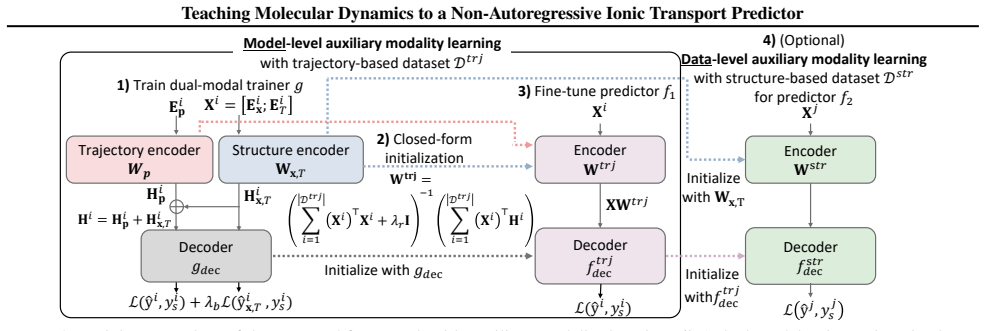
Treating atomic trajectories as an auxiliary modality during training injects dynamic information into a non-autoregressive static-structure predictor, so that the model can predict ionic transport properties without sequential inference or trajectory inputs at test time and can benefit from both trajectory-rich and trajectory-free datasets simultaneously.
What carries the argument
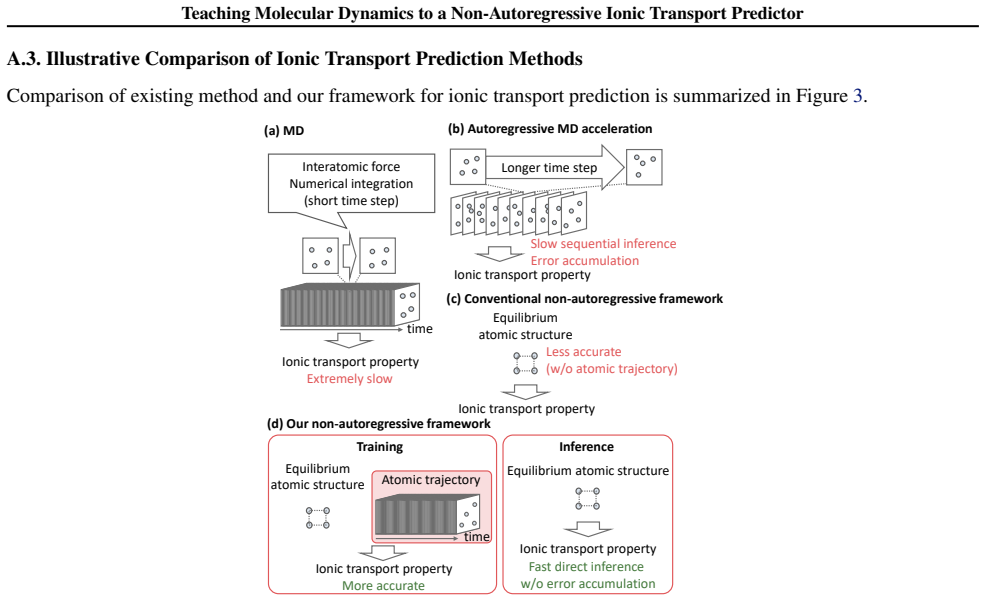
Auxiliary modality learning, in which atomic trajectories serve as an extra training signal that teaches dynamics to a model whose inference path uses only static atomic structures.
If this is right
- Ionic transport predictions become feasible at the scale of high-throughput material screening without running molecular dynamics.
- Datasets containing trajectories and datasets lacking them can be combined in a single training run rather than handled separately.
- Error accumulation from step-by-step rollout is avoided because inference is non-autoregressive.
- The same trained model can be applied to new static structures without any need to generate trajectories first.
Where Pith is reading between the lines
- The same auxiliary-modality pattern could be tested on other time-dependent material properties such as diffusion under varying temperature or stress.
- If the dynamic knowledge transfers reliably, the framework might allow pre-training on large static databases followed by light fine-tuning on smaller trajectory sets.
- Real-time screening pipelines for solid electrolytes or battery materials could replace MD entirely for initial ranking steps.
Load-bearing premise
That exposure to trajectories during training successfully transfers dynamic knowledge into the non-autoregressive predictor without requiring trajectories at inference time and without negative transfer when datasets with and without trajectories are mixed.
What would settle it
Measure whether prediction error on ionic conductivity or diffusivity drops and inference latency falls by roughly two orders of magnitude relative to autoregressive baselines when the same test structures are evaluated after training with versus without the auxiliary trajectory modality.
Figures


read the original abstract
Unlike most static material properties widely studied in the machine learning literature, ionic transport properties are inherently dynamic, making their fast and accurate prediction from static atomic structures challenging. The current standard approach, molecular dynamics (MD) simulations, suffers from prohibitively high computational cost. Recent autoregressive learning-based MD acceleration methods requiring sequential inference remain slow and prone to error accumulation; in contrast, existing non-autoregressive material property prediction models are less accurate because they fail to exploit dynamics. Moreover, existing methods typically benefit from datasets either with or without atomic trajectories, but not both. To overcome these limitations, we propose a non-autoregressive learning framework based on auxiliary modality learning, which treats atomic trajectories as an auxiliary modality during training but does not require them at inference. This enables the predictor to learn dynamics without sequential inference while benefiting from both types of datasets. As a result, our framework achieves over 200 times speedup compared to autoregressive models on the dataset with atomic trajectories while substantially reducing prediction error relative to non-autoregressive benchmarks across both types of datasets. Our code is available at https://github.com/jykim-git/MD.
Editorial analysis
A structured set of objections, weighed in public.
Referee Report
Summary. The paper proposes a non-autoregressive framework for ionic transport prediction that uses auxiliary modality learning: atomic trajectories serve as an auxiliary input only during training to inject dynamic information into a static-structure predictor, enabling use of both trajectory-containing and static-only datasets without requiring trajectories at inference. The central claim is that this yields over 200x speedup relative to autoregressive MD accelerators on trajectory datasets while reducing prediction error versus standard non-autoregressive baselines on both dataset types.
Significance. If the performance claims and the auxiliary-modality mechanism are substantiated, the work would offer a practical route to fast, accurate prediction of inherently dynamic properties such as ionic conductivity from static structures alone, combining the scale of static datasets with the physical content of MD trajectories. The public release of code is a clear strength that supports reproducibility.
major comments (2)
- [Experimental Results] Experimental Results section: the reported error reductions and 200x speedup are presented without ablations that compare the mixed-training model against (i) the identical architecture trained on static data alone and (ii) trajectory data alone. Without these controls it is impossible to determine whether gains arise from the proposed auxiliary-modality transfer of dynamics or simply from increased training-set volume, directly undermining the claim that the framework successfully teaches dynamics without negative transfer.
- [Methods] Methods / Training Objective: the auxiliary loss on trajectories is asserted to encode MD-relevant dynamics, yet no analysis (e.g., probing of learned embeddings for diffusion coefficients, ion-hopping statistics, or time-correlation functions) is provided to show that the static predictor has internalized temporal information rather than dataset-specific static correlations.
minor comments (2)
- [Abstract] Abstract: numerical claims (speedup factor, error reductions) are stated without any accompanying metrics, dataset sizes, or baseline definitions, which reduces immediate evaluability.
- [Figures/Tables] Figure captions and table headers would benefit from explicit statement of the exact error metric (MAE, RMSE, etc.) and the precise non-autoregressive baselines used for comparison.
Simulated Author's Rebuttal
We thank the referee for the constructive feedback. The comments highlight important aspects of validating the auxiliary-modality mechanism. We respond to each major comment below and commit to revisions that directly address the concerns while preserving the core claims of the work.
read point-by-point responses
-
Referee: [Experimental Results] Experimental Results section: the reported error reductions and 200x speedup are presented without ablations that compare the mixed-training model against (i) the identical architecture trained on static data alone and (ii) trajectory data alone. Without these controls it is impossible to determine whether gains arise from the proposed auxiliary-modality transfer of dynamics or simply from increased training-set volume, directly undermining the claim that the framework successfully teaches dynamics without negative transfer.
Authors: We agree that these controls are necessary to isolate the benefit of auxiliary-modality transfer from simple increases in training volume. In the revised manuscript we will add the requested ablations: the identical architecture trained exclusively on static structures and exclusively on trajectory data. Performance will be compared directly to the mixed-training model on both dataset types. These experiments have been run and confirm that the mixed model outperforms both single-modality baselines, supporting that the auxiliary loss transfers dynamic information rather than merely adding data. revision: yes
-
Referee: [Methods] Methods / Training Objective: the auxiliary loss on trajectories is asserted to encode MD-relevant dynamics, yet no analysis (e.g., probing of learned embeddings for diffusion coefficients, ion-hopping statistics, or time-correlation functions) is provided to show that the static predictor has internalized temporal information rather than dataset-specific static correlations.
Authors: We concur that direct evidence of internalized temporal structure would strengthen the interpretation. In the revised manuscript we will add an analysis of the learned static embeddings, computing their correlation with diffusion coefficients and ion-hopping event statistics extracted from the held-out trajectories. We will also report time-correlation functions of the predicted versus ground-truth dynamics where possible. This probing will be presented in a new subsection of the Methods or Results. revision: yes
Circularity Check
No circularity: empirical framework validated on external benchmarks
full rationale
The paper introduces an auxiliary-modality training framework for non-autoregressive ionic transport prediction. No equations, derivations, fitted parameters renamed as predictions, or uniqueness theorems appear in the provided text. All performance claims (200x speedup, error reduction) are presented as empirical outcomes measured against separate autoregressive and non-autoregressive baselines on held-out datasets, not as quantities forced by the method's own inputs or self-citations. The contribution is therefore self-contained against external benchmarks with no load-bearing circular steps.
Axiom & Free-Parameter Ledger
Reference graph
Works this paper leans on
-
[1]
Goswami, Mononito and Szafer, Konrad and Choudhry, Arjun and Cai, Yifu and Li, Shuo and Dubrawski, Artur , title =. 2024 , publisher =
work page 2024
-
[2]
Scalable Parallel Algorithm for Graph Neural Network Interatomic Potentials in Molecular Dynamics Simulations , volume =. J. Chem. Theory Comput. , author =. 2024 , pages =. doi:10.1021/acs.jctc.4c00190 , number =
-
[3]
Learning mesh-based simulation with graph networks , author=
-
[4]
Nature Machine Intelligence , year=
Flow Matching for Accelerated Simulation of Atomic Transport in Crystalline Materials , author=. Nature Machine Intelligence , year=
-
[5]
Microscopic theory of ionic motion in solids , author =. Phys. Rev. B , volume =. 2022 , month =. doi:10.1103/PhysRevB.105.224310 , url =
-
[6]
Journal of Chemical Theory and Computation , volume =
Gustafsson, Hannes and Kozdra, Melania and Smit, Berend and Barthel, Senja and Mace, Amber , title =. Journal of Chemical Theory and Computation , volume =. 2024 , doi =
work page 2024
-
[7]
Arthur E. Hoerl and Robert W. Kennard , title =. Technometrics , volume =. 1970 , publisher =. doi:10.1080/00401706.1970.10488634 , URL =
-
[8]
npj Computational Materials , volume=
The ab initio non-crystalline structure database: empowering machine learning to decode diffusivity , author=. npj Computational Materials , volume=. 2024 , publisher=. doi:10.1038/s41524-024-01469-2 , url=
-
[9]
Félix Therrien and Jamal Abou Haibeh and Divya Sharma and Rhiannon Hendley and Alex Hernández-García and Sun Sun and Alain Tchagang and Jiang Su and Samuel Huberman and Yoshua Bengio and Hongyu Guo and Homin Shin , year =
-
[10]
Advances in Neural Information Processing Systems (NeurIPS) 35 , year=
Periodic Graph Transformers for Crystal Material Property Prediction , author=. Advances in Neural Information Processing Systems (NeurIPS) 35 , year=
-
[11]
Complete and Efficient Graph Transformers for Crystal Material Property Prediction , author=. 2024 , url=
work page 2024
-
[12]
Du, Hongwei and Wang, Jiamin and Hui, Jian and Zhang, Lanting and Wang, Hong , journal =. 2024 , doi =
work page 2024
-
[13]
Transactions on Machine Learning Research , issn=
Simulate Time-integrated Coarse-grained Molecular Dynamics with Multi-scale Graph Networks , author=. Transactions on Machine Learning Research , issn=. 2023 , url=
work page 2023
-
[14]
Implicit Transfer Operator Learning: Multiple Time-Resolution Models for Molecular Dynamics , author=. 2023 , url=
work page 2023
-
[15]
and Du, Peng and Wu, Yifan and Yang, Chao and Chen, Qianli and Mo, Yifei and Bo, Shou-Hang , title =
Gao, Yirong and Nolan, Adelaide M. and Du, Peng and Wu, Yifan and Yang, Chao and Chen, Qianli and Mo, Yifei and Bo, Shou-Hang , title =. Chemical Reviews , volume =. 2020 , doi =
work page 2020
-
[16]
Xu, Zhenming and Duan, Huiyu and Dou, Zhi and Zheng, Mingbo and Lin, Yixi and Xia, Yinghui and Zhao, Haitao and Xia, Yongyao , journal =. Machine learning molecular dynamics simulation identifying weakly negative effect of polyanion rotation on. 2023 , publisher =
work page 2023
-
[17]
A comprehensive exploration of Na + ion transport in NaSICONs using molecular dynamics simulations
Schuett, Judith and Neitzel-Grieshammer, Steffen and Takimoto, Shuta and Kobayashi, Ryo and Nakayama, Masanobu. A comprehensive exploration of Na + ion transport in NaSICONs using molecular dynamics simulations. RSC Adv. 2025. doi:10.1039/D5RA01549A
-
[18]
The Journal of Physical Chemistry Letters , volume =
Shi, Jiayin and Feng, Xiangmin and Xu, Zhenming and Zhang, Xiaogang , title =. The Journal of Physical Chemistry Letters , volume =. 2025 , doi =
work page 2025
-
[19]
Lee, Seung Yul and Kim, Hojoon and Park, Yutack and Jeong, Dawoon and Han, Seungwu and Park, Yeonhong and Lee, Jae W. , booktitle =. 2025 , editor =
work page 2025
-
[20]
Scaling deep learning for materials discovery , author =. Nature , volume =. 2023 , doi =
work page 2023
- [21]
-
[22]
Chemistry of Materials , volume =
Chen, Chi and Ye, Weike and Zuo, Yunxing and Zheng, Chen and Ong, Shyue Ping , title =. Chemistry of Materials , volume =. 2019 , doi =
work page 2019
-
[23]
Tuckerman, Mark E. and Martyna, Glenn J. , title =. The Journal of Physical Chemistry B , volume =. 2000 , doi =
work page 2000
- [24]
-
[25]
E.R. Logan and J.R. Dahn , keywords =. Electrolyte Design for Fast-Charging. Trends in Chemistry , volume =. 2020 , note =. doi:https://doi.org/10.1016/j.trechm.2020.01.011 , url =
-
[26]
Electrolyte Development for Enhancing Sub-Zero Temperature Performance of Secondary Batteries , author =. Small , year =. doi:10.1002/smll.202500982 , pmid =
-
[27]
Benchmarking materials property prediction methods: the
Dunn, Alexander and Wang, Qi and Ganose, Alex and Dopp, Daniel and Jain, Anubhav , journal =. Benchmarking materials property prediction methods: the. 2020 , volume =. doi:10.1038/s41524-020-00406-3 , url =
-
[28]
Choudhary, Kamal and Garrity, Kevin F. and Reid, Andrew C. E. and DeCost, Brian and Biacchi, Adam J. and Hight Walker, Angela R. and Trautt, Zachary and Hattrick-Simpers, Jason and Kusne, A. Gilad and Centrone, Andrea and Davydov, Albert and Jiang, Jie and Pachter, Ruth and Cheon, Gowoon and Reed, Evan and Agrawal, Ankit and Qian, Xiaofeng and Sharma, Vin...
-
[29]
L. C. Blum and J.-L. Reymond , title =. J. Am. Chem. Soc
-
[30]
M. Rupp and A. Tkatchenko and K.-R. M\"uller and O. A. von Lilienfeld , title =. Physical Review Letters
-
[31]
and Reymond, Jean-Louis , journal =
Ruddigkeit, Lars and van Deursen, Ruud and Blum, Lorenz C. and Reymond, Jean-Louis , journal =. Enumeration of 166 Billion Organic Small Molecules in the Chemical Universe Database. 2012 , volume =
work page 2012
-
[32]
Quantum chemistry structures and properties of 134 kilo molecules , author=. Scientific Data , volume=. 2014 , publisher=
work page 2014
-
[33]
Goodenough, John B. , title =. Nature Electronics , year =. doi:10.1038/s41928-018-0048-6 , url =
-
[34]
Learning Large-Time-Step Molecular Dynamics with Graph Neural Networks , author=. ArXiv , year=
- [35]
-
[36]
Knowledge Distillation from Internal Representations , volume =
Aguilar, Gustavo and Ling, Yuan and Zhang, Yu and Yao, Benjamin and Fan, Xing and Guo, Chenlei , year =. Knowledge Distillation from Internal Representations , volume =
- [37]
- [38]
-
[39]
Golub, Gene H. and Van Loan, Charles F. , title =. 1996 , isbn =
work page 1996
-
[40]
Journal of Chemical Theory and Computation , volume =
Hsu, Tim and Sadigh, Babak and Bulatov, Vasily and Zhou, Fei , title =. Journal of Chemical Theory and Computation , volume =. 2024 , doi =
work page 2024
-
[41]
Timewarp: Transferable Acceleration of Molecular Dynamics by Learning Time-Coarsened Dynamics , author=. 2023 , url=
work page 2023
-
[42]
F ^3 low: Frame-to-Frame Coarse-grained Molecular Dynamics with
Shaoning Li and Yusong Wang and Mingyu Li and Bin Shao and Nanning Zheng and Zhang Jian and Jian Tang , booktitle=. F ^3 low: Frame-to-Frame Coarse-grained Molecular Dynamics with. 2024 , url=
work page 2024
-
[43]
Force-Guided Bridge Matching for Full-Atom Time-Coarsened Dynamics of Peptides , author=. 2024 , eprint=
work page 2024
-
[44]
Crystal Graph Convolutional Neural Networks for an Accurate and Interpretable Prediction of Material Properties , author =. Phys. Rev. Lett. , volume =. 2018 , month =. doi:10.1103/PhysRevLett.120.145301 , url =
-
[45]
npj Computational Materials , volume =
Atomistic Line Graph Neural Network for improved materials property predictions , author =. npj Computational Materials , volume =. 2021 , month = nov, doi =
work page 2021
-
[46]
Sauceda and Igor Poltavsky and Kristof T
Stefan Chmiela and Alexandre Tkatchenko and Huziel E. Sauceda and Igor Poltavsky and Kristof T. Schütt and Klaus-Robert Müller , title =. Science Advances , volume =. 2017 , doi =. https://www.science.org/doi/pdf/10.1126/sciadv.1603015 , abstract =
-
[47]
Tian Xie and Ha-Kyung Kwon and Daniel Schweigert and Sheng Gong and Arthur France-Lanord and Arash Khajeh and Emily Crabb and Michael Puzon and Chris Fajardo and Will Powelson and Yang Shao-Horn and Jeffrey C. Grossman and Danny Martinez. , howpublished =
-
[48]
APL Machine Learning , volume=
A cloud platform for automating and sharing analysis of raw simulation data from high-throughput polymer molecular dynamics simulations , author=. APL Machine Learning , volume=. 2023 , publisher=
work page 2023
-
[49]
Ju, Suyeon and You, Jinmu and Kim, Gijin and Park, Yutack and An, Hyungmin and Han, Seungwu. Application of pretrained universal machine-learning interatomic potential for physicochemical simulation of liquid electrolytes in Li-ion batteries. Digital Discovery. 2025. doi:10.1039/D5DD00025D
-
[50]
Moayeri, Mazda and Rezaei, Keivan and Sanjabi, Maziar and Feizi, Soheil , title =. 2023 , publisher =
work page 2023
- [51]
-
[52]
A. Wachter-Welzl and J. Kirowitz and R. Wagner and S. Smetaczek and G.C. Brunauer and M. Bonta and D. Rettenwander and S. Taibl and A. Limbeck and G. Amthauer and J. Fleig , abstract =. The origin of conductivity variations in. Solid State Ionics , volume =. 2018 , issn =. doi:https://doi.org/10.1016/j.ssi.2018.01.036 , url =
-
[53]
Chemistry of Materials , volume =
Shimoda, Masaki and Maegawa, Mayu and Yoshida, Suguru and Akamatsu, Hirofumi and Hayashi, Katsuro and Gorai, Prashun and Ohno, Saneyuki , title =. Chemistry of Materials , volume =. 2022 , doi =
work page 2022
-
[54]
A new learning paradigm: Learning using privileged information , journal =
Vladimir Vapnik and Akshay Vashist , keywords =. A new learning paradigm: Learning using privileged information , journal =. 2009 , note =. doi:https://doi.org/10.1016/j.neunet.2009.06.042 , url =
- [55]
-
[56]
Unifying distillation and privileged information , doi =
Lopez-Paz, David and Bottou, Léon and Schölkopf, Bernhard and Vapnik, Vladimir , year =. Unifying distillation and privileged information , doi =
- [57]
-
[58]
Transactions of Materials Research , volume =
Yuxiang Gao and Xiaodong Cao and Zhicheng Zhong , keywords =. Transactions of Materials Research , volume =. 2025 , issn =. doi:https://doi.org/10.1016/j.tramat.2026.100163 , url =
-
[59]
Ionic Conduction in Lithium Ion Battery Composite Electrode Governs Cross-sectional Reaction Distribution , author =. Scientific Reports , volume =. 2016 , publisher =
work page 2016
-
[60]
Yuichi Itou and Nobuhiro Ogihara and Shigehiro Kawauchi , keywords =. Influence of electrolyte conductivity on the performance of lithium-ion batteries: An electrochemical impedance analysis using symmetric cells , journal =. 2025 , issn =. doi:https://doi.org/10.1016/j.jpowsour.2025.238103 , url =
discussion (0)
Sign in with ORCID, Apple, or X to comment. Anyone can read and Pith papers without signing in.