Recognition: 2 theorem links
· Lean TheoremLow-Cost Neural Radiance Fields
Pith reviewed 2026-05-12 04:20 UTC · model grok-4.3
The pith
None of the tested extensions to accelerated NeRF variants outperform the original baselines when training time is held constant on reduced-view data.
A machine-rendered reading of the paper's core claim, the machinery that carries it, and where it could break.
Core claim
This paper conducts a comparative study of DS-NeRF, TensoRF, and HashNeRF along with three sets of extensions for the low-compute low-data regime. It adds a COLMAP-derived depth-supervision loss to TensoRF, ablates the feature-decoding MLP while testing input downsampling on the synthetic Lego scene, and introduces four architectural variants of the HashNeRF color and density networks. Under iso-time evaluation on reduced-view LLFF and synthetic Lego data, none of the extensions conclusively outperform the published baselines. The experiments instead characterize transfer behavior of the extensions and identify remaining design questions.
What carries the argument
The iso-time evaluation protocol that applies the depth-supervised TensoRF-DS, MLP-ablated TensoRF, and residual or convolutional HashNeRF variants to reduced-view LLFF and Lego scenes while reporting PSNR against matched training budgets.
If this is right
- Depth supervision added to TensoRF produces no conclusive PSNR gain on reduced-view LLFF data when total training time is equalized.
- Ablating the feature-decoding MLP and downsampling inputs in TensoRF create measurable PSNR-runtime tradeoffs on the synthetic Lego scene.
- The four proposed HashNeRF architectural variants generate different PSNR versus training-time balances without exceeding baseline performance under iso-time conditions.
- The experiments map which of the tested ideas transfer to constrained data and compute settings and which do not.
Where Pith is reading between the lines
- Equalizing training time exposes that simple add-on losses and network redesigns alone may not overcome the data and compute limits of current accelerated NeRF methods.
- The characterization of transfer behavior suggests prioritizing depth supervision only for scenes where COLMAP keypoints remain reliable at low view counts.
- These findings connect to the practical goal of running high-quality view synthesis on devices with limited memory and processor cycles by showing where current tweaks fall short.
Load-bearing premise
The depth-supervision loss, MLP ablation, and HashNeRF architectural variants are implemented without introducing biases specific to the code, and the reduced-view LLFF and Lego tests fairly stand for the broader low-data low-compute regime.
What would settle it
Re-running the TensoRF-DS extension or any HashNeRF variant with independently verified code and observing a clear PSNR increase over the corresponding baseline at identical total training time on the reduced LLFF scenes would falsify the no-outperformance result.
Figures


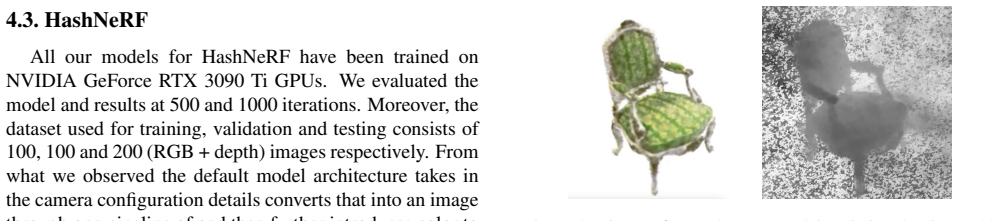
read the original abstract
Neural Radiance Fields (NeRF) achieve high-quality novel-view synthesis, but their long training times and reliance on dense input views limit accessibility. We present a comparative study of three accelerated NeRF variants - DS-NeRF, TensoRF, and HashNeRF and explore extensions targeted at the low-compute, low-data regime. First, we add a depth-supervision loss derived from COLMAP keypoints to TensoRF (TensoRF-DS) and evaluate it on the LLFF dataset under reduced view counts. Second, we ablate the feature-decoding MLP of TensoRF and study the effect of input downsampling on PSNR and runtime on the synthetic Lego scene. Third, we propose four architectural variants of the HashNeRF color and density networks, including residual and convolutional designs, and report PSNR/training-time tradeoffs under matched iteration budgets. Under iso-time evaluation, none of our extensions conclusively outperform the published baselines, but the experiments characterize which extensions transfer to constrained settings and surface design questions for future work.
Editorial analysis
A structured set of objections, weighed in public.
Referee Report
Summary. The manuscript presents a comparative empirical study of accelerated NeRF variants (DS-NeRF, TensoRF, HashNeRF) and targeted extensions for low-compute/low-data regimes. Extensions include depth-supervision loss added to TensoRF (TensoRF-DS) on reduced-view LLFF, MLP ablation and input downsampling for TensoRF on synthetic Lego, and four architectural variants (residual, convolutional) of HashNeRF color/density networks. Under iso-time evaluation on LLFF and Lego scenes, none of the extensions conclusively outperform published baselines, though the work characterizes transfer behavior and raises design questions.
Significance. If the empirical results hold, the paper offers practical value by emphasizing iso-time rather than iso-iteration comparisons in resource-constrained NeRF settings. The cautious negative finding helps calibrate expectations for depth supervision and architectural tweaks, while the ablations surface concrete questions (e.g., MLP size vs. downsampling tradeoffs) that can guide follow-on work. The systematic scope on reduced-view LLFF and synthetic data is a strength for the target regime.
major comments (1)
- [Results] Results section (and abstract claim): PSNR/runtime tables and iso-time comparisons are presented without error bars, standard deviations from repeated runs, or statistical tests. This directly weakens the central assertion that 'none of our extensions conclusively outperform the published baselines,' as observed differences cannot be assessed for significance versus noise or implementation variance.
minor comments (2)
- [Methods] Exact hyperparameter values, random seeds, and COLMAP keypoint extraction details for the depth-supervision loss are not provided, limiting reproducibility of the TensoRF-DS and HashNeRF variant experiments.
- [Figures/Tables] Figure captions and table legends should explicitly state the iteration budgets and wall-clock time matching procedure used for iso-time evaluation.
Simulated Author's Rebuttal
We thank the referee for the constructive review and for recognizing the practical value of our iso-time comparisons in resource-constrained settings. We address the single major comment below.
read point-by-point responses
-
Referee: [Results] Results section (and abstract claim): PSNR/runtime tables and iso-time comparisons are presented without error bars, standard deviations from repeated runs, or statistical tests. This directly weakens the central assertion that 'none of our extensions conclusively outperform the published baselines,' as observed differences cannot be assessed for significance versus noise or implementation variance.
Authors: We agree that the lack of error bars and statistical tests limits the strength of the word 'conclusively' in our claims. All reported results derive from single training runs per configuration, as the computational cost of NeRF variants—even the accelerated ones—precluded repeated trials with different random seeds within the scope of this study. In the revised manuscript we will replace 'conclusively outperform' with the more precise phrasing 'did not demonstrate improvements over' in the abstract and results section, and we will add an explicit limitations paragraph noting the single-run nature of the evaluation and the consequent absence of variance estimates. These changes preserve the observed trends across scenes while removing the unsupported claim of statistical conclusiveness. revision: yes
Circularity Check
No significant circularity
full rationale
The manuscript is an empirical ablation study comparing accelerated NeRF variants (DS-NeRF, TensoRF, HashNeRF) and their extensions under iso-time and reduced-view constraints. All load-bearing claims rest on reported PSNR and runtime measurements from controlled experiments on LLFF and synthetic Lego scenes; no equations, fitted parameters renamed as predictions, or self-referential definitions appear in the derivation chain. The central negative result (no extension conclusively outperforms baselines) and characterization of transfer behavior are direct observations from the experimental protocol rather than reductions to prior inputs or self-citations.
Axiom & Free-Parameter Ledger
Lean theorems connected to this paper
-
IndisputableMonolith/Foundation/RealityFromDistinction.leanreality_from_one_distinction unclear?
unclearRelation between the paper passage and the cited Recognition theorem.
Under iso-time evaluation, none of our extensions conclusively outperform the published baselines
What do these tags mean?
- matches
- The paper's claim is directly supported by a theorem in the formal canon.
- supports
- The theorem supports part of the paper's argument, but the paper may add assumptions or extra steps.
- extends
- The paper goes beyond the formal theorem; the theorem is a base layer rather than the whole result.
- uses
- The paper appears to rely on the theorem as machinery.
- contradicts
- The paper's claim conflicts with a theorem or certificate in the canon.
- unclear
- Pith found a possible connection, but the passage is too broad, indirect, or ambiguous to say the theorem truly supports the claim.
Reference graph
Works this paper leans on
-
[1]
FirstName LastName , title =
-
[2]
FirstName Alpher , title =
-
[3]
Journal of Foo , volume = 13, number = 1, pages =
FirstName Alpher and FirstName Fotheringham-Smythe , title =. Journal of Foo , volume = 13, number = 1, pages =
-
[4]
Journal of Foo , volume = 14, number = 1, pages =
FirstName Alpher and FirstName Fotheringham-Smythe and FirstName Gamow , title =. Journal of Foo , volume = 14, number = 1, pages =
-
[5]
FirstName Alpher and FirstName Gamow , title =
-
[6]
NeRF: Representing Scenes as Neural Radiance Fields for View Synthesis , author=. 2020 , booktitle=
work page 2020
-
[7]
Proceedings of the IEEE/CVF Conference on Computer Vision and Pattern Recognition (CVPR) , month =
Deng, Kangle and Liu, Andrew and Zhu, Jun-Yan and Ramanan, Deva , title =. Proceedings of the IEEE/CVF Conference on Computer Vision and Pattern Recognition (CVPR) , month =
-
[8]
European Conference on Computer Vision (ECCV) , year =
Anpei Chen and Zexiang Xu and Andreas Geiger and Jingyi Yu and Hao Su , title =. European Conference on Computer Vision (ECCV) , year =
-
[9]
Instant neural graphics primitives with a multiresolution hash encoding
Thomas M\"uller and Alex Evans and Christoph Schied and Alexander Keller , title =. ACM Trans. Graph. , issue_date =. 2022 , pages =. doi:10.1145/3528223.3530127 , publisher =
-
[10]
Conference on Computer Vision and Pattern Recognition (CVPR) , year=
Sch\". Conference on Computer Vision and Pattern Recognition (CVPR) , year=
-
[11]
European Conference on Computer Vision (ECCV) , year=
Sch\". European Conference on Computer Vision (ECCV) , year=
-
[12]
ACM Transactions on Graphics (TOG) , year=
Local Light Field Fusion: Practical View Synthesis with Prescriptive Sampling Guidelines , author=. ACM Transactions on Graphics (TOG) , year=
discussion (0)
Sign in with ORCID, Apple, or X to comment. Anyone can read and Pith papers without signing in.