Recognition: 2 theorem links
· Lean TheoremPrice Distortions in Korea's Electricity Market: Barriers to Renewable Integration and Reform Pathways
Pith reviewed 2026-05-12 04:43 UTC · model grok-4.3
The pith
Korea's electricity market cannot provide effective price signals under its current design, requiring four reforms to be adopted jointly to align with energy policy goals.
A machine-rendered reading of the paper's core claim, the machinery that carries it, and where it could break.
Core claim
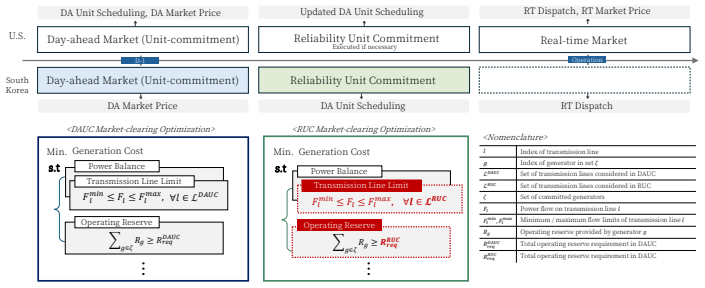
Under the current Korean market design, the market cannot readily provide effective price signals. These reforms therefore need to be implemented jointly to establish a coherent market design in which price signals are aligned with Korea's energy policy objectives. The reforms are introducing locational marginal pricing to manage transmission constraints, establishing a real-time market to reflect temporal value, integrating market and system operations to resolve inconsistencies, and transitioning from the cost-based pool to a price-based bidding system.
What carries the argument
The cost-based pool with uniform pricing mechanism, which fails to account for locational, temporal, and cost-specific factors, addressed through a joint package of four market reforms.
Load-bearing premise
That correcting the four identified distortions through simultaneous reforms will generate coherent price signals that support renewable integration without creating new market inefficiencies or practical barriers to adoption.
What would settle it
A comparison of price signal accuracy and renewable investment rates before and after implementing the full reform package versus implementing only some reforms, looking for whether joint changes lead to prices that better match actual system needs during peak congestion or variable renewable output.
Figures



read the original abstract
Structural distortions in price signals within the Korean electricity market, governed by a cost-based pool (CBP) and a uniform pricing mechanism, fundamentally undermine the nation's energy transition goals. The current market design fails to reflect transmission constraints, real-time supply and demand dynamics, and generator-specific costs, leading to inefficient resource allocation and hindering long-term investments in renewable energy and grid flexibility. This paper identifies the key drivers of these distortions and proposes a holistic reform package to enhance market efficiency. The package includes four key reforms: \stepcounter{excep}(\roman{excep}) introducing a locational marginal pricing system to manage transmission constraints; \stepcounter{excep}(\roman{excep}) establishing a real-time market to reflect temporal value; \stepcounter{excep}(\roman{excep}) integrating market and system operations to resolve inconsistencies; and \stepcounter{excep}(\roman{excep}) transitioning from CBP to a price-based bidding system. Each reform targets a distinct source of inefficiency. The broader contribution of this study, however, lies in showing that, under the current Korean market design, the market cannot readily provide effective price signals. These reforms therefore need to be implemented jointly to establish a coherent market design in which price signals are aligned with Korea's energy policy objectives.
Editorial analysis
A structured set of objections, weighed in public.
Referee Report
Summary. The paper claims that structural distortions in Korea's electricity market, arising from its cost-based pool (CBP) and uniform pricing design, prevent effective price signals by failing to reflect transmission constraints, real-time supply/demand dynamics, and generator-specific costs. This hinders renewable integration and long-term investments. It identifies four key distortions and proposes a holistic package of four joint reforms—locational marginal pricing, a real-time market, integration of market and system operations, and transition to price-based bidding—to align signals with Korea's energy policy objectives, arguing that partial reforms would be insufficient.
Significance. If the qualitative assessment holds, the work would offer useful policy insights into coordinated market reforms needed for renewable transitions in cost-based systems like Korea's, emphasizing the risks of misaligned incentives. It could guide similar analyses in other regulated markets, though its impact is constrained by the absence of empirical grounding or modeling to quantify effects.
major comments (3)
- [Abstract and §3] Abstract and §3 (Distortions): The central assertion that the four listed distortions (transmission constraints, real-time dynamics, generator-specific costs, bidding rules) are the primary barriers preventing effective price signals rests entirely on qualitative description with no empirical measurement, price-impact quantification, dispatch simulation under renewable variability, or comparison of uniform vs. locational pricing outcomes.
- [§4] §4 (Reform Pathways): The claim that the four reforms 'need to be implemented jointly' to establish coherent signals is not supported by any analysis of reform interactions, potential new inefficiencies (e.g., volatility or gaming risks), implementation frictions, or a counterfactual of partial vs. full rollout.
- [§2] §2 (Market Design): No data, tables, or modeling results are presented to demonstrate the scale of distortions or predicted benefits of reforms, leaving the load-bearing policy conclusion without falsifiable evidence or error bounds.
minor comments (2)
- [Abstract] Abstract: The reform enumeration uses unrendered LaTeX commands (e.g., 'stepcounter{excep}'); replace with standard (i), (ii), (iii), (iv) formatting.
- [Throughout] Throughout: Several policy references lack specific citations to Korean market rules or prior studies on CBP distortions; add targeted references for traceability.
Simulated Author's Rebuttal
We thank the referee for the detailed and constructive comments, which help clarify the scope and evidentiary basis of our analysis. We appreciate the acknowledgment of the paper's potential policy relevance for cost-based markets undergoing renewable transitions. In response, we will revise the manuscript to more explicitly frame the work as a qualitative structural assessment, expand the discussion of reform interactions with references to international experiences, and incorporate additional descriptive data where available to illustrate market parameters. These changes will strengthen the presentation without altering the core contribution.
read point-by-point responses
-
Referee: [Abstract and §3] Abstract and §3 (Distortions): The central assertion that the four listed distortions (transmission constraints, real-time dynamics, generator-specific costs, bidding rules) are the primary barriers preventing effective price signals rests entirely on qualitative description with no empirical measurement, price-impact quantification, dispatch simulation under renewable variability, or comparison of uniform vs. locational pricing outcomes.
Authors: We agree that the analysis relies on qualitative reasoning derived from the market rules and their logical implications rather than new empirical quantification or simulations. The manuscript's aim is to identify inherent design flaws in the CBP and uniform pricing that systematically misalign price signals with system needs, particularly for renewables. In revision, we will update the abstract and §3 to state this scope explicitly and cite existing empirical literature on analogous distortions (e.g., studies of uniform pricing impacts in European markets and locational pricing benefits in U.S. ISOs). This will better contextualize the argument while preserving the design-based contribution. revision: partial
-
Referee: [§4] §4 (Reform Pathways): The claim that the four reforms 'need to be implemented jointly' to establish coherent signals is not supported by any analysis of reform interactions, potential new inefficiencies (e.g., volatility or gaming risks), implementation frictions, or a counterfactual of partial vs. full rollout.
Authors: The joint-implementation claim follows from the mutual reinforcement among the four distortions identified; isolated reforms risk creating new inconsistencies (e.g., locational prices without real-time markets may still fail to value flexibility). We will add a dedicated subsection in §4 that analyzes complementarities, references implementation experiences from markets such as PJM and ERCOT, and discusses potential risks including volatility, strategic behavior, and sequencing frictions. A short counterfactual comparison of partial versus coordinated rollout will also be included to substantiate the argument. revision: yes
-
Referee: [§2] §2 (Market Design): No data, tables, or modeling results are presented to demonstrate the scale of distortions or predicted benefits of reforms, leaving the load-bearing policy conclusion without falsifiable evidence or error bounds.
Authors: Section 2 serves as a descriptive overview of Korea's current market architecture to ground the subsequent distortion analysis. We recognize that it currently lacks quantitative illustrations. In the revised version, we will add a table summarizing key observable parameters (e.g., renewable capacity shares, historical price volatility metrics from public KEPCO and KEM data) and note data limitations on precise distortion magnitudes. The policy conclusions remain anchored in the structural design analysis rather than statistical modeling, consistent with the paper's focus on identifying barriers and coordinated reform pathways. revision: partial
Circularity Check
No circularity: qualitative policy analysis without derivations or self-referential reductions
full rationale
The paper is a qualitative policy analysis identifying market distortions under Korea's CBP and uniform pricing and proposing four joint reforms. It contains no equations, derivations, fitted parameters, or quantitative modeling. The central claim—that current design prevents effective price signals and requires simultaneous reforms—rests on descriptive identification of issues (transmission constraints, real-time dynamics, generator costs, bidding rules) and logical argument for coherence, without any reduction to self-citations, ansatzes, or prior fitted results. No load-bearing step reduces by construction to its inputs, satisfying the criteria for a self-contained non-circular finding.
Axiom & Free-Parameter Ledger
axioms (1)
- domain assumption The current market design fails to reflect transmission constraints, real-time supply and demand dynamics, and generator-specific costs, leading to inefficient resource allocation.
Lean theorems connected to this paper
-
IndisputableMonolith/Foundation/RealityFromDistinction.leanreality_from_one_distinction unclear?
unclearRelation between the paper passage and the cited Recognition theorem.
The current market design fails to reflect transmission constraints, real-time supply and demand dynamics, and generator-specific costs... proposes four key reforms: (i) locational marginal pricing... (ii) real-time market... (iii) integrating market and system operations... (iv) transitioning from CBP to a price-based bidding system.
-
IndisputableMonolith/Cost/FunctionalEquation.leanwashburn_uniqueness_aczel unclear?
unclearRelation between the paper passage and the cited Recognition theorem.
SMP is determined by the screened generator with the highest avoided cost... SPi,t = ICi,t + NLCi/Qi,t + SU Ci/(Qi,t × HoursOn i,t)
What do these tags mean?
- matches
- The paper's claim is directly supported by a theorem in the formal canon.
- supports
- The theorem supports part of the paper's argument, but the paper may add assumptions or extra steps.
- extends
- The paper goes beyond the formal theorem; the theorem is a base layer rather than the whole result.
- uses
- The paper appears to rely on the theorem as machinery.
- contradicts
- The paper's claim conflicts with a theorem or certificate in the canon.
- unclear
- Pith found a possible connection, but the passage is too broad, indirect, or ambiguous to say the theorem truly supports the claim.
Reference graph
Works this paper leans on
-
[1]
The Electric- ity Journal , 107484doi: https://doi.org/10.1016/j.tej.2025.107484
Electricity market design with increasing renewable generation: Lessons from alberta. The Electric- ity Journal , 107484doi: https://doi.org/10.1016/j.tej.2025.107484. Cadwalader, M., Gribik, P., Hogan, W., Pope, S.,
-
[2]
International Journal of Elec- trical Power & Energy Systems 98, 520–530
Rethinking restructured electricity market design: Lessons learned and future needs. International Journal of Elec- trical Power & Energy Systems 98, 520–530. doi: https://doi.org/10. 1016/j.ijepes.2017.12.014. Cramton, P.,
work page 2017
-
[3]
URL: https://www.kpx.or.kr. accessed: 2026-03-13. Exchange, K.P., 2025b. Power system operation statistics: Decem- ber
work page 2026
-
[4]
URL: https://www.kpx.or.kr/board.es?mid=a10102000000& bid=0159&act=view&list_no=74511. accessed: 2026-03-13. Facchini, A., Rubino, A., Caldarelli, G., Di Liddo, G.,
work page 2026
-
[5]
Changes to gate closure and its impact on wholesale electricity prices: The case of the uk. Energy Policy 125, 110–121. URL: https://www.sciencedirect. com/science/article/pii/S0301421518306992, doi: https://doi.org/ 10.1016/j.enpol.2018.10.047. Herrero, I., Rodilla, P., Batlle, C.,
-
[6]
Electricity market-clearing prices and investment incentives: The role of pricing rules. Energy Economics 47, 42–51. URL: https://www.sciencedirect.com/science/article/pii/ S0140988314002709, doi: https://doi.org/10.1016/j.eneco.2014.10
-
[7]
The Electricity Journal 27, 23–49
Electricity market design and efficient pricing: Applications for new england and beyond. The Electricity Journal 27, 23–49. URL: https://www.sciencedirect.com/science/article/ pii/S1040619014001705, doi: https://doi.org/10.1016/j.tej.2014. 07.009. Hogan, W.W.,
-
[8]
The Electricity Journal 29, 33–47
Virtual bidding and electricity market design. The Electricity Journal 29, 33–47. URL: https://www.sciencedirect. com/science/article/pii/S104061901630063X, doi: https://doi.org/ 10.1016/j.tej.2016.05.009. Hohl, C., Lo Prete, C., Radhakrishnan, A., Webster, M.,
-
[10]
IEEE Power and Energy Magazine 19, 86–96
Variable renewable energy integration: Status around the world. IEEE Power and Energy Magazine 19, 86–96. doi: 10.1109/MPE.2021.3104156. Hortaçsu, A., Puller, S.L.,
-
[11]
Evaluation of inertia resource for securing nadir frequency in hvdc interconnected system with high penetra- tion of res. Energy Reports 9, 1374–1383. doi: https://doi.org/10.1016/ j.egyr.2023.05.192. 2022 The 3rd International Conference on Power and Electrical Engineering. Korea MOIS,
work page 2023
-
[12]
URL: https://new.kpx.or.kr/board.es?mid=a10102000000& bid=0088&act=view&list_no=76610. accessed: 2026-03-13. KOTRA,
work page 2026
-
[13]
The Electricity Journal , 107489doi: https://doi.org/10.1016/j.tej.2025
How new (and old) power system operating constraints map to australia’s wholesale electricity market model. The Electricity Journal , 107489doi: https://doi.org/10.1016/j.tej.2025. 107489. Leslie, G.W., Stern, D.I., Shanker, A., Hogan, M.T.,
-
[14]
The Electricity Journal 33, 106847
De- signing electricity markets for high penetrations of zero or low marginal cost intermittent energy sources. The Electricity Journal 33, 106847. URL: https://www.sciencedirect.com/science/article/ pii/S1040619020301391, doi: https://doi.org/10.1016/j.tej.2020. 106847. special Issue: The Future Electricity Market Summit. Li, S., Zhang, S., Andrews-Speed, P.,
-
[15]
Using diverse market-based approaches to integrate renewable energy: Experiences from china. Energy Policy 125, 330–337. doi: https://doi.org/10.1016/j.enpol.2018.11
-
[16]
Utilities Policy 49 73, 101312
Market design options for elec- tricity markets with high variable renewable generation. Utilities Policy 49 73, 101312. URL: https://www.sciencedirect.com/science/article/ pii/S0957178721001454, doi: https://doi.org/10.1016/j.jup.2021. 101312. Maliszewski, R., Rozier, G., Cummings, R.,
-
[18]
Market de- sign for a high-renewables european electricity system. Renewable and Sus- tainable Energy Reviews 91, 695–707. doi: https://doi.org/10.1016/j. rser.2018.04.025. Ok, K., Lee, S., Park, M., Ju, A., Cho, S.,
work page doi:10.1016/j 2018
-
[19]
doi: 10.5370/KIEE.2021.70. 7.969. Park, W.Y., Khanna, N., Kim, J.H., Shiraishi, K., Abhyankar, N., Paliwal, U., Lin, J., Phadke, A., Moon, H.S., Song, Y.H., et al.,
-
[20]
Electric Power Systems Research 229, 110184
Assessment of frequency stability and required inertial support for power grids with high penetration of renewable energy sources. Electric Power Systems Research 229, 110184. doi: https://doi. org/10.1016/j.epsr.2024.110184. 50 Schweppe, F.C., Caramanis, M.C., Tabors, R.D., Bohn, R.E.,
-
[21]
Renewable Energy 145, 2271–2285
Challenges and solution technologies for the integration of variable renewable energy sourcesa re- view. Renewable Energy 145, 2271–2285. doi: https://doi.org/10.1016/ j.renene.2019.06.147. S.Lee,
work page 2019
-
[22]
IEEE Transactions on Power Systems 36, 4270–4280
Inertia- enhanced distributed voltage and frequency control of low-inertia micro- grids. IEEE Transactions on Power Systems 36, 4270–4280. doi: 10.1109/ TPWRS.2021.3057078. 51
discussion (0)
Sign in with ORCID, Apple, or X to comment. Anyone can read and Pith papers without signing in.