Recognition: no theorem link
Protocol for Efficient Generation of Fusion-Based Quantum Computing Resource States from Quantum Emitters
Pith reviewed 2026-05-12 04:52 UTC · model grok-4.3
The pith
Logically encoded 24-photon FBQC resource states can be generated deterministically from three quantum emitters using eleven CNOT gates.
A machine-rendered reading of the paper's core claim, the machinery that carries it, and where it could break.
Core claim
By exploiting the symmetries present in FBQC resource states, the NP-hard search over all possible photon emission orderings can be reduced to a tractable problem whose solution is a deterministic circuit that produces a logically encoded 24-photon resource state from as few as three quantum emitters and eleven CNOT gates.
What carries the argument
Symmetry-reduced optimization over photon emission orderings that identifies minimal-emitter deterministic emitter circuits.
If this is right
- Resource-state generation for FBQC becomes deterministic in the emitter circuit rather than relying on post-selection.
- The hardware footprint for producing 24-photon logical states drops to three emitters and eleven two-qubit gates.
- Generation rates for the basic blocks of FBQC increase because fewer emitters are occupied per state.
- The same symmetry reduction can be reused to optimize circuits for other sizes of FBQC resource states.
Where Pith is reading between the lines
- The symmetry technique may transfer to resource-state generation in other photonic or graph-state models that share similar entanglement patterns.
- Experimental verification would require checking whether real emitter noise preserves the logical encoding after the 11-gate sequence.
- The approach could be combined with existing photonic multiplexing or error-correction schemes to further lower overhead.
- If the same reduction applies to non-encoded states, the minimal emitter count for simpler FBQC blocks might drop even lower.
Load-bearing premise
The symmetries of FBQC resource states are strong enough to shrink the full search over emission orderings to a smaller space that still contains a valid minimal deterministic circuit.
What would settle it
An exhaustive enumeration or independent optimizer that finds any valid deterministic circuit for the same 24-photon logical state using fewer than three emitters would falsify the minimality claim.
Figures




read the original abstract
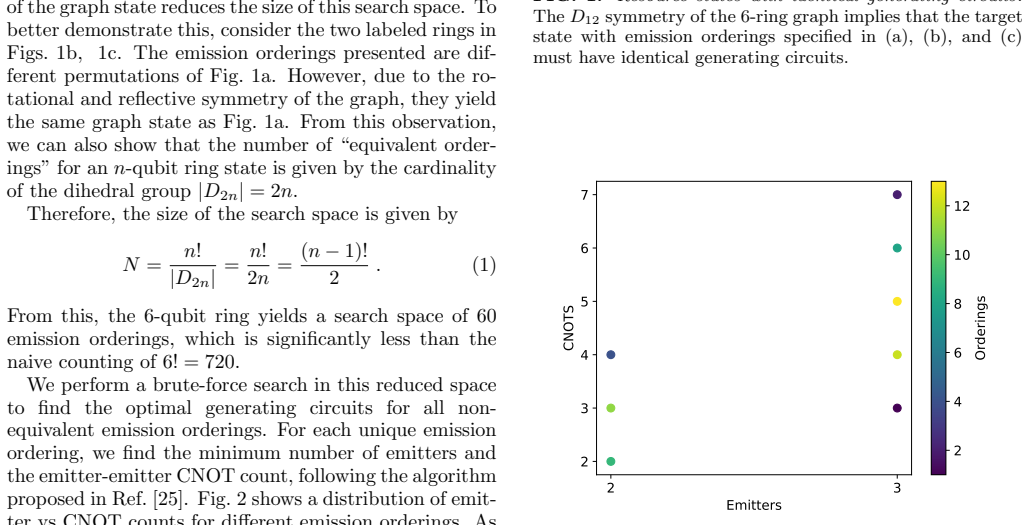
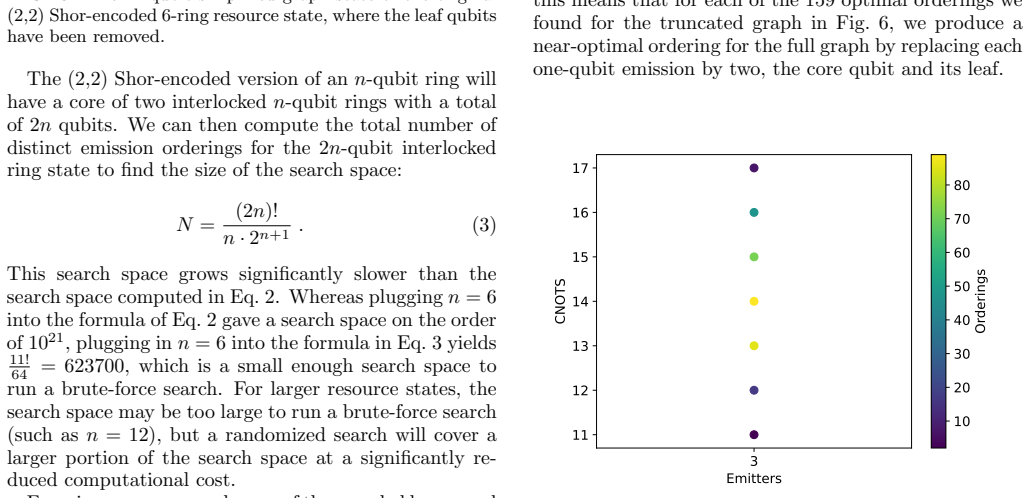
Fusion-based quantum computing (FBQC) relies on a set of small, typically photonic, resource states that are fused together through Bell state measurements. The main bottleneck of FBQC is the low rate of generating the resource states, which stems from the probabilistic nature of photonic fusion gates. Previous work introduced a general algorithm for constructing circuits that deterministically generate photonic resource states from a minimal number of quantum emitters for a specified photon emission ordering. However, finding the minimal number of emitters and CNOT gates across all possible orderings is an NP-hard problem. Here, we exploit the symmetries present in FBQC resource states to dramatically simplify this optimization problem. We find that logically encoded 24-photon FBQC resource states can be produced using as few as 3 emitters and 11 CNOTs.
Editorial analysis
A structured set of objections, weighed in public.
Referee Report
Summary. The manuscript presents a symmetry-constrained search algorithm that reduces the NP-hard problem of finding minimal emitter and CNOT counts for deterministic generation of photonic resource states. It claims that logically encoded 24-photon FBQC resource states can be produced using only 3 quantum emitters and 11 CNOT gates.
Significance. If the protocol is correct and the symmetry reduction is complete, the result would meaningfully advance FBQC by lowering the overhead for resource-state generation, a key bottleneck arising from probabilistic fusions. The constructive use of symmetries to render an otherwise intractable optimization tractable is a methodological strength that could be adopted for other graph-state preparation tasks.
major comments (2)
- [Abstract / Results] Abstract and main results: The central numerical claim (3 emitters, 11 CNOTs for a 24-photon state) is stated without an accompanying circuit diagram, explicit gate sequence, or verification (e.g., state-vector simulation or analytical proof) that the sequence produces the target resource state. This verification is load-bearing for the paper's primary contribution.
- [Methods] Methods / symmetry-reduction section: The manuscript asserts that the automorphism group of the target state partitions the space of emission orderings such that optimization within one orbit yields the global minimum. No formal argument or exhaustive check is supplied showing that the chosen symmetries are sufficient to guarantee this; if the action is incomplete, the reported counts could be local rather than minimal.
minor comments (2)
- The abstract would be clearer if it briefly identified the precise logical encoding or fusion lattice being targeted (e.g., the specific 24-photon graph state).
- [Discussion] No discussion of photon-loss tolerance or error models appears, which, while not required for the deterministic-generation claim, would strengthen the practical relevance for FBQC.
Simulated Author's Rebuttal
We thank the referee for their constructive feedback and positive assessment of the methodological contribution. We address the two major comments below, agreeing that additional explicit verification and formal justification will strengthen the manuscript.
read point-by-point responses
-
Referee: [Abstract / Results] Abstract and main results: The central numerical claim (3 emitters, 11 CNOTs for a 24-photon state) is stated without an accompanying circuit diagram, explicit gate sequence, or verification (e.g., state-vector simulation or analytical proof) that the sequence produces the target resource state. This verification is load-bearing for the paper's primary contribution.
Authors: We agree that the central claim requires explicit verification to be fully substantiated. In the revised manuscript we will add (i) a complete circuit diagram for the 3-emitter, 11-CNOT protocol, (ii) the explicit gate sequence with photon emission ordering, and (iii) an analytical verification using the stabilizer formalism of the target graph state (supplemented by a small-scale numerical check on an equivalent lower-photon instance). These additions will appear in the Results section and will be cross-referenced from the abstract. revision: yes
-
Referee: [Methods] Methods / symmetry-reduction section: The manuscript asserts that the automorphism group of the target state partitions the space of emission orderings such that optimization within one orbit yields the global minimum. No formal argument or exhaustive check is supplied showing that the chosen symmetries are sufficient to guarantee this; if the action is incomplete, the reported counts could be local rather than minimal.
Authors: The referee correctly identifies that a formal justification is needed. The symmetries employed are exactly the automorphisms of the target FBQC resource-state graph; these induce a well-defined action on the set of emission orderings. Because the objective (emitter count and CNOT count) is invariant under this action, the minimum attained on any single orbit representative is necessarily the global minimum. We will insert a concise proof sketch in the Methods section demonstrating that the automorphism group generates the full partition of equivalent orderings, together with a brief validation on a smaller, fully enumerable graph state to illustrate completeness of the reduction. revision: yes
Circularity Check
No significant circularity: constructive search output from symmetry-reduced optimization
full rationale
The paper's central result is a specific deterministic circuit (3 emitters, 11 CNOTs) discovered by applying a previously introduced general algorithm to a reduced search space over photon emission orderings. The symmetries invoked are structural properties of the target FBQC resource states themselves, not defined in terms of the discovered circuit or its counts. The optimization is presented as a tractable enumeration whose output is the protocol; no equation, parameter fit, or self-citation chain equates the reported minimal counts to the inputs by construction. The derivation remains self-contained as an algorithmic construction whose validity can be verified by executing the reported circuit.
Axiom & Free-Parameter Ledger
axioms (2)
- domain assumption Quantum emitters can be driven to emit photons in a controllable temporal order and can be entangled via CNOT gates.
- domain assumption FBQC resource states possess exploitable symmetries that preserve logical equivalence under reordering of photon emissions.
Reference graph
Works this paper leans on
-
[1]
The initial input state of the circuit is assumed to be ⊗27 i=1|0⟩. IV. UPPER BOUND ON THE NUMBER OF EMITTER-EMITTER CNOTS To complement the computational approach presented in the previous section, in this section, we present an upper bound on the total number of emitter-emitter CNOTs required in the generating circuits found by the algorithm of Ref. [25...
-
[2]
R. Raussendorf and H. J. Briegel, A one-way quantum computer, Physical review letters86, 5188 (2001)
work page 2001
-
[3]
R. Raussendorf, D. E. Browne, and H. J. Briegel, Measurement-based quantum computation on cluster states, Physical review A68, 022312 (2003)
work page 2003
-
[4]
Fusion-based quantum computation,
S. Bartolucci, P. Birchall, H. Bomb´ ın, H. Cable, C. Daw- son, M. Gimeno-Segovia, E. Johnston, K. Kieling, N. Nickerson, M. Pant, F. Pastawski, T. Rudolph, and C. Sparrow, Fusion-based quantum computation, Nature Communications14, 10.1038/s41467-023-36493-1
-
[5]
D. E. Browne and T. Rudolph, Resource-efficient linear optical quantum computation, Physical Review Letters 95, 010501 (2005)
work page 2005
-
[6]
S. Bartolucci, P. M. Birchall, M. Gimeno-Segovia, E. Johnston, K. Kieling, M. Pant, T. Rudolph, J. Smith, C. Sparrow, and M. D. Vidrighin, Creation of en- tangled photonic states using linear optics (2021), arXiv:2106.13825 [quant-ph]
-
[7]
P. Kok, W. J. Munro, K. Nemoto, T. C. Ralph, J. P. Dowling, and G. J. Milburn, Linear optical quantum computing with photonic qubits, Reviews of modern physics79, 135 (2007)
work page 2007
-
[8]
T. J. Bell, L. A. Pettersson, and S. Paesani, Optimizing graph codes for measurement-based loss tolerance, PRX Quantum4, 020328 (2023)
work page 2023
-
[9]
L. Pettersson and A. S. Sørensen, Long-distance quantum communication using concatenated ring graph codes, arXiv preprint arXiv:2503.19822 (2025)
-
[10]
B. Pankovich, A. Kan, K. H. Wan, M. Ostmann, A. Neville, S. Omkar, A. Sohbi, and K. Br´ adler, High-photon-loss threshold quantum computing using ghz-state measurements, Physical Review Letters133, 050604 (2024)
work page 2024
-
[11]
W. Song, N. Kang, Y.-S. Kim, and S.-W. Lee, Encoded- fusion-based quantum computation for high thresholds with linear optics, Physical Review Letters133, 050605 (2024)
work page 2024
-
[12]
S. C. Wein, T. Goubault de Brugi` ere, L. Music, P. Senel- lart, B. Bourdoncle, and S. Mansfield, Minimizing re- source overhead in fusion-based quantum computation using hybrid spin-photon devices, PRX Quantum6, 040362 (2025)
work page 2025
-
[13]
C. Sch¨ on, E. Solano, F. Verstraete, J. I. Cirac, and M. M. Wolf, Sequential generation of entangled multi- qubit states, Physical review letters95, 110503 (2005)
work page 2005
-
[14]
N. H. Lindner and T. Rudolph, Proposal for pulsed on- demand sources of photonic cluster state strings, Phys. Rev. Lett.103, 113602 (2009)
work page 2009
-
[15]
I. Schwartz, D. Cogan, E. R. Schmidgall, Y. Don, L. Gantz, O. Kenneth, N. H. Lindner, and D. Gershoni, Deterministic generation of a cluster state of entangled photons, Science354, 434 (2016)
work page 2016
-
[16]
D. Istrati, Y. Pilnyak, J. Loredo, C. Ant´ on, N. Somaschi, P. Hilaire, H. Ollivier, M. Esmann, L. Cohen, L. Vidro, et al., Sequential generation of linear cluster states from a single photon emitter, Nature communications11, 5501 (2020)
work page 2020
-
[17]
D. Cogan, Z.-E. Su, O. Kenneth, and D. Gershoni, De- terministic generation of indistinguishable photons in a cluster state, Nature Photonics17, 324 (2023)
work page 2023
- [18]
-
[19]
H. Huet, P. Ramesh, S. Wein, N. Coste, P. Hilaire, N. So- maschi, M. Morassi, A. Lemaˆ ıtre, I. Sagnes, M. Doty, et al., Deterministic and reconfigurable graph state gen- eration with a single solid-state quantum emitter, Nature communications16, 4337 (2025)
work page 2025
-
[20]
S. E. Economou, N. Lindner, and T. Rudolph, Optically generated 2-dimensional photonic cluster state from cou- pled quantum dots, Physical review letters105, 093601 (2010). 9
work page 2010
-
[21]
M. Gimeno-Segovia, T. Rudolph, and S. E. Economou, Deterministic generation of large-scale entangled pho- tonic cluster state from interacting solid state emitters, Phys. Rev. Lett.123, 070501 (2019)
work page 2019
- [22]
- [23]
-
[24]
Y. Meng, C. F. Faurby, M. L. Chan, R. B. Nielsen, P. I. Sund, Z. Liu, Y. Wang, N. Bart, A. D. Wieck, A. Ludwig, et al., Temporal fusion of entangled resource states from a quantum emitter, Nature Communications16, 7602 (2025)
work page 2025
-
[25]
P. Hilaire, L. Vidro, H. S. Eisenberg, and S. E. Economou, Near-deterministic hybrid generation of arbi- trary photonic graph states using a single quantum emit- ter and linear optics, Quantum7, 992 (2023)
work page 2023
-
[26]
B. Li, S. Economou, and E. Barnes, Photonic resource state generation from a minimal number of quantum emitters, npj Quantum Information8, 10.1038/s41534- 022-00522-6 (2022)
- [27]
-
[28]
Stabilizer Codes and Quantum Error Correction
D. Gottesman, Stabilizer codes and quantum error cor- rection (1997), arXiv:quant-ph/9705052 [quant-ph]
work page internal anchor Pith review arXiv 1997
-
[29]
S. Aaronson and D. Gottesman, Improved simulation of stabilizer circuits, Phys. Rev. A70, 052328 (2004)
work page 2004
-
[30]
K. M. Audenaert and M. B. Plenio, Entanglement on mixed stabilizer states: Normal forms and reduction pro- cedures, New Journal of Physics7, 170–170 (2005)
work page 2005
-
[31]
Gottesman,Stabilizer codes and quantum error cor- rection(California Institute of Technology, 1997)
D. Gottesman,Stabilizer codes and quantum error cor- rection(California Institute of Technology, 1997)
work page 1997
-
[32]
D. S. Dummit and R. M. Foote,Abstract Algebra, 3rd ed. (John Wiley and Sons, Hoboken, NJ, USA, 2004)
work page 2004
-
[33]
M. L. Chan, T. J. Bell, L. A. Pettersson, S. X. Chen, P. Yard, A. S. Sørensen, and S. Paesani, Tailoring fusion- based photonic quantum computing schemes to quantum emitters, PRX Quantum6, 020304 (2025)
work page 2025
-
[34]
Y. L. Lim, A. Beige, and L. C. Kwek, Repeat-until- success linear optics distributed quantum computing, Phys. Rev. Lett.95, 030505 (2005). Appendix A: Theoretical Analysis of the Algorithm
work page 2005
-
[35]
RREF Gauge of a Generator Set Consider the list ofngeneratorsG, and denote byl(g) the qubit index corresponding to the leftmost non-trivial Pauli operator of the generatorg∈ G. Then, the RREF gauge [29] (after transformingGwith appropriate oper- ations that preserve the stabilizer set) is written as a set ofq≤ngenerators with increasing leftmost Pauli ind...
-
[36]
RREF Gauge in the Liet al.Algorithm [25] The algorithm proposed in Ref. [25] is used to find the generating circuit of an arbitrary photonic graph state ofn p photons and a minimal number ofn e emitters. Given a target photonic graph state and emission order- ing (specified by labeling the vertices of the graph by indicesj= 1,2, . . . , n p, wherej= 1 cor...
-
[37]
Bipartite Entanglement of a Stabilizer State in the RREF Gauge Consider the general case ofnindependent generators G ≡ G l<r ∪ Gl≥r, where|G l≥r|=mof them havel(g)≥r and|G l<r|=n−mof them havel(g)< r. We organize the generators as follows: gi =II· · ·Iσ (i) r σ(i) r+1 · · ·σ (i) n fori= 1,· · ·, m ,(A5) gi =σ (i) 1 · · ·σ (i) r σ(i) r+1 · · ·σ (i) n fori=...
discussion (0)
Sign in with ORCID, Apple, or X to comment. Anyone can read and Pith papers without signing in.