Recognition: 2 theorem links
· Lean TheoremCharacterizing the Scale Height and Filamentary Structure of Radiatively Cooled MADs
Pith reviewed 2026-05-12 01:51 UTC · model grok-4.3
The pith
Above a critical accretion rate, radiative cooling thins and densifies filaments in magnetically arrested black hole disks while raising efficiency.
A machine-rendered reading of the paper's core claim, the machinery that carries it, and where it could break.
Core claim
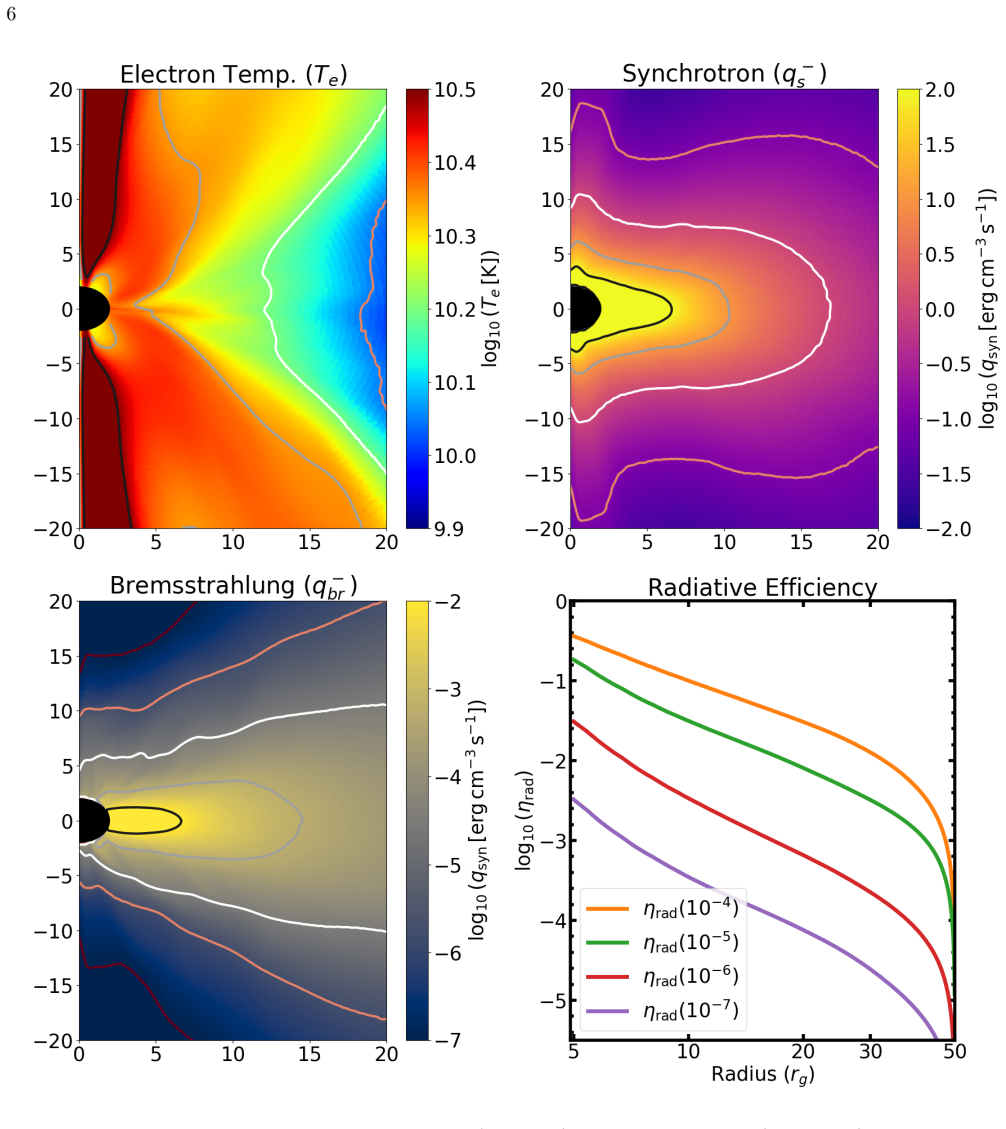
In the inner regions of these MAD flows, magnetic field accumulation already enforces a discrete filamentary gas structure. Once radiative losses exceed magnetic heating, the drop in gas thermal pressure further compresses the filaments, raises the overall radiative efficiency relative to lower-rate runs, and renders standard scale-height diagnostics unreliable; the authors therefore replace them with a measure anchored at the polar location of the density peak.
What carries the argument
The transition mass accretion rate, found where the radiative cooling time becomes shorter than the heating time supplied by local magnetic coupling, which in turn forces thinner denser filaments and necessitates redefining disk scale height by the polar position of the density maximum.
Load-bearing premise
Heating is supplied only through local coupling to the magnetic field, allowing the transition rate to be located where cooling overtakes that heating.
What would settle it
A simulation or observation at accretion rates above the predicted transition that shows no reduction in filament thickness or no rise in radiative efficiency would falsify the claimed effect of cooling.
Figures


read the original abstract
Radiative cooling can strongly influence the structure and dynamics of black hole accretion disks. Here, we perform general relativistic magnetohydrodynamic (GR-MHD) simulations of magnetically arrested disks (MADs) around a non-spinning black hole. Radiative cooling is consistently included in the simulations and its intensity is scaled by the mass accretion rate ranging from $10^{-7}$ to $10^{-4} \dot{M}_{\mathrm{Edd}}$. Considering synchrotron and bremsstrahlung emission, we quantify how radiative losses modify the disk structure and the accretion dynamics. In the inner MAD disk regions, accumulation of magnetic field regulates gas accretion, enforcing the gas into a discrete interchange-driven filamentary structure. We identify, both analytically and numerically, a transition mass accretion rate above which radiative cooling becomes faster than the heating, which is assumed to occur via local coupling to the magnetic field. Above this mass accretion rate, cooling substantially reduces the gas thermal pressure, leading to considerably thinner and denser accretion filaments, and a substantial increase in radiative efficiency, relative to lower accretion rates. We show that under these conditions, conventional measures of the disk scale height become misleading in MAD flows. We therefore introduce an alternative definition based on the polar position of the density maximum, which more robustly characterizes the filamentary structure of the disks in the presence of strong magnetic fields and cooling.
Editorial analysis
A structured set of objections, weighed in public.
Referee Report
Summary. The paper performs GR-MHD simulations of non-spinning MADs with radiative cooling (synchrotron and bremsstrahlung) whose intensity is scaled to mass accretion rates spanning 10^{-7} to 10^{-4} Eddington. It analytically and numerically identifies a transition accretion rate above which cooling exceeds heating (assumed to occur via local magnetic-field coupling), producing thinner and denser interchange-driven filaments, a jump in radiative efficiency, and rendering conventional disk scale-height measures misleading; an alternative scale-height definition based on the polar position of the density maximum is introduced to better characterize the filamentary structure.
Significance. If the transition criterion and new scale-height metric prove robust, the results would clarify how radiative cooling alters filamentary accretion in the MAD regime and could inform modeling of sources near the transition from radiatively inefficient to efficient accretion, such as Sgr A* or low-luminosity AGN.
major comments (2)
- [Analytical/numerical identification of transition (abstract and associated methods/results sections)] The central transition mass-accretion-rate criterion is obtained by equating the cooling timescale to a heating timescale that assumes local coupling between gas and magnetic field. In the GRMHD runs, however, dissipation arises from numerical resistivity, reconnection, and grid-scale effects; no direct comparison is presented between the assumed heating rate and the actual dissipation rate measured from the simulation data. This verification is required to confirm that the reported transition location is not shifted by the mismatch between the analytic assumption and the numerical dissipation mechanism.
- [Scale-height definition and filament characterization sections] The claim that conventional scale-height measures become misleading under strong cooling relies on the filamentary structure being substantially altered above the transition. Quantitative evidence (e.g., explicit comparison of the conventional H/R versus the new polar-density-maximum definition across the full accretion-rate range, including error bars or convergence checks) is needed to demonstrate that the new definition is demonstrably superior rather than merely different.
minor comments (2)
- Clarify the precise functional form used to scale the cooling intensity with accretion rate and confirm that the same scaling is applied uniformly in both the analytic criterion and the simulations.
- Add a brief statement on numerical resolution, convergence tests, and any resolution-dependent effects on the measured filament thickness or dissipation rate.
Simulated Author's Rebuttal
We thank the referee for their constructive and detailed comments, which have helped clarify key aspects of our work. We respond point-by-point to the major comments below. Where appropriate, we have revised the manuscript to incorporate additional analyses and quantitative comparisons.
read point-by-point responses
-
Referee: [Analytical/numerical identification of transition (abstract and associated methods/results sections)] The central transition mass-accretion-rate criterion is obtained by equating the cooling timescale to a heating timescale that assumes local coupling between gas and magnetic field. In the GRMHD runs, however, dissipation arises from numerical resistivity, reconnection, and grid-scale effects; no direct comparison is presented between the assumed heating rate and the actual dissipation rate measured from the simulation data. This verification is required to confirm that the reported transition location is not shifted by the mismatch between the analytic assumption and the numerical dissipation mechanism.
Authors: We agree that a direct verification strengthens the result. The local-coupling assumption for heating is physically motivated by the dominance of magnetic reconnection in MADs, but we acknowledge the distinction from numerical dissipation. In the revised manuscript, we will add a new subsection comparing the assumed heating timescale to the actual dissipation rate extracted from the simulations (via magnetic energy decay rates and reconnection diagnostics) across the accretion-rate range. This comparison will confirm that the transition location remains robust and is not materially shifted by numerical effects. revision: yes
-
Referee: [Scale-height definition and filament characterization sections] The claim that conventional scale-height measures become misleading under strong cooling relies on the filamentary structure being substantially altered above the transition. Quantitative evidence (e.g., explicit comparison of the conventional H/R versus the new polar-density-maximum definition across the full accretion-rate range, including error bars or convergence checks) is needed to demonstrate that the new definition is demonstrably superior rather than merely different.
Authors: We agree that quantitative evidence is needed to demonstrate superiority. In the revised manuscript, we will add a new figure (and accompanying text) that explicitly compares the conventional H/R (density-weighted vertical scale) against the new polar-density-maximum definition over the full range of accretion rates. Time-averaged values will be shown with error bars representing the standard deviation from temporal variability. This will illustrate the clear divergence above the transition and how the new metric more faithfully tracks the thinned, dense filaments. We will also discuss resolution adequacy for the filamentary features, though a full multi-resolution convergence study across all rates would require additional simulations beyond the current scope. revision: partial
Circularity Check
No circularity; derivation relies on explicit assumption and direct simulation outputs
full rationale
The paper states an explicit assumption that heating occurs via local coupling to the magnetic field, then analytically and numerically compares this to the cooling time to locate a transition accretion rate. Structural consequences (thinner filaments, higher efficiency) and the new scale-height definition (polar position of density maximum) are presented as downstream results of that comparison and the GR-MHD runs. No step redefines a quantity in terms of itself, renames a fitted parameter as a prediction, or reduces the central claim to a self-citation chain. The analysis is self-contained against the stated physics and simulation data.
Axiom & Free-Parameter Ledger
free parameters (1)
- cooling intensity scaling
axioms (1)
- domain assumption Heating occurs via local coupling to the magnetic field
Lean theorems connected to this paper
-
IndisputableMonolith/Cost/FunctionalEquation.leanwashburn_uniqueness_aczel unclearheating is assumed to occur via local coupling to the magnetic field... du_gas/dt ≈ u_B m_p v_r / (ρ r)
-
IndisputableMonolith/Foundation/AlexanderDuality.leanalexander_duality_circle_linking unclearnew definition based on the polar position of the density maximum
Reference graph
Works this paper leans on
-
[1]
Abramowicz, M. A., & Fragile, P. C. 2013, Living Reviews in Relativity, 16, 1, doi: 10.12942/lrr-2013-1
-
[2]
Asahina, Y., Takahashi, H. R., & Ohsuga, K. 2020, ApJ, 901, 96, doi: 10.3847/1538-4357/abaf51
-
[3]
Reviews of Modern Physics , author =
Balbus, S. A., & Hawley, J. F. 1998, Reviews of Modern Physics, 70, 1, doi: 10.1103/RevModPhys.70.1 Bégué, D., Pe’er, A., Zhang, G. Q., Zhang, B. B., &
-
[4]
2023, ApJS, 264, 32, doi: 10.3847/1538-4365/aca276
Pevzner, B. 2023, ApJS, 264, 32, doi: 10.3847/1538-4365/aca276
-
[5]
Bisnovatyi-Kogan, G. S., & Ruzmaikin, A. A. 1976, Ap&SS, 42, 401, doi: 10.1007/BF01225967
-
[6]
2018, A&A, 613, A2, doi: 10.1051/0004-6361/201732149
Bronzwaer, T., Davelaar, J., Younsi, Z., et al. 2018, A&A, 613, A2, doi: 10.1051/0004-6361/201732149
-
[7]
2025, MNRAS, 537, 2496, doi: 10.1093/mnras/staf200
Chael, A. 2025, MNRAS, 537, 2496, doi: 10.1093/mnras/staf200
-
[8]
Chan, H.-S., Dexter, J., & Begelman, M. C. 2026, arXiv e-prints, arXiv:2603.00525, doi: 10.48550/arXiv.2603.00525 14
-
[9]
Dibi, S., Drappeau, S., Fragile, P. C., Markoff, S., & Dexter, J. 2012, Monthly Notices of the Royal Astronomical Society, 426, 1928, doi: 10.1111/j.1365-2966.2012.21857.x
-
[10]
Dihingia, I. K., Mizuno, Y., Fromm, C. M., & Rezzolla, L. 2023, MNRAS, 518, 405, doi: 10.1093/mnras/stac3165
-
[11]
Drappeau, S., Dibi, S., Dexter, J., Markoff, S., & Fragile, P. C. 2013, MNRAS, 431, 2872, doi: 10.1093/mnras/stt388
-
[12]
A., Narayan, R., Ostriker, E., & Yi, I
Esin, A. A., Narayan, R., Ostriker, E., & Yi, I. 1996, ApJ, 465, 312, doi: 10.1086/177421 Event Horizon Telescope Collaboration, Akiyama, K., & Alberdi, e. a. 2022, The Astrophysical Journal Letters, 930, L12, doi: 10.3847/2041-8213/ac6674
-
[13]
Fishbone, L. G., & Moncrief, V. 1976, ApJ, 207, 962, doi: 10.1086/154565
-
[14]
Fragile, P. C., & Meier, D. L. 2009, ApJ, 693, 771, doi: 10.1088/0004-637X/693/1/771
-
[15]
2025, MNRAS, 540, 2820, doi: 10.1093/mnras/staf890
Smith, Z. 2025, MNRAS, 540, 2820, doi: 10.1093/mnras/staf890
-
[16]
Gammie, C. F., McKinney, J. C., & Tóth, G. 2003, The Astrophysical Journal, 589, 444, doi: 10.1086/374594
-
[17]
Igumenshchev, I. V. 2008, ApJ, 677, 317, doi: 10.1086/529025
-
[18]
Kawazura, Y., Barnes, M., & Schekochihin, A. A. 2019, Proceedings of the National Academy of Science, 116, 771, doi: 10.1073/pnas.1812491116
-
[19]
2020, MNRAS, 494, 3656, doi: 10.1093/mnras/staa955
Liska, M., Tchekhovskoy, A., & Quataert, E. 2020, MNRAS, 494, 3656, doi: 10.1093/mnras/staa955
-
[20]
2024, ApJ, 966, 47, doi: 10.3847/1538-4357/ad344a
Musoke, G. 2024, ApJ, 966, 47, doi: 10.3847/1538-4357/ad344a
-
[21]
2023, ApJL, 944, L48, doi: 10.3847/2041-8213/acb6f4
Porth, O. 2023, ApJL, 944, L48, doi: 10.3847/2041-8213/acb6f4
-
[22]
Liska, M. T. P., Musoke, G., Tchekhovskoy, A., Porth, O., & Beloborodov, A. M. 2022, The Astrophysical Journal, Letters, 935, L1, doi: 10.3847/2041-8213/ac84db
-
[23]
Lubow, S. H., Papaloizou, J. C. B., & Pringle, J. E. 1994, MNRAS, 267, 235, doi: 10.1093/mnras/267.2.235 Martí, J. M., & Müller, E. 2003, Living Reviews in Relativity, 6, 7, doi: 10.12942/lrr-2003-7 —. 2015, Living Reviews in Computational Astrophysics, 1, 3, doi: 10.1007/lrca-2015-3
-
[24]
McKinney, J. C., & Gammie, C. F. 2004, ApJ, 611, 977, doi: 10.1086/422244
-
[25]
2014, Monthly Notices of the Royal Astronomical Society, 441, 3177, doi: 10.1093/mnras/stu762
Narayan, R. 2014, Monthly Notices of the Royal Astronomical Society, 441, 3177, doi: 10.1093/mnras/stu762
-
[26]
2022, MNRAS, 511, 3795, doi:10.1093/mnras/stac285
Curd, B. 2022, MNRAS, 511, 3795, doi: 10.1093/mnras/stac285
-
[27]
Narayan, R., Igumenshchev, I. V., & Abramowicz, M. A. 2003, PASJ, 55, L69, doi: 10.1093/pasj/55.6.L69
-
[28]
Narayan, R., Sadowski, A., Penna, R. F., & Kulkarni, A. K. 2012, Monthly Notices of the Royal Astronomical Society, 426, 3241, doi: 10.1111/j.1365-2966.2012.22002.x
-
[29]
2006, ApJ, 641, 626, doi: 10.1086/500349
Zanna, L. 2006, ApJ, 641, 626, doi: 10.1086/500349
-
[30]
Porth, O., Mizuno, Y., Younsi, Z., & Fromm, C. M. 2021, MNRAS, 502, 2023, doi: 10.1093/mnras/stab163
-
[31]
2019, ApJS, 243, 26, doi: 10.3847/1538-4365/ab29fd
Porth, O., Chatterjee, K., Narayan, R., et al. 2019, ApJS, 243, 26, doi: 10.3847/1538-4365/ab29fd
-
[32]
2013, Relativistic Hydrodynamics (Cambridge University Press)
Rezzolla, L., & Zanotti, O. 2013, Relativistic Hydrodynamics (Cambridge University Press)
work page 2013
-
[33]
2022, ApJL, 924, L32, doi: 10.3847/2041-8213/ac46a1
Ripperda, B., Liska, M., Chatterjee, K., et al. 2022, ApJL, 924, L32, doi: 10.3847/2041-8213/ac46a1
-
[34]
Rowan, M. E., Sironi, L., & Narayan, R. 2019, ApJ, 873, 2, doi: 10.3847/1538-4357/ab03d7
-
[35]
Rybicki, G. B., & Lightman, A. P. 1986, Radiative Processes in Astrophysics (John Wiley & Sons, Ltd)
work page 1986
-
[36]
2024, arXiv e-prints, arXiv:2411.09556, doi: 10.48550/arXiv.2411.09556
Salas, L., Liska, M., Markoff, S., et al. 2024, arXiv e-prints, arXiv:2411.09556, doi: 10.48550/arXiv.2411.09556
-
[37]
2025, ApJL, 981, L11, doi: 10.3847/2041-8213/adb749 Sądowski, A., Wielgus, M., Narayan, R., et al
Singh, A., Bégué, D., & Pe’er, A. 2025, ApJL, 981, L11, doi: 10.3847/2041-8213/adb749 Sądowski, A., Wielgus, M., Narayan, R., et al. 2017, Monthly Notices of the Royal Astronomical Society, 466, 705, doi: 10.1093/mnras/stw3116
-
[38]
Stepney, S., & Guilbert, P. W. 1983, MNRAS, 204, 1269, doi: 10.1093/mnras/204.4.1269
-
[39]
Tchekhovskoy, A., & McKinney, J. C. 2012, MNRAS, 423, L55, doi: 10.1111/j.1745-3933.2012.01256.x
-
[40]
Tchekhovskoy, A., Narayan, R., & McKinney, J. C. 2011, Monthly Notices of the Royal Astronomical Society: Letters, 418, L79, doi: 10.1111/j.1745-3933.2011.01147.x Tóth, G. 2000, Journal of Computational Physics, 161, 605, doi: 10.1006/jcph.2000.6519
-
[41]
2025, arXiv e-prints, arXiv:2508.15532, doi: 10.48550/arXiv.2508.15532
Wallace, J., Bégué, D., & Pe’er, A. 2025, arXiv e-prints, arXiv:2508.15532, doi: 10.48550/arXiv.2508.15532
-
[42]
White, C. J., Mullen, P. D., Jiang, Y.-F., et al. 2023, ApJ, 949, 103, doi: 10.3847/1538-4357/acc8cf
-
[43]
Wong, G. N., Du, Y., Prather, B. S., & Gammie, C. F. 2021, ApJ, 914, 55, doi: 10.3847/1538-4357/abf8b8
-
[44]
Yoon, D., Chatterjee, K., Markoff, S. B., et al. 2020, Monthly Notices of the Royal Astronomical Society, 499, 3178, doi: 10.1093/mnras/staa3031
-
[45]
2023, Science, 381, 961, doi: 10.1126/science.abo4504 15
You, B., Cao, X., Yan, Z., et al. 2023, Science, 381, 961, doi: 10.1126/science.abo4504 15
-
[46]
, archivePrefix = "arXiv", eprint =
Yuan, F., & Narayan, R. 2014, ARA&A, 52, 529, doi: 10.1146/annurev-astro-082812-141003
-
[47]
Q., Bégué, D., Pe’er, A., & Zhang, B
Zhang, G. Q., Bégué, D., Pe’er, A., & Zhang, B. B. 2024, ApJ, 962, 135, doi: 10.3847/1538-4357/ad167b
-
[48]
Zhang, L., Stone, J. M., Mullen, P. D., et al. 2025, ApJ, 995, 26, doi: 10.3847/1538-4357/ae0f91
discussion (0)
Sign in with ORCID, Apple, or X to comment. Anyone can read and Pith papers without signing in.