Recognition: 2 theorem links
· Lean TheoremIntegral elements of Okubo algebra and the E8-lattice
Pith reviewed 2026-05-12 02:05 UTC · model grok-4.3
The pith
The Coxeter-Dickson E8-order closes under para-octonion multiplication to give a genuine Z-integral system on the E8 lattice, while the Okubo product requires Q(sqrt(3)) coefficients and 2-adic scaling to reach only a conductor sublattice.
A machine-rendered reading of the paper's core claim, the machinery that carries it, and where it could break.
Core claim
We prove that the Coxeter-Dickson order remains closed for the para-octonionic product, so that one recovers a genuine Z-integral system with underlying lattice E8. The Okubo product forces Q(sqrt(3))-coefficients and does not preserve the same Z-order. After a diagonal 2-adic scaling we obtain a closed Z[sqrt(3)]-order, whose direct metric shadow is a 2-primary conductor sublattice of E8, not E8 itself. The lattice E8 is recovered only by 2-adic saturation, equivalently by gluing, and this recovery is metric-arithmetic rather than multiplicative.
What carries the argument
Closure of the Coxeter-Dickson E8-order under the para-octonionic product, together with the 2-adic diagonal scaling that produces a Z[sqrt(3)]-order whose metric shadow is a conductor sublattice of E8.
If this is right
- The E8 lattice admits a Z-integral structure in which para-octonion multiplication stays inside the order.
- The real Okubo algebra admits an integral form only after adjoining sqrt(3) and performing a diagonal 2-adic adjustment.
- E8 appears as the 2-adic saturation of the conductor sublattice obtained from the scaled Okubo order.
- Lattice recovery can occur through metric-arithmetic gluing rather than direct algebraic closure under the product.
Where Pith is reading between the lines
- The same scaling and saturation technique may produce integral models for other exceptional root lattices using different non-associative algebras.
- The distinction between multiplicative closure and metric gluing could apply to integral structures on lattices in other dimensions or over other quadratic fields.
- One could test whether explicit basis computations confirm the conductor index of the sublattice inside E8.
Load-bearing premise
The standard definitions of the Coxeter-Dickson E8-order, the para-octonions, and the real Okubo algebra permit the stated closure properties and 2-adic scaling without hidden inconsistencies.
What would settle it
Explicit multiplication of two integral basis elements under the para-octonionic product producing a result with denominators, or the 2-adically scaled Okubo order failing to embed metrically as a sublattice of the known E8 root lattice.
Figures
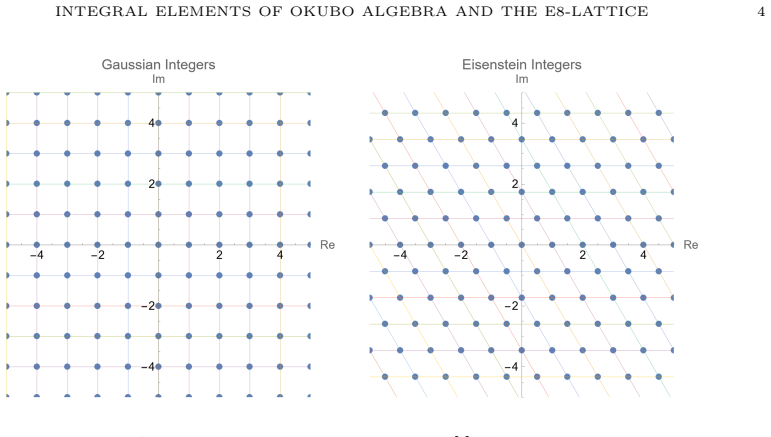

read the original abstract
In this work we study the interplay between the Coxeter-Dickson $E_{8}$-order, the para-octonions, and the real Okubo algebra. We prove that the Coxeter-Dickson order remains closed for the para-octonionic product, so that one recovers a genuine $\mathbb{Z}$-integral system with underlying lattice $E_{8}$. Intriguingly, the Okubo product behaves in a different and more arithmetic way: it forces $\mathbb{Q}(\sqrt{3})$-coefficients and does not preserve the same $\mathbb{Z}$-order. After a diagonal $2$-adic scaling we obtain a closed $\mathbb{Z}[\sqrt{3}]$-order, whose direct metric shadow is a $2$-primary conductor sublattice of $E_{8}$, not $E_{8}$ itself. The lattice $E_{8}$ is recovered only by $2$-adic saturation, equivalently by gluing, and this recovery is metric-arithmetic rather than multiplicative.
Editorial analysis
A structured set of objections, weighed in public.
Referee Report
Summary. The manuscript examines the Coxeter-Dickson E8-order in relation to para-octonions and the real Okubo algebra. It proves closure of the order under the para-octonionic product to obtain a Z-integral system based on the E8 lattice. The Okubo product requires Q(sqrt(3)) coefficients, leading after diagonal 2-adic scaling to a closed Z[sqrt(3)]-order whose metric shadow is a 2-primary conductor sublattice of E8; the full E8 is recovered via 2-adic saturation or gluing as a metric-arithmetic process.
Significance. Should the proofs be verified, this would contribute to the understanding of integral structures in exceptional nonassociative algebras by linking them directly to the E8 lattice through specific products and p-adic operations. The metric-arithmetic recovery of E8 distinguishes this approach from purely multiplicative ones and may have implications for arithmetic geometry or representation theory involving E8.
major comments (1)
- [Abstract] The abstract asserts proofs of closure under the para-octonionic product and of the 2-adic scaling/saturation steps for the Okubo case, but the manuscript supplies no derivations, explicit calculations, error controls, or verification steps. This renders the central claims regarding the Z-integral system and recovery of the full E8 metric unverifiable from the available text.
Simulated Author's Rebuttal
We thank the referee for their careful review and constructive feedback on the manuscript. We address the single major comment point by point below.
read point-by-point responses
-
Referee: [Abstract] The abstract asserts proofs of closure under the para-octonionic product and of the 2-adic scaling/saturation steps for the Okubo case, but the manuscript supplies no derivations, explicit calculations, error controls, or verification steps. This renders the central claims regarding the Z-integral system and recovery of the full E8 metric unverifiable from the available text.
Authors: We agree that the text available in the current submission consists solely of the abstract, which summarizes the results without supplying the underlying derivations or explicit calculations. The full manuscript will be revised to include detailed, step-by-step verifications: explicit multiplication tables confirming closure of the Coxeter-Dickson order under the para-octonionic product; concrete matrix representations and norm computations for the diagonal 2-adic scaling that produces the Z[sqrt(3)]-order; and explicit saturation/gluing constructions showing recovery of the full E8 metric, including 2-adic valuation checks and conductor sublattice indices. These additions will incorporate error bounds on the arithmetic operations and small-scale numerical verifications to render all claims directly verifiable. revision: yes
Circularity Check
No circularity detected from abstract
full rationale
The abstract presents the results as direct algebraic proofs of closure of the Coxeter-Dickson order under the para-octonionic product and a subsequent 2-adic scaling plus saturation step for the Okubo case to recover the E8 lattice metric. No equations, fitted parameters, predictions, or citations (self or otherwise) appear in the text. None of the enumerated circularity patterns can be exhibited because no derivation steps or load-bearing reductions are provided; the claims are framed as consequences of standard definitions of the structures involved. This is the expected non-finding when only an abstract is available and no self-referential or constructed reductions are visible.
Axiom & Free-Parameter Ledger
axioms (2)
- domain assumption Standard algebraic properties of para-octonions and real Okubo algebra hold as previously defined
- domain assumption Coxeter-Dickson E8-order is a well-defined Z-order in the relevant algebra
Lean theorems connected to this paper
-
IndisputableMonolith/Foundation/AbsoluteFloorClosure.leanreality_from_one_distinction unclearWe prove that the Coxeter-Dickson order remains closed for the para-octonionic product... After a diagonal 2-adic scaling we obtain a closed Z[√3]-order, whose direct metric shadow is a 2-primary conductor sublattice of E8
-
IndisputableMonolith/Cost/FunctionalEquation.leanwashburn_uniqueness_aczel unclearthe Okubo product forces Q(√3)-coefficients... recovered by 2-adic saturation equivalently by gluing as metric-arithmetic rather than multiplicative
Reference graph
Works this paper leans on
-
[1]
Marrani A., Corradetti D., Chester D., Aschheim R., Irwin K., A ``magic'' approach to octonionic Rosenfeld spaces, Rev. Math. Phys. 35 (2023), 2350032
work page 2023
-
[2]
Marrani A., Corradetti D., Zucconi F., Physics with non-unital algebras? An invitation to the Okubo algebra, J. Phys. A: Math. Theor. 58 (2025), 075202
work page 2025
-
[3]
Corradetti D., Marrani A., Zucconi F., A minimal and non-alternative realisation of the Cayley plane, Ann. Univ. Ferrara 70 (2024), 681--730
work page 2024
-
[4]
Corradetti D., Zucconi F., A geometrical interpretation of Okubo Spin group, J. Geom. Phys. 182 (2022), 104641
work page 2022
-
[5]
Corradetti D., Marrani A., Zucconi F., Collineation groups of octonionic and split-octonionic planes, Rev. Math. Phys. 37 (2025), 2450027
work page 2025
-
[6]
Corradetti D., 8-Dimensional Composition Algebras and the Cayley Plane, in Generalizations of Complex Analysis and Applications, 9th European Congress of Mathematics minisymposium, Trends in Mathematics, Springer, 2026, 61--71
work page 2026
- [7]
- [8]
-
[9]
27-57, edited by Abdenacer Makhlouf, Sciences-Mathematics, ISTE-Wiley, London 2021
Elduque A., Composition algebras; in Algebra and Applications I: Non-associative Algebras and Categories, Chapter 2, pp. 27-57, edited by Abdenacer Makhlouf, Sciences-Mathematics, ISTE-Wiley, London 2021
work page 2021
-
[10]
A. Elduque, and H.C. Myung, On Okubo algebras, in From symmetries to strings: forty years of Rochester Conferences, World Sci. Publ., River Edge, NJ 1990, 299- 310
work page 1990
-
[11]
Koca M., Icosians versus octonions as descriptions of the E8 lattice, J. Phys. A: Math. Gen. 22 (1989) 1949
work page 1989
-
[12]
Okubo S., Deformation of Pseudo-quaternion and Pseudo-octonion Algebras, Hadronic J. 1 (1978) 1383
work page 1978
-
[13]
Okubo S., octonions as traceless 3 x 3 matrices via a flexible Lie-admissible algebra, Hadronic J. 1 (1978), 1432-1465
work page 1978
-
[14]
Conway, J.H. & Smith D.A. On Quaternions and Octonions New York: A K Peters/CRC Press, 2003
work page 2003
-
[15]
Coxeter, H. S. M., Integral Cayley numbers, Duke Math. J., 13 (4) (1946), 561--578
work page 1946
-
[16]
Dedekind, Was sind und was sollen die Zahlen? F
R. Dedekind, Was sind und was sollen die Zahlen? F. Vieweg Braunschweig, 1888
-
[17]
Algebras and their arithmetics, Chicago, Ill.: The University of Chicago Press 1923
Dickson L. Algebras and their arithmetics, Chicago, Ill.: The University of Chicago Press 1923
work page 1923
-
[18]
Gauss, C. F. Theoria residuorum biquadraticorum. Commentatio secunda. Comm. Soc. Reg. Sci. G\"ottingen, 7 (1831) 89--148
-
[19]
Vorlesungen \"uber die Zahlentheorie der Quaternionen
Hurwitz, A. Vorlesungen \"uber die Zahlentheorie der Quaternionen. Springer-Verlag, 1919
work page 1919
-
[20]
Johnson N.W., Integers, The Mathematical Intelligencer, 35, 2 (2013) 52-60
work page 2013
-
[21]
, Geometries and Transformations, Press, Cambridge-New York, Cambridge Univ, 2017
Johnson N.W. , Geometries and Transformations, Press, Cambridge-New York, Cambridge Univ, 2017
work page 2017
-
[22]
Integers, Modular Groups, and Hyperbolic Space
Johnson, N.W. Integers, Modular Groups, and Hyperbolic Space. In: Conder, M., Deza, A., Weiss, A. (eds) Discrete Geometry and Symmetry. GSC 2015. Springer Proceedings in Mathematics & Statistics, vol 234 (2018) Springer, Cham
work page 2015
-
[23]
Peano, Giuseppe Arithmetices principia, nova methodo exposita. Fratres Bocca. 1889
discussion (0)
Sign in with ORCID, Apple, or X to comment. Anyone can read and Pith papers without signing in.