Recognition: 2 theorem links
· Lean TheoremA Stochastic Hybrid Automaton for Smartphone Battery Dynamics: Electro-Thermal Coupling and First-Passage Time-to-Empty Estimation
Pith reviewed 2026-05-12 04:32 UTC · model grok-4.3
The pith
A stochastic model of smartphone battery dynamics shows shutdown can occur from voltage collapse during high-power use even when charge remains.
A machine-rendered reading of the paper's core claim, the machinery that carries it, and where it could break.
Core claim
The authors formulate a stochastic hybrid automaton whose continuous states are state of charge, polarization voltage, and battery temperature, driven by a first-order Thevenin circuit coupled to a lumped thermal model; user behavior evolves as a piecewise deterministic Markov process across five modes, and battery exhaustion is the first-passage time at which terminal voltage crosses the shutdown threshold or instantaneous power becomes infeasible.
What carries the argument
The stochastic hybrid automaton that evolves continuous electro-thermal states between discrete switches in a five-mode user-activity Markov process and registers shutdown as the first time terminal voltage hits cutoff.
If this is right
- Monte Carlo runs of the automaton produce full time-to-empty distributions that quantify premature-shutdown risk through lower-tail percentiles.
- Sensitivity sweeps identify ambient temperature, internal resistance, weak-signal radio overhead, and screen brightness as dominant drivers of early cutoff.
- The framework directly supports an operating-system policy that caps peak power once resistance limits the feasible envelope.
- The same structure yields concrete guidance for users on avoiding high-load tasks when the phone is cold or aged.
Where Pith is reading between the lines
- Real-time resistance estimates from the phone could feed the model to trigger dynamic throttling before voltage sag becomes critical.
- The same hybrid-automaton structure could be adapted to predict usable range in electric vehicles under cold-weather high-load conditions.
- Field calibration against crowdsourced battery telemetry from many devices would allow the model to adjust its parameters automatically over time.
Load-bearing premise
The first-order Thevenin equivalent circuit, lumped thermal model, and five-mode user-activity process are accurate enough representations of actual smartphone behavior to produce reliable first-passage time-to-empty distributions.
What would settle it
Record actual shutdown times on multiple phones under controlled low ambient temperatures and repeated high-power bursts, then test whether the measured times fall inside the model's predicted first-passage distribution.
Figures


read the original abstract
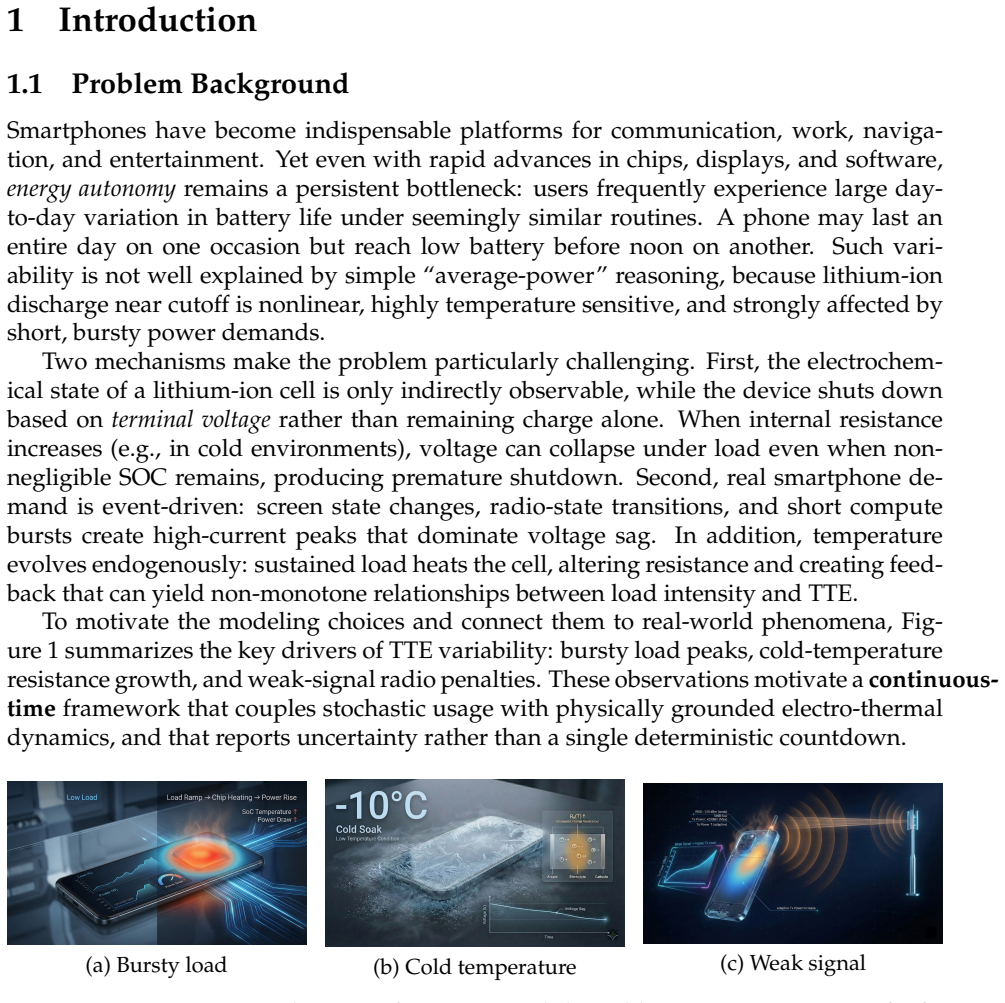
Smartphone time-to-empty (TTE) is difficult to predict because shutdown is governed not only by remaining charge, but also by instantaneous power capability under temperature-, aging-, and load-dependent voltage sag. We develop a stochastic hybrid automaton for smartphone battery dynamics that couples a first-order Thevenin equivalent-circuit model with a lumped thermal model and a stochastic user-activity process. The continuous state includes state of charge, polarization voltage, and battery temperature; user behavior is represented as a piecewise deterministic Markov process switching among idle, social/web, video, gaming, and weak-signal modes. Shutdown is formulated as a first-passage event when terminal voltage crosses a cutoff threshold or when requested power exceeds the instantaneous feasibility envelope. The model captures a voltage-collapse mechanism that simple Coulomb-counting or linear discharge models miss: cold temperature or battery aging increases internal resistance, so high-power bursts can drive terminal voltage below cutoff even when substantial charge remains. Monte Carlo simulation yields a full TTE distribution rather than a single countdown, allowing lower-tail risk to be quantified by the 5th percentile. Sensitivity analysis identifies ambient temperature, internal resistance, weak-signal radio penalty, and screen brightness as major drivers of premature shutdown risk. These results motivate practical user guidance and an operating-system-level resistance-aware throttling policy that limits peak power in the power-limited regime. The framework provides a physically grounded, risk-aware approach for explaining and extending usable smartphone battery life under real-world uncertainty.
Editorial analysis
A structured set of objections, weighed in public.
Referee Report
Summary. The paper develops a stochastic hybrid automaton for smartphone battery dynamics that couples a first-order Thevenin equivalent-circuit model with a lumped thermal model and a five-mode piecewise deterministic Markov process (idle, social/web, video, gaming, weak-signal) for user activity. Continuous states track state of charge, polarization voltage, and temperature; shutdown is defined as a first-passage event when terminal voltage drops below cutoff or requested power exceeds the instantaneous feasibility envelope. Monte Carlo simulation produces full TTE distributions (including 5th-percentile risk) and sensitivity analysis identifies ambient temperature, internal resistance, weak-signal penalty, and screen brightness as key drivers. The central claim is that the coupled model captures a voltage-collapse mechanism (high-resistance bursts driving cutoff despite remaining charge) missed by Coulomb counting or linear discharge models, motivating resistance-aware throttling policies.
Significance. If experimentally validated, the framework would offer a physically grounded, risk-aware alternative to deterministic battery models, enabling quantification of premature-shutdown probability under temperature, aging, and load variability. The Monte Carlo first-passage formulation and sensitivity results provide concrete, actionable insights for OS-level power management that simpler models cannot supply. The hybrid automaton structure is a natural fit for electro-thermal-stochastic coupling and could be extended to other portable systems.
major comments (2)
- [§5 (Numerical Results and Monte Carlo Simulations)] §5 (Numerical Results and Monte Carlo Simulations): The reported TTE distributions, 5th-percentile risk values, and sensitivity plots are generated entirely from the model assumptions with no comparison to measured voltage traces, shutdown times, or power-sag events from physical smartphone batteries under controlled temperature, aging, or load profiles. Without such grounding, the claim that the model captures a voltage-collapse mechanism missed by Coulomb counting remains an unverified output of the modeling choices rather than a demonstrated improvement.
- [§3 (Stochastic User-Activity Process)] §3 (Stochastic User-Activity Process): The five-mode PDMP switching rates are treated as free parameters whose values are not calibrated or validated against real usage traces; because these rates directly shape the high-power burst statistics that trigger the voltage-collapse events, the resulting TTE distributions inherit unquantified uncertainty that undermines the sensitivity conclusions.
minor comments (2)
- [Abstract] The definition of the 'feasibility envelope' for instantaneous power is introduced in the abstract but only formalized later; a brief forward reference or inline equation would improve readability.
- [§2 (Electro-Thermal Model)] Notation for the temperature-dependent internal resistance parameters (R_0(T), R_p(T)) is used consistently but would benefit from an explicit table listing all free parameters and their physical units.
Simulated Author's Rebuttal
We thank the referee for the constructive feedback and for recognizing the potential of the stochastic hybrid automaton framework. We address each major comment below, providing clarifications on the modeling foundations while acknowledging the value of empirical grounding.
read point-by-point responses
-
Referee: §5 (Numerical Results and Monte Carlo Simulations): The reported TTE distributions, 5th-percentile risk values, and sensitivity plots are generated entirely from the model assumptions with no comparison to measured voltage traces, shutdown times, or power-sag events from physical smartphone batteries under controlled temperature, aging, or load profiles. Without such grounding, the claim that the model captures a voltage-collapse mechanism missed by Coulomb counting remains an unverified output of the modeling choices rather than a demonstrated improvement.
Authors: We agree that direct experimental validation with physical smartphone measurements would provide stronger support for the claims. The model parameters are drawn from established literature on first-order Thevenin equivalent-circuit models and lumped thermal models for Li-ion batteries, and the voltage-collapse phenomenon under high internal resistance is a documented physical effect in power-limited discharge regimes. Our primary contribution is the stochastic hybrid formulation enabling full TTE distributions and sensitivity analysis. In the revised manuscript we will expand Section 5 with additional references to experimental observations of voltage sag in smartphone batteries, explicitly discuss the simulation-based nature of the results, and add a dedicated limitations subsection motivating future empirical validation. revision: partial
-
Referee: §3 (Stochastic User-Activity Process): The five-mode PDMP switching rates are treated as free parameters whose values are not calibrated or validated against real usage traces; because these rates directly shape the high-power burst statistics that trigger the voltage-collapse events, the resulting TTE distributions inherit unquantified uncertainty that undermines the sensitivity conclusions.
Authors: The switching rates are chosen to represent aggregate usage patterns drawn from publicly reported smartphone usage statistics (e.g., average session durations for gaming, video, and web browsing). In the revised Section 3 we will add explicit citations to these sources and provide a brief sensitivity study showing how moderate variations in the rates affect the lower tail of the TTE distribution. While full per-user calibration would require individual trace data outside the present scope, the existing Monte Carlo results already quantify the impact of load variability, and the identified key drivers (temperature, resistance, weak-signal penalty) remain robust under the chosen parameterization. revision: partial
Circularity Check
No circularity detected: model built from independent established components
full rationale
The derivation assembles a stochastic hybrid automaton by coupling a standard first-order Thevenin equivalent-circuit model, a lumped thermal model, and a piecewise deterministic Markov process for user modes. These components are introduced as external domain knowledge with no equations that define outputs in terms of themselves or rename fitted parameters as predictions. Monte Carlo first-passage simulations and sensitivity results follow directly from the forward dynamics without self-referential reductions or load-bearing self-citations. The voltage-collapse claim is a consequence of the coupled state evolution rather than an input presupposed by construction.
Axiom & Free-Parameter Ledger
free parameters (3)
- user activity mode switching rates
- temperature-dependent internal resistance parameters
- thermal model coefficients
axioms (3)
- domain assumption First-order Thevenin equivalent circuit sufficiently captures battery voltage and polarization dynamics
- domain assumption Lumped-parameter thermal model adequately represents battery temperature evolution
- domain assumption User behavior is adequately represented by a piecewise deterministic Markov process with the listed discrete modes
Lean theorems connected to this paper
-
IndisputableMonolith/Cost/FunctionalEquation.leanwashburn_uniqueness_aczel unclearWe employ a first-order Thevenin Equivalent Circuit Model (ECM)... coupled with a lumped thermal system... Arrhenius-type relationship R0(T) = Rref · exp(Ea/Rg (1/T − 1/Tref))
Reference graph
Works this paper leans on
-
[1]
Li-ion Battery Aging Datasets (e.g., B0005, B0006, B0007, B0018)
NASA Ames Prognostics Center of Excellence (PCoE). Li-ion Battery Aging Datasets (e.g., B0005, B0006, B0007, B0018). NASA Prognostics Data Repository
- [2]
-
[3]
J. Newman and K. E. Thomas-Alyea.Electrochemical Systems. Wiley, 3rd edition, 2004
work page 2004
-
[4]
G. L. Plett. Extended Kalman filtering for battery management systems of LiPB- based HEV battery packs: Part 1–3.Journal of Power Sources, 134:252–292, 2004
work page 2004
-
[5]
D. Bernardi, E. Pawlikowski, and J. Newman. A general energy balance for battery systems.Journal of the Electrochemical Society, 132(1):5–12, 1985
work page 1985
- [6]
-
[7]
M. H. A. Davis. Piecewise-deterministic Markov processes: a general class of non- diffusion stochastic models.Journal of the Royal Statistical Society: Series B, 46(3):353– 388, 1984
work page 1984
-
[8]
D. T. Gillespie. Exact stochastic simulation of coupled chemical reactions.The Journal of Physical Chemistry, 81(25):2340–2361, 1977
work page 1977
-
[9]
I. M. Sobol’. Global sensitivity indices for nonlinear mathematical models and their Monte Carlo estimates.Mathematics and Computers in Simulation, 55(1–3):271–280, 2001
work page 2001
-
[10]
A. Saltelli, M. Ratto, T. Andres, et al.Global Sensitivity Analysis: The Primer. Wiley, 2008
work page 2008
-
[11]
A. Saltelli, P . Annoni, I. Azzini, et al. Variance based sensitivity analysis of model output. Design and estimator for the total sensitivity index.Computer Physics Com- munications, 181(2):259–270, 2010
work page 2010
-
[12]
R. T. Rockafellar and S. Uryasev. Optimization of conditional value-at-risk.Journal of Risk, 2(3):21–41, 2000
work page 2000
-
[13]
Jorion.Value at Risk: The New Benchmark for Managing Financial Risk
P . Jorion.Value at Risk: The New Benchmark for Managing Financial Risk. McGraw-Hill, 3rd edition, 2007. 29 Report on Use of AI
work page 2007
-
[14]
AI Tools Used •Gemini 3 Pro(Google, Released Nov 2025): Used for high-level mathematical mod- eling, theoretical derivations (Electro-Thermal coupling), generating advanced La- TeX visualization code (TikZ/PGFPlots), and polishing the academic tone of the Abstract and Introduction. •ChatGPT 5.2(OpenAI, Released Dec 2025): Used for writing Python simulatio...
work page 2025
-
[15]
Detailed Usage Log Phase 1: Mathematical Framework & Physics (Gemini 3 Pro) Query: “I need to construct a continuous-time model for smartphone battery dynam- ics that accounts for the ’Voltage Collapse’ phenomenon in cold weather.Specifics:
-
[16]
How do I couple a First-Order Thevenin ECM with a lumped thermal model? 2. What is the standard equation for Entropy-based heat generation (Qrev) in Li-ion batteries? 3. How should I model the user’s stochastic behavior (switching apps) mathematically?” AI Output (Summary):Gemini provided the coupled system of ODEs used inSec- tion 3, specifically introdu...
-
[17]
Verification and Integrity Statement We, the members of Team #2614784, acknowledge the use of the aforementioned AI tools. We certify that: 1.Scientific Accuracy:All equations, physical laws (e.g., Arrhenius, Ohm’s Law), and parameter values were verified against standard textbooks (Newman et al.) and the NASA dataset. AI was not treated as a source of tr...
discussion (0)
Sign in with ORCID, Apple, or X to comment. Anyone can read and Pith papers without signing in.