Recognition: no theorem link
From Angle of Repose to Heap Morphology: Full-Field Calibration of DEM for Granular Powders
Pith reviewed 2026-05-12 01:51 UTC · model grok-4.3
The pith
Full-field heap morphology provides a more reliable calibration for DEM models of granular powders than angle of repose measurements.
A machine-rendered reading of the paper's core claim, the machinery that carries it, and where it could break.
Core claim
The authors claim that averaging repeated experimental heap profiles and comparing them pixel by pixel in grayscale to averaged numerical heap profiles from DEM simulations yields unique and reliable parameter calibrations, overcoming the non-uniqueness problem inherent in angle of repose based methods for cohesive granular powders such as Ti6Al4V and Al6061.
What carries the argument
The pixel-wise grayscale comparison between the average experimental heap profile and the average numerical heap profile, which serves as the objective function for tuning DEM parameters.
If this is right
- Parameter sets for DEM models of cohesive powders become unique instead of non-unique.
- Calibration accounts for the entire heap morphology rather than just a single angle value.
- Simulations of powder behavior in additive manufacturing become more predictive.
- The approach is validated as applicable to real industrial metal powders.
Where Pith is reading between the lines
- This method could be applied to other types of granular materials beyond metals.
- Future work might integrate this full-field approach with additional metrics like particle size distribution for even tighter calibration.
- Improved calibrations may lead to better predictions of powder flow in industrial equipment.
Load-bearing premise
That matching the average experimental and numerical heap profiles through pixel-wise grayscale comparison alone is sufficient to identify unique DEM parameter sets without needing further validation metrics or error analysis.
What would settle it
Demonstrating that distinct DEM parameter combinations can generate average numerical heap profiles that match the experimental profile equally well in pixel-wise grayscale but produce different results in independent experiments such as shear cell tests or dynamic flow measurements.
Figures





read the original abstract
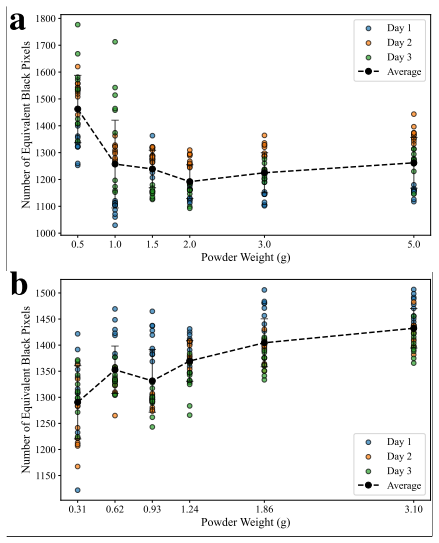
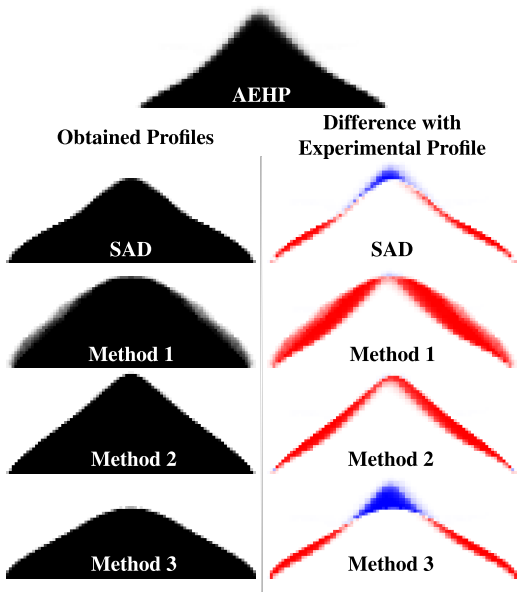
The calibration of discrete element method (DEM) models is commonly performed by tuning model parameters to match an experimental measurements, most commonly the angle of repose (AOR). Although widely used, AOR-based calibration metrics do not adequately characterize the full heap morphology, particularly when dealing with cohesive granular materials. As a result, AOR-based calibrations often leads to non-unique parameter sets. In this work, we propose a DEM calibration procedure based on full-field image analysis of static powder heaps rather than scalar AOR measurements. The method compares an average experimental heap profile (AEHP), obtained from repeated GranuHeap experiments, with an average numerical heap profile (ANHP) generated from DEM simulations. This comparison is performed using pixel-wise grayscale intensity values of both average heap profiles. Two metal powders commonly used in additive manufacturing, Ti6Al4V and Al6061, are used to evaluate the proposed methodology. This work highlights the limitations of traditional AOR-based approaches and demonstrates that full-field heap morphology offers a more reliable framework for DEM calibration.
Editorial analysis
A structured set of objections, weighed in public.
Referee Report
Summary. The manuscript proposes a DEM calibration procedure for cohesive granular powders that replaces the conventional scalar angle of repose (AOR) metric with a full-field comparison of average experimental heap profiles (AEHP) obtained from repeated GranuHeap experiments against average numerical heap profiles (ANHP) generated by DEM simulations. The comparison is performed via pixel-wise grayscale intensity matching on 2D projections of the heaps. The method is applied to Ti6Al4V and Al6061 metal powders, with the central claim that AOR calibration produces non-unique parameter sets while the full-field morphology approach provides a more reliable and unique calibration framework.
Significance. If the uniqueness and superiority claims are quantitatively substantiated, the work would address a recognized limitation in DEM modeling of cohesive materials relevant to additive manufacturing, offering a more comprehensive calibration target that incorporates full heap shape rather than a single scalar value. The use of repeated experiments to form averaged profiles is a constructive step toward reproducibility.
major comments (3)
- [Abstract and §3] Abstract and §3 (method description): The assertion that AOR-based calibrations 'often leads to non-unique parameter sets' is stated without any quantitative demonstration, such as explicit examples of multiple parameter combinations that match AOR within experimental tolerance but produce visibly different heap morphologies.
- [§4] §4 (results and comparison): No quantitative error metrics (e.g., RMSE, normalized pixel difference, or correlation coefficient) or parameter-identifiability analysis are reported for the pixel-wise grayscale matching; without these, it is not possible to verify that the full-field metric actually resolves non-uniqueness or yields statistically distinguishable parameter sets.
- [§2.2 and §4.1] §2.2 and §4.1: The assumption that 2D projected average profiles sufficiently capture 3D morphological differences (including azimuthal variation and internal structure) is not tested against multi-view imaging or 3D reconstruction; this leaves open the possibility that distinct 3D configurations produce indistinguishable 2D grayscale fields.
minor comments (2)
- [Method] Clarify the precise procedure for generating AEHP and ANHP, including number of repetitions, image alignment/registration method, and any thresholding applied to grayscale intensities.
- [Figures] Add scale bars, quantitative difference maps, and legend values to all heap-profile figures to allow direct assessment of the grayscale comparison quality.
Simulated Author's Rebuttal
We thank the referee for the constructive and detailed review. We address each major comment below and have revised the manuscript to incorporate quantitative demonstrations, error metrics, and expanded discussion of limitations where appropriate.
read point-by-point responses
-
Referee: [Abstract and §3] Abstract and §3 (method description): The assertion that AOR-based calibrations 'often leads to non-unique parameter sets' is stated without any quantitative demonstration, such as explicit examples of multiple parameter combinations that match AOR within experimental tolerance but produce visibly different heap morphologies.
Authors: We agree that the claim would be strengthened by a concrete quantitative example. In the revised manuscript, we have added to §3 an illustrative case using the Ti6Al4V powder parameters: two distinct sets (differing in cohesion energy density and rolling friction) that produce AOR values within 1.5° (within experimental tolerance) but yield visibly different heap shapes when their full-field profiles are compared. This example is supported by the corresponding ANHP images and intensity maps. revision: yes
-
Referee: [§4] §4 (results and comparison): No quantitative error metrics (e.g., RMSE, normalized pixel difference, or correlation coefficient) or parameter-identifiability analysis are reported for the pixel-wise grayscale matching; without these, it is not possible to verify that the full-field metric actually resolves non-uniqueness or yields statistically distinguishable parameter sets.
Authors: We acknowledge this gap. The revised §4 now reports RMSE and Pearson correlation coefficient values for the pixel-wise grayscale intensity differences between AEHP and ANHP for both powders. We have also included a parameter-identifiability analysis showing that small perturbations around the calibrated values produce statistically larger changes in the full-field metric than in AOR, with tabulated sensitivity results. revision: yes
-
Referee: [§2.2 and §4.1] §2.2 and §4.1: The assumption that 2D projected average profiles sufficiently capture 3D morphological differences (including azimuthal variation and internal structure) is not tested against multi-view imaging or 3D reconstruction; this leaves open the possibility that distinct 3D configurations produce indistinguishable 2D grayscale fields.
Authors: The GranuHeap instrument used here records 2D projections, consistent with standard powder characterization practice. While we have not performed multi-view or 3D reconstructions, the averaged 2D profiles already encode more morphological information (slope distribution, surface texture, and overall shape) than the scalar AOR. We have expanded the text in §2.2 and §4.1 to explicitly acknowledge this as a limitation of the current 2D setup and to note that extensions to multi-view imaging remain future work. We maintain that the 2D full-field approach still provides a more robust calibration target than AOR for the intended application. revision: partial
Circularity Check
No load-bearing circularity; empirical heap-profile comparison stands independently of inputs
full rationale
The paper proposes an empirical calibration method that compares average experimental heap profiles (AEHP) with average numerical heap profiles (ANHP) via pixel-wise grayscale intensities, then asserts this yields more reliable DEM parameters than scalar AOR. No derivation chain, equation, or self-citation reduces the central claim to a tautology or fitted input by construction. The non-uniqueness critique of AOR is presented as a known limitation supported by external literature rather than a self-referential definition. The full-field metric's superiority is demonstrated through direct experimental-simulation comparison on Ti6Al4V and Al6061 powders, without renaming known results or smuggling ansatzes via prior self-citations. Minor self-citation is possible in the methods but is not load-bearing for the uniqueness or reliability claim. This is the normal non-circular outcome for an applied calibration study.
Axiom & Free-Parameter Ledger
Reference graph
Works this paper leans on
-
[1]
W. J. Sames, F. A. List, S. Pannala, R. R. Dehoff, and Al Et. The metallurgy and processing science of metal additive manufacturing.International Materials Reviews, 2016. doi: 10.1080/09506608.2015.1116649
-
[2]
Behrooz Jadidi, Mohammadreza Ebrahimi, Farhad Ein-Mozaffari, and Ali Lohi. Calibration of DEM input pa- rameters for simulation of the cohesive materials: Comparison of response surface method and machine learning models.Particuology, 100:214–231, May 2025. ISSN 1674-2001. doi: 10.1016/j.partic.2025.03.018
-
[3]
P. A. Cundall and O. D. L. Strack. A discrete numerical model for granular assemblies.Géotechnique, 29(1): 47–65, March 1979. ISSN 0016-8505. doi: 10.1680/geot.1979.29.1.47. 16
-
[4]
Seungkyun Yim, Huakang Bian, Kenta Aoyagi, Kenta Yamanaka, and Akihiko Chiba. Spreading behav- ior of Ti48Al2Cr2Nb powders in powder bed fusion additive manufacturing process: Experimental and dis- crete element method study.Additive Manufacturing, 49:102489, January 2022. ISSN 2214-8604. doi: 10.1016/j.addma.2021.102489
-
[5]
Seungkyun Yim, Hao Wang, Kenta Aoyagi, Kenta Yamanaka, and Akihiko Chiba. Comparative evalua- tion of powder spreading strategies to enhance powder bed quality in powder bed fusion additive manufac- turing: A DEM simulation study.Powder Technology, 453:120614, March 2025. ISSN 0032-5910. doi: 10.1016/j.powtec.2025.120614
-
[6]
Qiong Wu, Yi Zou, Surendra Archaryagie Kanishka, Louis Ngai Sum Chiu, Yuhang Wu, Chuang Qiao, Haopeng Shen, Xizhong An, and Aijun Huang. Challenges of powder spreading in laser powder bed fusion additive manufacturing of lattice structures: The phenomena, mechanisms, and solutions.Journal of Manufacturing Processes, 157:575–592, January 2026. ISSN 1526-61...
-
[7]
Increase in packing density during multi-layer powder spreading: An experimental and numerical study
Olivier Gaboriault, Anatolie Timercan, Roger Pelletier, Louis-Philippe Lefebvre, David Melancon, and Bruno Blais. Increase in packing density during multi-layer powder spreading: An experimental and numerical study. Powder Technology, 478:122460, July 2026. ISSN 0032-5910. doi: 10.1016/j.powtec.2026.122460
-
[8]
Angga Pratama Herman, Jieqing Gan, Zongyan Zhou, and Aibing Yu. Discrete particle simulation for mixing of granular materials in ribbon mixers: A scale-up study.Powder Technology, 400:117222, March 2022. ISSN 0032-5910. doi: 10.1016/j.powtec.2022.117222
-
[9]
Ferreira, Toni El Geitani, Daniel Silva, Bruno Blais, and Gabriela C
Victor O. Ferreira, Toni El Geitani, Daniel Silva, Bruno Blais, and Gabriela C. Lopes. In-depth validation of unresolved CFD-DEM simulations of liquid fluidized beds.Powder Technology, 426:118652, August 2023. ISSN 0032-5910. doi: 10.1016/j.powtec.2023.118652
-
[10]
Xizhong Chen, Junwu Wang, and Jinghai Li. Multiscale modeling of rapid granular flow with a hybrid discrete-continuum method.Powder Technology, 304:177–185, December 2016. ISSN 0032-5910. doi: 10.1016/j.powtec.2016.08.017
-
[11]
Tian Tian, Jinglin Su, Jinhui Zhan, Shujun Geng, Guangwen Xu, and Xiaoxing Liu. Discrete and continuum modeling of granular flow in silo discharge.Particuology, 36:127–138, February 2018. ISSN 1674-2001. doi: 10.1016/j.partic.2017.04.001
-
[12]
Shahab Golshan, Peter Munch, Rene Gassmöller, Martin Kronbichler, and Bruno Blais. Lethe-DEM: An open- source parallel discrete element solver with load balancing.Computational Particle Mechanics, 10(1):77–96, February 2023. ISSN 2196-4378, 2196-4386. doi: 10.1007/s40571-022-00478-6. 17
-
[13]
D. Werner, A. L. Nicu¸ san, L. Shaw, J. P. K. Seville, B. D. Jenkins, A. Ingram, and C. R. K. Windows-Yule. Open- source DEM digital models of widely-used powder characterisation tools, Part I: Shear testing and powder rheol- ogy.Powder Technology, 466:121363, December 2025. ISSN 0032-5910. doi: 10.1016/j.powtec.2025.121363
-
[14]
Christoph Meier, Reimar Weissbach, Johannes Weinberg, Wolfgang A. Wall, and A. John Hart. Modeling and characterization of cohesion in fine metal powders with a focus on additive manufacturing process simulations. Powder Technology, 343:855–866, February 2019. ISSN 0032-5910. doi: 10.1016/j.powtec.2018.11.072
-
[15]
T. Forgber, J. G. Khinast, and E. Fink. A hybrid workflow for investigating wide DEM parameter spaces.Powder Technology, 404:117440, May 2022. ISSN 0032-5910. doi: 10.1016/j.powtec.2022.117440
-
[16]
G. Yablokova, M. Speirs, J. Van Humbeeck, J. P. Kruth, J. Schrooten, R. Cloots, F. Boschini, G. Lumay, and J. Luyten. Rheological behavior ofβ-Ti and NiTi powders produced by atomization for SLM production of open porous orthopedic implants.Powder Technology, 283:199–209, October 2015. ISSN 0032-5910. doi: 10.1016/j.powtec.2015.05.015
-
[17]
Seyed Masoud Ashrafizadeh, Omid Ejtehadi, Roger Pelletier, Mahdi Habibnejad-Korayem, Sina Haeri, and Stephen Yue. Experimental and numerical investigation of re-coating process parameters on the spreadabil- ity of plasma-atomized powder.Powder Technology, 469:121851, February 2026. ISSN 0032-5910. doi: 10.1016/j.powtec.2025.121851
-
[18]
Laura Cordova, Ton Bor, Marc de Smit, Mónica Campos, and Tiedo Tinga. Measuring the spreadability of pre-treated and moisturized powders for laser powder bed fusion.Additive Manufacturing, 32:101082, March
-
[19]
doi: 10.1016/j.addma.2020.101082
ISSN 2214-8604. doi: 10.1016/j.addma.2020.101082
-
[20]
Amishga Alphonius, Lucka Barbeau, Bruno Blais, Olivier Gaboriault, Olivier Guévremont, Justin Lamouche, Pierre Laurentin, Oreste Marquis, Peter Munch, Victor Oliveira Ferreira, Hélène Papillon-Laroche, Paul Alexan- der Patience, Laura Prieto Saavedra, and Mikael Vaillant. Lethe 1.0: An open-source parallel high-order com- putational fluid dynamics softwar...
-
[21]
Pasquale C. Africa, Daniel Arndt, Wolfgang Bangerth, Bruno Blais, Marc Fehling, Rene Gassmöller, Timo Heis- ter, Luca Heltai, Sebastian Kinnewig, Martin Kronbichler, Matthias Maier, Peter Munch, Magdalena Schreter- Fleischhacker, Jan P. Thiele, Bruno Turcksin, David Wells, and Vladimir Yushutin. The deal.II library, Version 9.6.Journal of Numerical Mathem...
-
[22]
Rene Gassmöller, Harsha Lokavarapu, Eric Heien, Elbridge Gerry Puckett, and Wolfgang Bangerth. Flexible and Scalable Particle-in-Cell Methods With Adaptive Mesh Refinement for Geodynamic Computations.Geo- chemistry, Geophysics, Geosystems, 19(9):3596–3604, 2018. ISSN 1525-2027. doi: 10.1029/2018GC007508. 18
-
[23]
Corné J. Coetzee and Otto C. Scheffler. Review: The Calibration of DEM Parameters for the Bulk Modelling of Cohesive Materials.Processes, 11(1):5, January 2023. ISSN 2227-9717. doi: 10.3390/pr11010005
-
[24]
J. P. K. Seville, C. D. Willett, and P. C. Knight. Interparticle forces in fluidisation: A review.Powder Technology, 113(3):261–268, December 2000. ISSN 0032-5910. doi: 10.1016/S0032-5910(00)00309-0
-
[25]
B. V Derjaguin, V . M Muller, and Yu. P Toporov. Effect of contact deformations on the adhesion of particles. Journal of Colloid and Interface Science, 53(2):314–326, November 1975. ISSN 0021-9797. doi: 10.1016/0021- 9797(75)90018-1
-
[26]
Jun Ai, Jian-Fei Chen, J. Michael Rotter, and Jin Y . Ooi. Assessment of rolling resistance models in dis- crete element simulations.Powder Technology, 206(3):269–282, January 2011. ISSN 0032-5910. doi: 10.1016/j.powtec.2010.09.030
-
[27]
Peilin Li, Mustafa Ucgul, Sang-Heon Lee, and Chris Saunders. A new approach for the automatic measurement of the angle of repose of granular materials with maximal least square using digital image processing.Computers and Electronics in Agriculture, 172:105356, May 2020. ISSN 01681699. doi: 10.1016/j.compag.2020.105356
-
[28]
Hamzah M. Beakawi Al-Hashemi and Omar S. Baghabra Al-Amoudi. A review on the angle of re- pose of granular materials.Powder Technology, 330:397–417, May 2018. ISSN 0032-5910. doi: 10.1016/j.powtec.2018.02.003
-
[29]
Dominik Müller, Eric Fimbinger, and Clemens Brand. Algorithm for the determination of the angle of repose in bulk material analysis.Powder Technology, 383:598–605, May 2021. ISSN 00325910. doi: 10.1016/j.powtec.2021.01.010
-
[30]
Jun Katagiri, Nana Shoji, Jun Yoneda, and Satoshi Takeya. Limits of identifiability and uncertainty propagation in DEM parameter calibration using the angle of repose as the objective function.Computational Particle Mechanics, 14:334–345, April 2026. ISSN 2196-4386. doi: 10.1016/j.cpms.2026.03.008. 19
discussion (0)
Sign in with ORCID, Apple, or X to comment. Anyone can read and Pith papers without signing in.