Recognition: no theorem link
Substrate-engineered tunable bound states in the continuum and directional radiation in dielectric metasurfaces
Pith reviewed 2026-05-12 03:16 UTC · model grok-4.3
The pith
Substrate layers break out-of-plane symmetry to make BICs tunable or robust in dielectric metasurfaces depending on guided-mode matching.
A machine-rendered reading of the paper's core claim, the machinery that carries it, and where it could break.
Core claim
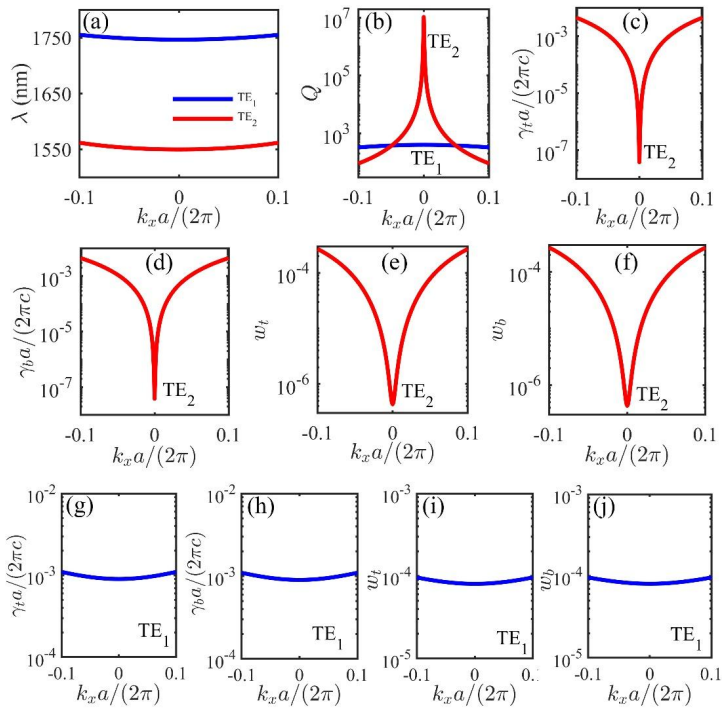
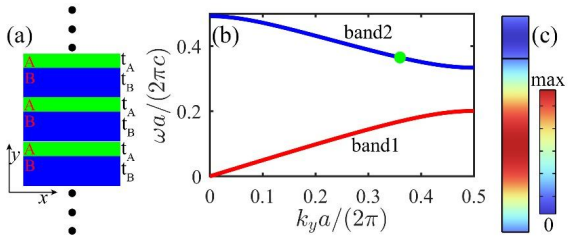
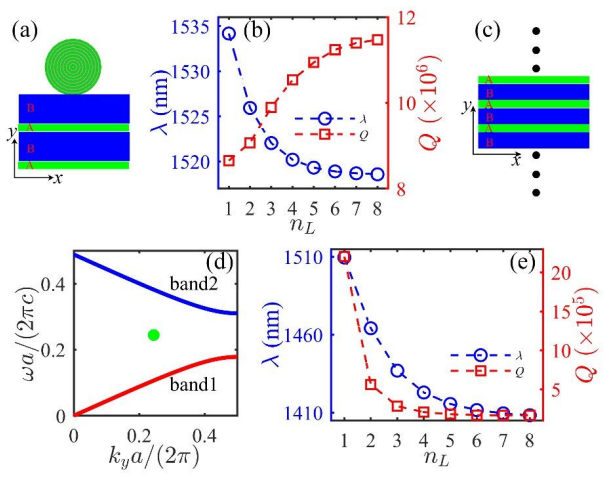
A substrate-free metasurface of periodically arranged multilayer cylinders supports overlapping magnetic dipole and electric quadrupole resonances that produce electric mirror and symmetry-protected BICs at 1550 nm. Adding multilayer substrates breaks out-of-plane symmetry and excites guided modes; when the guided-mode wavelength matches the BIC and coupling to the substrate is suppressed, the BIC wavelength remains nearly invariant while the Q factor increases with layer number, whereas spectral detuning and enhanced coupling produce blueshifts and rapid Q degradation.
What carries the argument
The interplay between guided-mode wavelength matching to the BIC resonance and the strength of coupling to the substrate layers, which controls whether the BIC stays robust or becomes tunable.
If this is right
- High-Q BICs can be preserved or tuned simply by choosing substrate layer count and material to set the guided-mode match.
- Directional radiation becomes available once out-of-plane symmetry is broken while keeping the BIC wavelength fixed.
- The same design works at 1550 nm and can be adapted for other telecom or near-IR wavelengths by scaling the cylinder geometry.
- The method supplies a general way to engineer BICs through vertical symmetry breaking without redesigning the lateral lattice.
Where Pith is reading between the lines
- The same matching principle could be tested in metasurfaces that use different multipole combinations or in photonic-crystal slabs with controlled vertical asymmetry.
- Active substrates incorporating phase-change or electro-optic layers might allow electrical or optical switching between robust and tunable BIC regimes.
- The findings imply that precise control of substrate thickness and refractive index is more critical for maintaining high Q than small lateral fabrication errors.
Load-bearing premise
Numerical models of guided-mode excitation and coupling suppression accurately represent the behavior of real fabricated devices without unaccounted material losses or fabrication imperfections.
What would settle it
Fabricated devices in which the BIC resonance wavelength still shifts even when the guided-mode wavelength is matched to the BIC and substrate coupling is minimized.
Figures




read the original abstract
Tunable bound states in the continuum (BICs) in metasurfaces offer powerful opportunities to control light-matter interactions, yet the role of out-of-plane symmetry breaking remains poorly understood. Here, we reveal a mechanism that enables tunable high-Q BICs and directional radiation through out-of-plane symmetry breaking in all-dielectric metasurfaces. A substrate-free metasurface composed of periodically arranged multilayer cylinders that support overlapping magnetic dipole and electric quadrupole resonances, yielding electric mirror and symmetry-protected BIC responses at 1550 nm. Introducing multilayer substrates breaks out-of-plane symmetry and excites guided modes. When the guided-mode wavelength matches that of the BIC and coupling to the substrate is suppressed, the BIC wavelength remains nearly invariant, while the Q factor increases with layer number. In contrast, spectral detuning and enhanced coupling lead to pronounced blueshifts and rapid Q degradation. The interplay between guided-mode matching and coupling strength thus governs whether a BIC remains robust or becomes tunable. These findings establish a general framework for BIC engineering via out-of-plane symmetry breaking and provide a versatile platform for tunable metasurfaces with potential applications in integrated optics.
Editorial analysis
A structured set of objections, weighed in public.
Referee Report
Summary. The manuscript investigates tunable bound states in the continuum (BICs) in all-dielectric metasurfaces formed by periodically arranged multilayer cylinders that support overlapping magnetic dipole and electric quadrupole resonances at 1550 nm. It claims that introducing multilayer substrates breaks out-of-plane symmetry and excites guided modes; when the guided-mode wavelength matches the BIC wavelength and substrate coupling is suppressed, the BIC wavelength remains nearly invariant while the Q factor increases with layer number. In contrast, spectral detuning and enhanced coupling produce blueshifts and rapid Q degradation. The interplay between guided-mode matching and coupling strength is presented as the mechanism that determines whether a BIC remains robust or becomes tunable, enabling directional radiation control.
Significance. If the numerical results hold, the work supplies a concrete design rule for engineering tunable high-Q BICs via controlled out-of-plane symmetry breaking, which could be useful for integrated photonic devices requiring wavelength-stable resonances or directional emission.
major comments (3)
- The central claim that guided-mode matching and coupling suppression produce wavelength invariance and Q-factor growth with layer number is demonstrated only through numerical models. No analytical derivation of the invariance condition (independent of the specific FDTD/FEM discretization) is provided, leaving the result tied to simulation choices rather than a general principle.
- The manuscript does not address material absorption, fabrication-induced disorder in cylinder dimensions or substrate interfaces, or unintended radiation channels. These effects could detune the matching condition or enhance coupling, undermining the predicted robustness and tunability in real devices.
- The abstract states that the metasurface supports 'electric mirror and symmetry-protected BIC responses,' yet the transition from symmetry-protected to tunable behavior upon substrate addition is not accompanied by a quantitative comparison of radiation channels or Q-factor extraction methods across the layer-number series.
minor comments (2)
- The description of 'directional radiation' is mentioned but lacks explicit far-field pattern data or angular dependence plots tied to the layer-number variation.
- Notation for the guided-mode wavelength matching condition and the definition of 'coupling strength' should be introduced with equations early in the text for clarity.
Simulated Author's Rebuttal
We thank the referee for the constructive and detailed comments on our manuscript. We address each major comment below and outline the revisions we will make to strengthen the work.
read point-by-point responses
-
Referee: The central claim that guided-mode matching and coupling suppression produce wavelength invariance and Q-factor growth with layer number is demonstrated only through numerical models. No analytical derivation of the invariance condition (independent of the specific FDTD/FEM discretization) is provided, leaving the result tied to simulation choices rather than a general principle.
Authors: We acknowledge that the demonstration relies on numerical simulations. The invariance condition follows from the physical requirement that the guided-mode wavelength matches the BIC resonance while substrate coupling is suppressed; this is explained via the symmetry-breaking mechanism and mode overlap in the text. To address the concern, we will add a brief coupled-mode theory analysis in the revised manuscript that derives the wavelength-invariance condition analytically under the matching assumption, showing it is independent of specific discretization details. revision: partial
-
Referee: The manuscript does not address material absorption, fabrication-induced disorder in cylinder dimensions or substrate interfaces, or unintended radiation channels. These effects could detune the matching condition or enhance coupling, undermining the predicted robustness and tunability in real devices.
Authors: We agree these practical factors are important for device relevance. In the revision we will add a new subsection that incorporates realistic silicon absorption at 1550 nm, estimates the impact of fabrication disorder (via statistical variation in cylinder radii and interface roughness) on the Q factor and matching condition, and examines unintended radiation channels through far-field angular spectra to confirm the directional properties remain robust within expected tolerances. revision: yes
-
Referee: The abstract states that the metasurface supports 'electric mirror and symmetry-protected BIC responses,' yet the transition from symmetry-protected to tunable behavior upon substrate addition is not accompanied by a quantitative comparison of radiation channels or Q-factor extraction methods across the layer-number series.
Authors: The abstract correctly describes the substrate-free case. We will revise the manuscript to include a quantitative multipole decomposition of the radiation channels for the substrate-free and multilayer cases, explicitly state the Q-factor extraction method (Lorentzian fitting to the resonance dip in transmission), and apply it uniformly across the layer-number series. These additions will be presented in an expanded results section with a supporting figure. revision: yes
Circularity Check
No significant circularity; mechanism derived from independent numerical simulations of symmetry breaking
full rationale
The paper's central claim—that the interplay between guided-mode matching and substrate coupling governs BIC robustness versus tunability—is presented as an outcome of numerical modeling (FDTD/FEM) of multilayer cylinders on substrates. No equations define the BIC wavelength invariance or Q-factor trends in terms of themselves. No parameters are fitted to a data subset and then relabeled as predictions. No self-citations supply load-bearing uniqueness theorems or ansatzes. The derivation chain consists of direct application of Maxwell's equations to the described geometries, yielding the reported spectral behaviors as computed results rather than tautological reductions. This matches the reader's assessment of a structural-symmetry argument without self-referential fitting.
Axiom & Free-Parameter Ledger
Reference graph
Works this paper leans on
-
[1]
H. Friedrich, D. Wintgen, Interfering resonances and bound states in the continuum, Phys. Rev. A 32(6), 3231-3242 (1985)
work page 1985
-
[2]
X. Yin, J. Jin, M. Soljačić, et al., Observation of topologically enabled unidirectional guided resonances, Nature 580, 467-471 (2020)
work page 2020
-
[3]
C. W. Hsu, B. Zhen, J. Lee, S.-L. Chua, S. G. Johnson, J. D. Joannopoulos, M. Soljačić, Observation of trapped light within the radiation continuum, Nature 499,188-191 (2013)
work page 2013
-
[4]
M.-S. Hwang, H.-C. Lee, K.-H. Kim, K.-Y. Jeong, S.-H. Kwon, K. Koshelev, Y. Kivshar, H.-G. Park, Ultralow-threshold laser using super-bound states in the continuum, Nat. Commun. 12, 4135 (2021)
work page 2021
-
[5]
S. J. Shen, B.-R. Lee, Y. C. Peng, Y. J. Wang, Y.-W. Huang, Y. Kivshar, M. L. Tseng, Dielectric high‑Q metasurfaces for surface-enhanced deep-UV absorption and chiral photonics, ACS Photonics , 12 (6), 2955-2964 (2025)
work page 2025
-
[6]
C. Li, T. He, X. Rao, C. Feng, J. Zhu, S. Dong, Z. Wei, H. Jiao, Y. Shi, Z. Wang, and X . Cheng, Toroidal dipole Fabry -Perot bound states in the continuum metasurfaces for ultrasensitive chiral detection, Photon. Res. 13(9), 2497-2509 (2025)
work page 2025
- [7]
-
[8]
Q. He, S . Sun, S . Xiao, L. Zhou, High-efficiency metasurfaces: principles, realizations, and applications, Adv. Optical Mater., 6(19), 1800415 (2018)
work page 2018
-
[9]
N. Yu, P. Genevet, M. A. Kats, et al., Light propagation with phase discontinuities: generalized laws of reflection and refraction, Science 334(6054), 333-337 (2011)
work page 2011
-
[10]
N. Muhammad, Z. Su, Q. Jiang, Y. Wang, L. Huang, Radiationless optical modes in metasurfaces: recent progress and applications, Light: Science & Applications, 13,192 (2024)
work page 2024
-
[11]
W. Zhao, S. Wang, Y. Jing, H. Ge, Q. Wang, Y. Zeng, B. Jia, N. Xu, Giant structurally modulated intrinsic chirality of quasi-bound states in continuum, Opt. Lett. 50(5), 1649-1652 (2025)
work page 2025
-
[12]
T. Liu, J . Qiu, M . Qin, X . Tu, H. Qiu, F. Wu, T. Yu, Q. Liu, S. Xiao, High-efficiency infrared upconversion imaging with nonlinear silicon metasurfaces empowered by quasi -bound states in the continuum, Opto-Electron Adv. 9, 250257(2026)
work page 2026
-
[13]
M. Qin, G . Wei, H . Xu, R . Ma, H . Li, W. Gao, J . Liu, F . Wu, Polarization -insensitive and polarization-controlled dual -band third -harmonic generation in silicon metasurfaces driven by quasi - bound states in the continuum, Appl. Phys. Lett. 124(5), 051703 (2024)
work page 2024
-
[14]
W. Wong, X. Huang, O. L. C. Lem, C. Jagadish, H. H. Tan, Near-unity spontaneous emission factor InP surface-emitting lasers based on quasi -bound states in the continuum, Sci. Adv. 11 (36), eadx6527 (2025)
work page 2025
-
[15]
Z. Wang, T. Liang, H. Zhang, Ultrahigh-Q quadrupole resonance quasi-BICs excited with different polarized light in an all-dielectric metasurface for refractive index sensing, Optics Communications, 591, 132141 (2025)
work page 2025
-
[16]
S. Lv, F. Hu, W. Luo, H. Xu, L. An, Design of tunable selective light-absorbing metasurfaces driven by intrinsically chiral quasi-bound states in the continuum, Opt. Express 32(17), 30053-30064 (2024)
work page 2024
- [17]
-
[18]
J. C. Zhang, D. P. Tsai, S. W. Pang, Non-local bound states in the continuum for nanoscale alignment, Nat. Photon. 20, 296-300 (2026)
work page 2026
-
[19]
A. Beisenova, W. Adi, W. Wu, S. K. Biswas, S. Rosas, B. Stamenic, D. D. John, F. Yesilkoy, Wafer- scale all-dielectric quasi-BIC metasurfaces: bridging high -throughput deep -UV lithography with nanophotonic applications, Nano Lett. 26, 2059-2067 (2026)
work page 2059
-
[20]
C. Zhou, R. Jin, H . He, J. Huang, G. Li, L. Huang, Robust ultrahigh -Q resonances in tetramer metasurfaces through centroid symmetry protection and area conservation, Light: Science & Applications, 15, 84(2026)
work page 2026
-
[21]
B. Wang, R. Pan, L. Yang, X. Ji, H . Yang, J. Li, Destructive interference mediated topological transitions in bilayer metasurfaces, Phys. Rev. Lett., 136(4), 043801 (2026)
work page 2026
-
[22]
C. Liu, Z. Du, S. Pang, M. Yang, Y. Li, J. Wang, J. Wang, B. Wang, Evolution of circularly polarized states spawned from off-Γ point BICs, Chin. Opt. Lett. 23(12), 123604 (2025)
work page 2025
-
[23]
J. Zeng, Y. Zhou, X. Fu, J. Yang, Y. Chen, W. Hong, Tunable quasi-bound states in the continuum with intrinsic chirality in a phase-change metasurface, Opt. Express 33(13), 27014-27025 (2025)
work page 2025
-
[24]
S.T. Ha, Y . H. Fu, N. K. Emani, Z. Pan, R. M. Bakker, R. Paniagua-Domínguez, A. I. Kuznetsov. Directional lasing in resonant semiconductor nanoantenna arrays , Nature Nanotech . 13, 1042 -1047 (2018)
work page 2018
-
[25]
K. Koshelev, A. Bogdanov, Y. Kivshar, Meta-optics and bound states in the continuum , Science Bulletin, 64(12), 836-842 (2019)
work page 2019
- [26]
-
[27]
C. Liao, L. Zhou, B. Wen, X. Ye, H. Zhu, J. Yang, G. Li, Z. Zhou, J. Zhou, J. Cai, Defect-insensitive bound states in the continuum in antisymmetric trapezoid metasurfaces in the visible range Nanophotonics, 14(22), 3681-3689 (2025)
work page 2025
-
[28]
Y. Li, S. Han, Y. Ao, Extrinsic and intrinsic chiral dual bound states in the continuum with opposite circular dichroism supported by an all-dielectric metasurface, Opt. Lett. 50(17), 5422-5425 (2025)
work page 2025
-
[29]
S. Ma, S. Wen, X. Mi, H. Zhao, Terahertz optical modulator and highly sensitive terahertz sensor governed by bound states in the continuum in graphene -dielectric hybrid metamaterial, Optics Communications 536, 129398 (2023)
work page 2023
- [30]
- [31]
-
[32]
L. Kühner, F. J. Wendisch, A. A. Antonov, J. Bürger, L. Hüttenhofer, L. de S. Menezes, S. A.Maier, M. V . Gorkunov, Y. Kivshar, A. Tittl, Unlocking the out-of-plane dimension for photonic bound states in the continuum to achieve maximum optical chirality, Light Sci Appl 12, 250 (2023)
work page 2023
-
[33]
S. Li, T. Sang, C. Yang, J. Lu, Y. Wang, Phase-change metasurfaces for dynamic control of chiral quasi-bound states in the continuum, Opt. Lett. 48(24), 6488-6491 (2023)
work page 2023
-
[34]
B. Chen, W. Zhu, H. Jiang, L. Wang, C. Zhou, H. Zhang, Chiral quasi-bound states in the continuum with near -unity and switchable circular dichroism in a photosensitive silicon metasurface, Opt. Lett. 50(10), 3321-3324 (2025)
work page 2025
-
[35]
H. He, F. Lai, Y. Zhang, X. Zhang, C. Tian, X. Li, Y. Wang, S. Xiao, L. Huang, Spectro-polarimetric detection enabled by multidimensional metasurface with quasibound states in the continuum, Opto - Electron. Adv. 8(10), 250015(2025)
work page 2025
-
[36]
F. Wu, M. Luo, J. Wu, C. Fan, X. Qi, Y. Jian, D. Liu, S. Xiao, G. Chen, H. Jiang, Y. Sun, H. Chen, Dual quasibound states in the continuum in compound grating waveguide structures for large positive and negative Goos-Hanchen shifts with perfect reflection, Phys. Rev. A, 104(2), 023518 (2021)
work page 2021
-
[37]
V . Develay, O. Bahrova, I. Septembre, D. Bobylev, C. Brimont, L. Doyennette, B. Alloing, H. Souissi, E. Cambril, S. Bouchoule, J. Zúñiga -Pérez, D. Solnyshkov, G. Malpuech, T. Guillet , Soliton formation in a bound state in the continuum GaN waveguide polariton laser, arXiv:2512.23368
-
[38]
H. Song, B. Hong, N. Wang, G. P. Wang, Kerker-type positional disorder immune metasurfaces, Opt. Express 31(15), 24243-24259 (2023)
work page 2023
-
[39]
H. Song, X . Zhang, Y. Sun, G. P. Wang, Manipulating reflection -type all -dielectric non -local metasurfaces via the parity of a particle number, Opt. Express, 32(23), 40467-40487 (2024)
work page 2024
-
[40]
Liu, Generalized magnetic mirrors, Phys
W. Liu, Generalized magnetic mirrors, Phys. Rev. Lett. 119(12), 123902 (2017)
work page 2017
- [41]
-
[42]
L. V . R. Marcos, J. I. Larruquert, J. A. Méndez, et al., Self-consistent optical constants of SiO 2 and Ta2O5 films, Opt. Mater. Express 6(11), 3622–3637 (2016)
work page 2016
-
[43]
B. Munkhbat , P. Wrobel, T. J. Antosiewicz, T. O. Shegai, Optical constants of several multilayer transition metal dichalcogenides measured by spectroscopic ellipsometry in the 300-1700 nm range: high index, anisotropy, and hyperbolicity, ACS Photonics 9(7), 2398-2407 (2022)
work page 2022
-
[44]
Liu, Superscattering pattern shaping for radially anisotropic nanowires, Phys
W. Liu, Superscattering pattern shaping for radially anisotropic nanowires, Phys. Rev. A 96(2), 023854 (2017)
work page 2017
-
[45]
H. Chen and L. Gao, Anomalous electromagnetic scattering from radially anisotropic nanowires, Phys. Rev. A 86(3), 033825 (2012)
work page 2012
-
[46]
A. C. Valero, H. K. Shamkhi, A. S. Kupriianov, et al., Superscattering emerging from the physics of bound states in the continuum, Nat. Commun. 14, 4689 (2023)
work page 2023
-
[47]
C. F. Bohren and D. R. Huffman, Absorption and scattering of light by small particles, (Wiley, New York, 1983)
work page 1983
- [48]
-
[49]
COMSOL Multiphysics® v. 6.2. www.comsol.com. COMSOL AB, Stockholm, Sweden
-
[50]
J. D. Joannopoulos, S. G. Johnson, J. N. Winn, et al., Photonic Crystals: Molding the Flow of Light - Second Edition (REV-Revised, 2), (Princeton University Press, 2008)
work page 2008
-
[51]
H. Song, X. Zhang, J. Wang, Y. Sun, G. P. Wang, Bound state in the continuum and polarization - insensitive electric mirror in a low-contrast metasurface, Opt. Express 32(15), 26867-26883 (2024)
work page 2024
-
[52]
M. Kang, L. Mao, S. Zhang, M. Xiao, H. Xu, C. T. Chan, Merging bound states in the continuum by harnessing higher-order topological charges, Light Sci. Appl. 11, 228 (2022)
work page 2022
-
[53]
P. Hu, J. Wang, Q. Jiang, J. Wang, L. Shi, D. Han, Z. Q. Zhang, C. T. Chan, J. Zi, Global phase diagram of bound states in the continuum, Optica 9(12), 1353-1361 (2022)
work page 2022
-
[54]
Y. Zeng, G. Hu, K. Liu, Z. Tang, C.-W. Qiu, Dynamics of topological polarization singularity in momentum space, Phys. Rev. Lett., 127(17), 176101 (2021)
work page 2021
-
[55]
M. Born and E. Wolf, Principles of Optics: Electromagnetic Theory of Propagation, Interference, and Diffraction of Light, 7th (expanded) Edition, (Publishing House of Electronics Industry, Beijing, 2006)
work page 2006
-
[56]
D. T. Pierce and W. E. Spicer, Electronic structure of amorphous Si from photoemission and optical studies, Phys. Rev. B 5(8), 3017-3029 (1972)
work page 1972
-
[57]
B. Yu, F. Yang, M. Zeng, X. Meng, Z. Qian, Y. Tai, T. Li, Liquid crystal enables extraordinarily precise tunability for a high-Q ultra-narrowband filter based on a quasi-BIC metasurface, Adv. Funct. Mater. 35(2), 2413098 (2025). Figba t Figure 1. Meta-atom scattering analysis. (a) Schematic of the meta-atom, i.e., a multilayer cylinder. Green denotes the ...
work page 2025
discussion (0)
Sign in with ORCID, Apple, or X to comment. Anyone can read and Pith papers without signing in.