Recognition: 1 theorem link
· Lean TheoremParallel packing equilateral triangles into a square
Pith reviewed 2026-05-12 02:47 UTC · model grok-4.3
The pith
Any collection of equilateral triangles homothetic to a given one with total area at most √3/4 packs parallel into a unit square.
A machine-rendered reading of the paper's core claim, the machinery that carries it, and where it could break.
Core claim
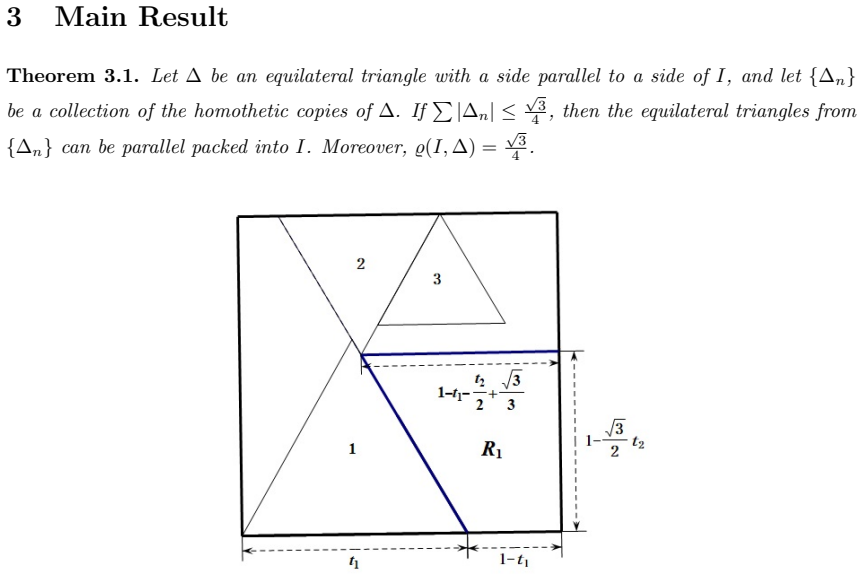
Suppose that I is a unit square and that Δ is an equilateral triangle with a side parallel to a side of I. We prove that any collection of triangles homothetic to Δ, whose total area does not exceed √3/4, can be parallel packed into I. The upper bound of √3/4 is tight.
What carries the argument
Parallel packing of homothetic copies of the fixed equilateral triangle Δ with sides parallel to the unit square I, controlled by the area threshold √3/4.
If this is right
- Any such collection whose areas sum to √3/4 or less admits a non-overlapping placement inside the square using only translations.
- The maximum achievable total area for parallel packings of these triangles is exactly √3/4.
- The result supplies a complete area threshold for feasibility in this orientation-restricted setting.
Where Pith is reading between the lines
- The same area bound would likely fail if each triangle were permitted to rotate independently.
- Analogous thresholds may exist for parallel packings of other polygons with fixed orientation into squares or rectangles.
- The construction that saturates the bound could serve as a test case for algorithms that attempt to pack under orientation constraints.
Load-bearing premise
Every triangle in the collection must be homothetic to the reference equilateral triangle and must share exactly the same orientation with one side parallel to a side of the square.
What would settle it
Exhibit a collection of homothetic equilateral triangles whose total area is at most √3/4 yet cannot be placed inside the unit square without overlaps or boundary violations, or exhibit a valid packing whose total area exceeds √3/4.
Figures
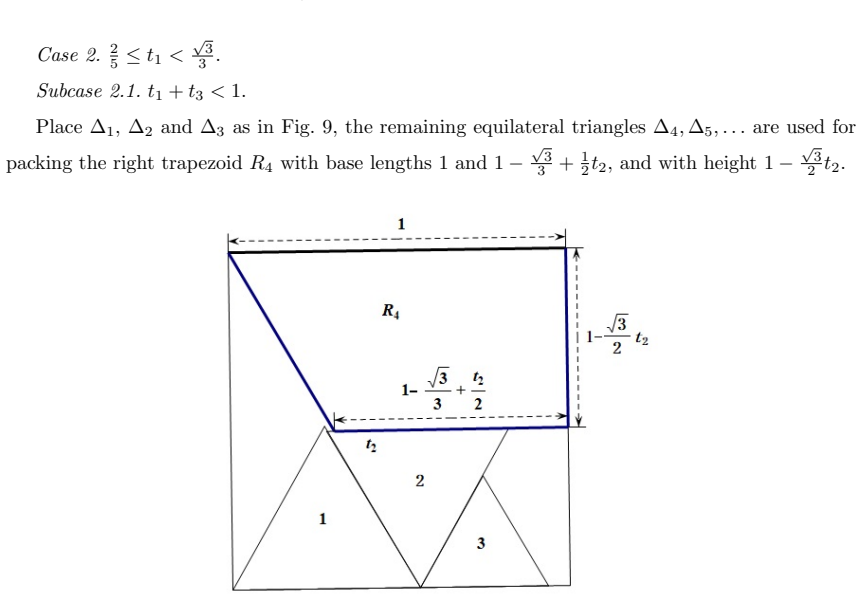

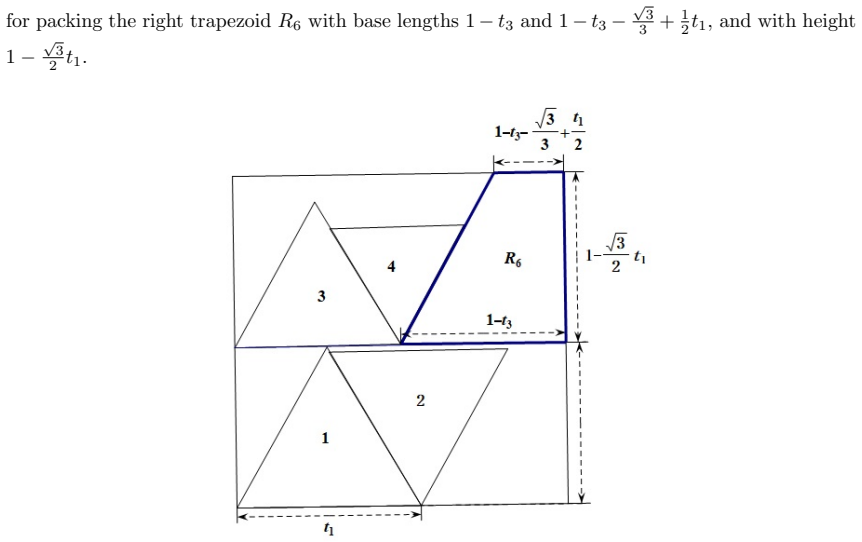
read the original abstract
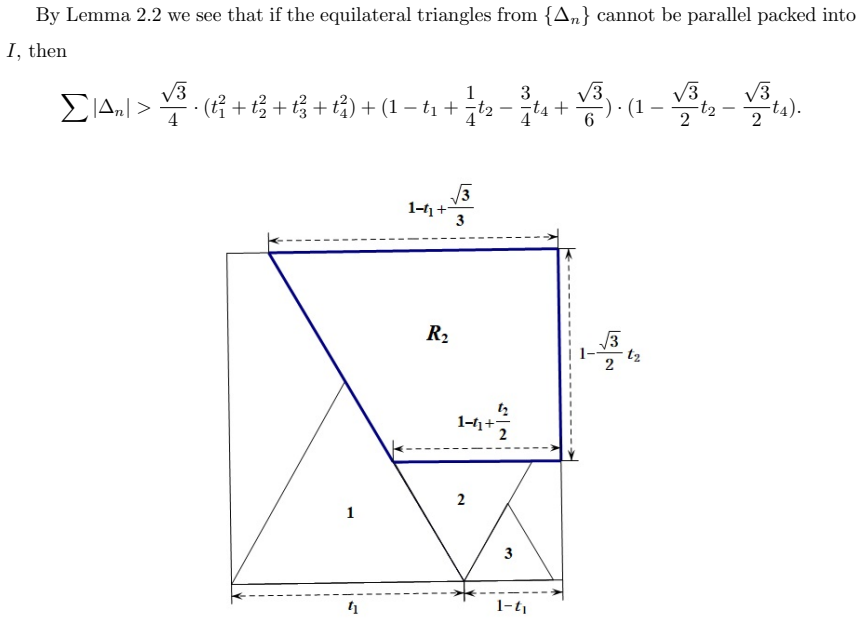
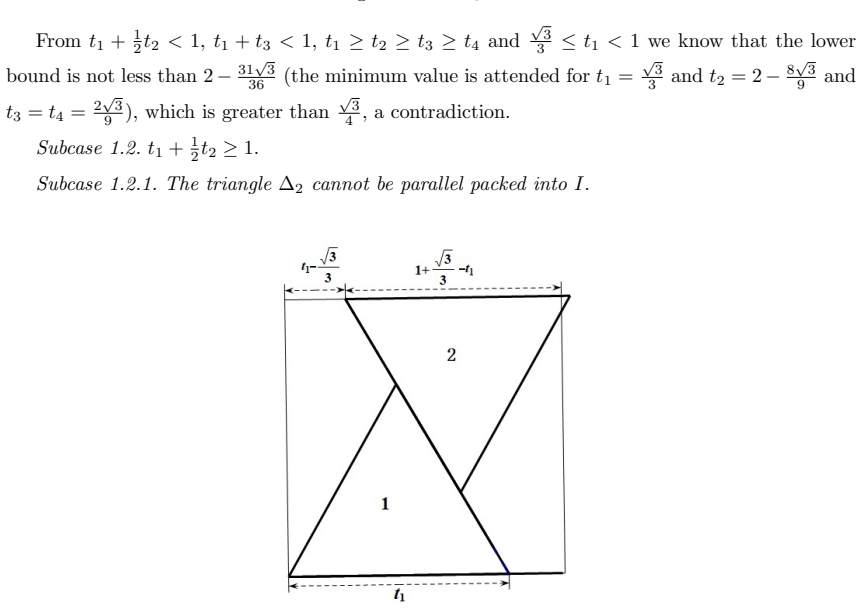
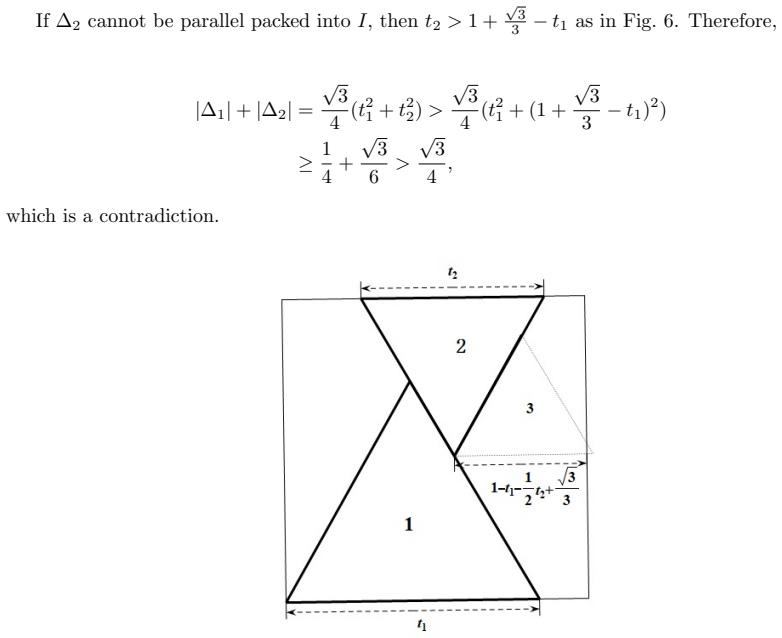
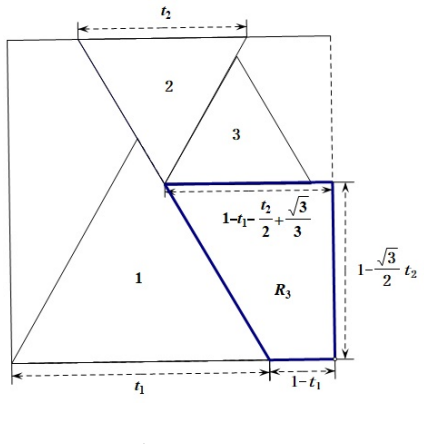
Suppose that $I$ is a unit square and that $\Delta$ is an equilateral triangle with a side parallel to a side of $I$. In this note, we prove that any collection of triangles homothetic to $\Delta$, whose total area does not exceed $\frac{\sqrt{3}}{4}$, can be parallel packed into $I$. The upper bound of $\frac{\sqrt{3}}{4}$ is tight.
Editorial analysis
A structured set of objections, weighed in public.
Referee Report
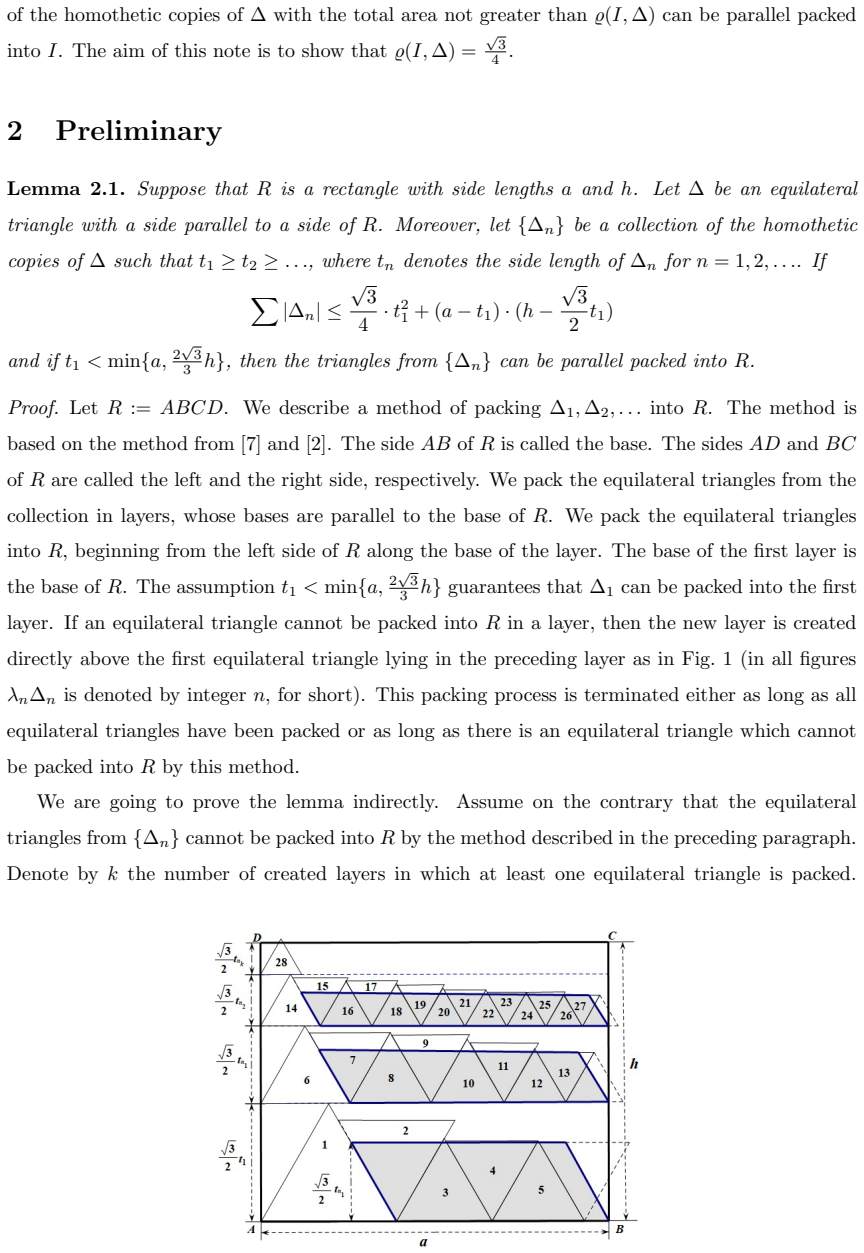
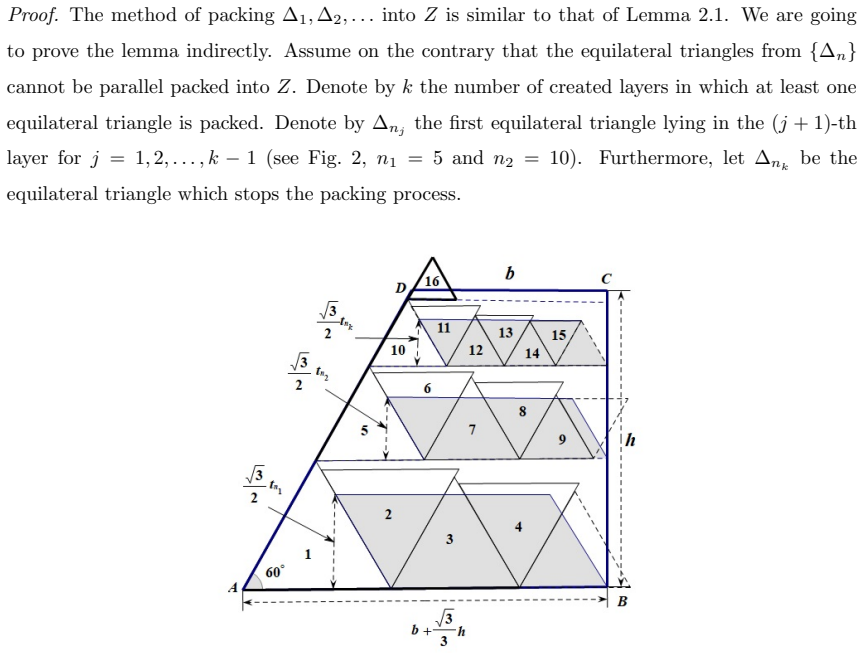
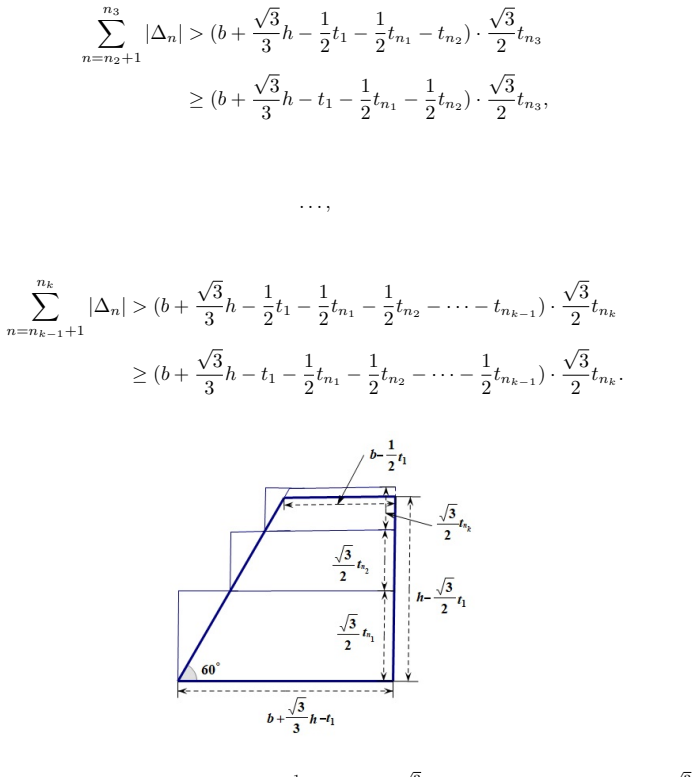
Summary. The paper proves that any finite collection of equilateral triangles homothetic to a fixed equilateral triangle Δ (with sides parallel to those of the unit square I) whose total area is at most √3/4 can be packed into I without rotations or overlaps. The proof proceeds via an explicit construction that partitions the triangles into horizontal strips whose heights are set by the largest triangle in each strip, followed by greedy left-to-right placement within each strip; the area bound ensures the sum of strip heights is at most 1. Tightness is shown by observing that any single triangle with area exceeding √3/4 has side length greater than 1 and thus cannot fit in I.
Significance. If the result holds, it supplies a sharp area threshold for the parallel (fixed-orientation) packing of equilateral triangles into a square. The explicit, uniform construction over arbitrary finite collections is a clear strength, as it yields both existence and a practical packing procedure without requiring commensurability of side lengths. This contributes a clean, constructive result to the literature on constrained packing problems in combinatorial geometry.
minor comments (2)
- [Proof] A single illustrative figure showing the strip construction and greedy placement for a small mixed-size collection would improve readability of the proof.
- [Introduction] The opening paragraph could briefly recall the definition of homothety to ensure the manuscript is self-contained for readers outside the immediate area.
Simulated Author's Rebuttal
We thank the referee for the careful reading of the manuscript, the accurate summary of the result, and the recommendation to accept. No specific concerns or major comments were raised.
Circularity Check
No significant circularity; direct constructive proof
full rationale
The paper states and proves a packing theorem by explicit construction: triangles are placed into horizontal strips of height equal to the largest remaining triangle, then packed greedily left-to-right within each strip. The total-area hypothesis directly implies that the sum of strip heights is at most 1, so the construction fits inside the unit square. Tightness is shown by observing that any single triangle of area > √3/4 has side >1 and cannot fit. No equations reduce to fitted parameters, no self-citations are load-bearing, and the argument contains no self-definitional steps or renamed empirical patterns. The derivation is self-contained against the stated assumptions.
Axiom & Free-Parameter Ledger
axioms (1)
- standard math Basic properties of Euclidean plane geometry, area additivity, and homothety preserving angles and parallelism
Lean theorems connected to this paper
-
IndisputableMonolith/Foundation/AlexanderDuality.leanalexander_duality_circle_linking unclearany collection of triangles homothetic to Δ, whose total area does not exceed √3/4, can be parallel packed into I
Reference graph
Works this paper leans on
-
[1]
Results Math.74(4), Article 158 (2019)
Fu, M., Lian, Y., Zhang Y.: On parallel packing and covering of squares and cubes. Results Math.74(4), Article 158 (2019)
work page 2019
- [2]
-
[3]
Januszewski, J.: Translative packing of a square with sequences of squares. Colloq. Math. 121(2), 273–280 (2010)
work page 2010
-
[4]
Results Math.77(1), Article 48 (2022)
Januszewski, J., Liu, X., Su, Z., Zielonka, L.: Parallel packing squares into a triangle. Results Math.77(1), Article 48 (2022)
work page 2022
-
[5]
Results Math.78(1), Article 31 (2023)
Januszewski, J., Liu, X., Su, Z., Zielonka, L.: Parallel packing squares into an obtuse triangle. Results Math.78(1), Article 31 (2023)
work page 2023
- [6]
-
[7]
W., Moser, L.: Some packing and covering theorems
Moon, J. W., Moser, L.: Some packing and covering theorems. Colloq. Math.17(1), 103–110 (1967)
work page 1967
-
[8]
Su, Z., Lu, M., Liu, X.: Parallel packing of triangles with squares. Rocky Mountain J. Math. 51(6), 2209–2216 (2021). 12
work page 2021
discussion (0)
Sign in with ORCID, Apple, or X to comment. Anyone can read and Pith papers without signing in.