Recognition: no theorem link
The Carrier Pigeon Internet Protocol: An Algorithmic (and Lighthearted) Perspective
Pith reviewed 2026-05-12 02:58 UTC · model grok-4.3
The pith
A polynomial-time demand aggregation algorithm approximates the fewest carrier pigeons needed for two-hop and multihop messages within a factor of two, even though exact minimization is NP-hard.
A machine-rendered reading of the paper's core claim, the machinery that carries it, and where it could break.
Core claim
The authors prove NP-hardness for minimizing the number of pigeons required under two-hop and multihop routing. They then give a polynomial-time algorithm based on demand aggregation that returns a feasible pigeon schedule whose total count is guaranteed to be at most twice the minimum possible.
What carries the argument
Demand aggregation, the technique of grouping compatible messages so that the same pigeons can serve multiple demands without violating the one-use-per-pigeon rule.
Load-bearing premise
All communication demands are known in advance so that pigeon uses can be aggregated and planned offline.
What would settle it
A concrete set of node-to-node demands for which the aggregation algorithm returns a schedule using strictly more than twice the minimum number of pigeons required by any feasible schedule.
Figures
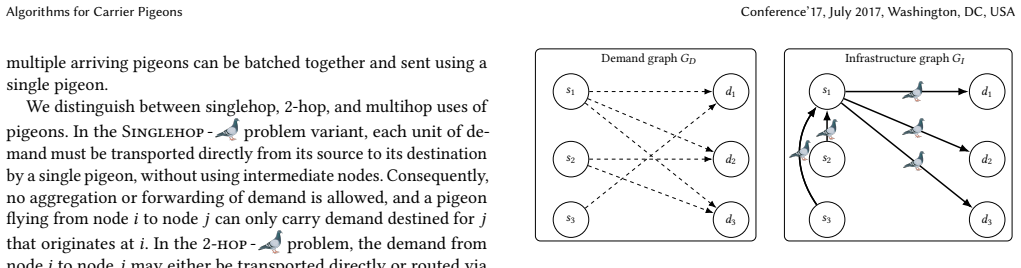


read the original abstract
The theoretical model behind the pigeon post as a link layer in a communication network was introduced by Shannon (under the guise of studying One-Time Pads for cryptography). That is, to send a one-hop message to $v$, a node $u$ needs a mail pigeon bred and raised at $v$. When sending a message using a pigeon to $v$, node $u$ loses the pigeon. To send another message to $v$, node $u$ needs another pigeon of $v$. It has been demonstrated that the communication bandwidth achievable with pigeon post can exceed that of networks using other media. This has already motivated the introduction of Internet standards that allow the use of pigeons as Internet link-layer media. In this paper, we begin to fill in the missing piece: designing algorithms for breeding and scheduling pigeons to meet a given communication demand efficiently, minimizing the number of pigeons required. We consider singlehop, 2-hop, and multihop pigeon use. While the singlehop variant admits a simple characterization, both the 2-hop and the multihop variants are NP-hard. For the latter variants, we present a polynomial-time algorithm based on demand aggregation that achieves a 2-approximation for the number of pigeons used. We believe that this pigeon-based perspective offers both amusing and instructive insights into network design and hopefully, into ornithology.
Editorial analysis
A structured set of objections, weighed in public.
Referee Report
Summary. The paper models pigeon-based communication following Shannon's one-time-pad-inspired setup, where pigeons must be pre-bred at the destination node and are consumed on each use. It analyzes the minimum-pigeon scheduling problem for single-hop, 2-hop, and multihop demands. The single-hop case admits a simple characterization; the 2-hop and multihop cases are asserted to be NP-hard; and a polynomial-time demand-aggregation algorithm is presented that yields a 2-approximation on the number of pigeons required.
Significance. If the stated hardness results and approximation guarantee hold, the work supplies a constructive algorithmic treatment of resource allocation under the pigeon model, illustrating how offline demand aggregation can produce a constant-factor guarantee. This offers limited but instructive insight into unconventional network media and may serve pedagogical purposes in network-algorithm design.
major comments (2)
- [Abstract] The abstract asserts NP-hardness for both the 2-hop and multihop variants together with a polynomial-time 2-approximation via demand aggregation, yet the manuscript provides neither the hardness reduction nor the proof that the aggregation procedure achieves a factor of 2. These claims are load-bearing for the central contribution.
- The description of the demand-aggregation procedure (how demands are combined across hops while respecting the consumption and pre-breeding constraints) is not elaborated with sufficient detail to verify polynomial runtime or the approximation ratio.
minor comments (1)
- The lighthearted framing is consistent with the title but occasionally blurs the boundary between informal remarks and formal statements; a brief dedicated technical section separating the algorithmic results would improve clarity.
Simulated Author's Rebuttal
We thank the referee for the careful and constructive review of our manuscript. We agree that the central claims regarding NP-hardness and the 2-approximation require explicit supporting arguments in the text, and we will revise the paper to address these points in detail.
read point-by-point responses
-
Referee: [Abstract] The abstract asserts NP-hardness for both the 2-hop and multihop variants together with a polynomial-time 2-approximation via demand aggregation, yet the manuscript provides neither the hardness reduction nor the proof that the aggregation procedure achieves a factor of 2. These claims are load-bearing for the central contribution.
Authors: We acknowledge that the submitted manuscript does not contain the explicit hardness reduction or the formal proof of the approximation ratio. These elements were not included in the initial version. In the revision we will add a dedicated section that presents a polynomial-time reduction establishing NP-hardness for the 2-hop and multihop variants, together with a complete proof that the demand-aggregation algorithm yields a 2-approximation while respecting pre-breeding and consumption constraints. revision: yes
-
Referee: [—] The description of the demand-aggregation procedure (how demands are combined across hops while respecting the consumption and pre-breeding constraints) is not elaborated with sufficient detail to verify polynomial runtime or the approximation ratio.
Authors: We agree that the current description of the demand-aggregation procedure is insufficiently detailed. The revision will include pseudocode for the algorithm, a proof that it runs in polynomial time, and a step-by-step argument showing how demands are aggregated across hops without violating the pre-breeding requirement at each node or the one-time consumption of each pigeon, thereby establishing the claimed approximation guarantee. revision: yes
Circularity Check
No significant circularity; results derive from external model and standard algorithmic techniques
full rationale
The paper states its model (pigeons pre-bred at destination and consumed per use) as taken from Shannon and assumes offline known demands for aggregation. NP-hardness for 2-hop/multihop and the 2-approximation via demand aggregation are presented as constructive proofs and algorithms on this model, without reducing to self-definitions, fitted parameters renamed as predictions, or load-bearing self-citations. Single-hop admits an independent simple characterization. No equations or steps collapse by construction to inputs; the derivation chain is self-contained against the stated assumptions.
Axiom & Free-Parameter Ledger
axioms (1)
- domain assumption To send a message to node v, a node u requires a pigeon bred and raised at v; each use consumes the pigeon.
Reference graph
Works this paper leans on
-
[1]
Miklós Ajtai. 1994. The complexity of the pigeonhole principle.Combinatorica 14, 4 (1994), 417–433
work page 1994
-
[2]
Chen Avin, Manya Ghobadi, Chen Griner, and Stefan Schmid. 2020. On the com- plexity of traffic traces and implications.Proceedings of the ACM on Measurement and Analysis of Computing Systems4, 1 (2020), 1–29
work page 2020
-
[3]
Chen Avin, Kaushik Mondal, and Stefan Schmid. 2020. Demand-aware network designs of bounded degree.Distributed Computing33, 3 (2020), 311–325
work page 2020
-
[4]
Chen Avin and Stefan Schmid. 2025. Revolutionizing Datacenter Networks via Reconfigurable Topologies.Commun. ACM68, 6 (2025), 44–53
work page 2025
-
[5]
BBC. 2011. SA pigeon ’faster than broadband’. https://web.archive.org/ web/20110414225332/http://news.bbc.co.uk/2/hi/africa/8248056.stm Accessed: 24/12/2025. Conference’17, July 2017, Washington, DC, USA Matthias Bentert, Shay Kutten, Darya Melnyk, Tijana Milentijević, and Stefan Schmid
-
[6]
Martin J. Beckmann, C. B. McGuire, and Christopher B. Winsten. 1956.Studies in the Economics of Transportation. Yale University Press
work page 1956
- [7]
-
[8]
Samuel W Bent, Daniel D Sleator, and Robert E Tarjan. 1985. Biased search trees. SIAM J. Comput.14, 3 (1985), 545–568
work page 1985
-
[9]
Zhi Cao and Eric Masanet. 2022. Material efficiency to tackle the sand crisis. Nature Sustainability5, 5 (2022), 370–371
work page 2022
-
[10]
B. Carpenter and R. Hinden. [n. d.].Adaptation of RFC 1149 for IPv6. RFC 6249. RFC Editor. doi:10.17487/RFC2549
-
[11]
Benoit Crevier, Jean-François Cordeau, and Gilbert Laporte. 2007. The multi- depot vehicle routing problem with inter-depot routes.European journal of operational research176, 2 (2007), 756–773
work page 2007
-
[12]
Erik D Demaine, Dion Harmon, John Iacono, and Mihai P a ˇ traşcu. 2007. Dynamic optimality—almost.SIAM J. Comput.37, 1 (2007), 240–251
work page 2007
-
[13]
Josep Díaz, Jordi Petit, and Maria Serna. 2002. A survey of graph layout problems. ACM Computing Surveys (CSUR)34, 3 (2002), 313–356
work page 2002
-
[14]
Gutiérrez-Espeleta, Nyovani Madise, Ying Wang, Robert Watson, Tamiru A
United Nations Environment Programme, Edgar E. Gutiérrez-Espeleta, Nyovani Madise, Ying Wang, Robert Watson, Tamiru A. Abiye, Ana Paula Aguiar, Peter Alexander, Barbara Amon, Apoorva Arya, Ghassem Asrar, Lindsay Beevers, Medani Bhandari, Meena Bohara, Gillian Bowser, David Broadstock, Monday Businge, Donovan Campbell, Kateřina Černý Pixová, Lynette Cheah ...
work page 2025
-
[15]
Shimon Even, Alon Itai, and Adi Shamir. 1975. On the complexity of time table and multi-commodity flow problems. In16th annual symposium on foundations of computer science (FOCS). IEEE, 184–193
work page 1975
-
[16]
Nathan Farrington, George Porter, Sivasankar Radhakrishnan, Hamid Hajabdolali Bazzaz, Vikram Subramanya, Yeshaiahu Fainman, George Papen, and Amin Vahdat. 2010. Helios: a hybrid electrical/optical switch architecture for modular data centers. InProceedings of the ACM SIGCOMM 2010 Conference. 339–350
work page 2010
-
[17]
Bernard Fortz and Mikkel Thorup. 2000. Internet traffic engineering by optimiz- ing OSPF weights. InProceedings IEEE INFOCOM 2000. conference on computer communications. Nineteenth annual joint conference of the IEEE computer and communications societies (Cat. No. 00CH37064), Vol. 2. IEEE, 519–528
work page 2000
-
[18]
Monia Ghobadi, Ratul Mahajan, Amar Phanishayee, Nikhil Devanur, Janard- han Kulkarni, Gireeja Ranade, Pierre-Alexandre Blanche, Houman Rastegarfar, Madeleine Glick, and Daniel Kilper. 2016. Projector: Agile reconfigurable data center interconnect. InProceedings of the 2016 ACM SIGCOMM Conference. 216– 229
work page 2016
- [19]
- [20]
-
[21]
Mohammad Taghi Hajiaghayi, Jeong Han Kim, Tom Leighton, and Harald Räcke
-
[22]
InProceedings of the 37th Annual ACM Symposium on Theory of Computing (STOC ’05)
Oblivious routing in directed graphs with random demands. InProceedings of the 37th Annual ACM Symposium on Theory of Computing (STOC ’05). ACM, 193–201. doi:10.1145/1060590.1060619
-
[23]
2001.The highly unofficial CPIP WG
The highly unofficial CPIP WG. 2001.The highly unofficial CPIP WG. Technical Report. University of Bergen. https://web.archive.org/web/20140215072548/http: //www.blug.linux.no/rfc1149/ Retrieved 24/12/2025
- [24]
-
[25]
Yanping Huang, Youlong Cheng, Ankur Bapna, Orhan Firat, Dehao Chen, Mia Chen, HyoukJoong Lee, Jiquan Ngiam, Quoc V Le, Yonghui Wu, et al. 2019. Gpipe: Efficient training of giant neural networks using pipeline parallelism.Advances in neural information processing systems32 (2019)
work page 2019
-
[26]
David A Huffman. 2007. A method for the construction of minimum-redundancy codes.Proceedings of the IRE40, 9 (2007), 1098–1101
work page 2007
-
[27]
2017.The state of food security and nutrition in the world 2017
UNICEF IFAD et al. 2017.The state of food security and nutrition in the world 2017. FAO
work page 2017
-
[28]
1976.Queueing Systems, Volume II: Computer Applications
Leonard Kleinrock. 1976.Queueing Systems, Volume II: Computer Applications. John Wiley & Sons
work page 1976
-
[29]
Vanessa Lamb. 2023. Constructing the global sand crisis: Four reasons to inter- rogate crisis and scarcity in narrating extraction.The Extractive Industries and Society15 (2023), 101282
work page 2023
-
[30]
Jean-Pierre Luminet. 2021. Closed Timelike Curves, Singularities and Causality: A Survey from Gödel to Chronological Protection.Universe7, 1 (Jan. 2021), 12. doi:10.3390/universe7010012
-
[31]
Carolina Elisabet Masin, Alejandra Duran, Cristina Susana Zalazar, and Maria Emilia Fernandez. 2024. Composting-vermicomposting of pigeon dropping waste: A contribution to the reduction of urban contamination. (2024)
work page 2024
-
[32]
Alberto Medina, Nina Taft, Kavé Salamatian, Supratik Bhattacharyya, and Christophe Diot. 2002. Traffic matrix estimation: existing techniques and new directions. InProceedings of the ACM SIGCOMM 2002 Conference on Applications, Technologies, Architectures, and Protocols for Computer Communication (SIGCOMM ’02). ACM, 161–174. doi:10.1145/633025.633041
-
[33]
Deepak Narayanan, Mohammad Shoeybi, Jared Casper, Patrick LeGresley, Mostofa Patwary, Vijay Korthikanti, Dmitri Vainbrand, Prethvi Kashinkunti, Julie Bernauer, Bryan Catanzaro, et al. 2021. Efficient large-scale language model training on gpu clusters using megatron-lm. InProceedings of the International Conference for High Performance Computing, Networki...
work page 2021
-
[34]
Pascal Peduzzi, Josefine Reimer Lynggaard, and Stephanie Chuah. 2022. Sand and sustainability: 10 strategic recommendations to avert a crisis. (2022)
work page 2022
-
[35]
Leon Poutievski, Omid Mashayekhi, Joon Ong, Arjun Singh, Mukarram Tariq, Rui Wang, Jianan Zhang, Virginia Beauregard, Patrick Conner, Steve Gribble, et al. 2022. Jupiter evolving: transforming google’s datacenter network via optical circuit switches and software-defined networking. InProceedings of the ACM SIGCOMM 2022 Conference. 66–85
work page 2022
-
[36]
Hungry Beast Real Human Stories. 2010. Pigeons vs. Australian Internet. url: https://www.youtube.com/watch?v=ci2bFFGM8T8. Accessed: 24/12/2025
work page 2010
-
[37]
Grégory Salle. 2022. On the ‘global sand crisis’: From capital accumulation to ecological planning. (2022)
work page 2022
-
[38]
Stefan Schmid, Chen Avin, Christian Scheideler, Michael Borokhovich, Bernhard Haeupler, and Zvi Lotker. 2015. Splaynet: Towards locally self-adjusting networks. IEEE/ACM Transactions on Networking24, 3 (2015), 1421–1433
work page 2015
-
[39]
Claude E Shannon. 1949. Communication theory of secrecy systems.The Bell system technical journal28, 4 (1949), 656–715
work page 1949
-
[40]
Sharanpreet Singh, Jaswinder Singh, Amandeep Kaur, Jagroop Kaur, Adarsh Pal Vig, and Sartaj Ahmad Bhat. 2019. Nutrient recovery from pigeon dropping by using exotic earthworm Eisenia fetida.Sustainable Chemistry and Pharmacy12 (2019), 100126
work page 2019
-
[41]
Daniel Dominic Sleator and Robert Endre Tarjan. 1985. Self-adjusting binary search trees.Journal of the ACM (JACM)32, 3 (1985), 652–686
work page 1985
- [42]
-
[43]
Google team. 2002. Google PigeonRank. url: http://www.google.com/technology/pigeonrank.html. Accessed: 24/12/2025
work page 2002
-
[44]
BBC News Technology. 2016. Pigeons vs. Australian Internet. url: Pigeon flies past broadband in data speed race. Accessed: 24/12/2025
work page 2016
-
[45]
Niren Tolsi. 2009. Winston the homing pigeon draws tweets of sup- port. url: https://mg.co.za/article/2009-09-10-winston-the-homing-pigeon-draws- tweets-of-support/. Accessed: 24/12/2025
work page 2009
-
[46]
2002.The vehicle routing problem
Paolo Toth and Daniele Vigo. 2002.The vehicle routing problem. SIAM
work page 2002
-
[47]
Gilbert S Vernam. 1926. Cipher printing telegraph systems: For secret wire and radio telegraphic communications.Journal of the AIEE45, 2 (1926), 109–115
work page 1926
-
[48]
D. Waitzman. 1990.A Standard for the Transmission of IP Datagrams on A vian Carriers. RFC 1149. RFC Editor. doi:10.17487/RFC1149
-
[49]
Wikipedia contributors. 2014. Google Pigeon Protocol. https: //en.wikipedia.org/wiki/Google_Pigeon#:~:text=Google%20Pigeon%20is% 20the%20code,local%20listings%20in%20a%20search. [Online; accessed 24-December-2025]
work page 2014
-
[50]
Wikipedia contributors. 2025. Pigeon post. https://en.wikipedia.org/wiki/ Pigeon_post?utm_source=chatgpt.com [Online; accessed 24-December-2025]
work page 2025
discussion (0)
Sign in with ORCID, Apple, or X to comment. Anyone can read and Pith papers without signing in.