Recognition: 2 theorem links
· Lean TheoremAccuracy assessment of scalar wave propagation methods for diffractive optics design: from thin elements to thick binary grating
Pith reviewed 2026-05-12 04:58 UTC · model grok-4.3
The pith
Accuracy maps in frequency-thickness space mark where thin-element, BPM, and WPM methods match rigorous results for binary gratings.
A machine-rendered reading of the paper's core claim, the machinery that carries it, and where it could break.
Core claim
The central claim is that accuracy maps in the spatial frequency-thickness parameter space reveal the domains of validity for the thin-element approximation, the beam propagation method, and the wave propagation method when applied to binary diffractive gratings, using the Fourier modal method as reference, and thereby provide practical guidelines for choosing forward models in inverse design pipelines.
What carries the argument
Accuracy maps in the spatial frequency-thickness parameter space that display transmitted-field overlap between each scalar method and the rigorous Fourier modal method reference.
If this is right
- The thin-element approximation remains accurate primarily for thin gratings at low spatial frequencies.
- Beam propagation and wave propagation methods maintain accuracy for thicker gratings and higher frequencies than the thin-element approximation.
- Design pipelines can use the maps to select the cheapest forward model that still meets a target accuracy.
- Random binary gratings form a sufficient test ensemble for mapping method validity.
Where Pith is reading between the lines
- The maps could be interpolated into a continuous decision surface that an optimizer queries at each iteration.
- Non-binary or multilevel gratings might shift the validity boundaries, requiring separate maps.
- Experimental confirmation on fabricated samples would test whether field overlap predicts end-to-end system performance.
Load-bearing premise
That overlap of the transmitted field is a sufficient and representative accuracy metric for the needs of diffractive optics inverse design, and that randomly generated binary gratings adequately cover the relevant design space.
What would settle it
Fabricate binary gratings designed under each scalar method inside and outside the claimed validity regions, then measure actual diffraction efficiency or image quality in an optical setup and check whether measured performance tracks the predicted overlap values.
Figures
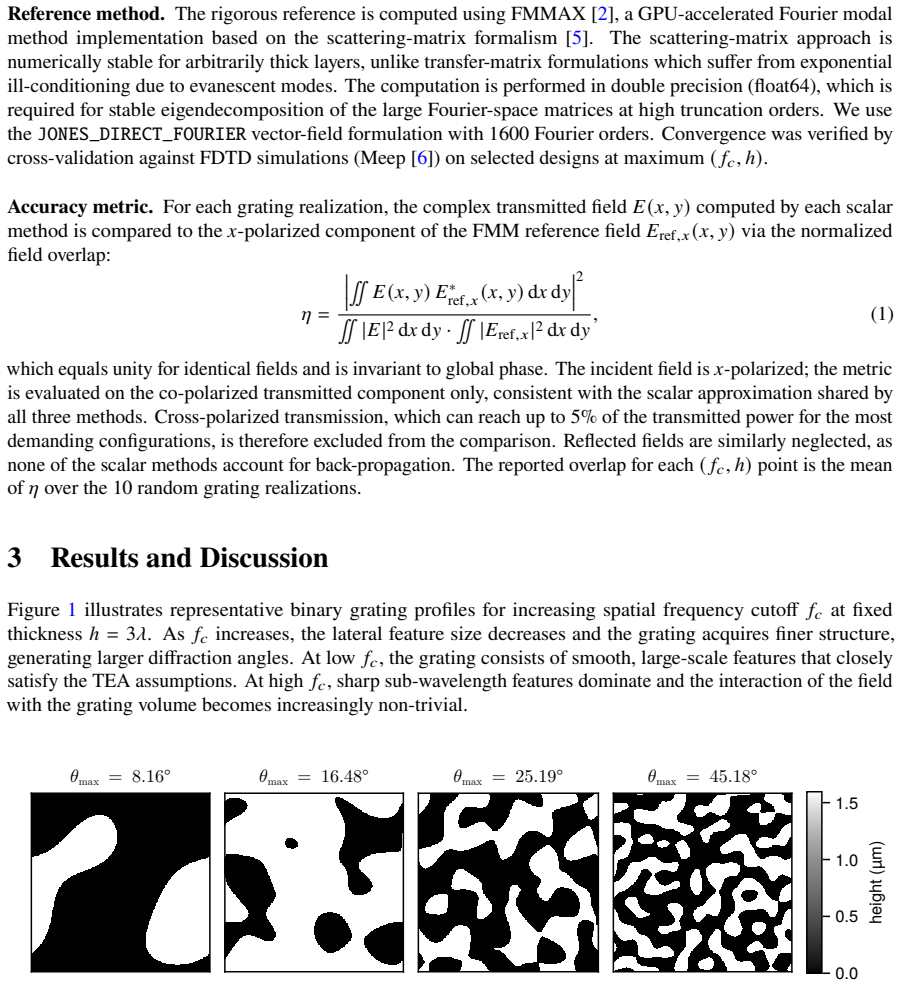


read the original abstract
We present a systematic accuracy assessment of the thin-element approximation (TEA), the beam propagation method (BPM), and the wave propagation method (WPM) for binary diffractive gratings, using the rigorous Fourier modal method (FMM) as a reference. Random binary gratings are generated over a range of spatial frequency cutoffs and thicknesses, and the transmitted field overlap between each scalar method and the reference is measured. The results are summarized as accuracy maps in the spatial frequency-thickness parameter space, revealing the domain of validity of each method and providing practical guidelines for the choice of forward model in diffractive optics inverse design pipelines.
Editorial analysis
A structured set of objections, weighed in public.
Referee Report
Summary. The manuscript claims to provide a systematic accuracy assessment of the thin-element approximation (TEA), beam propagation method (BPM), and wave propagation method (WPM) against the rigorous Fourier modal method (FMM) reference for binary diffractive gratings. Random binary gratings are generated over ranges of spatial frequency cutoffs and thicknesses; transmitted-field overlap is computed for each scalar method; results are presented as accuracy maps in the spatial-frequency–thickness parameter space to delineate validity domains and supply practical guidelines for choosing forward models in diffractive-optics inverse-design pipelines.
Significance. If the maps prove robust, the work would supply concrete, parameter-space guidelines that could help practitioners select computationally efficient scalar propagators without sacrificing essential accuracy in inverse-design loops. The use of an independent rigorous reference (FMM) and a direct numerical comparison strategy is standard and strengthens the assessment.
major comments (2)
- Abstract: the central claim that the accuracy maps supply 'practical guidelines for the choice of forward model in diffractive optics inverse design pipelines' rests on two untested assumptions—(i) that transmitted-field overlap is a sufficient proxy for the errors that actually degrade design performance (e.g., diffraction-order efficiencies, localized phase fidelity, or fabrication tolerance), and (ii) that randomly generated binary gratings adequately sample the structures encountered under optimization. Neither correlation nor coverage is demonstrated, rendering the maps' applicability to inverse design only partially supported.
- Results (accuracy maps): no quantitative comparison is reported between the overlap metric and order-specific or spatially localized error measures, nor is any test performed on gratings produced by actual inverse-design optimization (which typically exhibit spatial correlations absent from the random ensemble). These omissions are load-bearing for the stated utility of the maps.
Simulated Author's Rebuttal
We thank the referee for the careful and constructive review of our manuscript. The comments correctly identify limitations in how directly our results support claims about inverse-design utility. We address each point below and will revise the manuscript accordingly to clarify scope and limitations.
read point-by-point responses
-
Referee: Abstract: the central claim that the accuracy maps supply 'practical guidelines for the choice of forward model in diffractive optics inverse design pipelines' rests on two untested assumptions—(i) that transmitted-field overlap is a sufficient proxy for the errors that actually degrade design performance (e.g., diffraction-order efficiencies, localized phase fidelity, or fabrication tolerance), and (ii) that randomly generated binary gratings adequately sample the structures encountered under optimization. Neither correlation nor coverage is demonstrated, rendering the maps' applicability to inverse design only partially supported.
Authors: We agree that the manuscript relies on transmitted-field overlap for random binary gratings without demonstrating explicit correlations to design-specific metrics such as diffraction efficiencies or tests on optimized structures. The overlap metric was selected as it quantifies overall field fidelity, which underpins any forward model used in gradient-based design. Random generation was chosen to enable dense, unbiased sampling of the spatial-frequency–thickness space. We will revise the abstract to specify that the guidelines are derived from field-overlap accuracy on random ensembles and add a paragraph in the Discussion acknowledging that further validation against optimization-specific errors and correlated structures would strengthen applicability. revision: yes
-
Referee: Results (accuracy maps): no quantitative comparison is reported between the overlap metric and order-specific or spatially localized error measures, nor is any test performed on gratings produced by actual inverse-design optimization (which typically exhibit spatial correlations absent from the random ensemble). These omissions are load-bearing for the stated utility of the maps.
Authors: The current work does not include quantitative comparisons of overlap to order efficiencies or localized errors, nor tests on inverse-design-optimized gratings. Such additions would require a separate, computationally intensive study focused on optimization loops. Our emphasis is on systematic parameter-space coverage with random gratings to reveal general validity domains. In revision we will insert a brief discussion relating overlap deviations to expected impacts on diffraction orders and noting that random ensembles lack the spatial correlations typical of optimized designs, thereby qualifying the maps' direct use in inverse-design pipelines. revision: partial
Circularity Check
No circularity: direct numerical comparison against independent reference
full rationale
The paper performs an empirical accuracy assessment by generating random binary gratings across spatial-frequency and thickness ranges, computing transmitted-field overlap between scalar methods (TEA, BPM, WPM) and the rigorous FMM reference, and summarizing results as validity maps. No derivations, parameter fits, or self-citations are load-bearing; the maps are direct simulation outputs. The assessment is self-contained against external benchmarks with no reduction of claims to inputs by construction.
Axiom & Free-Parameter Ledger
axioms (2)
- domain assumption The Fourier modal method supplies the exact reference solution for the chosen grating geometries
- domain assumption Field overlap is an appropriate scalar metric for judging suitability in inverse-design pipelines
Lean theorems connected to this paper
-
IndisputableMonolith/Foundation/RealityFromDistinction.leanreality_from_one_distinction unclearaccuracy maps in the spatial frequency-thickness parameter space... practical guidelines for the choice of forward model in diffractive optics inverse design pipelines
-
IndisputableMonolith/Cost/FunctionalEquation.leanwashburn_uniqueness_aczel uncleartransmitted field overlap η between each scalar method and the FMM reference
Reference graph
Works this paper leans on
-
[1]
Journal of Open Source Software , keywords =
Barré, Nicolas , title =. Journal of Open Source Software , keywords =. doi:10.21105/joss.09734 , year =
-
[2]
Nicolas Barr\'. Differentiable wave propagation method for shape optimization of freeform optics beyond the paraxial approximation , volume =. Optics Letters , number =. 2025 , doi =
work page 2025
-
[3]
Fourier modal method for inverse design of metasurface-enhanced micro-LEDs , author=. 2023 , eprint=
work page 2023
-
[4]
S. Schmidt and T. Tiess and S. Schr\". Wave-optical modeling beyond the thin-element approximation , volume =. Optics Express , number =. 2016 , doi =
work page 2016
-
[5]
Dong Cheon Kim and Andreas Hermerschmidt and Pavel Dyachenko and Toralf Scharf , journal =. Inverse design and demonstration of high-performance wide-angle diffractive optical elements , volume =. 2020 , doi =
work page 2020
-
[6]
Computer Physics Communications , author=
S4 : A free electromagnetic solver for layered periodic structures , journal =. 2012 , issn =. doi:10.1016/j.cpc.2012.04.026 , author =
-
[7]
Meep: A flexible free-software package for electromagnetic simulations by the FDTD method , journal =. 2010 , issn =. doi:10.1016/j.cpc.2009.11.008 , author =
-
[8]
New method for nonparaxial beam propagation , volume =
Anurag Sharma and Arti Agrawal , journal =. New method for nonparaxial beam propagation , volume =. 2004 , doi =
work page 2004
discussion (0)
Sign in with ORCID, Apple, or X to comment. Anyone can read and Pith papers without signing in.