Recognition: 2 theorem links
· Lean TheoremA Patchwise Local Fourier Extension Method for Function Approximation on General Two-Dimensional Domains
Pith reviewed 2026-05-12 04:38 UTC · model grok-4.3
The pith
A patchwise local Fourier extension approximates smooth functions on general 2D domains with linear online complexity.
A machine-rendered reading of the paper's core claim, the machinery that carries it, and where it could break.
Core claim
By embedding the domain in a Cartesian grid and decomposing it into interior rectangles plus boundary trapezoids, converting every patch to a fixed-size array via local transfer or one-dimensional completion, and applying the same truncated-SVD Fourier extension operator on each array while reusing the reference matrices, the method obtains O(N) online complexity for N output points while preserving high accuracy for smooth target functions.
What carries the argument
The local Fourier extension operator stabilized by truncated SVD on fixed-size tensor-product arrays, with precomputed reference matrices reused across patches.
If this is right
- Approximations remain stable and accurate on arbitrary smooth curved domains without the global ill-conditioning typical of single-frame Fourier methods.
- Once local resolution is fixed, adding more patches increases cost only linearly with total output points.
- Boundary patches add only a uniformly bounded extra cost from their one-dimensional transfer steps.
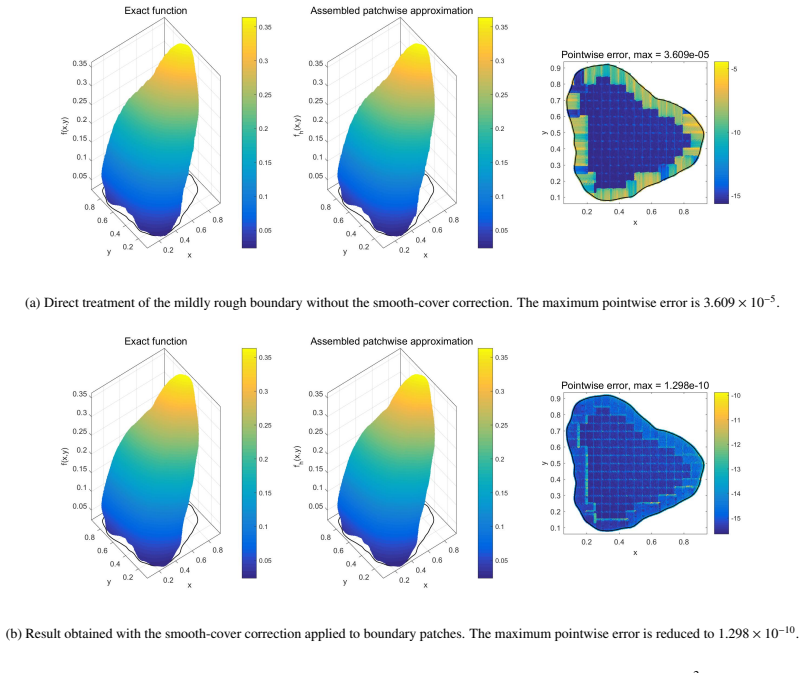
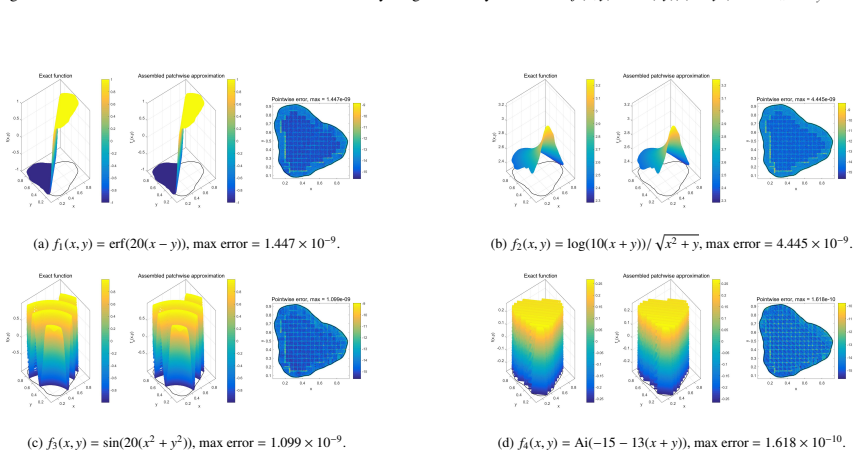
- A single fixed set of local parameters suffices for high accuracy across multiple tested domains, including one with a mildly rough boundary when a smooth-cover correction is applied.
Where Pith is reading between the lines
- The same fixed-size patch strategy could be applied in three dimensions by extending the decomposition and transfer steps to volumetric patches.
- Allowing local resolution to adapt per patch while still reusing SVDs for each resolution level would support adaptive approximation without losing the linear scaling.
- The precomputed SVD reuse pattern suggests the method could be combined with other local basis constructions that admit similar offline precomputation.
Load-bearing premise
The target functions are smooth enough that local patch approximations plus boundary data transfers and completions preserve the target accuracy without introducing errors that force retuning of parameters for each new domain.
What would settle it
Run the method on a sequence of increasingly rough boundaries or less smooth test functions and observe whether the observed error fails to decrease at the expected rate or the measured runtime grows faster than linearly with the number of output points.
Figures





read the original abstract
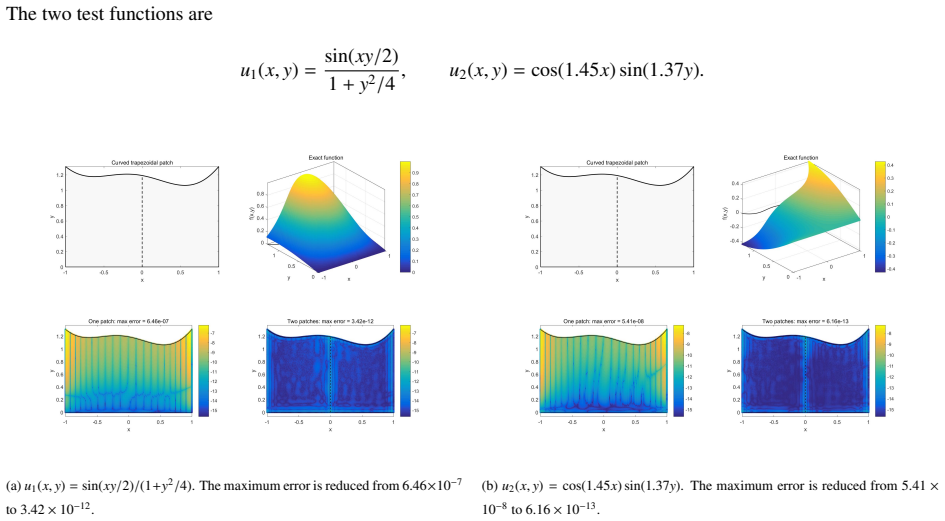
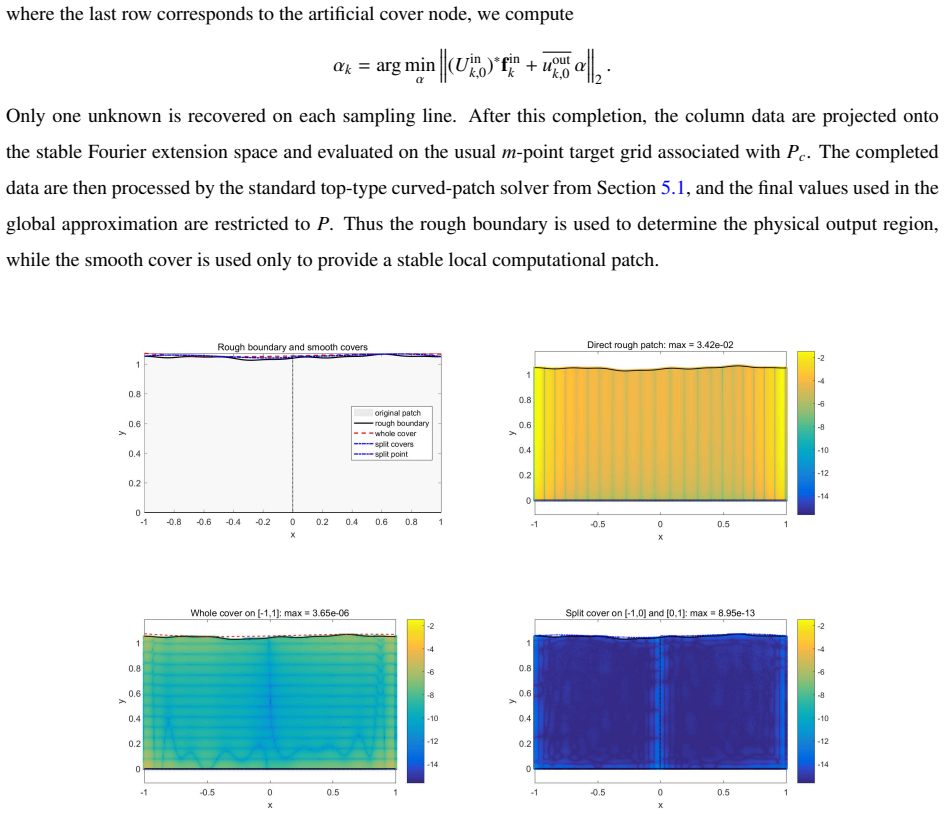
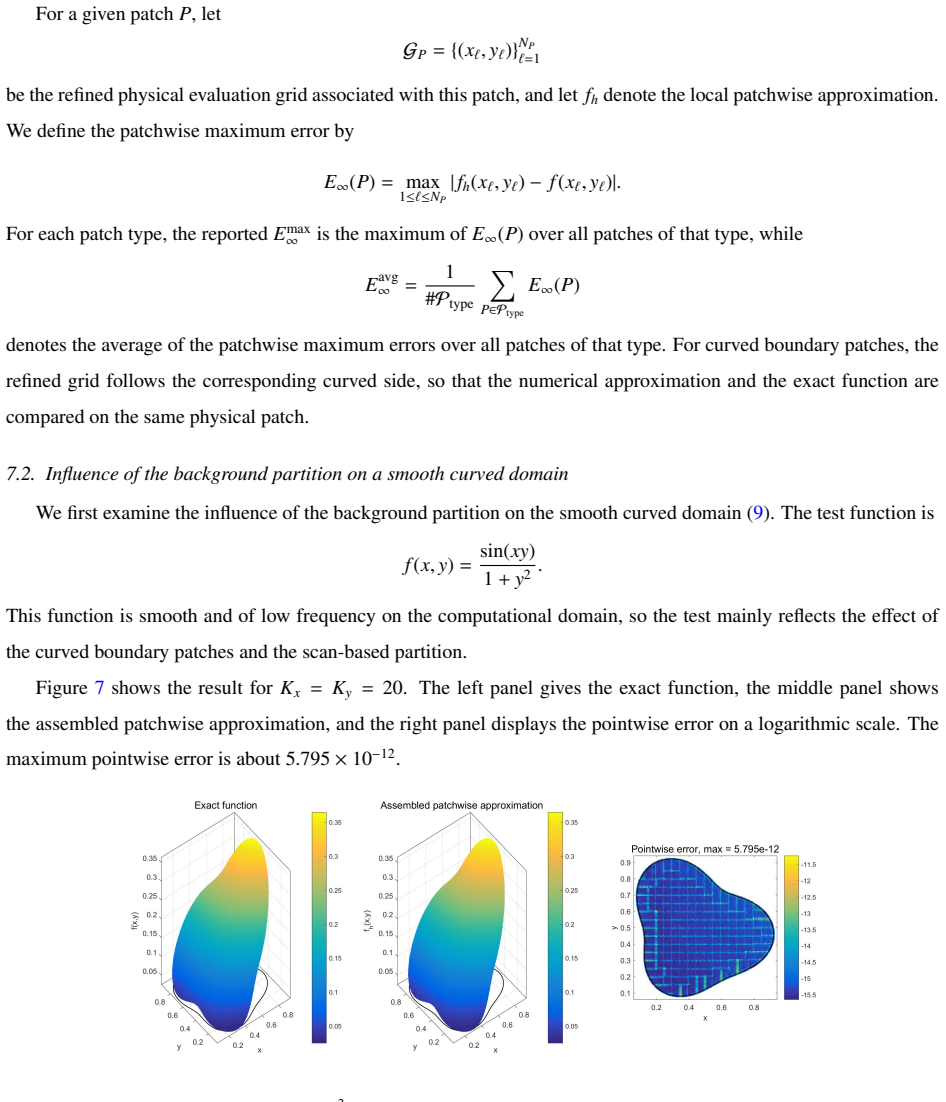
We propose a patchwise local Fourier extension method for approximating smooth functions on general two dimensional domains with curved boundaries. The domain is embedded into a Cartesian background grid and decomposed into rectangular interior patches and one-side curved trapezoidal boundary patches. After local data transfer, all patches are converted into fixed-size tensor-product arrays and approximated by a truncated-SVD stabilized local Fourier extension procedure. Unlike global Fourier frame approximations, the proposed method localizes both the geometry and the ill-conditioned extension process. For fixed local parameters, the local algebraic operations are performed on fixed-size systems, and the reference Fourier extension matrices and their singular value decompositions are reused across patches. Boundary patches require additional one-dimensional transfer or completion steps, but their costs remain uniformly bounded by the local resolution. Consequently, the online complexity is \(O(N)\), where \(N\) denotes the total number of retained output points for fixed local resolution. Numerical experiments on smooth curved domains and on a mildly rough boundary domain demonstrate that the method achieves high accuracy with a fixed set of local parameters. The smooth-cover correction reduces the boundary-induced error by several orders of magnitude in the full-domain rough-boundary test, without changing the underlying scan-based partition.
Editorial analysis
A structured set of objections, weighed in public.
Referee Report
Summary. The manuscript proposes a patchwise local Fourier extension method for approximating smooth functions on general 2D domains with curved boundaries. The domain is embedded in a Cartesian grid and partitioned into rectangular interior patches and one-sided curved trapezoidal boundary patches. After local data transfer, all patches are converted to fixed-size tensor-product arrays and approximated via a truncated-SVD stabilized local Fourier extension. Precomputed reference matrices and SVDs are reused across patches, yielding O(N) online complexity for fixed local resolution and truncation threshold. Numerical experiments on smooth curved domains and one mildly rough boundary case report high accuracy, with a smooth-cover correction reducing boundary-induced errors by several orders of magnitude.
Significance. If the accuracy and complexity claims hold, the work offers a practical localization of Fourier extension methods that mitigates global ill-conditioning while handling curved geometries. The reuse of fixed-size algebraic components and the O(N) scaling for fixed local parameters are clear strengths for efficiency. The approach could enable high-accuracy approximation in applications such as spectral methods on irregular domains without per-domain retuning, provided the boundary handling is uniformly accurate.
major comments (2)
- [Boundary patch handling section] The description of boundary-patch data transfer and 1D completion (abstract and the section detailing boundary patches) asserts that these steps have costs uniformly bounded by local resolution and preserve the accuracy of the interior truncated-SVD extension. However, no a priori bound or operator-norm estimate is provided showing that the transfer error remains below the interior truncation error for fixed local parameters when curvature or boundary regularity varies. This is load-bearing for the central claim of fixed-parameter high accuracy across domains.
- [Numerical experiments section] Numerical experiments section: the reported high accuracy on smooth domains and the several-orders-of-magnitude improvement from the smooth-cover correction on the rough-boundary test are presented without tables or figures that systematically vary local resolution and SVD truncation threshold while measuring full-domain error. This makes it difficult to confirm that the boundary-induced error stays controlled without retuning.
minor comments (2)
- [Abstract] The abstract refers to 'one mildly rough boundary domain' without specifying the exact geometry or roughness measure; adding a brief description or reference to the corresponding figure would improve clarity.
- [Throughout manuscript] Notation for the local resolution parameter and SVD truncation threshold should be introduced once and used consistently in both the algorithmic description and the complexity analysis.
Simulated Author's Rebuttal
We thank the referee for the careful reading and constructive comments. We address each major comment below, indicating the revisions we will make to strengthen the manuscript.
read point-by-point responses
-
Referee: [Boundary patch handling section] The description of boundary-patch data transfer and 1D completion (abstract and the section detailing boundary patches) asserts that these steps have costs uniformly bounded by local resolution and preserve the accuracy of the interior truncated-SVD extension. However, no a priori bound or operator-norm estimate is provided showing that the transfer error remains below the interior truncation error for fixed local parameters when curvature or boundary regularity varies. This is load-bearing for the central claim of fixed-parameter high accuracy across domains.
Authors: We agree that the manuscript lacks a rigorous a priori operator-norm bound on the boundary data transfer and 1D completion error. The current presentation describes these steps algorithmically, asserts uniform bounded cost by local resolution, and demonstrates accuracy preservation through numerical tests on the considered domains. Deriving a general bound that holds for arbitrary curvature and boundary regularity would require additional analysis of the transfer operators, which lies beyond the scope of the present work focused on practical localization and O(N) complexity. In the revision we will explicitly note this limitation in the boundary-patch section and state that the claims rely on numerical evidence for the tested cases. revision: partial
-
Referee: [Numerical experiments section] Numerical experiments section: the reported high accuracy on smooth domains and the several-orders-of-magnitude improvement from the smooth-cover correction on the rough-boundary test are presented without tables or figures that systematically vary local resolution and SVD truncation threshold while measuring full-domain error. This makes it difficult to confirm that the boundary-induced error stays controlled without retuning.
Authors: We accept this criticism. The existing experiments illustrate performance with a single fixed set of local parameters across domains. To address the request, we will add new figures and tables in the revised numerical experiments section that systematically vary the local resolution (points and modes per patch) and the SVD truncation threshold. These will report full-domain errors (L2 and maximum norm) for both the smooth curved domains and the mildly rough boundary case, with and without the smooth-cover correction, thereby providing clearer evidence that boundary-induced errors remain controlled for the fixed-parameter regime. revision: yes
- Deriving a complete a priori operator-norm estimate for the boundary data transfer and 1D completion steps that holds uniformly for arbitrary curvature and boundary regularity.
Circularity Check
No significant circularity; derivation is self-contained algorithmic construction
full rationale
The paper describes a patchwise method that decomposes the domain, transfers data to fixed-size tensor-product arrays, and applies truncated-SVD Fourier extension with precomputed reference matrices reused across patches. The O(N) online complexity follows directly from the fixed local resolution and uniform bounding of boundary transfer costs by that resolution, without any reduction of the complexity or accuracy claims to fitted parameters, self-definitions, or load-bearing self-citations. Numerical experiments are presented as validation of fixed-parameter performance on test domains rather than as inputs that define the results by construction. No equations or steps in the provided text exhibit the enumerated circular patterns.
Axiom & Free-Parameter Ledger
free parameters (2)
- local resolution
- SVD truncation threshold
axioms (1)
- domain assumption The function to be approximated is sufficiently smooth on the domain.
Lean theorems connected to this paper
-
IndisputableMonolith/Foundation/RealityFromDistinction.leanreality_from_one_distinction unclearWe establish a basic error estimate that relates the two-dimensional local approximation error to one-dimensional directional Fourier extension defects and to the geometry of the local patch mapping
Reference graph
Works this paper leans on
-
[1]
Y . Wang, I. Stepanova, V . Titarenko, A. Yagola, Inverse Problems in Geophysics and Solution Methods., Higher Education Press, 2011
work page 2011
-
[2]
J. P. Boyd, A comparison of numerical algorithms for Fourier extension of the first, second, and third kinds, Journal of Computational Physics 178 (1) (2002) 118–160
work page 2002
-
[3]
J. P. Boyd, Fourier embedded domain methods: Extending a function defined on an irregular region to a rectangle so that the extension is spatially periodic and smooth, Applied Mathematics and Computation 161 (2) (2005) 591–597
work page 2005
-
[4]
O. P. Bruno, Y . Han, M. M. Pohlman, Accurate, high-order representation of complex three-dimensional surfaces via Fourier continuation analysis, Journal of Computational Physics 227 (2) (2007) 1094–1125. 27
work page 2007
-
[5]
O. P. Bruno, M. Lyon, High-order unconditionally stable FC-AD solvers for general smooth domains I. basic elements, Journal of Computational Physics 229 (6) (2010) 2009–2033
work page 2010
-
[6]
M. Lyon, O. P. Bruno, High-order unconditionally stable FC-AD solvers for general smooth domains II. elliptic, parabolic and hyperbolic PDEs; theoretical considerations, Journal of Computational Physics 229 (9) (2010) 3358–3381
work page 2010
-
[7]
R. Matthysen, D. Huybrechs, Function approximation on arbitrary domains using Fourier extension frames, SIAM Journal on Numerical Analysis 56 (3) (2018) 1360–1385
work page 2018
- [8]
-
[9]
D. Huybrechs, On the Fourier extension of nonperiodic functions, SIAM Journal on Numerical Analysis 47 (6) (2010) 4326–4355
work page 2010
- [10]
- [11]
- [12]
- [13]
-
[14]
O. P. Bruno, J. Paul, Two-dimensional Fourier continuation and applications, SIAM Journal on Scientific Com- puting 44 (2) (2022) A964–A992
work page 2022
-
[15]
Z. Zhao, Y . Wang, A local Fourier extension method for function approximation, Inverse Problems and Imaging 22 (2026) 1–13. 28
work page 2026
discussion (0)
Sign in with ORCID, Apple, or X to comment. Anyone can read and Pith papers without signing in.