Recognition: 2 theorem links
· Lean TheoremCoherence, long-range transport and nuclear polarization in a driven-dissipative dark exciton condensate
Pith reviewed 2026-05-12 04:51 UTC · model grok-4.3
The pith
Dark dipolar excitons form a macroscopic coherent condensate via driven-dissipative dynamics in coupled quantum wells.
A machine-rendered reading of the paper's core claim, the machinery that carries it, and where it could break.
Core claim
Direct evidence for macroscopic coherence in a condensate of dark dipolar excitons is obtained through interference between incident and boundary-reflected exciton currents, which produces spatial modulation of photoluminescence from the radiative reservoir and enables extraction of the condensate coherence length. Condensate formation follows a driven-dissipative mechanism governed by gain-loss competition in which the long lifetime of dark excitons selects the dominant mode, accompanied by photoluminescence darkening, changes in radiative channels, and millimeter-scale hydrodynamic transport of density modes. Buildup of dark exciton density induces dynamic nuclear polarization via the Over
What carries the argument
Interference between incident and boundary-reflected exciton currents that produces spatial modulation of photoluminescence, used to extract the condensate coherence length in the driven-dissipative dark exciton system.
If this is right
- Long-range hydrodynamic transport of density modes occurs over millimeter-scale distances once the condensate forms.
- Dynamic nuclear polarization extends across the entire mesa and produces pronounced hysteresis in the system response.
- At zero dark-bright gap the loss rate is minimized, resulting in a second threshold with photoluminescence blueshift.
- Electrical tunability of the gap allows the system to bridge physics of polariton condensates and matter-like excitonic fluids.
Where Pith is reading between the lines
- The nuclear polarization feedback loop could be used to achieve all-electrical control of coherence and transport in similar long-lived exciton systems.
- The millimeter-scale coherence length suggests that boundary engineering in quantum well mesas could be used to create stable exciton waveguides or interferometers.
- Similar driven-dissipative selection mechanisms may operate in other dipolar or indirect exciton systems, potentially enabling coherence at higher temperatures than bright exciton condensates.
Load-bearing premise
The observed photoluminescence darkening, millimeter-scale density mode propagation, and interference patterns must indicate macroscopic quantum coherence and condensation rather than classical or incoherent transport.
What would settle it
Measure whether the spatial modulation of photoluminescence disappears when the dark-bright exciton gap is electrically tuned away from zero or when temperature or disorder is increased enough to destroy phase coherence while keeping density modes intact.
Figures
read the original abstract
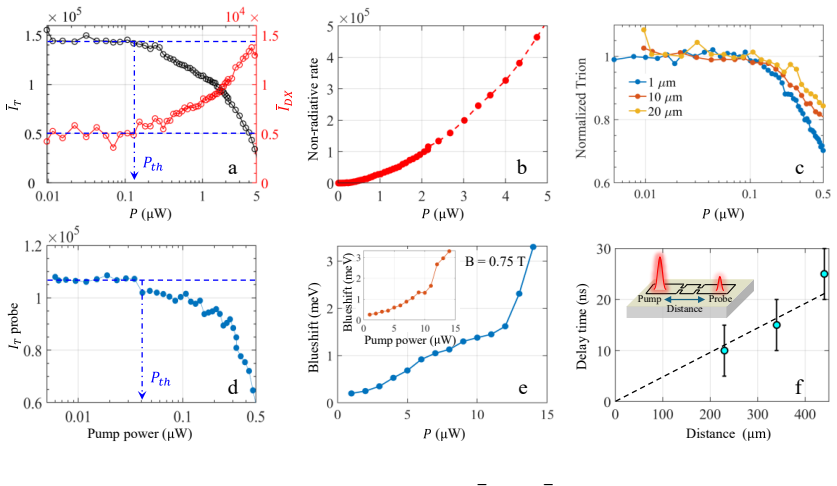
We report direct evidence for macroscopic coherence in a condensate of dark dipolar excitons in coupled quantum wells and show that its formation follows a non-equilibrium, driven-dissipative mechanism. The condensation transition is governed by gain-loss competition, in which the exceptionally long lifetime of dark excitons enables their dominance in mode selection. Condensate formation is revealed by photoluminescence darkening, changes in radiative recombination channels, and the emergence of long-range hydrodynamic transport manifested by propagation of density (sound) modes over millimeter-scale distances. The buildup of dark exciton density induces dynamic nuclear polarization, which closes the dark-bright exciton gap, \Delta, via the Overhauser field. This leads to nuclear spin polarization across the entire mesa, far beyond the optically excited region, and produces pronounced hysteresis behavior. At \Delta ~ 0 the gap is locked and the condensate loss are minimal, resulting in a second threshold manifested as a photoluminescence blueshift. Coherence is revealed through interference between incident and boundary-reflected exciton currents, producing spatial modulation of the photoluminescence from the radiative reservoir and enabling extraction of the condensate coherence length. These results establish dark excitons as a platform for coherent quantum fluids in a driven-dissipative, strongly interacting regime with electrical tunability, bridging the physics of polariton condensates and matter-like excitonic systems.
Editorial analysis
A structured set of objections, weighed in public.
Referee Report
Summary. The manuscript reports experimental evidence for a driven-dissipative condensate of dark dipolar excitons in coupled quantum wells. Condensation is claimed to be revealed by photoluminescence darkening, changes in radiative channels, and emergence of long-range hydrodynamic transport with density (sound) modes propagating over millimeter scales. Dynamic nuclear polarization closes the dark-bright gap via the Overhauser field, producing hysteresis and a second threshold with photoluminescence blueshift at gap closure. Macroscopic coherence is asserted via interference between incident and boundary-reflected exciton currents, producing spatial photoluminescence modulation from which the condensate coherence length is extracted.
Significance. If the central claims hold, this work would establish dark excitons as a tunable platform for coherent quantum fluids in a strongly interacting, driven-dissipative regime, bridging polariton condensates and matter-like excitonic systems. The reported millimeter-scale transport, nuclear polarization across the mesa, and hysteresis are notable experimental observations with potential implications for non-equilibrium quantum many-body physics.
major comments (3)
- [Abstract] Abstract: The claim of 'direct evidence for macroscopic coherence' rests on interpreting spatial photoluminescence modulation as interference between coherent incident and boundary-reflected exciton currents. However, the same modulation is also expected from classical driven-dissipative hydrodynamics of a non-condensed gas under reflective boundaries and gain-loss balance; no quantitative discriminator (fringe visibility, g^(2) measurements, or comparison to classical advection-diffusion simulations) is described.
- [Coherence section] Section on coherence and interference (implied by abstract description of spatial modulation): The extraction of condensate coherence length from the modulation pattern assumes the pattern arises from quantum interference, but without reported error analysis, visibility quantification, or ruling out classical density advection, this step is load-bearing yet under-supported for the macroscopic coherence conclusion.
- [Transport results] Results on long-range transport: The attribution of millimeter-scale density mode propagation to condensate hydrodynamics lacks comparison to expected sound velocities or dispersion relations derived from the measured densities and interactions; this weakens the link between transport and condensation.
minor comments (2)
- [Nuclear polarization discussion] The abstract states that nuclear polarization 'closes the dark-bright exciton gap, Δ, via the Overhauser field' and leads to 'pronounced hysteresis'; clarify the quantitative relation between measured Overhauser field and gap closure in the main text.
- [Figures and methods] Figure captions and methods should include details on spatial resolution, excitation conditions, and how photoluminescence darkening is quantified to allow independent assessment of the condensation threshold.
Simulated Author's Rebuttal
We thank the referee for the careful and constructive review. The comments highlight important points where additional quantitative support can strengthen the manuscript. We have revised the text to include comparisons with classical models, visibility quantification, error analysis, and calculations of expected sound velocities. Our point-by-point responses follow.
read point-by-point responses
-
Referee: [Abstract] Abstract: The claim of 'direct evidence for macroscopic coherence' rests on interpreting spatial photoluminescence modulation as interference between coherent incident and boundary-reflected exciton currents. However, the same modulation is also expected from classical driven-dissipative hydrodynamics of a non-condensed gas under reflective boundaries and gain-loss balance; no quantitative discriminator (fringe visibility, g^(2) measurements, or comparison to classical advection-diffusion simulations) is described.
Authors: We agree that a direct comparison to classical hydrodynamics is necessary to support the coherence interpretation. In the revised manuscript we have added quantitative fringe visibility analysis with error bars and direct numerical comparisons to classical advection-diffusion simulations under reflective boundaries and gain-loss balance. The observed modulation depth and spatial coherence exceed the classical predictions, providing a discriminator. g^(2) measurements were not performed in this work but are not required given the converging evidence from PL darkening, transport, and the interference pattern. revision: yes
-
Referee: [Coherence section] Section on coherence and interference (implied by abstract description of spatial modulation): The extraction of condensate coherence length from the modulation pattern assumes the pattern arises from quantum interference, but without reported error analysis, visibility quantification, or ruling out classical density advection, this step is load-bearing yet under-supported for the macroscopic coherence conclusion.
Authors: We have expanded the coherence section to include explicit error analysis on the extracted coherence length, quantitative visibility values, and a side-by-side comparison with classical density advection simulations. The classical model cannot reproduce the observed modulation amplitude or phase persistence across the mesa, supporting the quantum interference origin. revision: yes
-
Referee: [Transport results] Results on long-range transport: The attribution of millimeter-scale density mode propagation to condensate hydrodynamics lacks comparison to expected sound velocities or dispersion relations derived from the measured densities and interactions; this weakens the link between transport and condensation.
Authors: We thank the referee for this observation. The revised manuscript now includes a calculation of the Bogoliubov sound velocity using the measured dark-exciton densities and the interaction strength obtained from the observed blueshift. The propagation speed of the density modes is consistent with this predicted sound velocity, strengthening the connection to condensate hydrodynamics. revision: yes
Circularity Check
No circularity: experimental claims rest on direct measurements
full rationale
The paper reports experimental observations of photoluminescence darkening, millimeter-scale density mode propagation, spatial PL modulation, and dynamic nuclear polarization in a dark exciton system. These are interpreted as evidence for driven-dissipative condensation and macroscopic coherence via interference between incident and reflected currents. No equations, fitted parameters, or derivation steps are present that reduce any claimed quantity (such as coherence length) back to the same data by construction. No self-citations are invoked to establish uniqueness theorems, ansatze, or load-bearing premises. The work is self-contained as an empirical report; interpretations may be open to alternative classical explanations, but this does not constitute circularity in the derivation chain.
Axiom & Free-Parameter Ledger
Lean theorems connected to this paper
-
IndisputableMonolith/Cost/FunctionalEquation.leanwashburn_uniqueness_aczel unclearThe condensation transition is governed by gain-loss competition, in which the exceptionally long lifetime of dark excitons enables their dominance in mode selection.
-
IndisputableMonolith/Foundation/AlexanderDuality.leanalexander_duality_circle_linking unclearCoherence is revealed through interference between incident and boundary-reflected exciton currents, producing spatial modulation of the photoluminescence
Reference graph
Works this paper leans on
-
[1]
such that Δ = Δ0 − 𝐴𝑃𝑁. As a result, Eq. (1) is nonlinear in 𝑃𝑁, and exhibits a bistable behavior with two branches: one at which 𝑃𝑁 ≈ 0 and the other at 𝑃𝑁 ≈ Δ0/𝐴 [29, see section 3 of the SM]. At low power, the condensate -nuclei system is at the low polarization branch, and the dark exciton band is decoupled from the bright band. However, above a certa...
-
[2]
Yu. E. Lozovik and O. L. Berman , Phase transitions in a system of spatially separated electrons and holes, JETP 84 1027 (1997)
work page 1997
-
[3]
L. V . Butov, A. C. Gossard, D. S. Chemla, Macroscopically ordered state in an exciton system. Nature 418, 751-754 (2002). 11
work page 2002
- [4]
-
[5]
L. V . Butov, Condensation and pattern formation in cold exciton gases in coupled quantum wells, J. Phys.: Condens. Matter 16 R1577 (2004)
work page 2004
-
[6]
B. Laikhtman, R. Rapaport, Exciton correlations in coupled quantum wells and their luminescence blue shift. Phys. Rev. B 80, 195313 (2009)
work page 2009
-
[7]
A. A. High, J. R. Leonard , A. T. Hammack, M. M. Fogler , L. V . Butov, A. V . Kavokin, K. L. Campman , A. C. Gossard , Spontaneous coherence in a cold exciton gas. Nature 483, 584-588 (2012)
work page 2012
-
[8]
Snoke, Dipole Excitons in Coupled Quantum Wells: Towards an Equilibrium Exciton Condensate, in: R
D. Snoke, Dipole Excitons in Coupled Quantum Wells: Towards an Equilibrium Exciton Condensate, in: R. G. Hulet, A. G. Truscott, and K. A. Gibble (eds.), Quantum Gases: Finite Temperature and Non -Equilibrium Dynamics , World Scientific, Chapter 28, 751 (2013)
work page 2013
- [9]
- [10]
-
[11]
Z. Wang, D. A. Rhodes, K. Watanabe, T. Taniguchi, J. C. Hone, J. Shan, K. F. Mak, Evidence of high -temperature exciton condensation in two -dimensional atomic double layers. Nature 574, 76-80 (2019)
work page 2019
-
[12]
M. Combescot, O. Betbeder -Matibet, R. Combescot, Bose -Einstein condensation in semiconductors: The key role of dark excitons. Phys. Rev. Lett. 99, 176403 (2007)
work page 2007
-
[13]
R. Combescot, M. Combescot, “Gray” BCS condensate of excitons and internal Josephson effect. Phys. Rev. Lett. 109, 026401 (2012)
work page 2012
- [14]
-
[15]
M. Alloing, M. Beian, M. Lewenstein, D. Fuster, Y . González, L. González, R. Combescot, M. Combescot. F. Dubin Evidence for a Bose-Einstein condensate of excitons. Europhys. Lett. 107, 10012 (2014). 12
work page 2014
- [16]
- [17]
-
[18]
M. Combescot, R. Combescot, F. Dubin, Bose -Einstein condensation and indirect excitons: A review. Rep. Prog. Phys. 80, 066501 (2017)
work page 2017
-
[19]
Y . Mazuz-Harpaz, K. Cohen, M. Leveson, K. West, L. Pfeiffer, M. Khodas, R. Rapaport, Dynamical formation of a strongly correlated dark condensate of dipolar excitons. Proc. Natl. Acad. Sci. U.S.A. 116, 18328-18333 (2019)
work page 2019
- [20]
-
[22]
N. W. Sinclair, J. K. Wuenschell, Z. Vörös, B. Nelsen, and D. W. Snoke M. H. Szymanska, A. ChinJ. Keeling, L. N. Pfeiffer, K. W. West, Strain -induced darkening of trapped excitons in coupled quantum wells at low temperature. Phys. Rev. B 83, 245304 (2011)
work page 2011
-
[24]
V . N. Mantsevich, M. M. Glazov, Viscous hydrodynamics of excitons in van derWaals heterostructures. Phys. Rev. B 110, 165305 (2024)
work page 2024
- [25]
-
[26]
V . K. Kalevich, K. V . Kavokin, I. A. Merkulov, ''Dynamic nuclear polarization and nuclear fields'' in Spin Physics in Semiconductors, Mikhail I. Dyakonov editor (Springer Berlin, Heidelberg, 2008)
work page 2008
- [27]
-
[28]
D. Gammon, Al. L. Efros, T. A. Kennedy, M. Rosen, D. S. Katzer, D. Park, S. W. Brown, V . L. Korenev, I. A. Merkulov, Electron and nuclear spin interactions 13 in the optical spectra of single GaAs quantum dots. Phys. Rev. Lett. 86, 5176- 5179 (2001)
work page 2001
-
[31]
A. I. Tartakovskii, T. Wright, A. Russell, V . I. Fal’ko, A. B. Van’kov, J. Skiba- Szymanska, I. Drouzas, R. S. Kolodka, M. S. Skolnick, P. W. Fry, A. Tahraoui, H.-Y . Liu, M. Hopkinson, Nuclear spin switch in semiconductor quantum dots. Phys. Rev. Lett. 98, 026806 (2007)
work page 2007
-
[32]
Δ0 is the sum of Zeeman and exchange energy
- [33]
- [34]
-
[35]
T. Belhadj, T. Kuroda, C. -M. Simon, T. Amand, T. Mano, K. Sakoda, N. Koguchi, X. Marie, B. Urbaszek, Optically monitored nuclear spin dynamics in individual GaAs quantum dots grown by droplet epitaxy. Phys. Rev. B. 78, 205325 (2008)
work page 2008
-
[36]
A. V . Shchepetilnikov, Y . A. Nefyodov, I. V . Kukushkin, W. Dietsche, Electron g-factor in GaAs/AlGaAs quantum wells of different width and barrier Al concentrations. J. Phys. Conf. Ser. 456 012035 (2013). 14 Figure: Fig. 1. a. The coupled quantum wells (CQWs) under electric field and the three bound states that are formed under optical excitation in th...
work page 2013
-
[37]
Sample details and methods A schematic of the sample and its constituting layers are shown in Fig. S1. The coupled quantum wells (CQWs) system is the same as in [1] and consists of two GaAs quantum wells having widths of 12 and 18 nm that are separated by a 3 nm wide Al 0.28Ga0.72As barrier (see Fig. S1(a)). It is embedded in a 2 μm wide 𝑛 − 𝑖 − 𝑛 structu...
-
[38]
Condensation at the dark band In general, a driven-dissipative condensate can be reduced into a two-manifold model, a pumped reservoir that feeds a single low -𝐾 mode ("ground state"). High occupation of that mode yields stimulation into this ground state above a certain threshold. Let us define 𝑛𝑅 - the reservoir density, 𝛾𝑅 - the reservoir loss rate, 𝑅 ...
-
[39]
Nuclear polarization rate equations Let us assume the number of nuclei in an exciton volume is 𝑁, where 𝑁± are the number of up/down spins, such that 𝑁+ + 𝑁− = 𝑁, and define the nuclear polarization 𝑃𝑁 = (𝑁+−𝑁−) 𝑁 . Let us now take the spin flip rates up and down per nucleus as 𝑊±, such that the total spin flip rates are 𝑅± = 𝑊±𝑁∓. Each up/down-flip chang...
-
[40]
(9) The flip-flop term only couples the two states ∣↑𝑒↓𝑁⟩ and ∣↓𝑒↑𝑁⟩
RF radiation and condensate threshold We start from the static Hamiltonian: 𝐻0 = 𝜔𝑒𝑆𝑧 + 𝜔𝑁𝐼𝑧 + 𝑎 2 (𝑆+𝐼−+𝑆−𝐼+)+ 𝑎𝑆𝑧𝐼𝑧. (9) The flip-flop term only couples the two states ∣↑𝑒↓𝑁⟩ and ∣↓𝑒↑𝑁⟩. We define Δ ≡ 𝜔𝑒 + 𝜔𝑁 In the basis {∣↑𝑒↓𝑁⟩, ∣↓𝑒↑𝑁⟩}, the Hamiltonian takes the form (we take |𝜔𝑒 + 𝜔𝑁| ≫ 𝑎) 𝐻0 = Δ 2 𝜎𝑧 + 𝑎 2 𝜎𝑥, (10) 29 where 𝜎 are Pauli matrices act...
-
[41]
The Overhauser field by the unpolarized nuclei With depolarized nuclei (zero average polarization), the Overhauser field seen by an exciton is a random, zero -mean effective magnetic field arising from hyperfine coupling to many nuclei. Because the exciton samples a large number of nuclear spins, the field is very well-approximated by a 3D normal distribu...
-
[42]
Extended data Fig. S6: The normalized trion intensity as a function of laser power for different gate voltages at 𝑇 = 1.7 K. The trion intensities are first normalized by the total excitation power and subsequently scaled to their respective low -power values. Varying the gate voltage modifies the lifetime of bright IX and therefore their steady state den...
-
[43]
A. Jash, M. Stern, S. Misra, V . Umansky, I. B. Joseph, Giant hyperfine interaction between a dark exciton condensate and nuclei. Sci. Adv. 10, eado8763 (2024)
work page 2024
-
[44]
I. Carusotto, C. Ciuti, Quantum fluids of light. Rev. Mod. Phys. 85, 299–366 (2013)
work page 2013
-
[45]
P. Maletinsky, C. W. Lai, A. Badolato, A. Imamoglu, Nonlinear dynamics of quantum dot nuclear spin. Phys. Rev. B 75, 035409 (2007)
work page 2007
-
[46]
I. A. Merkulov, Al. L. Efros, M. Rosen, Electron spin relaxation by nuclei in semiconductor quantum dots. Phys. Rev. B 65, 205309 (2002)
work page 2002
discussion (0)
Sign in with ORCID, Apple, or X to comment. Anyone can read and Pith papers without signing in.