Recognition: 2 theorem links
· Lean TheoremSpin Quadrupolar orders in d-wave Unconventional Magnetism
Pith reviewed 2026-05-12 04:58 UTC · model grok-4.3
The pith
A weak non-magnetic periodic potential induces spatial spin quadrupole distributions in d-wave unconventional magnetic states without enlarging the unit cell.
A machine-rendered reading of the paper's core claim, the machinery that carries it, and where it could break.
Core claim
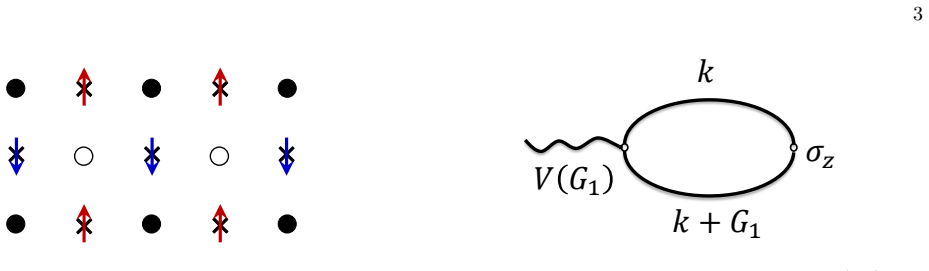
The paper establishes that the interplay between the crystal potential and the intrinsic d-wave spin-splitting naturally induces a spatial spin quadrupole distribution without enlarging the unit cell. By calculating the spin-charge cross susceptibility using linear response theory in the d-wave α-phase unconventional magnetic state, the authors bridge the momentum-space multipoles in the even partial wave channel to real-space spin multipole orders.
What carries the argument
The spin-charge cross susceptibility under linear response to a weak non-magnetic periodic potential in the presence of d-wave spin splitting.
If this is right
- The induced spin quadrupole is staggered yet fits inside the original unit cell.
- The mechanism directly links even partial-wave momentum multipoles to real-space spin multipole orders.
- The quadrupole arises from symmetry properties of the d-wave state combined with the periodic potential.
- Similar real-space orders are expected in other metallic systems that host anisotropic spin splitting.
Where Pith is reading between the lines
- Real-space probes sensitive to local spin moments could detect the quadrupole order as a signature of the underlying d-wave state.
- The linear-response method could be applied to other unconventional magnetic phases to predict their real-space multipoles.
- If the base magnetic state proves fragile under stronger potentials, nonlinear response calculations would become necessary to check the quadrupole induction.
Load-bearing premise
The d-wave unconventional magnetic state remains stable under the added weak non-magnetic periodic potential, with linear response theory fully capturing the induced effects.
What would settle it
Observation of either no staggered spin quadrupole distribution or instability of the d-wave state when a weak periodic potential is applied would falsify the proposed induction mechanism.
Figures

read the original abstract
Unconventional magnetism represents a class of metallic states whose Fermi surfaces exhibit spin-dependent splittings under the non-trivial representations of the rotation group. The $d$-wave $\alpha$-phase unconventional magnetic state, commonly known as altermagnet, recently, has attracted significant attention. While these systems exhibit distinct anisotropic $d$-wave characteristics in momentum space, how this microscopic topology translates into the spin distributions in real space remains a question. In this work, we bridge the intrinsic spin quadrupolar ordering in momentum space to the real-space staggered magnetic distribution. By introducing a weak, non-magnetic periodic crystal potential into a $d$-wave unconventional magnetic state, the spin-charge cross susceptibility is calculated by using the linear response theory. We reveal that the interplay between the crystal potential and the intrinsic $d$-wave spin-splitting naturally induces a spatial spin quadrupole distribution without enlarging the unit cell. Our study thus provides a physical connection between momentum-space multipoles in the even partial wave channel and real-space spin multipole orders.
Editorial analysis
A structured set of objections, weighed in public.
Referee Report
Summary. The paper claims that introducing a weak non-magnetic periodic crystal potential into a d-wave altermagnetic (unconventional magnetic) state and computing the spin-charge cross susceptibility via linear response theory reveals that the interplay between the crystal potential and the intrinsic d-wave spin-splitting naturally induces a spatial spin quadrupole distribution in real space without enlarging the unit cell. This is presented as providing a physical connection between momentum-space multipoles in the even partial wave channel and real-space spin multipole orders.
Significance. If the linear-response construction and background-state stability hold, the result offers a direct mapping from the momentum-space d-wave spin splitting of altermagnets to a real-space staggered spin quadrupole pattern on the original lattice. This could aid interpretation of spin textures in candidate altermagnetic materials and suggests that certain real-space multipoles emerge without additional symmetry breaking or cell doubling.
major comments (2)
- [Linear response calculation (main text)] The central claim requires that the d-wave altermagnetic state remains stable as the unperturbed background when the weak non-magnetic periodic potential is added. The manuscript provides no eigenvalue spectrum of the response matrix, no self-consistency check, and no discussion of possible instabilities driven by the anisotropic d-wave splitting. This assumption is load-bearing for the induced quadrupole pattern to follow from first-order linear response alone.
- [Results on induced spin quadrupole] The abstract and results assert that the induced distribution is fully captured by the spin-charge cross susceptibility without higher-order renormalization or cell enlargement. No explicit bound on the response magnitude or test of the linear approximation (e.g., comparison to second-order terms) is given, leaving open whether the claimed real-space quadrupole is robust or an artifact of the perturbative truncation.
minor comments (2)
- [Abstract] The abstract refers to 'the d-wave α-phase unconventional magnetic state' without specifying the explicit form of the momentum-space spin splitting or the lattice model Hamiltonian used in the susceptibility calculation.
- [Introduction/Methods] Notation for the spin quadrupole tensor and the periodic potential should be defined more clearly at first use to aid readability for readers outside the immediate subfield.
Simulated Author's Rebuttal
We thank the referee for the careful reading of our manuscript and the constructive comments on the assumptions in our linear-response treatment. We address each major comment point by point below.
read point-by-point responses
-
Referee: The central claim requires that the d-wave altermagnetic state remains stable as the unperturbed background when the weak non-magnetic periodic potential is added. The manuscript provides no eigenvalue spectrum of the response matrix, no self-consistency check, and no discussion of possible instabilities driven by the anisotropic d-wave splitting. This assumption is load-bearing for the induced quadrupole pattern to follow from first-order linear response alone.
Authors: We agree that the stability of the d-wave altermagnetic background is essential for the validity of the first-order calculation. Our approach treats the crystal potential as a weak perturbation on the established altermagnetic state, which is a standard assumption in linear-response studies of this type. The manuscript does not contain an explicit eigenvalue spectrum of the response matrix or a self-consistency loop. We will revise the text to add a dedicated paragraph discussing the regime of validity: specifically, that the potential strength is taken much smaller than the altermagnetic splitting, so that any instability would appear only at higher order. A full numerical diagonalization of the response matrix lies outside the present scope but can be noted as a natural extension. revision: partial
-
Referee: The abstract and results assert that the induced distribution is fully captured by the spin-charge cross susceptibility without higher-order renormalization or cell enlargement. No explicit bound on the response magnitude or test of the linear approximation (e.g., comparison to second-order terms) is given, leaving open whether the claimed real-space quadrupole is robust or an artifact of the perturbative truncation.
Authors: The spin quadrupole pattern is obtained strictly from the first-order spin-charge cross susceptibility, which by definition excludes cell enlargement and higher-order renormalization. We acknowledge that an explicit bound on the response amplitude would make the linear regime clearer. In the revised manuscript we will include a short estimate showing that the induced quadrupole moment scales linearly with the potential strength and remains small compared with the intrinsic altermagnetic order parameter when the potential is weak, thereby confirming that second-order corrections are negligible in the stated limit. revision: yes
Circularity Check
No circularity: result follows from explicit linear-response calculation on assumed background
full rationale
The derivation begins with an assumed d-wave altermagnetic state possessing intrinsic momentum-space spin splitting, introduces a weak non-magnetic periodic potential, and computes the spin-charge cross susceptibility via linear response theory to obtain the induced real-space spin quadrupole. This is a standard perturbative construction whose output (the quadrupole pattern on the original lattice) is not equivalent to the inputs by definition, nor obtained by fitting parameters to the target quantity, nor justified solely by self-citation chains. The abstract and description present the quadrupole as an emergent consequence of the interplay rather than a renamed or self-defined input. No load-bearing steps reduce to tautology or fitted prediction; the central claim remains an independent calculational result under the stated assumptions.
Axiom & Free-Parameter Ledger
axioms (1)
- domain assumption Linear response theory applies to the spin-charge cross susceptibility in the d-wave unconventional magnetic state under a weak non-magnetic periodic potential.
Lean theorems connected to this paper
-
IndisputableMonolith/Cost/FunctionalEquation.leanwashburn_uniqueness_aczel unclear?
unclearRelation between the paper passage and the cited Recognition theorem.
the static spin-charge cross-susceptibility ... χ(G1) = T ∑iωn ∫BZ d²k/(2π)² tr[G(k,iωn)G(k+G1,iωn)σz] ... χ = −(m k_f² / π G²) (1/√(1−Q²)) (1/(1+Q) − 1/(1−Q))
-
IndisputableMonolith/Foundation/AlexanderDuality.leanalexander_duality_circle_linking unclear?
unclearRelation between the paper passage and the cited Recognition theorem.
the induced real-space spin density ... Sz(r) = χ V0 (cos Gx − cos Gy) ... χ(R G1) = −χ(G1)
What do these tags mean?
- matches
- The paper's claim is directly supported by a theorem in the formal canon.
- supports
- The theorem supports part of the paper's argument, but the paper may add assumptions or extra steps.
- extends
- The paper goes beyond the formal theorem; the theorem is a base layer rather than the whole result.
- uses
- The paper appears to rely on the theorem as machinery.
- contradicts
- The paper's claim conflicts with a theorem or certificate in the canon.
- unclear
- Pith found a possible connection, but the passage is too broad, indirect, or ambiguous to say the theorem truly supports the claim.
Reference graph
Works this paper leans on
-
[1]
C. Wu and S.-C. Zhang, Dynamic generation of spin-orbit coupling, Phys. Rev. Lett.93, 036403 (2004)
work page 2004
-
[2]
C. Wu, K. Sun, E. Fradkin, and S.-C. Zhang, Fermi liquid instabilities in the spin channel, Phys. Rev. B75, 115103 (2007)
work page 2007
-
[3]
C. Wu,https://online.kitp.ucsb.edu/online/ coldatoms07/wu1/, online talk at Kavli Institute for Theoretical Physics, University of California, Santa Barbara, 2007
work page 2007
- [4]
-
[5]
V. Oganesyan, S. A. Kivelson, and E. Fradkin, Quantum theory of a nematic fermi fluid, Phys. Rev. B64, 195109 (2001)
work page 2001
-
[6]
T. Jungwirth, R. M. Fernandes, E. Fradkin, A. H. Mac- Donald, J. Sinova, and L. ˇSmejkal, Altermagnetism: An unconventional spin-ordered phase of matter, Newton1 (2025)
work page 2025
-
[7]
L. ˇSmejkal, J. Sinova, and T. Jungwirth, Emerging re- search landscape of altermagnetism, Phys. Rev. X12, 040501 (2022)
work page 2022
-
[8]
L. ˇSmejkal, J. Sinova, and T. Jungwirth, Beyond conven- tional ferromagnetism and antiferromagnetism: A phase with nonrelativistic spin and crystal rotation symmetry, Phys. Rev. X12, 031042 (2022)
work page 2022
-
[9]
I. Mazin and P. editors, Altermagnetism - a new punch line of fundamental magnetism (2022)
work page 2022
-
[10]
P. Liu, J. Li, J. Han, X. Wan, and Q. Liu, Spin-group symmetry in magnetic materials with negligible spin- orbit coupling, Phys. Rev. X12, 021016 (2022)
work page 2022
-
[11]
Z. Xiao, J. Zhao, Y. Li, R. Shindou, and Z.-D. Song, Spin space groups: full classification and applications, Phys. Rev. X14, 031037 (2024)
work page 2024
-
[12]
X. Chen, J. Ren, Y. Zhu, Y. Yu, A. Zhang, P. Liu, J. Li, Y. Liu, C. Li, and Q. Liu, Enumeration and representa- tion theory of spin space groups, Phys. Rev. X14, 031038 (2024)
work page 2024
- [13]
-
[14]
S.-W. Cheong and F.-T. Huang, Altermagnetism classi- fication, npj Quantum Mater.10, 38 (2025)
work page 2025
-
[15]
C. Song, H. Bai, Z. Zhou, L. Han, H. Reichlova, J. H. Dil, J. Liu, X. Chen, and F. Pan, Altermagnets as a new class of functional materials, Nat. Rev. Mater.10, 473 (2025)
work page 2025
-
[16]
X. Duan, J. Zhang, Z. Zhu, Y. Liu, Z. Zhang, I. ˇZuti´ c, and T. Zhou, Antiferroelectric altermagnets: Antiferro- electricity alters magnets, Phys. Rev. Lett.134, 106801 (2025)
work page 2025
-
[17]
Z.-M. Wang, Y. Zhang, S.-B. Zhang, J.-H. Sun, E. Dagotto, D.-H. Xu, and L.-H. Hu, Spin-orbital alter- magnetism, Phys. Rev. Lett.135, 176705 (2025)
work page 2025
-
[18]
Z. Zhou, X. Cheng, M. Hu, R. Chu, H. Bai, L. Han, J. Liu, F. Pan, and C. Song, Manipulation of the alter- magnetic order in crsb via crystal symmetry, Nature638, 645 (2025)
work page 2025
- [19]
-
[20]
J. Tian, J. Li, H. Liu, Y. Li, Z. Liu, L. Li, J. Li, G. Liu, and J. Shi, Spin-layer coupling in an altermagnetic mul- tilayer: A design principle for spintronics, Phys. Rev. B 111, 035437 (2025)
work page 2025
-
[21]
R. Jaeschke-Ubiergo, V.-K. Bharadwaj, W. Campos, R. Zarzuela, N. Biniskos, R. M. Fernandes, T. Jungwirth, J. Sinova, and L. ˇSmejkal, Atomic altermagnetism, arXiv preprint arXiv:2503.10797 (2025)
-
[22]
R. Bhattarai, P. Minch, and T. D. Rhone, High- 7 throughput screening of altermagnetic materials, Phys. Rev. Mater.9, 064403 (2025)
work page 2025
-
[23]
Z. Feng, X. Zhou, L. ˇSmejkal, L. Wu, Z. Zhu, H. Guo, R. Gonz´ alez-Hern´ andez, X. Wang, H. Yan, P. Qin,et al., An anomalous hall effect in altermagnetic ruthenium dioxide, Nat. Electron.5, 735 (2022)
work page 2022
-
[24]
T. Sato, S. Haddad, I. C. Fulga, F. F. Assaad, and J. van den Brink, Altermagnetic anomalous hall effect emerging from electronic correlations, Phys. Rev. Lett. 133, 086503 (2024)
work page 2024
- [25]
discussion (0)
Sign in with ORCID, Apple, or X to comment. Anyone can read and Pith papers without signing in.