Recognition: 2 theorem links
· Lean TheoremRisk-Aware Safe Throughput Forecasting for Starlink Networks
Pith reviewed 2026-05-12 04:08 UTC · model grok-4.3
The pith
Starlink throughput can be forecast safely by selecting lower-quantile predictors that respect a preset overestimation budget.
A machine-rendered reading of the paper's core claim, the machinery that carries it, and where it could break.
Core claim
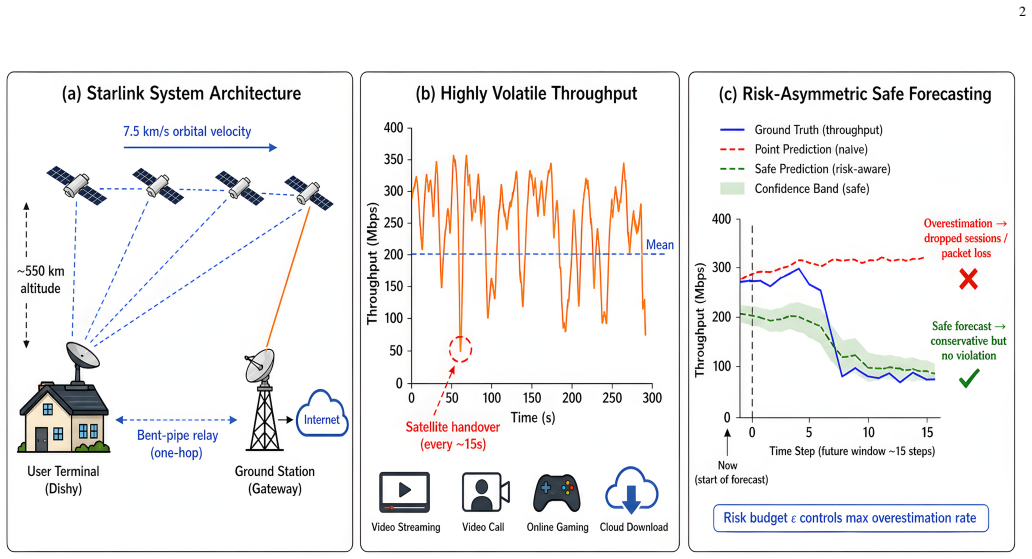
The paper claims that Budget-Guided Coarse-to-Fine Quantile Selection produces forecasts that satisfy any prescribed overestimation budget on three real Starlink datasets while recording the lowest average MAE, mean positive error, and tail positive error among all budget-feasible methods; in high-risk and severe-risk low-throughput regimes the method cuts harmful positive errors by 11.0 percent and 12.6 percent, and the resulting safe forecasts reduce dropped sessions in an admission-control evaluation.
What carries the argument
Budget-Guided Coarse-to-Fine Quantile Selection (BG-CFQS), which trains a family of lower-quantile predictors, locates the quantile boundary that satisfies the risk budget, and refines the boundary region to pick the most accurate feasible predictor.
If this is right
- The selected predictor satisfies the risk budget on all three real-world Starlink datasets.
- It records the lowest average MAE, mean positive error, and tail positive error among budget-feasible methods.
- In high-risk and severe-risk low-throughput periods it reduces harmful positive errors by 11.0 percent and 12.6 percent.
- Admission-control simulations using these forecasts show fewer dropped sessions than unsafe alternatives.
Where Pith is reading between the lines
- The same budget-guided quantile selection could be applied to capacity forecasting in other highly variable wireless systems such as 5G mmWave or non-terrestrial networks.
- Tighter risk budgets would force more conservative predictions and might leave usable capacity idle, creating a tunable trade-off between safety and utilization.
- Extending the method to multi-step or joint forecasts across neighboring beams could further reduce the need for post-hoc safety margins in network planning.
Load-bearing premise
That a family of lower-quantile predictors can always be trained so one feasible boundary exists inside the prescribed overestimation budget and still stays competitive in accuracy, and that the three collected datasets capture enough variability for the method to work without later fixes.
What would settle it
Finding additional Starlink traces or live-network runs where no lower-quantile predictor meets the overestimation budget while keeping error competitive, or where the safe forecasts produce the same or higher number of dropped sessions in admission control.
Figures


read the original abstract
As a representative low Earth orbit (LEO) broadband system, Starlink exhibits highly variable access throughput, making short-term forecasting essential for network resource management. Existing forecasting methods mainly optimize symmetric point-prediction metrics such as MAE and RMSE, but they do not explicitly control the asymmetric risk of overestimating future throughput, which can cause over-admission, bandwidth overbooking, and service violations. This paper formulates Starlink throughput prediction as a risk-budgeted safe forecasting problem, where the predictor must satisfy a prescribed overestimation budget while maintaining competitive accuracy. We propose Budget-Guided Coarse-to-Fine Quantile Selection (BG-CFQS), a data-driven framework that trains a family of lower-quantile predictors, locates the quantile boundary satisfying the risk budget, and refines the boundary region to select the most accurate feasible predictor. Experiments on three real-world Starlink throughput datasets show that BG-CFQS satisfies the risk budget on all datasets and achieves the lowest average MAE, mean positive error, and tail positive error among budget-feasible methods. In high-risk and severe-risk low-throughput regimes, BG-CFQS reduces harmful positive errors by 11.0% and 12.6%, respectively. An admission-control evaluation further shows that the proposed safe forecasts reduce dropped sessions, demonstrating that risk-aware forecasting can translate prediction safety into application-level benefits.
Editorial analysis
A structured set of objections, weighed in public.
Referee Report
Summary. The paper formulates Starlink throughput forecasting as a risk-budgeted safe prediction task, where the model must respect a user-specified overestimation budget to avoid over-admission. It introduces Budget-Guided Coarse-to-Fine Quantile Selection (BG-CFQS), which trains a family of lower-quantile predictors, uses coarse-to-fine search to identify a feasible quantile boundary satisfying the budget, and selects the most accurate feasible predictor within that region. Experiments on three real Starlink throughput traces show that BG-CFQS meets the budget on all datasets, reports the lowest MAE, mean positive error, and tail positive error among feasible methods, reduces harmful positive errors by 11.0% and 12.6% in high- and severe-risk low-throughput regimes, and yields fewer dropped sessions in an admission-control evaluation.
Significance. If the empirical results hold under broader conditions, the work provides a practical data-driven approach to risk-aware forecasting that directly links prediction safety to application-level outcomes such as reduced session drops. The use of real-world LEO traces and the explicit admission-control experiment strengthen the case for deployability in variable-throughput satellite networks. However, the absence of any existence guarantee or sufficient condition on the data distribution for finding a feasible quantile boundary limits the generality of the safety claim.
major comments (3)
- [BG-CFQS method description and experimental setup] The central claim that BG-CFQS always returns a safe predictor satisfying the prescribed overestimation budget rests on the unproven assumption that a feasible lower-quantile boundary exists for any input risk budget and data distribution. No theorem, sufficient condition, or analysis of failure cases (e.g., high-variance low-throughput regimes where even the lowest quantile exceeds the budget) is provided; the reported success is limited to three specific traces.
- [Admission-control evaluation] The admission-control evaluation inherits the same precondition: if no feasible predictor is found, the claimed reduction in dropped sessions cannot be guaranteed. The paper reports benefits on the three datasets but does not characterize the fraction of regimes or budgets for which the coarse-to-fine search succeeds or fails.
- [Experiments on three real-world datasets] While the abstract states that BG-CFQS achieves the lowest average MAE, mean positive error, and tail positive error among budget-feasible methods, the manuscript provides no statistical significance tests, confidence intervals, or ablation on the number of quantile predictors trained, making it difficult to assess whether the reported 11.0% and 12.6% reductions are robust.
minor comments (2)
- [Evaluation metrics] Clarify the precise definition of 'positive error' and 'tail positive error' (e.g., whether they are conditional on overestimation events or unconditional) and how they relate to the risk budget.
- [BG-CFQS algorithm] The description of the coarse-to-fine search procedure would benefit from pseudocode or a step-by-step algorithm box to make the quantile-boundary selection reproducible.
Simulated Author's Rebuttal
We thank the referee for the constructive comments and for recognizing the practical relevance of risk-aware forecasting for Starlink throughput. We address each major comment point by point below, indicating the revisions we will incorporate. We agree that the current presentation would benefit from greater clarity on assumptions and additional empirical analysis.
read point-by-point responses
-
Referee: The central claim that BG-CFQS always returns a safe predictor satisfying the prescribed overestimation budget rests on the unproven assumption that a feasible lower-quantile boundary exists for any input risk budget and data distribution. No theorem, sufficient condition, or analysis of failure cases (e.g., high-variance low-throughput regimes where even the lowest quantile exceeds the budget) is provided; the reported success is limited to three specific traces.
Authors: We acknowledge that BG-CFQS provides no general existence guarantee and that safety is demonstrated only empirically. The coarse-to-fine procedure selects the most conservative feasible lower-quantile predictor that meets the budget; if no such predictor exists, the method would fail to return one. We will revise the method description and experimental sections to explicitly state this precondition, add a dedicated paragraph analyzing potential failure cases (including high-variance regimes), and report the selected quantile boundaries for each dataset and budget tested. Deriving a distribution-free sufficient condition, however, lies outside the scope of this empirical study. revision: partial
-
Referee: The admission-control evaluation inherits the same precondition: if no feasible predictor is found, the claimed reduction in dropped sessions cannot be guaranteed. The paper reports benefits on the three datasets but does not characterize the fraction of regimes or budgets for which the coarse-to-fine search succeeds or fails.
Authors: The admission-control results are conditioned on the cases where BG-CFQS identifies a feasible predictor. We will augment the evaluation section with a table or plot showing the fraction of time windows and risk budgets (5–20 %) for which the search succeeds on each trace. In the reported experiments the search succeeded for every tested budget, but the added characterization will make the scope of the claimed reduction explicit. revision: yes
-
Referee: While the abstract states that BG-CFQS achieves the lowest average MAE, mean positive error, and tail positive error among budget-feasible methods, the manuscript provides no statistical significance tests, confidence intervals, or ablation on the number of quantile predictors trained, making it difficult to assess whether the reported 11.0% and 12.6% reductions are robust.
Authors: We will add paired Wilcoxon signed-rank tests and 95 % confidence intervals for all reported metrics (MAE, mean positive error, tail positive error) comparing BG-CFQS against other feasible baselines. We will also include an ablation varying the number of lower-quantile predictors (5, 10, 20) and confirm that the 11.0 % and 12.6 % reductions in the high- and severe-risk regimes remain stable. These results will appear in the experimental section. revision: yes
- Providing a general theorem or sufficient condition that guarantees existence of a feasible quantile boundary for arbitrary data distributions and risk budgets.
Circularity Check
No circularity: empirical data-driven search with explicit external risk-budget input
full rationale
The paper formulates the problem as finding a predictor that satisfies a user-prescribed overestimation budget (an external input) while remaining accurate. BG-CFQS is described as training a family of lower-quantile models on the data, then using coarse-to-fine search to locate a boundary whose empirical overestimation rate stays inside the budget. The central results are purely experimental: on three real Starlink traces the method meets the budget and reports lower MAE/positive-error numbers than other budget-feasible baselines. No equation or claim reduces a derived quantity back to a fitted parameter by construction, no self-citation is invoked as a uniqueness theorem, and no ansatz is smuggled in. The existence of a feasible boundary is shown only on the supplied datasets rather than asserted as a general theorem; this is an empirical limitation, not a circular reduction. The derivation chain is therefore self-contained against external benchmarks.
Axiom & Free-Parameter Ledger
free parameters (1)
- risk budget
axioms (1)
- domain assumption Throughput data distributions allow reliable estimation of lower quantiles from historical observations.
Lean theorems connected to this paper
-
IndisputableMonolith/Cost/FunctionalEquation.leanwashburn_uniqueness_aczel unclear?
unclearRelation between the paper passage and the cited Recognition theorem.
BG-CFQS trains a family of lower-quantile predictors, locates the quantile boundary satisfying the risk budget, and refines the boundary region to select the most accurate feasible predictor.
-
IndisputableMonolith/Foundation/RealityFromDistinction.leanreality_from_one_distinction unclear?
unclearRelation between the paper passage and the cited Recognition theorem.
The goal of safe throughput forecasting is min A(Ŷ_safe, Y) s.t. R(Ŷ_safe, Y) ≤ ε.
What do these tags mean?
- matches
- The paper's claim is directly supported by a theorem in the formal canon.
- supports
- The theorem supports part of the paper's argument, but the paper may add assumptions or extra steps.
- extends
- The paper goes beyond the formal theorem; the theorem is a base layer rather than the whole result.
- uses
- The paper appears to rely on the theorem as machinery.
- contradicts
- The paper's claim conflicts with a theorem or certificate in the canon.
- unclear
- Pith found a possible connection, but the passage is too broad, indirect, or ambiguous to say the theorem truly supports the claim.
Reference graph
Works this paper leans on
-
[1]
G. Zheng, N. Wang, and R. R. Tafazolli, “Sdn in space: A virtual data-plane addressing scheme for supporting leo satellite and terrestrial networks integration,”IEEE/ACM Transactions on networking, vol. 32, no. 2, pp. 1781–1796, 2023
work page 2023
-
[2]
Dynamic discrete topology design and routing for satellite-terrestrial integrated networks,
S. Li, Q. Wu, and R. Wang, “Dynamic discrete topology design and routing for satellite-terrestrial integrated networks,”IEEE/ACM Trans- actions on Networking, vol. 32, no. 5, pp. 3840–3853, 2024
work page 2024
-
[3]
R. Gao, Y . Xu, H. Li, Q. Zhang, and Z. Yang, “Semantic-aware jointed coding and routing design in large-scale satellite networks: A deep learning approach,”IEEE/ACM Transactions on Networking, vol. 32, no. 6, pp. 5415–5429, 2024
work page 2024
-
[4]
Z. Lai, H. Li, Q. Zhang, Q. Wu, and J. Wu, “Starfront: Cooperatively constructing pervasive and low-latency cdns upon emerging leo satellites and clouds,”IEEE/ACM Transactions on Networking, vol. 31, no. 6, pp. 2559–2574, 2023
work page 2023
-
[5]
A survey on client throughput prediction algorithms in wired and wireless networks,
J. Schmid, A. Höss, and B. W. Schuller, “A survey on client throughput prediction algorithms in wired and wireless networks,”ACM Computing Surveys (CSUR), vol. 54, no. 9, pp. 1–33, 2021
work page 2021
-
[6]
A machine learning approach to tcp throughput prediction,
M. Mirza, J. Sommers, P. Barford, and X. Zhu, “A machine learning approach to tcp throughput prediction,”IEEE/ACM Transactions on Networking, vol. 18, no. 4, pp. 1026–1039, 2010
work page 2010
-
[7]
Lumos5g: Mapping and predicting commercial mmwave 5g throughput,
A. Narayanan, E. Ramadan, R. Mehta, X. Hu, Q. Liu, R. A. Fezeu, U. K. Dayalan, S. Verma, P. Ji, T. Liet al., “Lumos5g: Mapping and predicting commercial mmwave 5g throughput,” inProceedings of the ACM internet measurement conference, 2020, pp. 176–193
work page 2020
-
[8]
Realtime mobile bandwidth and handoff predictions in 4g/5g networks,
L. Mei, J. Gou, Y . Cai, H. Cao, and Y . Liu, “Realtime mobile bandwidth and handoff predictions in 4g/5g networks,”Computer Networks, vol. 204, p. 108736, 2022
work page 2022
-
[9]
Throughput predic- tion using machine learning in lte and 5g networks,
D. Minovski, N. Ögren, K. Mitra, and C. Åhlund, “Throughput predic- tion using machine learning in lte and 5g networks,”IEEE Transactions on Mobile Computing, vol. 22, no. 3, pp. 1825–1840, 2021
work page 2021
-
[10]
T3p: Demystifying low-earth orbit satellite broadband,
S. Tiwari, S. Bhushan, A. Taneja, M. Kassem, C. Luo, C. Zhou, Z. He, A. Raman, N. Sastry, L. Qiu, and D. Bhattacherjee, “T3p: Demystifying low-earth orbit satellite broadband,”arXiv preprint arXiv:2310.11835, 2023. 13
-
[11]
Vivisecting starlink throughput: Measurement and prediction,
Z. Liu, F.-X. G. Reidys, S. Tanveer, and D. Vasisht, “Vivisecting starlink throughput: Measurement and prediction,”Proceedings of the ACM on Networking, vol. 3, no. CoNEXT4, pp. 1–23, 2025
work page 2025
-
[12]
A first look at starlink performance,
F. Michel, M. Trevisan, D. Giordano, and O. Bonaventure, “A first look at starlink performance,” inProceedings of the 22nd ACM Internet Measurement Conference, 2022, pp. 130–136
work page 2022
-
[13]
A browser-side view of starlink connectivity,
M. M. Kassem, A. Raman, D. Perino, and N. Sastry, “A browser-side view of starlink connectivity,” inProceedings of the 22nd ACM Internet Measurement Conference, 2022, pp. 151–158
work page 2022
-
[14]
S. Ma, Y . C. Chou, H. Zhao, L. Chen, X. Ma, and J. Liu, “Network characteristics of leo satellite constellations: A starlink-based measure- ment from end users,” inIEEE INFOCOM 2023-IEEE Conference on Computer Communications. IEEE, 2023, pp. 1–10
work page 2023
-
[15]
A multifaceted look at starlink performance,
N. Mohan, A. E. Ferguson, H. Cech, R. Bose, P. R. Renatin, M. K. Marina, and J. Ott, “A multifaceted look at starlink performance,” in Proceedings of the ACM Web Conference 2024, 2024, pp. 2723–2734
work page 2024
-
[16]
Multi-timescale evaluation of starlink throughput,
J. Garcia, S. Sundberg, G. Caso, and A. Brunstrom, “Multi-timescale evaluation of starlink throughput,” inProceedings of the 1st ACM Workshop on LEO Networking and Communication, 2023, pp. 31–36
work page 2023
-
[17]
Making sense of constellations: Methodologies for understanding star- link’s scheduling algorithms,
H. B. Tanveer, M. Puchol, R. Singh, A. Bianchi, and R. Nithyanand, “Making sense of constellations: Methodologies for understanding star- link’s scheduling algorithms,” inCompanion of the 19th International Conference on Emerging Networking EXperiments and Technologies, 2023, pp. 37–43
work page 2023
-
[18]
Wetlinks: a large-scale longitudinal starlink dataset with contiguous weather data,
D. Laniewski, E. Lanfer, B. Meijerink, R. van Rijswijk-Deij, and N. Aschenbruck, “Wetlinks: a large-scale longitudinal starlink dataset with contiguous weather data,”arXiv preprint arXiv:2402.16448, 2024
-
[19]
Z. Lai, H. Li, Y . Deng, Q. Wu, J. Liu, Y . Li, J. Li, L. Liu, W. Liu, and J. Wu, “{StarryNet}: Empowering researchers to evaluate futuristic integrated space and terrestrial networks,” in20th USENIX Symposium on Networked Systems Design and Implementation (NSDI 23), 2023, pp. 1309–1324
work page 2023
-
[20]
S. Kassing, D. Bhattacherjee, A. B. Águas, J. E. Saethre, and A. Singla, “Exploring the" internet from space" with hypatia,” inProceedings of the ACM Internet Measurement conference, 2020, pp. 214–229
work page 2020
-
[21]
L2d2: Low latency distributed downlink for leo satellites,
D. Vasisht, J. Shenoy, and R. Chandra, “L2d2: Low latency distributed downlink for leo satellites,” inProceedings of the 2021 ACM SIGCOMM 2021 Conference, 2021, pp. 151–164
work page 2021
-
[22]
Democratizing leo satellite network measurement,
L. Izhikevich, M. Tran, K. Izhikevich, G. Akiwate, and Z. Durumeric, “Democratizing leo satellite network measurement,”Proceedings of the ACM on Measurement and Analysis of Computing Systems, vol. 8, no. 1, pp. 1–26, 2024
work page 2024
-
[23]
A machine learning framework for predict- ing downlink throughput in 4g-lte/5g cellular networks,
A. Al-Thaedan, Z. Shakir, A. Y . Mjhool, R. Alsabah, A. Al-Sabbagh, F. Nembhard, and M. Salah, “A machine learning framework for predict- ing downlink throughput in 4g-lte/5g cellular networks,”International Journal of Information Technology, vol. 16, no. 2, pp. 651–657, 2024
work page 2024
-
[24]
Are transformers effective for time series forecasting?
A. Zeng, M. Chen, L. Zhang, and Q. Xu, “Are transformers effective for time series forecasting?” inProceedings of the AAAI Conference on Artificial Intelligence, vol. 37, no. 9, 2023, pp. 11 121–11 128
work page 2023
-
[25]
A Time Series is Worth 64 Words: Long-term Forecasting with Transformers
Y . Nie, N. H. Nguyen, P. Sinthong, and J. Kalagnanam, “A time series is worth 64 words: Long-term forecasting with transformers,”arXiv preprint arXiv:2211.14730, 2022
work page internal anchor Pith review arXiv 2022
-
[26]
arXiv preprint arXiv:2210.02186 , year=
H. Wu, T. Hu, Y . Liu, H. Zhou, J. Wang, and M. Long, “Timesnet: Temporal 2d-variation modeling for general time series analysis,”arXiv preprint arXiv:2210.02186, 2022
-
[27]
iTransformer: Inverted Transformers Are Effective for Time Series Forecasting
Y . Liu, T. Hu, H. Zhang, H. Wu, S. Wang, L. Ma, and M. Long, “itrans- former: Inverted transformers are effective for time series forecasting,” arXiv preprint arXiv:2310.06625, 2023
work page internal anchor Pith review arXiv 2023
-
[28]
A control-theoretic approach for dynamic adaptive video streaming over http,
X. Yin, A. Jindal, V . Sekar, and B. Sinopoli, “A control-theoretic approach for dynamic adaptive video streaming over http,” inProceed- ings of the 2015 ACM conference on special interest group on data communication, 2015, pp. 325–338
work page 2015
-
[29]
Neural adaptive video stream- ing with pensieve,
H. Mao, R. Netravali, and M. Alizadeh, “Neural adaptive video stream- ing with pensieve,” inProceedings of the conference of the ACM special interest group on data communication, 2017, pp. 197–210
work page 2017
-
[30]
R. Koenker and K. F. Hallock,Quantile Regression. Cambridge University Press, 2001
work page 2001
-
[31]
Xgboost: A scalable tree boosting system,
T. Chen and C. Guestrin, “Xgboost: A scalable tree boosting system,” inProceedings of the 22nd acm sigkdd international conference on knowledge discovery and data mining, 2016, pp. 785–794
work page 2016
discussion (0)
Sign in with ORCID, Apple, or X to comment. Anyone can read and Pith papers without signing in.