Recognition: 2 theorem links
· Lean TheoremBoundary-dependent topological degeneracy in an Ising chain
Pith reviewed 2026-05-12 04:47 UTC · model grok-4.3
The pith
A boundary condition that removes end couplings and fields in the transverse Ising chain switches the existence of topological Kramers-like degeneracy in the phase diagram at nonzero temperature.
A machine-rendered reading of the paper's core claim, the machinery that carries it, and where it could break.
Core claim
Under this boundary condition the system maps exactly onto two independent Kitaev chains, with domain-wall excitations as spinless fermions. This produces a switch in the existence of the topological Kramers-like degeneracy in the phase diagram. The switch is traced, in the Majorana representation, to the gauge dependence of the winding number of the equivalent SSH chain. Finite-size numerical simulations confirm that the bulk-boundary correspondence continues to hold at nonzero temperature.
What carries the argument
The exact mapping of the boundary-modified Ising chain onto two independent Kitaev chains, with domain walls as spinless fermions
If this is right
- Topological degeneracy becomes explicitly dependent on the boundary condition even at finite temperature.
- The Majorana winding number, through its gauge choice, directly controls the presence or absence of the degeneracy.
- Bulk-boundary correspondence remains visible at nonzero temperature via the mapping and is confirmed by finite-size numerics.
- Domain-wall excitations are reinterpreted as the Majorana zero modes of the two decoupled Kitaev chains.
Where Pith is reading between the lines
- Engineered boundaries of this type could be used in quantum spin simulators to turn degeneracy on or off for information-storage purposes.
- The same boundary modification technique may expose analogous switches in other one-dimensional spin models with topological sectors.
- Thermal signatures of the switched degeneracy could appear in the specific-heat or susceptibility of a physical realization of the chain.
Load-bearing premise
The chosen boundary condition must allow an exact mapping to two completely independent Kitaev chains with no residual interactions between them.
What would settle it
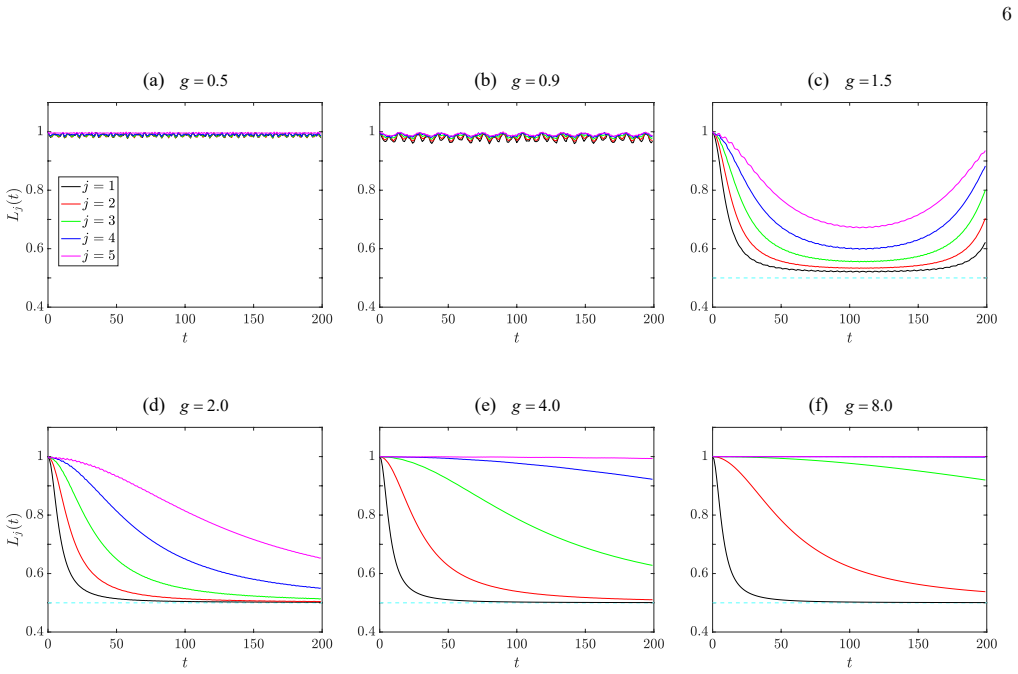
Exact diagonalization of a moderate-length chain under the special boundary condition at low but nonzero temperature would reveal whether the lowest two states are degenerate precisely in the phases predicted by the Kitaev mapping and split in the complementary phases.
Figures


read the original abstract
The topological degeneracy is a characteristic of quantum phase diagram in an Ising chain with transverse field. We revisit the phase diagram at nonzero temperature of an Ising chain with two types of open boundary conditions. In this work, we focus on an alternative boundary condition that not only removes the coupling between the two end sites but also eliminates the transverse field on them. We show that such a system can be exactly mapped onto two independent Kitaev chains, where spinless fermions correspond to domain-wall excitations. This results in a switch in the existence of the topological Kramers-like degeneracy in the phase diagram. The underlying mechanism is analyzed within the Majorana representation, which indicates that such a switch arises from the gauge dependence of the winding number in an SSH chain. The manifestation of bulk-boundary correspondence at nonzero temperature is demonstrated by numerical simulations on finite-size systems. This finding provides insight into the quantum spin chain.
Editorial analysis
A structured set of objections, weighed in public.
Referee Report
Summary. The manuscript analyzes the transverse-field Ising chain under modified open boundary conditions that eliminate both the inter-end coupling and the transverse field on the terminal sites. It claims that this choice permits an exact mapping of the full Hamiltonian onto two independent Kitaev chains, with spinless fermions representing domain-wall excitations. The mapping is asserted to produce a switch in the presence of topological Kramers-like degeneracy across the phase diagram relative to standard open boundaries. The underlying mechanism is traced to the gauge dependence of the winding number in an associated SSH chain within the Majorana representation, and finite-temperature bulk-boundary correspondence is illustrated by numerical simulations on finite-size systems.
Significance. If the exact decoupling holds, the work supplies a concrete illustration of boundary-condition control over finite-temperature topological degeneracy in a one-dimensional spin chain. The result clarifies how the choice of open boundaries can qualitatively alter the phase diagram and the manifestation of bulk-boundary correspondence at nonzero temperature, using only standard Jordan-Wigner and Majorana transformations.
major comments (2)
- [§3] §3 (Mapping to Kitaev chains): the central claim that the modified boundary conditions yield two completely independent Kitaev chains requires an explicit demonstration that all non-local Jordan-Wigner string operators cancel and produce no residual interactions between the two putative chains. The paper must show the full transformed Hamiltonian term-by-term to confirm that the domain-wall fermions remain non-interacting; any surviving cross term would invalidate the decoupling and the predicted switch in degeneracy.
- [§4] §4 (Majorana/winding-number analysis): the assertion that the degeneracy switch originates from gauge dependence of the winding number in the SSH chain must be accompanied by a precise definition of the gauge choice at finite temperature and a direct link to the numerical spectra. Without this, the finite-T bulk-boundary correspondence remains an interpretation rather than a derived consequence of the mapping.
minor comments (3)
- [Abstract] The abstract and introduction use 'Kramers-like' without a brief parenthetical clarifying how it differs from conventional Kramers degeneracy in the presence of time-reversal symmetry.
- [Numerical results section] Figure captions for the numerical spectra should explicitly state the system sizes, boundary-condition parameters, and temperature values used, rather than referring only to 'finite-size systems'.
- [§3] Notation for the two independent Kitaev chains (e.g., left and right or even/odd) should be introduced once and used consistently in both the analytic mapping and the Majorana discussion.
Simulated Author's Rebuttal
We thank the referee for the careful reading and constructive comments. We address the major points below and will revise the manuscript to incorporate the requested clarifications.
read point-by-point responses
-
Referee: [§3] §3 (Mapping to Kitaev chains): the central claim that the modified boundary conditions yield two completely independent Kitaev chains requires an explicit demonstration that all non-local Jordan-Wigner string operators cancel and produce no residual interactions between the two putative chains. The paper must show the full transformed Hamiltonian term-by-term to confirm that the domain-wall fermions remain non-interacting; any surviving cross term would invalidate the decoupling and the predicted switch in degeneracy.
Authors: We appreciate the referee highlighting the need for explicit verification. The manuscript derives the mapping via Jordan-Wigner transformation followed by Majorana redefinition, but does not expand every term. The modified boundaries (no end-to-end coupling and no terminal transverse fields) are chosen precisely so that the non-local strings cancel identically, leaving two decoupled Kitaev chains. In the revision we will insert a complete term-by-term expansion of the transformed Hamiltonian in §3, confirming the absence of cross terms and thereby rigorously establishing the exact decoupling and the resulting degeneracy switch. revision: yes
-
Referee: [§4] §4 (Majorana/winding-number analysis): the assertion that the degeneracy switch originates from gauge dependence of the winding number in the SSH chain must be accompanied by a precise definition of the gauge choice at finite temperature and a direct link to the numerical spectra. Without this, the finite-T bulk-boundary correspondence remains an interpretation rather than a derived consequence of the mapping.
Authors: We agree that the finite-temperature connection requires a sharper statement. The gauge is fixed by the boundary conditions themselves, which select the phase factors appearing in the Majorana operators and hence in the associated SSH chain. Because the mapping to two independent Kitaev chains is an exact operator identity that holds for the full Hamiltonian at any temperature, the degeneracy (or its absence) follows directly from the spectrum of those Kitaev chains rather than from a temperature-dependent winding number. In the revision we will (i) state the boundary-induced gauge choice explicitly and (ii) link it to the numerical finite-T spectra by showing that the degeneracy pattern observed in the simulations is precisely the one predicted by the decoupled Kitaev chains, thereby deriving the bulk-boundary correspondence from the mapping. revision: yes
Circularity Check
No significant circularity; mapping follows from standard transformations
full rationale
The central claim is an exact mapping of the modified open-boundary Ising Hamiltonian to two decoupled Kitaev chains via Jordan-Wigner string operators and Majorana fermions, with the degeneracy switch arising directly from the boundary terms and winding-number gauge dependence. This derivation is self-contained in the paper's Hamiltonian definitions and does not reduce any prediction to a fitted input, self-citation chain, or ansatz imported from the authors' prior work. The numerical finite-size checks serve as independent verification rather than circular confirmation. No load-bearing self-definitional steps or uniqueness theorems from overlapping authors appear in the derivation.
Axiom & Free-Parameter Ledger
axioms (2)
- domain assumption The alternative boundary condition allows an exact mapping onto two independent Kitaev chains with spinless fermions as domain-wall excitations.
- domain assumption The switch in degeneracy arises from the gauge dependence of the winding number in the SSH chain within the Majorana representation.
Lean theorems connected to this paper
-
IndisputableMonolith/Foundation/AlexanderDuality.leanalexander_duality_circle_linking unclear?
unclearRelation between the paper passage and the cited Recognition theorem.
such a system can be exactly mapped onto two independent Kitaev chains, where spinless fermions correspond to domain-wall excitations... gauge dependence of the winding number in an SSH chain
What do these tags mean?
- matches
- The paper's claim is directly supported by a theorem in the formal canon.
- supports
- The theorem supports part of the paper's argument, but the paper may add assumptions or extra steps.
- extends
- The paper goes beyond the formal theorem; the theorem is a base layer rather than the whole result.
- uses
- The paper appears to rely on the theorem as machinery.
- contradicts
- The paper's claim conflicts with a theorem or certificate in the canon.
- unclear
- Pith found a possible connection, but the passage is too broad, indirect, or ambiguous to say the theorem truly supports the claim.
Reference graph
Works this paper leans on
-
[1]
K. L. Zhang and Z. Song, Quantum phase transition in a quantum ising chain at nonzero temperatures, Phys. Rev. Lett.126, 116401 (2021)
work page 2021
-
[2]
K. Zhang and Z. Song, Nonlocal pseudospin dynamics in a quantum ising chain, Journal of Physics Communica- tions6, 095006 (2022)
work page 2022
-
[3]
Pfeuty, The one-dimensional ising model with a trans- verse field, Ann
P. Pfeuty, The one-dimensional ising model with a trans- verse field, Ann. Phys. (NY)57, 79 (1970)
work page 1970
-
[4]
Sachdev,Quantum phase transitions(Cambridge uni- versity press, 2011)
S. Sachdev,Quantum phase transitions(Cambridge uni- versity press, 2011)
work page 2011
- [5]
- [6]
- [7]
- [8]
- [9]
-
[10]
M. P. A. Fisher, Quantum phase transitions in disordered two-dimensional superconductors, Phys. Rev. Lett.65, 923 (1990)
work page 1990
- [11]
-
[12]
Q. Si, S. Rabello, K. Ingersent, and J. L. Smith, Locally critical quantum phase transitions in strongly correlated metals, Nature413, 804 (2001)
work page 2001
-
[13]
D. Porras and J. I. Cirac, Effective quantum spin systems with trapped ions, Phys. Rev. Lett.92, 207901 (2004). 8
work page 2004
- [14]
-
[15]
H. M. Rønnow, R. Parthasarathy, J. Jensen, G. Aep- pli, T. Rosenbaum, and D. McMorrow, Quantum phase transition of a magnet in a spin bath, Science308, 389 (2005)
work page 2005
-
[16]
K. Kim, S. Korenblit, R. Islam, E. Edwards, M. Chang, C. Noh, H. Carmichael, G. Lin, L. Duan, C. J. Wang, et al., Quantum simulation of the transverse ising model with trapped ions, New J. Phys.13, 105003 (2011)
work page 2011
-
[17]
A. Trenkwalder, G. Spagnolli, G. Semeghini, S. Coop, M. Landini, P. Castilho, L. Pezze, G. Modugno, M. In- guscio, A. Smerzi,et al., Quantum phase transitions with parity-symmetry breaking and hysteresis, Nat. Phys.12, 826 (2016)
work page 2016
-
[18]
B. S. Rem, N. K¨ aming, M. Tarnowski, L. Asteria, N. Fl¨ aschner, C. Becker, K. Sengstock, and C. Weiten- berg, Identifying quantum phase transitions using arti- ficial neural networks on experimental data, Nat. Phys. 15, 917 (2019)
work page 2019
-
[19]
A. Polkovnikov, K. Sengupta, A. Silva, and M. Vengalat- tore, Colloquium: Nonequilibrium dynamics of closed in- teracting quantum systems, Rev. Mod. Phys.83, 863 (2011)
work page 2011
-
[20]
F. H. Essler and M. Fagotti, Quench dynamics and relax- ation in isolated integrable quantum spin chains, J. Stat. Mech.2016, 064002 (2016)
work page 2016
-
[21]
N. O. Abeling and S. Kehrein, Quantum quench dynam- ics in the transverse field ising model at nonzero temper- atures, Phys. Rev. B93, 104302 (2016)
work page 2016
-
[22]
P. Jurcevic, H. Shen, P. Hauke, C. Maier, T. Brydges, C. Hempel, B. P. Lanyon, M. Heyl, R. Blatt, and C. F. Roos, Direct observation of dynamical quantum phase transitions in an interacting many-body system, Phys. Rev. Lett.119, 080501 (2017)
work page 2017
- [23]
-
[24]
F. Andraschko and J. Sirker, Dynamical quantum phase transitions and the loschmidt echo: A transfer matrix approach, Phys. Rev. B89, 125120 (2014)
work page 2014
-
[25]
H. T. Quan, Z. Song, X. F. Liu, P. Zanardi, and C. P. Sun, Decay of loschmidt echo enhanced by quantum criticality, Phys. Rev. Lett.96, 140604 (2006)
work page 2006
-
[26]
M. Cozzini, P. Giorda, and P. Zanardi, Quantum phase transitions and quantum fidelity in free fermion graphs, Phys. Rev. B75, 014439 (2007)
work page 2007
-
[27]
M. Heyl, A. Polkovnikov, and S. Kehrein, Dynamical quantum phase transitions in the transverse-field ising model, Phys. Rev. Lett.110, 135704 (2013)
work page 2013
-
[28]
R. Jafari and H. Johannesson, Loschmidt echo revivals: Critical and noncritical, Phys. Rev. Lett.118, 015701 (2017)
work page 2017
-
[29]
B. Mera, C. Vlachou, N. Paunkovi´ c, V. R. Vieira, and O. Viyuela, Dynamical phase transitions at finite tem- perature from fidelity and interferometric loschmidt echo induced metrics, Phys. Rev. B97, 094110 (2018)
work page 2018
-
[30]
A. Y. Kitaev, Unpaired majorana fermions in quantum wires, Phys. Usp.44, 131 (2001)
work page 2001
-
[31]
boundary-dependent topological de- generacy in an ising chain
e. s. Ma, The source data support the figures in the manuscript titled “boundary-dependent topological de- generacy in an ising chain”, 10.5281/zenodo.19212431 (2026)
discussion (0)
Sign in with ORCID, Apple, or X to comment. Anyone can read and Pith papers without signing in.