Recognition: no theorem link
Using Consumer Cameras to Observe Scintillation Light from Radiation
Pith reviewed 2026-05-12 02:25 UTC · model grok-4.3
The pith
Consumer cameras can capture scintillation light from radiation, revealing energy differences in spatial patterns.
A machine-rendered reading of the paper's core claim, the machinery that carries it, and where it could break.
Core claim
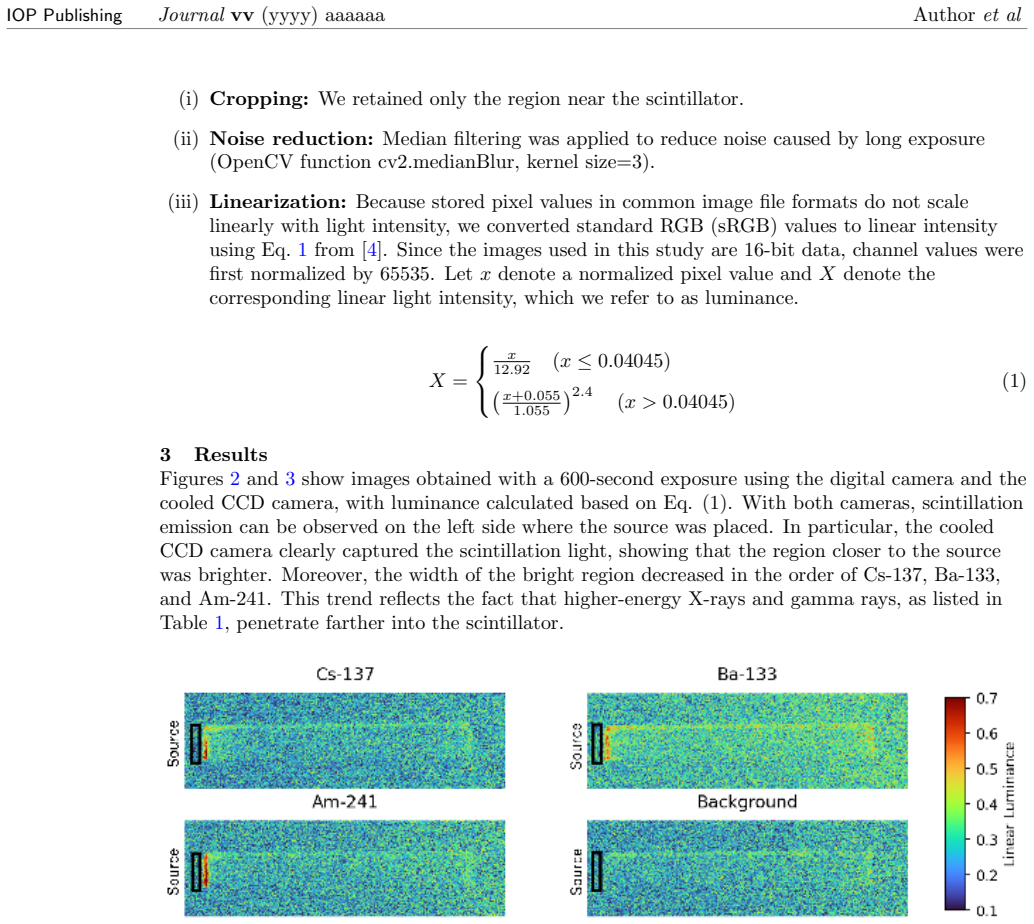
Scintillation light were able to be measured by a general-use camera, and their spatial distribution indicates radiation energy. This method could be utilized as an accessible imaging setup to compare radiation properties in a classroom.
What carries the argument
Consumer camera recording of visible scintillation light emitted when radiation strikes a scintillator.
Load-bearing premise
The light recorded by the cameras comes specifically from radiation-induced scintillation rather than noise, ambient light, or camera artifacts, and the spatial patterns reliably reflect radiation energy without calibration.
What would settle it
Camera images taken with no radiation source present would show identical light patterns to those with sources, or patterns would remain unchanged across different radiation energies and types.
Figures




read the original abstract
For a long time, the cloud chamber was the only educational tool available for measuring radiation. In recent years, simple radiation detectors combining scintillators with silicon photomultipliers have become increasingly common for these purposes. However, students are not able to see the scintillation light, the core process of radiation measurements with scintillators. Therefore, we explored the possibility of detecting scintillation light using two general-purpose cameras. In addition, we examined how differences in the spatial distribution relate to radiation types and energies. Scintillation light were able to be measured by a general-use camera, and their spatial distribution indicates radiation energy. This method could be utilized as an accessible imaging setup to compare radiation properties in a classroom.
Editorial analysis
A structured set of objections, weighed in public.
Referee Report
Summary. The manuscript proposes using consumer-grade cameras to capture scintillation light produced by radiation interactions in a scintillator. It claims that such light can be detected and that the spatial distribution of the light provides information about the radiation type and energy, enabling an accessible educational setup for classroom comparison of radiation properties.
Significance. If the experimental claims are substantiated with appropriate controls and quantitative analysis, this work could offer a low-cost, visual alternative to traditional radiation detection tools like cloud chambers or SiPM-based detectors, allowing students to directly observe the scintillation process and its dependence on radiation characteristics. This has potential educational value in physics classrooms for demonstrating radiation detection principles.
major comments (2)
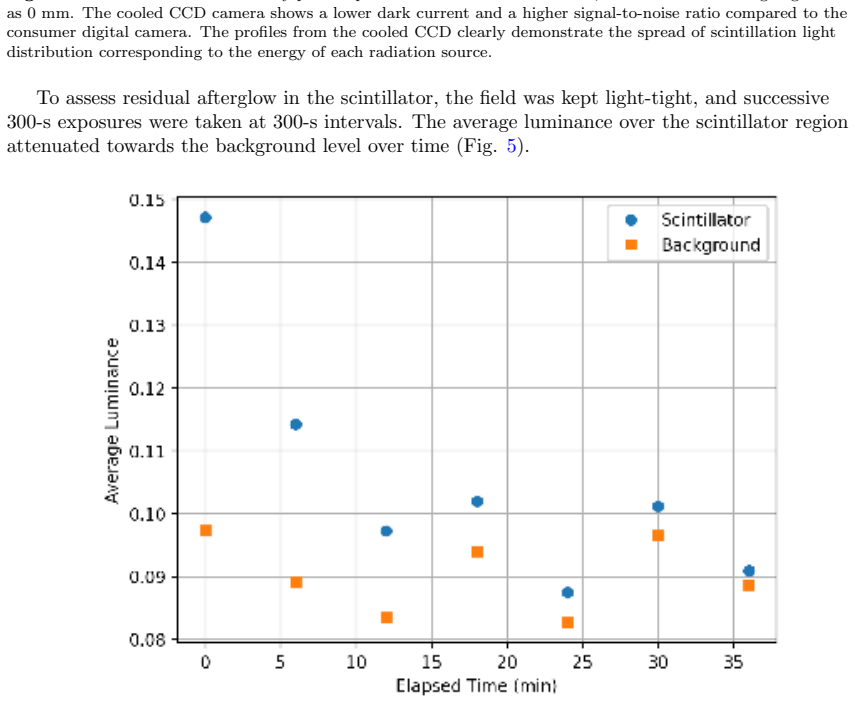
- [Abstract and Results] The abstract states that scintillation light was measured by a general-use camera and that spatial distributions indicate radiation energy, but the manuscript provides no description of control experiments (source-absent or shielded runs), background subtraction procedures, or quantitative metrics (e.g., radial profiles, intensity moments, or statistical comparisons across sources). This absence is load-bearing for the central claim of successful detection and energy correlation.
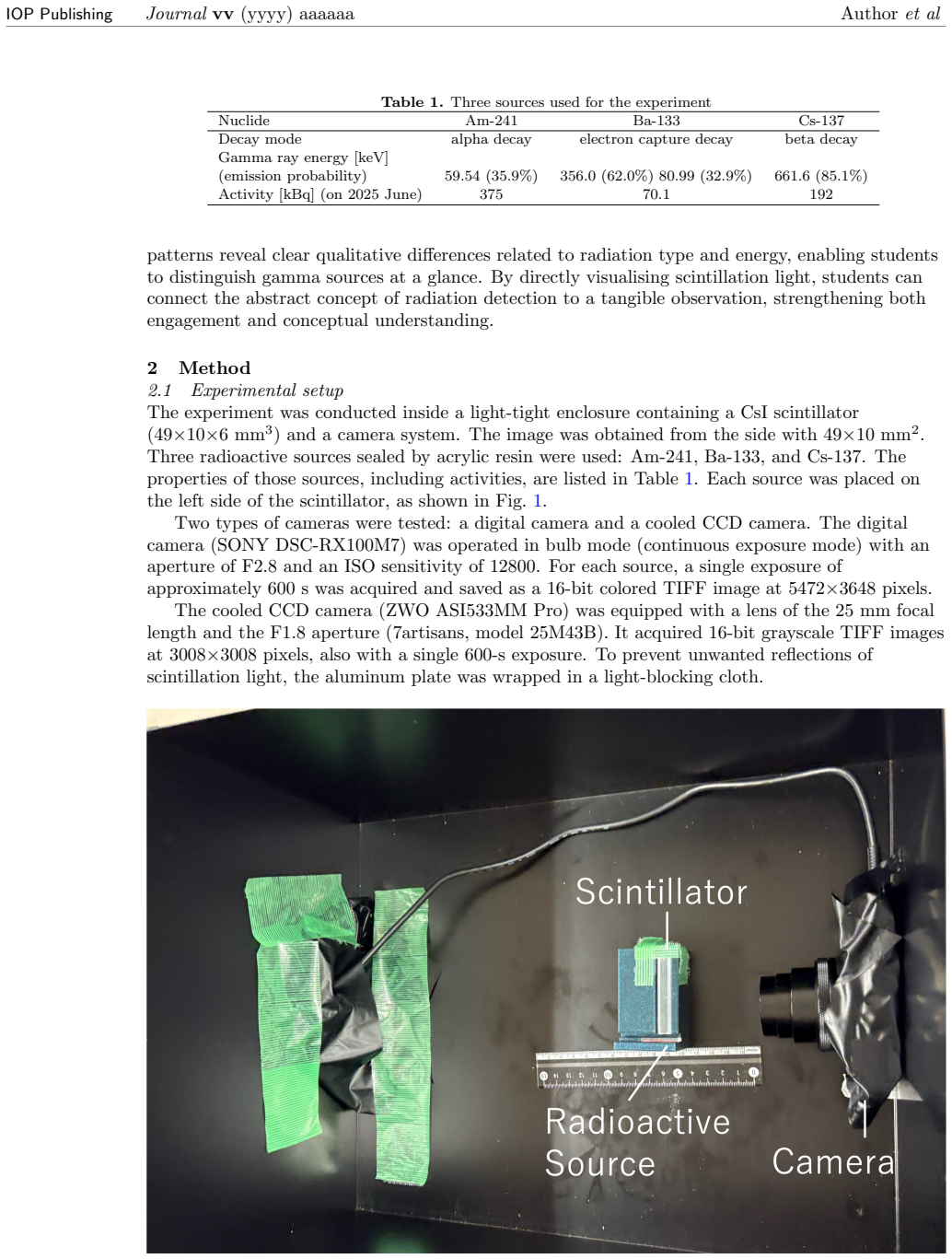
- [Experimental Setup] No details are given on camera calibration, scintillator type, radiation sources used, exposure settings, or how ambient light and sensor noise were excluded, leaving the attribution of captured light specifically to scintillation unverified.
minor comments (2)
- [Abstract] Grammatical issue in the abstract: 'Scintillation light were able to be measured' should read 'Scintillation light was able to be measured'.
- [Abstract] The abstract summarizes results without referencing any figures, tables, or data panels, which reduces the ability to connect claims to evidence.
Simulated Author's Rebuttal
We thank the referee for their thoughtful review and constructive suggestions. We agree that the manuscript would benefit from more detailed descriptions of controls and experimental parameters to better support our claims. We will revise the paper to address these points.
read point-by-point responses
-
Referee: [Abstract and Results] The abstract states that scintillation light was measured by a general-use camera and that spatial distributions indicate radiation energy, but the manuscript provides no description of control experiments (source-absent or shielded runs), background subtraction procedures, or quantitative metrics (e.g., radial profiles, intensity moments, or statistical comparisons across sources). This absence is load-bearing for the central claim of successful detection and energy correlation.
Authors: We acknowledge the importance of control experiments and quantitative analysis for validating our claims. In the revised manuscript, we will add a dedicated section describing the control runs (with sources absent and with shielding), the background subtraction method used, and quantitative metrics such as radial intensity profiles and comparisons of light distributions for different radiation sources and energies. This will substantiate the detection of scintillation light and its correlation with radiation properties. revision: yes
-
Referee: [Experimental Setup] No details are given on camera calibration, scintillator type, radiation sources used, exposure settings, or how ambient light and sensor noise were excluded, leaving the attribution of captured light specifically to scintillation unverified.
Authors: We agree that these experimental details are essential. The revised version will include comprehensive information on the camera models and calibration procedures, the specific scintillator materials employed, the radiation sources (including their activities and energies), camera exposure settings, and the protocols for minimizing ambient light (e.g., conducting experiments in a dark environment) and accounting for sensor noise through dark frame subtraction or similar techniques. revision: yes
Circularity Check
No derivation chain or fitted parameters; purely observational work
full rationale
The manuscript reports direct imaging of light from scintillators using consumer cameras and notes visual differences in spatial patterns with radiation sources. No equations, derivations, parameter fits, or self-citations appear in the provided text. Claims rest on experimental observation rather than any self-referential definition, imported uniqueness result, or reduction of a prediction to its own input. The work is therefore self-contained with no load-bearing circular steps.
Axiom & Free-Parameter Ledger
Reference graph
Works this paper leans on
-
[1]
Axani, Katarzyna Frankiewicz, and Janet M
Spencer N. Axani, Katarzyna Frankiewicz, and Janet M. Conrad. The cosmicwatch desktop muon detector: a self-contained, pocket sized particle detector.Journal of Instrumentation, 13(03):P03019, 2018
work page 2018
-
[2]
H. Enomoto, H. Abe, R. Hoashi, M. Kimura, R. Kita, N. Kobayashi, R. Kono, K. Kumagai, K. Maruta, R. Nakagawa, C. Nose, R. J. Saito, M. Sasaki, M. Takanashi, and K. S. Tanaka. Online support for research activities by high school and junior high school students. In38th International Cosmic Ray Conference (ICRC2023) – Outreach & Education (O&E), volume 444 ...
work page 2024
-
[3]
K.S. Tanaka, H. Abe, H. Enomoto, R. Hoashi, M. Kimura, R. Kita, N. Kobayashi, R. Kono, K. Kumagai, K. Maruta, R. Nakagawa, C. Nose, R. J. Saito, M. Sasaki, and M. Takanashi. Radiation detectors fabricated by secondary students. In38th International Cosmic Ray Conference (ICRC2023) – Outreach & Education (O&E), volume 444 ofPoS, September 2024. Pre-publish...
work page 2024
-
[4]
IEC. Multimedia systems and equipment – colour measurement and management – part 2-1: Colour management – default rgb colour space – srgb. Technical Report IEC 61966-2-1, International Electrotechnical Commission, 1999. 7
work page 1999
discussion (0)
Sign in with ORCID, Apple, or X to comment. Anyone can read and Pith papers without signing in.