Recognition: no theorem link
Who embraces AI in play? Exploratory modeling of player preference profiles toward game AI
Pith reviewed 2026-05-12 04:07 UTC · model grok-4.3
The pith
Players' attitudes toward AI in games form seven stable preference profiles across contexts.
A machine-rendered reading of the paper's core claim, the machinery that carries it, and where it could break.
Core claim
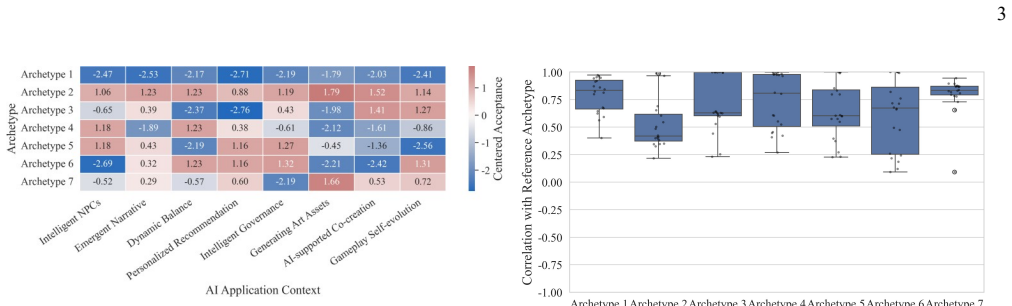
Based on questionnaire data from 771 digital game players, archetypal analysis of centered acceptance ratings across eight representative AI application contexts identifies seven distinctive profiles: AI-Skeptics, Broad AI-Supporters, Creative-Play Explorers, Experience-Oriented Supporters, Systemic Order Advocates, Emotion-Centered Supporters, and Governance-Skeptics. Exploratory logistic regressions associate profile membership with perceived AI literacy, gaming habits, disciplinary background, personality traits, and application-specific priorities.
What carries the argument
Archetypal Analysis applied to players' acceptance ratings across eight AI contexts in games, which extracts interpretable extreme profiles that represent combinations of attitudes.
If this is right
- Designers can segment audiences by these seven profiles instead of relying on average acceptance levels.
- AI features can be tuned differently for each profile, for example prioritizing creative tools for one group and governance controls for another.
- Player traits such as AI literacy and personality become predictors of which profile a person belongs to.
- The profiles supply an empirical vocabulary for discussing player differences in future game AI studies.
Where Pith is reading between the lines
- These profiles might predict actual in-game behavior if future studies track play data rather than self-reports.
- Similar archetypal modeling could be applied to AI attitudes in non-game domains like education or productivity software.
- Testing whether the profiles remain stable when players gain more experience with AI would clarify their long-term usefulness for design.
Load-bearing premise
Self-reported acceptance ratings across eight contexts capture stable, generalizable preference structures rather than context-specific or transient opinions.
What would settle it
A replication study with a new sample of players that recovers a substantially different number or set of profiles would indicate the original clusters do not generalize.
Figures

read the original abstract
Artificial intelligence is increasingly entering digital games through diverse functions. While prior work has shown that player attitudes toward game AI are strongly context-dependent, less is known about how these attitudes are structurally combined within different groups of players. This study addresses this gap by modeling players' cross-context AI acceptance as interpretable attitude profiles. Based on questionnaire data from 771 digital game players, we apply Archetypal Analysis (AA) to centered acceptance ratings across eight representative AI application contexts in games. The analysis identifies seven distinctive profiles: AI-Skeptics, Broad AI-Supporters, Creative-Play Explorers, Experience-Oriented Supporters, Systemic Order Advocates, Emotion-Centered Supporters, and Governance-Skeptics. Exploratory one-vs-rest (OvR) logistic regressions further suggest that profile membership is associated with players' perceived AI literacy, gaming habits, disciplinary background, personality traits, and application-specific priorities. By shifting attention from isolated acceptance judgments to patterned preference structures, this study provides an exploratory empirical vocabulary for segmenting game AI audiences and offers preliminary design implications for more context-sensitive and player-sensitive AI integration in digital games.
Editorial analysis
A structured set of objections, weighed in public.
Referee Report
Summary. The manuscript reports an exploratory analysis of 771 digital game players' acceptance ratings of AI across eight contexts using Archetypal Analysis, resulting in seven identified preference profiles (AI-Skeptics, Broad AI-Supporters, Creative-Play Explorers, Experience-Oriented Supporters, Systemic Order Advocates, Emotion-Centered Supporters, and Governance-Skeptics), with subsequent one-vs-rest logistic regressions exploring associations with player characteristics such as AI literacy, gaming habits, personality traits, and priorities.
Significance. If the profiles are robust, the work provides a useful empirical vocabulary for segmenting game AI audiences by patterned preferences rather than isolated judgments, building on prior context-dependency findings. The large sample and data-driven Archetypal Analysis approach are strengths that could support more tailored AI design in games.
major comments (2)
- [Methods (Archetypal Analysis)] The Archetypal Analysis procedure (Methods section): no criteria are reported for selecting k=7 archetypes (e.g., residual sum-of-squares elbow, cross-validation, or interpretability trade-off), nor any resampling, bootstrap, or split-sample stability checks. Without these, the claim that the seven listed profiles represent distinctive, recoverable structures rather than an arbitrary partitioning of the centered ratings is not fully supported and requires explicit justification and validation.
- [Results] Results section on profile derivation: the distinctiveness of the seven profiles is presented as data-driven output, but the absence of reported archetype stability metrics, error bars, or sensitivity to data subsets leaves open the possibility that modest changes in k or sample could alter or collapse the profiles, directly affecting the central claim of patterned preference structures.
minor comments (2)
- [Abstract] The eight AI application contexts could be listed or briefly described in the abstract or early Methods for accessibility to readers outside game AI research.
- [Results (OvR regressions)] In the OvR regression results, consider adding effect sizes or standardized coefficients alongside significance to better convey the strength of associations with profile membership.
Simulated Author's Rebuttal
We thank the referee for these constructive comments on the Archetypal Analysis. We agree that greater transparency and validation are needed for the choice of k=7 and the robustness of the resulting profiles. Below we respond point by point and indicate the revisions we will make.
read point-by-point responses
-
Referee: The Archetypal Analysis procedure (Methods section): no criteria are reported for selecting k=7 archetypes (e.g., residual sum-of-squares elbow, cross-validation, or interpretability trade-off), nor any resampling, bootstrap, or split-sample stability checks. Without these, the claim that the seven listed profiles represent distinctive, recoverable structures rather than an arbitrary partitioning of the centered ratings is not fully supported and requires explicit justification and validation.
Authors: We agree that explicit selection criteria and stability checks were not reported. In the original analysis, k was chosen after inspecting the RSS elbow (which flattened between k=6 and k=8) together with the interpretability of the seven resulting archetypes in the game-AI context. We will revise the Methods section to report the full RSS curve for k=2 to 10, state the combined RSS-plus-interpretability rule, and add a bootstrap stability analysis (1000 resamples) that quantifies variability in archetype vectors and membership probabilities. These additions will directly address the concern that the profiles might be arbitrary. revision: yes
-
Referee: Results section on profile derivation: the distinctiveness of the seven profiles is presented as data-driven output, but the absence of reported archetype stability metrics, error bars, or sensitivity to data subsets leaves open the possibility that modest changes in k or sample could alter or collapse the profiles, directly affecting the central claim of patterned preference structures.
Authors: We acknowledge that stability metrics and sensitivity checks are missing from the current Results. The revised manuscript will include bootstrap-derived stability metrics (e.g., mean cosine similarity of archetypes across resamples and standard deviations of membership probabilities) and a sensitivity table showing profile consistency for k=6 and k=8. These quantitative results will demonstrate that the seven profiles remain recoverable and distinctive, thereby supporting rather than undermining the central claim. revision: yes
Circularity Check
No circularity: profiles derived via standard AA on independent survey data
full rationale
The derivation applies Archetypal Analysis to centered acceptance ratings from 771 players across eight contexts, yielding seven named profiles as direct outputs of the unsupervised decomposition. Subsequent OvR logistic regressions test associations with external variables (literacy, habits, traits) but do not feed back into profile construction. No equations, self-definitions, fitted parameters renamed as predictions, or load-bearing self-citations appear; the method is a standard technique applied to fresh questionnaire data without reducing outputs to inputs by construction. This is self-contained against external benchmarks.
Axiom & Free-Parameter Ledger
free parameters (1)
- Number of archetypes
axioms (1)
- domain assumption Centered acceptance ratings across eight contexts form a suitable input space for archetypal analysis to recover meaningful preference structures.
Reference graph
Works this paper leans on
-
[1]
1Who embraces AI in play? Exploratory modeling ofplayer preference profiles toward game AI1stTing-Chen HsuSchool of Animation and Digital ArtsCommunication University of ChinaBeijing, Chinatingchenhsu.ac@gmail.com2ndJiangxu LinSchool of Animation and Digital ArtsCommunication University of ChinaBeijing, Chinachinalinjiangxu@gmail.com3rdWenran ChenSchool o...
discussion (0)
Sign in with ORCID, Apple, or X to comment. Anyone can read and Pith papers without signing in.