Recognition: 2 theorem links
· Lean TheoremMitigating cycle skipping in full waveform inversion using max-pooling-based approximate envelope and shot patching
Pith reviewed 2026-05-12 02:38 UTC · model grok-4.3
The pith
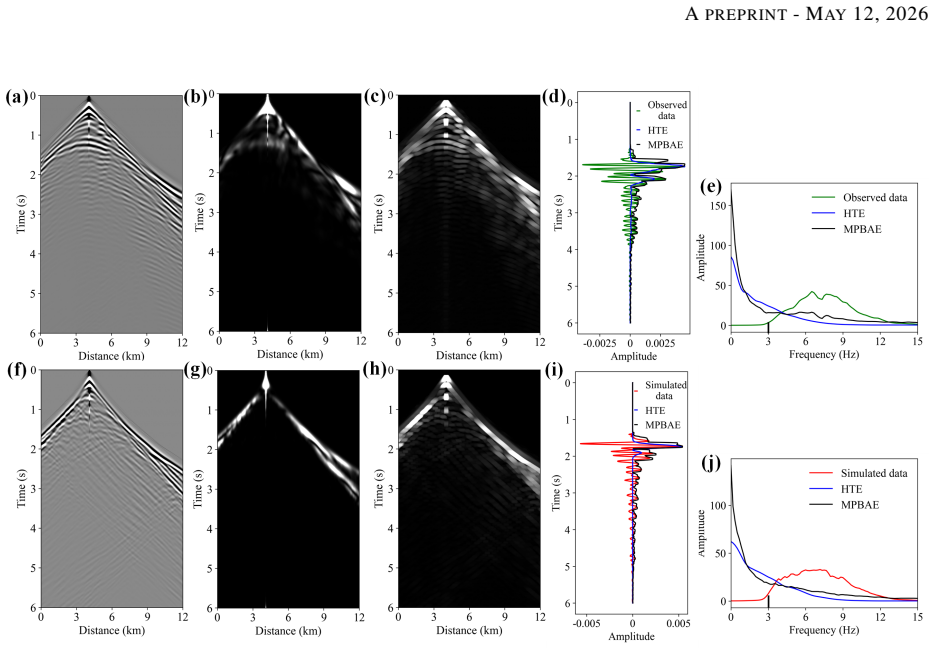
A max-pooling sequence yields a richer low-frequency envelope than the Hilbert transform, letting full-waveform inversion escape cycle skipping from poor initial models.
A machine-rendered reading of the paper's core claim, the machinery that carries it, and where it could break.
Core claim
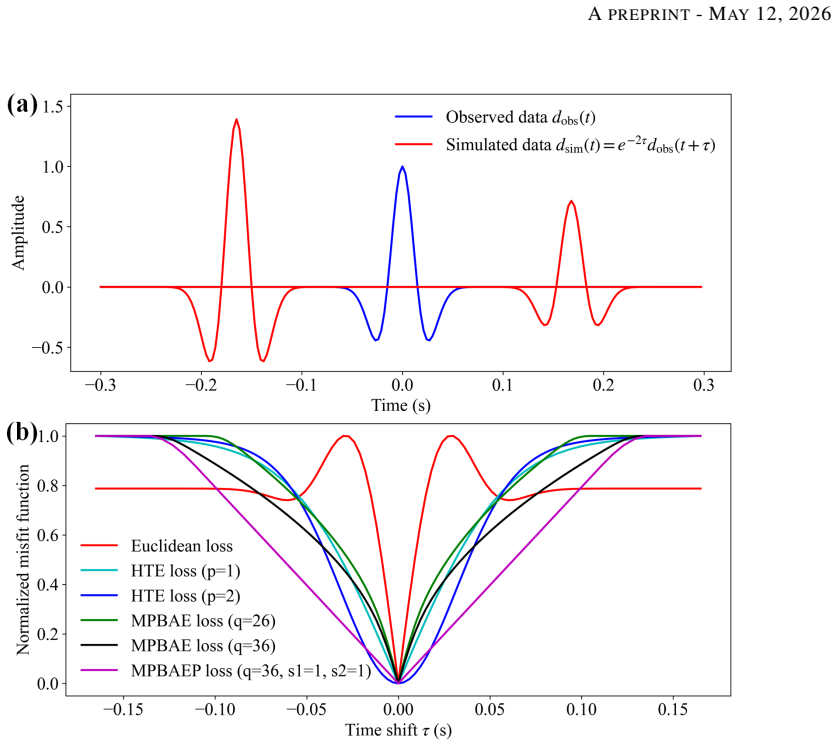
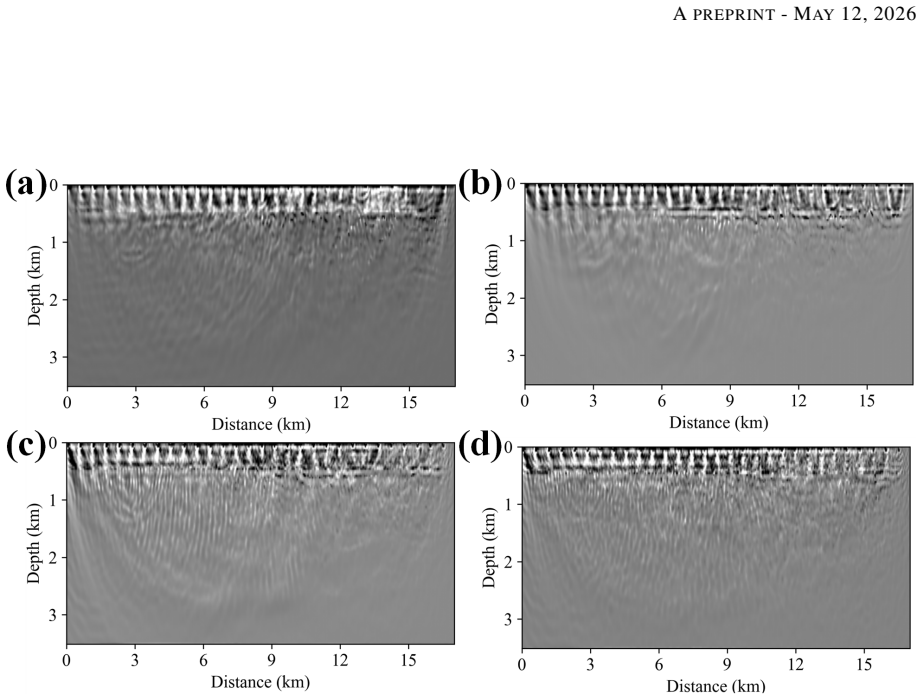
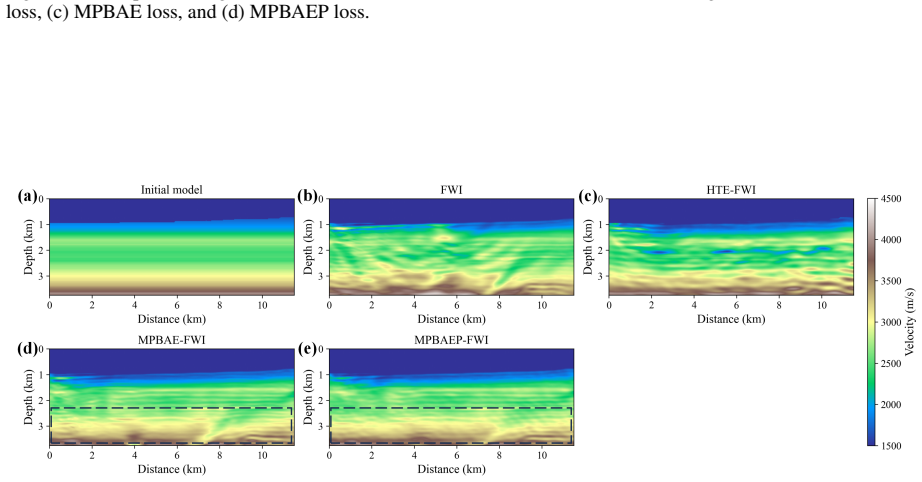
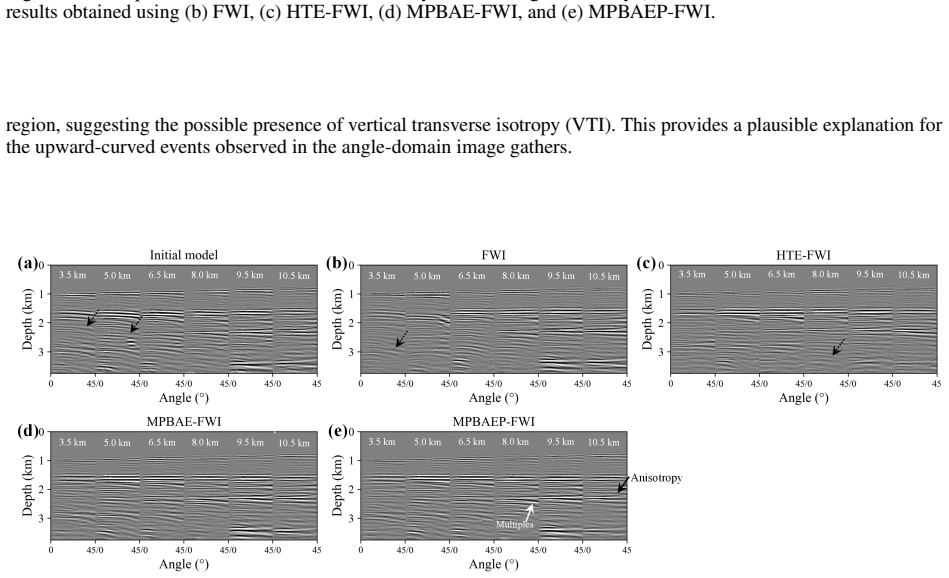
The authors compute an approximate envelope by applying a sequence of 2D max-pooling operations to the seismic data; this envelope contains richer low-frequency components than the Hilbert-transform envelope and therefore reduces cycle skipping. They further formulate an MPBAEP loss by dividing each shot gather into patches and exploiting the normalization property of the Euclidean misfit inside each patch, which produces locally balanced adjoint sources and accelerates convergence.
What carries the argument
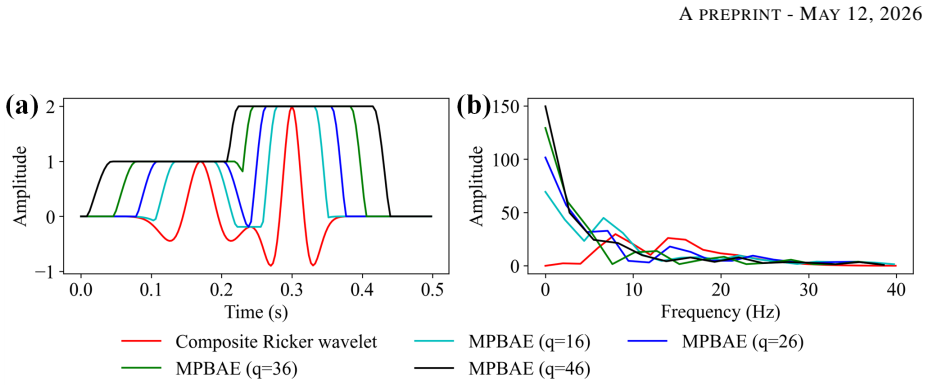
The max-pooling-based approximate envelope (MPBAE), obtained by successive 2D max-pooling operations that extract low-frequency information directly from the data without a Hilbert transform.
If this is right
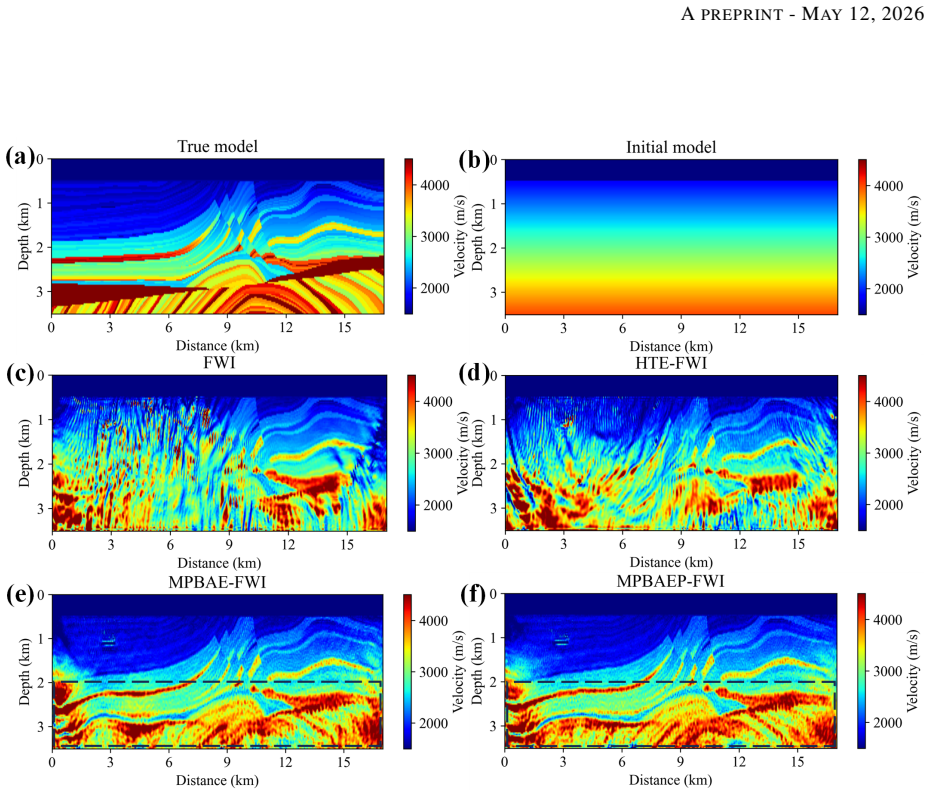
- MPBAE-FWI succeeds on initial models too inaccurate for HTE-FWI to converge.
- The patching step in MPBAEP-FWI improves gradient balance and shortens the number of iterations needed.
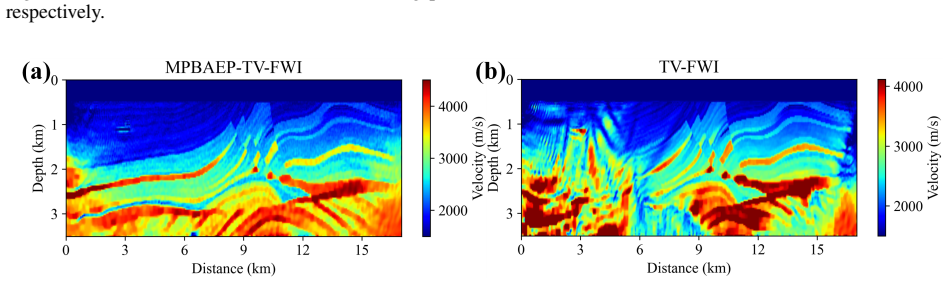
- Both variants remain effective on field data as well as synthetic data.
- The method directly targets the low-frequency deficiency that currently limits many FWI applications.
Where Pith is reading between the lines
- If max-pooling preserves enough phase information, the same envelope could be inserted into other waveform-based imaging methods that currently rely on Hilbert transforms.
- The local normalization effect of patching might generalize to 3D or to other misfit functions that suffer from uneven illumination.
- Because the envelope is generated by cheap pooling rather than a transform, the approach may lower the cost of generating low-frequency data for large-scale inversions.
Load-bearing premise
The sequence of 2D max-pooling operations produces an envelope containing genuinely richer low-frequency information without introducing artifacts or losing phase information critical for the inversion.
What would settle it
On a controlled synthetic test with a deliberately poor initial model, MPBAE-FWI or MPBAEP-FWI should fail to reach a lower data misfit or a more accurate velocity model than standard HTE-FWI if the max-pooled envelope does not actually supply usable extra low-frequency content.
Figures









read the original abstract
Full waveform inversion (FWI) can produce accurate subsurface velocity models. However, the lack of sufficiently low-frequency content in field data often causes cycle skipping and traps the inversion in local minima. The Hilbert-transform envelope (HTE) provides a low-frequency representation that helps mitigate cycle skipping, but it may be insufficient when the initial velocity model is highly inaccurate. To further enhance low-frequency information and reduce dependence on the initial model, we compute an approximate envelope using a sequence of 2D max-pooling operations. Compared with HTE, the resulting max-pooling-based approximate envelope (MPBAE) contains richer low-frequency components and better mitigates cycle skipping. We further combine the MPBAE loss with a shot patching strategy and exploit the inherent normalization property of the Euclidean loss to formulate the MPBAEP loss, in which each shot gather is divided into localized patches for misfit evaluation. This introduces local adjoint-source energy balancing, as the adjoint source associated with the Euclidean loss exhibits a normalization effect within each local region, thereby improving gradient balance and accelerating convergence. Numerical experiments on synthetic and field data demonstrate that MPBAE-FWI significantly outperforms HTE-FWI when the initial model is poor, while MPBAEP-FWI further improves inversion accuracy.
Editorial analysis
A structured set of objections, weighed in public.
Referee Report
Summary. The paper proposes using a sequence of 2D max-pooling operations to compute an approximate envelope (MPBAE) for full-waveform inversion (FWI) that supplies richer low-frequency content than the conventional Hilbert-transform envelope (HTE), thereby reducing cycle skipping when the initial velocity model is poor. It further combines the MPBAE misfit with a shot-patching strategy (MPBAEP) that exploits local normalization of the Euclidean loss to improve gradient balance. Numerical experiments on synthetic and field data are reported to show that MPBAE-FWI outperforms HTE-FWI and that MPBAEP-FWI yields additional accuracy gains.
Significance. If the central claims hold, the work supplies a practical, parameter-light algorithmic improvement for a long-standing difficulty in seismic imaging. The numerical experiments on both synthetic and field data constitute a concrete strength, offering direct evidence of behavior under realistic conditions rather than purely theoretical arguments.
major comments (2)
- [Abstract] Abstract: the statement that MPBAE-FWI 'significantly outperforms' HTE-FWI supplies no quantitative metrics (e.g., data misfit reduction, model error norms, or convergence curves), error bars, or details on data selection and inversion parameters, rendering the magnitude and reproducibility of the claimed improvement impossible to assess.
- [Method (MPBAE)] Section describing the MPBAE construction: no Fourier analysis of the composite max-pooling operator, no comparison of its spectrum to the Hilbert envelope below the lowest data frequency, and no demonstration that phase/traveltime fidelity is preserved are provided. Without such support, any observed improvement could be attributable to the shot-patching normalization rather than to genuinely richer low-frequency content in the envelope.
minor comments (1)
- [Numerical experiments] Ensure that the precise pooling kernel sizes, stride values, and patch dimensions are stated explicitly in the text and figure captions so that the experiments can be reproduced.
Simulated Author's Rebuttal
We thank the referee for the constructive and detailed review. We address each major comment point by point below and have revised the manuscript to strengthen the presentation of our results and methods.
read point-by-point responses
-
Referee: [Abstract] Abstract: the statement that MPBAE-FWI 'significantly outperforms' HTE-FWI supplies no quantitative metrics (e.g., data misfit reduction, model error norms, or convergence curves), error bars, or details on data selection and inversion parameters, rendering the magnitude and reproducibility of the claimed improvement impossible to assess.
Authors: We agree that the abstract would be strengthened by including quantitative support for the performance claim. In the revised version we will update the abstract to report specific metrics drawn from the synthetic and field-data experiments, including model-error-norm reductions and data-misfit values for MPBAE-FWI versus HTE-FWI, together with a concise statement of the key inversion parameters and data characteristics used. revision: yes
-
Referee: [Method (MPBAE)] Section describing the MPBAE construction: no Fourier analysis of the composite max-pooling operator, no comparison of its spectrum to the Hilbert envelope below the lowest data frequency, and no demonstration that phase/traveltime fidelity is preserved are provided. Without such support, any observed improvement could be attributable to the shot-patching normalization rather than to genuinely richer low-frequency content in the envelope.
Authors: We thank the referee for identifying this analytical gap. While the manuscript already presents separate numerical results for MPBAE-FWI (prior to shot patching) that demonstrate improved cycle-skipping mitigation on both synthetic and field data, we acknowledge the value of explicit spectral support. In the revision we will add a dedicated subsection that (i) derives the frequency response of the composite 2-D max-pooling operator, (ii) compares its spectrum directly with that of the Hilbert-transform envelope below the lowest data frequency, and (iii) discusses preservation of traveltime and phase information. These additions will help isolate the contribution of the richer low-frequency content from any effects of the subsequent shot-patching normalization. revision: yes
Circularity Check
No significant circularity; algorithmic proposal validated empirically
full rationale
The paper presents a methodological contribution consisting of a sequence of 2D max-pooling operations to form an approximate envelope and a shot-patching strategy for the misfit function. These are described as algorithmic constructions without any derivation chain that reduces a claimed result to its own inputs by construction. No equations are shown that equate a prediction to a fitted parameter, no load-bearing self-citations appear in the abstract or described text, and the performance claims rest on numerical experiments on synthetic and field data rather than on a self-referential mathematical identity. The work is therefore self-contained against external benchmarks.
Axiom & Free-Parameter Ledger
axioms (1)
- domain assumption Seismic wave propagation is governed by the wave equation
Lean theorems connected to this paper
-
IndisputableMonolith/Cost/FunctionalEquation.leanwashburn_uniqueness_aczel unclear?
unclearRelation between the paper passage and the cited Recognition theorem.
we compute an approximate envelope using a sequence of 2D max-pooling operations... LM P BAE = sqrt(sum (ζsim − ζobs)²)
-
IndisputableMonolith/Foundation/BranchSelection.leanbranch_selection unclear?
unclearRelation between the paper passage and the cited Recognition theorem.
Convexity analysis... MPBAE loss exhibits better convexity than the HTE loss
What do these tags mean?
- matches
- The paper's claim is directly supported by a theorem in the formal canon.
- supports
- The theorem supports part of the paper's argument, but the paper may add assumptions or extra steps.
- extends
- The paper goes beyond the formal theorem; the theorem is a base layer rather than the whole result.
- uses
- The paper appears to rely on the theorem as machinery.
- contradicts
- The paper's claim conflicts with a theorem or certificate in the canon.
- unclear
- Pith found a possible connection, but the passage is too broad, indirect, or ambiguous to say the theorem truly supports the claim.
Reference graph
Works this paper leans on
-
[1]
Inversion of seismic reflection data in the acoustic approximation.Geophysics, 49(8):1259–1266, 1984
Albert Tarantola. Inversion of seismic reflection data in the acoustic approximation.Geophysics, 49(8):1259–1266, 1984
work page 1984
-
[2]
An overview of full-waveform inversion in exploration geophysics.Geophysics, 74(6):WCC1–WCC26, 2009
Jean Virieux and Stéphane Operto. An overview of full-waveform inversion in exploration geophysics.Geophysics, 74(6):WCC1–WCC26, 2009
work page 2009
-
[3]
Full waveform inversion using envelope-based global correlation norm
Ju-Won Oh and Tariq Alkhalifah. Full waveform inversion using envelope-based global correlation norm. Geophysical Journal International, 213(2):815–823, 2018
work page 2018
-
[4]
Optimal transport for seismic full waveform inversion.arXiv preprint arXiv:1602.01540, 2016
Bjorn Engquist, Brittany D Froese, and Yunan Yang. Optimal transport for seismic full waveform inversion.arXiv preprint arXiv:1602.01540, 2016
-
[5]
Bingbing Sun and Tariq Alkhalifah. The application of an optimal transport to a preconditioned data matching function for robust waveform inversion.Geophysics, 84(6):R923–R945, 2019
work page 2019
-
[6]
SLEF Da Silva, A Karsou, A de Souza, F Capuzzo, F Costa, R Moreira, and M Cetale. A graph-space optimal transport objective function based on q-statistics to mitigate cycle-skipping issues in fwi.Geophysical Journal International, 231(2):1363–1385, 2022
work page 2022
-
[7]
Adaptive waveform inversion: Theory.Geophysics, 81(6):R429–R445, 2016
Michael Warner and Lluís Guasch. Adaptive waveform inversion: Theory.Geophysics, 81(6):R429–R445, 2016
work page 2016
-
[8]
Bingbing Sun and Tariq A Alkhalifah. Joint minimization of the mean and information entropy of the matching filter distribution for a robust misfit function in full-waveform inversion.IEEE Transactions on Geoscience and Remote Sensing, 58(7):4704–4720, 2020
work page 2020
-
[9]
Peng Yong, Romain Brossier, Ludovic Métivier, and Jean Virieux. Localized adaptive waveform inversion: theory and numerical verification.Geophysical Journal International, 233(2):1055–1080, 2023
work page 2023
-
[10]
Seismic envelope inversion and modulation signal model.Geophysics, 79(3):W A13–W A24, 2014
Ru-Shan Wu, Jingrui Luo, and Bangyu Wu. Seismic envelope inversion and modulation signal model.Geophysics, 79(3):W A13–W A24, 2014
work page 2014
-
[11]
Guoxin Chen, Wencai Yang, Yanan Liu, Hanchuang Wang, and Xingguo Huang. Salt structure elastic full waveform inversion based on the multiscale signed envelope.IEEE Transactions on Geoscience and Remote Sensing, 60:1–12, 2022
work page 2022
-
[12]
Chao Song, Yanghua Wang, Alan Richardson, and Cai Liu. Weighted envelope correlation-based waveform inversion using automatic differentiation.IEEE Transactions on Geoscience and Remote Sensing, 61:1–11, 2023
work page 2023
-
[13]
Fangshu Yang and Jianwei Ma. Fwigan: Full-waveform inversion via a physics-informed generative adversarial network.Journal of Geophysical Research: Solid Earth, 128(4):e2022JB025493, 2023
work page 2023
-
[14]
Omar M Saad, Randy Harsuko, and Tariq Alkhalifah. Siamesefwi: A deep learning network for enhanced full waveform inversion.Journal of Geophysical Research: Machine Learning and Computation, 1(3):e2024JH000227, 2024
work page 2024
-
[15]
Efficient learning of cnns using patch based features
Alon Brutzkus, Amir Globerson, Eran Malach, Alon Regev Netser, and Shai Shalev-Schwartz. Efficient learning of cnns using patch based features. InInternational Conference on Machine Learning, pages 2336–2356. PMLR, 2022
work page 2022
-
[16]
Patch-based abnormality maps for improved deep learning-based classification of huntington’s disease
Kilian Hett, Rémi Giraud, Hans Johnson, Jane S Paulsen, Jeffrey D Long, and Ipek Oguz. Patch-based abnormality maps for improved deep learning-based classification of huntington’s disease. InInternational Conference on Medical Image Computing and Computer-Assisted Intervention, pages 636–645. Springer, 2020
work page 2020
-
[17]
Nicolas Pielawski and Carolina Wählby. Introducing hann windows for reducing edge-effects in patch-based image segmentation.PLoS ONE, 15(3):e0229839, 2020
work page 2020
-
[18]
R-E Plessix. A review of the adjoint-state method for computing the gradient of a functional with geophysical applications.Geophysical Journal International, 167(2):495–503, 2006. 18 APREPRINT- MAY12, 2026
work page 2006
-
[19]
Alan Richardson. Seismic full-waveform inversion using deep learning tools and techniques.arXiv preprint arXiv:1801.07232, 2018
-
[20]
Seg/eaeg 3-d modeling project: 2nd update
Fred Aminzadeh, N Burkhard, L Nicoletis, Fabio Rocca, and K Wyatt. Seg/eaeg 3-d modeling project: 2nd update. The Leading Edge, 13(9):949–952, 1994
work page 1994
-
[21]
Marmousi2: An elastic upgrade for marmousi.The leading edge, 25(2):156–166, 2006
Gary S Martin, Robert Wiley, and Kurt J Marfurt. Marmousi2: An elastic upgrade for marmousi.The leading edge, 25(2):156–166, 2006
work page 2006
-
[22]
Xinru Mu, Omar M Saad, and Tariq Alkhalifah. Full waveform inversion with cnn-based velocity representation extension.Geophysical Journal International, page ggag034, 2026
work page 2026
-
[23]
Ernie Esser, Lluis Guasch, Tristan van Leeuwen, Aleksandr Y Aravkin, and Felix J Herrmann. Total variation regularization strategies in full-waveform inversion.SIAM Journal on Imaging Sciences, 11(1):376–406, 2018. 19
work page 2018
discussion (0)
Sign in with ORCID, Apple, or X to comment. Anyone can read and Pith papers without signing in.