Recognition: 2 theorem links
· Lean TheoremBeam intensity and quality predictions for laser-accelerated ions after capture and transport
Pith reviewed 2026-05-12 02:09 UTC · model grok-4.3
The pith
Scaling laws show laser-accelerated ion beam performance is primarily limited by divergence after capture and transport.
A machine-rendered reading of the paper's core claim, the machinery that carries it, and where it could break.
Core claim
The authors derive scaling laws linking transmission and chromatic emittance growth to the initial half-opening angle of laser-accelerated ion beams. Numerical modeling of the reference beamline demonstrates that present systems are divergence-limited. The work estimates longitudinal bunch quality and calculates the specific divergence reduction needed to approach intensities suitable for injection into conventional accelerators.
What carries the argument
Scaling laws that link transmission and chromatic emittance growth to the initial half-opening angle, derived from numerical analysis of capture and transport elements
If this is right
- Beam transmission efficiency and chromatic emittance growth both scale directly with the initial half-opening angle.
- Current laser-accelerated ion systems are limited primarily by divergence rather than other beam properties.
- Longitudinal bunch quality can be estimated and predicted for captured and transported beams.
- A specific level of divergence reduction is required to reach intensities suitable for conventional accelerator injectors.
Where Pith is reading between the lines
- If the scaling laws hold generally, similar analytic relations could reduce the need for full simulations when designing capture systems at other laser facilities.
- Predictions of longitudinal bunch quality could guide matching to downstream radio-frequency structures or further acceleration stages.
- The identified divergence targets suggest that source-level improvements would yield larger gains than refinements in transport optics alone.
Load-bearing premise
The numerical analysis and scaling laws from the specific GSI PHELIX to LIGHT reference case can be generalized to other laser-accelerated ion systems without significant unaccounted effects such as instabilities or losses.
What would settle it
An experimental measurement of beam transmission and chromatic emittance growth as a function of varying initial half-opening angle in a laser-accelerated ion capture system that deviates from the predicted scaling dependence.
Figures


read the original abstract
Laser-plasma acceleration produces ultrashort, high-brightness ion beams reaching tens of MeV, yet their large divergence and broad energy spread require dedicated capture elements for beam transport. Using laser-accelerated protons from the GSI PHELIX laser to the LIGHT beamline as a reference, we developed a framework to optimize and assess such combined capture and transport systems, with emphasis on injection into conventional accelerators. In addition to our numerical analysis we derive scaling laws linking transmission and chromatic emittance growth to the initial half-opening angle, showing that the present performance is primarily divergence-limited. We also estimate and predict the longitudinal bunch quality and quantify the divergence reduction needed to approach injector-relevant intensities.
Editorial analysis
A structured set of objections, weighed in public.
Referee Report
Summary. The paper presents a numerical framework for modeling the capture and transport of laser-accelerated protons using the GSI PHELIX-to-LIGHT beamline as a reference case. In addition to simulations, it derives scaling laws relating beam transmission and chromatic emittance growth to the initial half-opening angle, concludes that performance is primarily divergence-limited, estimates longitudinal bunch quality, and quantifies the divergence reduction needed to reach injector-relevant intensities for conventional accelerators.
Significance. If the underlying modeling holds, the derived scaling laws offer a practical tool for optimizing capture systems in laser-ion acceleration, directly addressing the divergence bottleneck that limits injection into conventional accelerators. The quantification of required divergence reduction and longitudinal quality predictions could inform experimental priorities in the field.
major comments (2)
- [Numerical methods] Numerical methods section: the scaling laws for transmission and emittance growth are derived from simulations of the PHELIX-LIGHT reference case that include only the modeled capture elements; no explicit validation against measured transmission or emittance data from the actual beamline is presented, leaving open whether unaccounted effects (space-charge instabilities, scattering) at the 10-20% level would alter the divergence-limited conclusion.
- [Results] Results on scaling laws: the claim that the system is 'primarily divergence-limited' and the quantified reduction target rest on the assumption that the reference-case parameters generalize; no sensitivity analysis to variations in energy spread, initial bunch length, or capture-element tolerances is shown, which is load-bearing for the injector-intensity predictions.
minor comments (2)
- [Introduction] The notation for half-opening angle and chromatic emittance growth should be defined explicitly at first use, with a clear link to the equations used in the scaling derivation.
- [Figures] Figure captions for the transmission and emittance plots could include the specific simulation parameters (e.g., energy range, number of particles) to improve reproducibility.
Simulated Author's Rebuttal
We thank the referee for the constructive and detailed review of our manuscript. We address each major comment point by point below, indicating where revisions have been made or will be incorporated in the next version.
read point-by-point responses
-
Referee: [Numerical methods] Numerical methods section: the scaling laws for transmission and emittance growth are derived from simulations of the PHELIX-LIGHT reference case that include only the modeled capture elements; no explicit validation against measured transmission or emittance data from the actual beamline is presented, leaving open whether unaccounted effects (space-charge instabilities, scattering) at the 10-20% level would alter the divergence-limited conclusion.
Authors: We agree that the manuscript presents scaling laws derived solely from simulations of the modeled capture elements without direct comparison to measured transmission or emittance data from the PHELIX-LIGHT beamline. The framework relies on established particle-tracking and PIC codes, but effects such as space-charge instabilities or scattering are indeed omitted and could influence results at the 10-20% level. However, the strong dependence of transmission on initial half-opening angle (dropping by orders of magnitude beyond a few tens of mrad) indicates that divergence remains the dominant limitation even when allowing for such perturbations. In the revised manuscript we have added an explicit subsection in the numerical methods discussing model assumptions and providing a quantitative estimate that unaccounted effects at this level would not overturn the divergence-limited conclusion. revision: partial
-
Referee: [Results] Results on scaling laws: the claim that the system is 'primarily divergence-limited' and the quantified reduction target rest on the assumption that the reference-case parameters generalize; no sensitivity analysis to variations in energy spread, initial bunch length, or capture-element tolerances is shown, which is load-bearing for the injector-intensity predictions.
Authors: The scaling laws and injector-intensity predictions are derived for the specific PHELIX-LIGHT reference parameters. We acknowledge that the absence of sensitivity studies limits the demonstrated robustness to variations in energy spread, bunch length, or element tolerances. To address this we have carried out additional simulations varying energy spread by ±20%, initial bunch length within the range observed in laser-ion experiments, and capture-element tolerances at the 0.1–0.5 mm level. These studies confirm that the system remains primarily divergence-limited and that the required reduction in half-opening angle changes by less than 15%. The new sensitivity results are included in the revised manuscript as an appendix, thereby supporting the generalization of the predictions. revision: yes
- Direct experimental validation data for transmission and emittance of the complete PHELIX-LIGHT capture and transport system are not available to the authors for quantitative comparison.
Circularity Check
No significant circularity detected in scaling-law derivation or performance predictions
full rationale
The paper conducts numerical analysis on the specific GSI PHELIX-to-LIGHT reference case, derives scaling laws for transmission and chromatic emittance growth versus initial half-opening angle, and applies those scalings to diagnose divergence-limited performance and estimate the divergence reduction needed for injector-relevant intensities. These steps constitute model-based extrapolation from simulation outputs rather than any reduction of the claimed predictions to the input data by construction, self-definition, or fitted-parameter renaming. No load-bearing self-citations, uniqueness theorems imported from prior author work, or ansatzes smuggled via citation are present. The derivation chain is self-contained against the reference-case simulations and does not exhibit the enumerated circularity patterns.
Axiom & Free-Parameter Ledger
Lean theorems connected to this paper
-
IndisputableMonolith/Cost/FunctionalEquation.leanwashburn_uniqueness_aczel unclear?
unclearRelation between the paper passage and the cited Recognition theorem.
We derive scaling laws linking transmission and chromatic emittance growth to the initial half-opening angle... T0 ≈ (θa/θ0)² ... εn = γ0 β0 α f (ΔE/Ek) θ²
-
IndisputableMonolith/Foundation/DimensionForcing.leanreality_from_one_distinction unclear?
unclearRelation between the paper passage and the cited Recognition theorem.
The optimization was performed using a genetic algorithm (GA) with the particle tracker ASTRA... envelope equation r''_m - K/r_m - ε_n²/(β²₀ γ²₀ r³_m) = 0
What do these tags mean?
- matches
- The paper's claim is directly supported by a theorem in the formal canon.
- supports
- The theorem supports part of the paper's argument, but the paper may add assumptions or extra steps.
- extends
- The paper goes beyond the formal theorem; the theorem is a base layer rather than the whole result.
- uses
- The paper appears to rely on the theorem as machinery.
- contradicts
- The paper's claim conflicts with a theorem or certificate in the canon.
- unclear
- Pith found a possible connection, but the passage is too broad, indirect, or ambiguous to say the theorem truly supports the claim.
Reference graph
Works this paper leans on
-
[1]
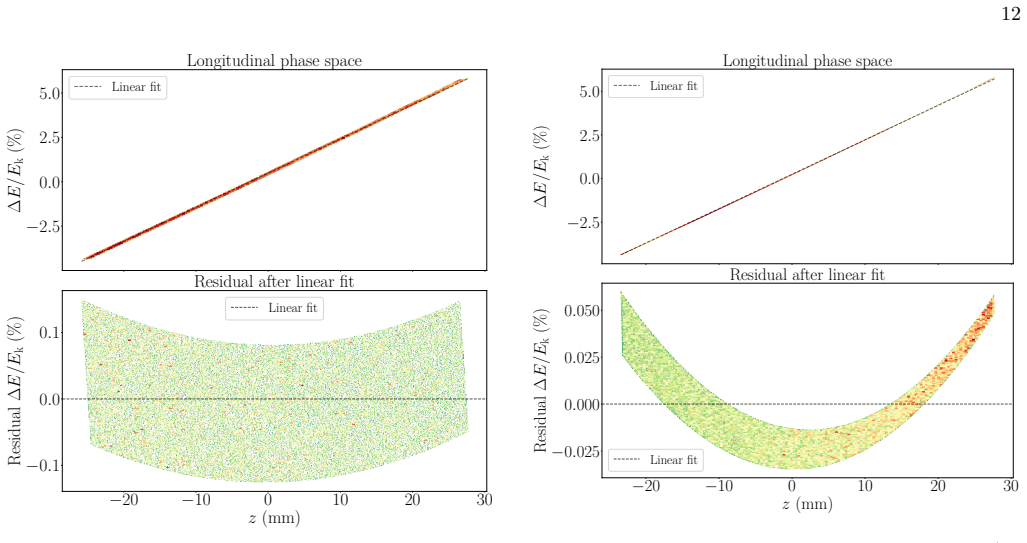
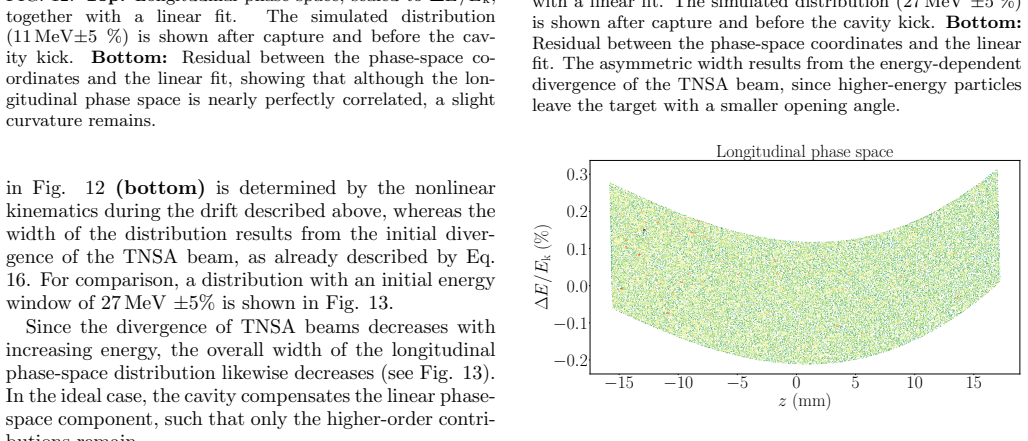
For comparison, a distribution with an initial energy window of 27 MeV ±5% is shown in Fig. 13. Since the divergence of TNSA beams decreases with increasing energy, the overall width of the longitudinal phase-space distribution likewise decreases (see Fig. 13). In the ideal case, the cavity compensates the linear phase- space component, such that only the...
-
[2]
T. E. Cowan, J. Fuchs, H. Ruhl, A. Kemp, P. Audebert, M. Roth, R. Stephens, I. Barton, A. Blazevic, E. Bram- brink, J. Cobble, J. Fern´ andez, J.-C. Gauthier, M. Geis- sel, M. Hegelich, J. Kaae, S. Karsch, G. P. Le Sage, S. Letzring, M. Manclossi, S. Meyroneinc, A. Newkirk, H. P´ epin, and N. Renard-LeGalloudec, Ultralow emit- tance, multi-mev proton beam...
work page 2004
-
[3]
S. Busold, A. Almomani, V. Bagnoud, W. Barth, S. Be- dacht, A. Blaˇ zevi´ c, O. Boine-Frankenheim, C. Bra- betz, T. Burris-Mog, T. Cowan, O. Deppert, M. Droba, H. Eickhoff, U. Eisenbarth, K. Harres, G. Hoffmeis- ter, I. Hofmann, O. Jaeckel, R. Jaeger, M. Joost, S. Kraft, F. Kroll, M. Kaluza, O. Kester, Z. Lecz, T. Merz, F. N¨ urnberg, H. Al-Omari, A. Orzh...
work page 2014
-
[4]
G. Aymar, T. Becker, S. Boogert, M. Borghesi, R. Bing- ham, C. Brenner, P. N. Burrows, O. C. Ettlinger, T. Dascalu, S. Gibson, T. Greenshaw, S. Gruber, D. Gujral, C. Hardiman, J. Hughes, W. G. Jones, K. Kirkby, A. Kurup, J.-B. Lagrange, K. Long, W. Luk, J. Matheson, P. McKenna, R. McLauchlan, Z. Naj- mudin, H. T. Lau, J. L. Parsons, J. Pasternak, J. Poz- ...
-
[5]
J. De Chant, K. Nakamura, Q. Ji, L. Obst-Huebl, S. Bar- ber, A. M. Snijders, C. G. R. Geddes, J. van Tilborg, A. J. Gonsalves, C. B. Schroeder, and E. Esarey, Mod- eling and design of compact, permanent-magnet trans- port systems for highly divergent, broad energy spread laser-driven proton beams, Phys. Rev. Accel. Beams 28, 033501 (2025)
work page 2025
-
[6]
J. G. Zhu, M. J. Wu, Q. Liao, Y. X. Geng, K. Zhu, C. C. Li, X. H. Xu, D. Y. Li, Y. R. Shou, T. Yang, P. J. Wang, D. H. Wang, J. J. Wang, C. E. Chen, X. T. He, Y. Y. Zhao, W. J. Ma, H. Y. Lu, T. Tajima, C. Lin, and X. Q. Yan, Experimental demonstration of a laser proton accelerator with accurate beam control through image-relaying transport, Phys. Rev. Acc...
work page 2019
-
[7]
T. Yang, H. Cheng, Y. Yan, M. Wu, D. Li, Y. Li, Y. Xia, C. Lin, and X. Yan, Designing of active plasma lens for focusing laser-plasma-accelerated pulsed proton beams, Phys. Rev. Accel. Beams 24, 031301 (2021)
work page 2021
-
[8]
Y. Yan, T. Yang, Z. Guo, H. Cheng, Y. Li, Y. Fang, Y. Xia, Q. He, C. Li, M. Huang, C. Lin, and X. Yan, Design and simulation of a radius-varying active plasma lens for focusing laser-accelerated protons, Nuclear In- struments and Methods in Physics Research Section A: Accelerators, Spectrometers, Detectors and Associated Equipment 1057, 168737 (2023)
work page 2023
-
[9]
Y. Yan, T. Yang, Z. Guo, M. Huang, H. Cheng, Y. Li, Y. Fang, C. Li, Y. Xia, Q. He, Y. Yan, C. Lin, and X. Yan, Experimental demonstration of radius-varying active plasma lensing for laser-plasma-accelerated proton beams with increased collection angle, Phys. Rev. Accel. Beams 27, 052802 (2024)
work page 2024
-
[10]
F. Kroll, F.-E. Brack, C. Bernert, S. Bock, E. Bodenstein, K. Br¨ uchner, T. Cowan, L. Gaus, R. Gebhardt, U. Hel- big, L. Karsch, T. Kluge, S. Kraft, M. Krause, E. Less- mann, U. Masood, S. Meister, J. Metzkes-Ng, A. Nossula, and E. Beyreuther, Tumour irradiation in mice with a laser-accelerated proton beam, Nature Physics 18, 316 (2022)
work page 2022
-
[11]
S. Busold, D. Schumacher, O. Deppert, C. Bra- betz, S. Frydrych, F. Kroll, M. Joost, H. Al-Omari, A. Blaˇ zevi´ c, B. Zielbauer, I. Hofmann, V. Bagnoud, T. E. Cowan, and M. Roth, Focusing and transport of high-intensity multi-mev proton bunches from a com- pact laser-driven source, Phys. Rev. ST Accel. Beams 16, 101302 (2013)
work page 2013
-
[12]
Mora, Plasma expansion into a vacuum, Phys
P. Mora, Plasma expansion into a vacuum, Phys. Rev. Lett. 90, 185002 (2003)
work page 2003
-
[13]
B. Schmitz, M. Metternich, and O. Boine-Frankenheim, Automated reconstruction of the initial distribution of laser accelerated ion beams from radiochromic film (rcf) stacks, Review of Scientific Instruments 93, 093306 (2022)
work page 2022
-
[14]
F. N¨ urnberg, M. Schollmeier, E. Brambrink, A. Blaˇ zevi´ c, D. C. Carroll, K. Flippo, D. C. Gautier, M. Geißel, K. Harres, B. M. Hegelich, O. Lundh, K. Markey, P. McKenna, D. Neely, J. Schreiber, and M. Roth, Ra- diochromic film imaging spectroscopy of laser-accelerated proton beams, Review of Scientific Instruments 80, 033301 (2009)
work page 2009
-
[15]
Z. Lecz, O. Boine-Frankenheim, and V. Kornilov, Trans- verse divergence in target normal sheath acceleration of a thick contamination layer, Nuclear Instruments and Methods in Physics Research Section A: Acceler- ators, Spectrometers, Detectors and Associated Equip- ment 774, 42 (2015)
work page 2015
-
[16]
I. Hofmann, J. M. ter Vehn, X. Yan, and H. Al-Omari, Chromatic energy filter and characterization of laser- accelerated proton beams for particle therapy, Nuclear Instruments and Methods in Physics Research Section A: Accelerators, Spectrometers, Detectors and Associ- ated Equipment 681, 44 (2012)
work page 2012
-
[17]
Busold, Construction and characterization of a laser- driven proton beamline at GSI , Ph.D
S. Busold, Construction and characterization of a laser- driven proton beamline at GSI , Ph.D. thesis (2014)
work page 2014
-
[18]
M. Metternich, Shaping of laser-accelerated ion beams for applications in high energy density physics , Ph.D. thesis, Technische Universit¨ at Darmstadt, Darmstadt (2023)
work page 2023
-
[19]
M. Migliorati, A. Bacci, C. Benedetti, E. Chiadroni, M. Ferrario, A. Mostacci, L. Palumbo, A. R. Rossi, L. Serafini, and P. Antici, Intrinsic normalized emittance growth in laser-driven electron accelerators, Phys. Rev. ST Accel. Beams 16, 011302 (2013)
work page 2013
-
[20]
Floettmann, Some basic features of the beam emit- tance, Phys
K. Floettmann, Some basic features of the beam emit- tance, Phys. Rev. ST Accel. Beams 6, 034202 (2003)
work page 2003
-
[21]
I. Hofmann, Performance of solenoids versus quadrupoles in focusing and energy selection of laser accelerated pro- tons, Physical Review Special Topics - Accelerators and Beams 16, 10.1103/physrevstab.16.041302 (2013)
-
[22]
F. Kroll, The Study and Development of Pulsed High- field Magnets for Application in Laser-plasma Physics , Wissenschaftlich-Technischer Bericht / HZDR (2018)
work page 2018
-
[23]
W. K. H. Panofsky and W. R. Baker, A focusing device for the external 350-mev proton beam of the 184-inch cyclotron at berkeley, Review of Scientific Instruments 21, 445 (1950)
work page 1950
-
[24]
B. Bayanov, V. Belov, A. Chernyakin, V. Eschenko, V. Karasuk, M. Petrichenkov, G. Silvestrov, and T. Vsevolozhskaya, Liquid lithium lens with high mag- netic fields, in Proceedings of the 1999 Particle Accelera- tor Conference (Cat. No.99CH36366) , Vol. 5 (1999) pp. 3086–3088 vol.5
work page 1999
-
[25]
I. Hofmann, J. Meyer-ter Vehn, X. Yan, A. Orzhekhovskaya, and S. Yaramyshev, Collection and focusing of laser accelerated ion beams for therapy applications, Phys. Rev. ST Accel. Beams 14, 031304 (2011)
work page 2011
-
[26]
T. P. Wangler, RF Linear Accelerators, 2nd ed. (Wiley- 14 VCH Verlag, 2010)
work page 2010
-
[27]
M. Reiser, Theory and design of charged particle beams , Wiley Series in Beam Physics and Accelerator Technol- ogy (John Wiley & Sons, Nashville, TN, 1994)
work page 1994
-
[28]
A. F. Gad, Pygad: An intuitive genetic algorithm python library, Multimedia Tools and Applications (2023)
work page 2023
-
[29]
K. Floettmann, Astra: A space charge tracking al- gorithm, https://www.desy.de/~mpyflo/ (1997), [Ac- cessed 16-10-2025]
work page 1997
-
[30]
Mayes, Python wrapper for astra, https://github
C. Mayes, Python wrapper for astra, https://github. com/ChristopherMayes/lume-astra (2020), [Accessed 16-10-2025]
work page 2020
-
[31]
M. Rossetti Conti, A. Bacci, D. Giove, V. Petrillo, S. Samsam, D. Sertore, and L. Serafini, New approach to space charge dominated beamline design, Phys. Rev. Accel. Beams 26, 094201 (2023)
work page 2023
-
[32]
J. A. Nelder and R. Mead, A simplex method for function minimization, The Computer Journal 7, 308 (1965), https://academic.oup.com/comjnl/article- pdf/7/4/308/1013182/7-4-308.pdf
work page 1965
- [33]
-
[34]
J. van Tilborg, S. K. Barber, H.-E. Tsai, K. K. Swan- son, S. Steinke, C. G. R. Geddes, A. J. Gonsalves, C. B. Schroeder, E. Esarey, S. S. Bulanov, N. A. Bobrova, P. V. Sasorov, and W. P. Leemans, Nonuniform discharge cur- rents in active plasma lenses, Phys. Rev. Accel. Beams 20, 032803 (2017)
work page 2017
-
[35]
C. A. Lindstrøm, E. Adli, G. Boyle, R. Corsini, A. E. Dyson, W. Farabolini, S. M. Hooker, M. Meisel, J. Osterhoff, J.-H. R¨ ockemann, L. Schaper, and K. N. Sjobak, Emittance preservation in an aberration-free ac- tive plasma lens, Phys. Rev. Lett. 121, 194801 (2018)
work page 2018
-
[36]
M. G. Haines, M. S. Wei, F. N. Beg, and R. B. Stephens, Hot-electron temperature and laser-light absorption in fast ignition, Phys. Rev. Lett. 102, 045008 (2009)
work page 2009
- [37]
-
[38]
J. Fuchs, P. Antici, E. D’Humi` eres, E. Lefebvre, M. Borghesi, E. Brambrink, C. A. Cecchetti, M. Kaluza, V. Malka, M. Manclossi, S. Meyroneinc, P. Mora, J. Schreiber, T. Toncian, H. P´ epin, and P. Audebert, Laser-driven proton scaling laws and new paths towards energy increase, Nature Physics 2, 48 (2006)
work page 2006
-
[39]
J. Kim, R. Rajawat, T. Wang, and G. Shvets, Accel- eration and focusing of multispecies ion beam using a converging laser-driven shock, Phys. Rev. E 111, 025203 (2025)
work page 2025
-
[40]
J. Park, J. H. Bin, S. Steinke, Q. Ji, S. S. Bulanov, M. Th´ evenet, J.-L. Vay, T. Schenkel, C. G. R. Geddes, C. B. Schroeder, and E. Esarey, Target normal sheath acceleration with a large laser focal diameter, Physics of Plasmas 27, 123104 (2020)
work page 2020
-
[41]
S. Steinke, J. H. Bin, J. Park, Q. Ji, K. Naka- mura, A. J. Gonsalves, S. S. Bulanov, M. Th´ evenet, C. Toth, J.-L. Vay, C. B. Schroeder, C. G. R. Geddes, E. Esarey, T. Schenkel, and W. P. Leemans, Accelera- tion of high charge ion beams with achromatic divergence by petawatt laser pulses, Phys. Rev. Accel. Beams 23, 021302 (2020)
work page 2020
-
[42]
T. S. Bauer, Development, Characterization, Alignment and Experimental Validation of Partial Sphere Target Arrays for Advanced Proton Acceleration Studies, Ph.D. thesis (2025)
work page 2025
-
[43]
B. Zeitler, K. Floettmann, and F. Gr¨ uner, Linearization of the longitudinal phase space without higher harmonic field, Phys. Rev. ST Accel. Beams 18, 120102 (2015)
work page 2015
discussion (0)
Sign in with ORCID, Apple, or X to comment. Anyone can read and Pith papers without signing in.