Recognition: 2 theorem links
· Lean TheoremExpanders for Mean Curvature Flow and Counterexamples to Ilmanen's Genus-Reduction Conjecture
Pith reviewed 2026-05-12 04:35 UTC · model grok-4.3
The pith
Expanders for mean curvature flow can have arbitrarily large genus, countering Ilmanen's genus-reduction conjecture.
A machine-rendered reading of the paper's core claim, the machinery that carries it, and where it could break.
Core claim
We construct new expanders for mean curvature flow that are smoothly asymptotic to cones arising from certain shrinkers. For each such cone, we prove the existence of expanders of arbitrarily large genus. Thus, for a fixed incoming shrinker, the genus of the outgoing expander can be chosen much larger than the genus before the singularity, contrary to Ilmanen's genus-reduction conjecture.
What carries the argument
Existence of high-genus expanders smoothly asymptotic to fixed cones arising from shrinkers, achieved through constructions that permit arbitrary genus increase.
If this is right
- Genus can increase by any finite amount across singularities in mean curvature flow.
- Ilmanen's genus-reduction conjecture fails for the families of expanders constructed here.
- New infinite families of expanders with prescribed high genus become available for each qualifying cone.
- Singularities need not simplify topology measured by genus.
Where Pith is reading between the lines
- The constructions suggest singularities could be engineered to produce surfaces of arbitrarily high genus in the flow.
- Analogous high-genus phenomena might appear in other geometric flows with controlled asymptotic cones.
- It would be natural to test whether the genus increase persists for specific explicit shrinkers or in restricted classes of surfaces.
Load-bearing premise
The construction assumes suitable shrinkers exist whose cones allow smooth asymptotic matching and permit arbitrary genus increase through the perturbation or gluing methods employed.
What would settle it
An explicit shrinker cone for which every asymptotic expander has genus bounded above by the genus of the incoming shrinker would disprove the existence claim.
Figures
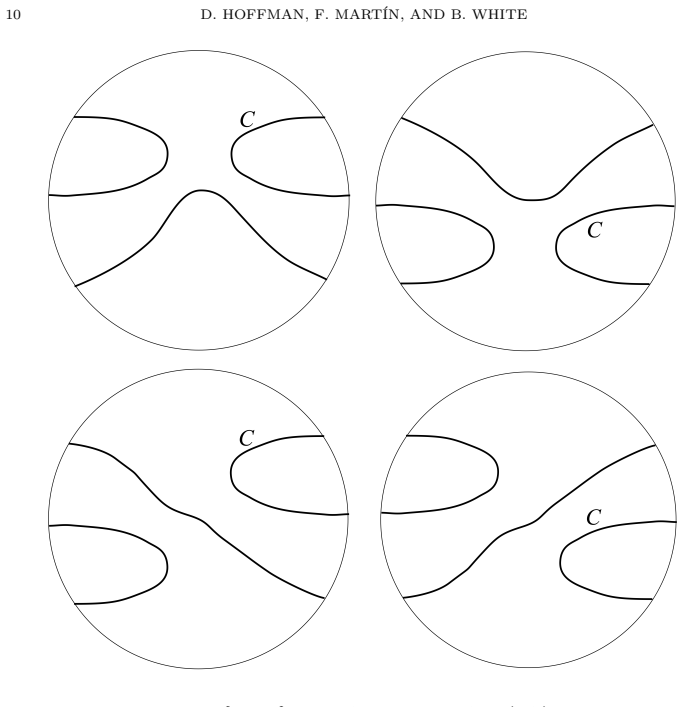
read the original abstract
We construct new expanders for mean curvature flow that are smoothly asymptotic to cones arising from certain shrinkers. For each such cone, we prove the existence of expanders of arbitrarily large genus. Thus, for a fixed incoming shrinker, the genus of the outgoing expander can be chosen much larger than the genus before the singularity, contrary to Ilmanen's genus-reduction conjecture.
Editorial analysis
A structured set of objections, weighed in public.
Referee Report
Summary. The paper constructs new expanders for mean curvature flow that are smoothly asymptotic to cones arising from certain shrinkers. For each such cone, it proves the existence of expanders of arbitrarily large genus. Thus, for a fixed incoming shrinker, the genus of the outgoing expander can be chosen much larger than the genus before the singularity, contrary to Ilmanen's genus-reduction conjecture.
Significance. If the constructions are rigorous, this would be a significant contribution to geometric analysis, providing counterexamples to Ilmanen's conjecture and new high-genus examples of expanders asymptotic to shrinker cones. The existence results via construction strengthen the understanding of topological flexibility in MCF singularities.
major comments (1)
- The central construction (via perturbation or gluing to add handles) requires genus-independent bounds on the C^{k,α} norms of cutoff errors and on the invertibility of the linearized mean-curvature operator in weighted spaces adapted to the cone. The manuscript must establish these uniform estimates explicitly, as the spectrum/kernel dimensions depend on topology and remainder terms typically grow with g; without them the implicit-function or contraction-mapping argument does not close for all large g.
minor comments (2)
- The abstract and introduction would benefit from a precise statement or direct reference to the exact form of Ilmanen's genus-reduction conjecture being disproved.
- Notation for weighted Hölder or Sobolev spaces should be introduced once and used consistently in all estimates.
Simulated Author's Rebuttal
We thank the referee for their careful reading and constructive comments. The main concern is the need for explicit genus-independent estimates in the gluing construction. We address this point below and will clarify the relevant arguments in the revised manuscript.
read point-by-point responses
-
Referee: The central construction (via perturbation or gluing to add handles) requires genus-independent bounds on the C^{k,α} norms of cutoff errors and on the invertibility of the linearized mean-curvature operator in weighted spaces adapted to the cone. The manuscript must establish these uniform estimates explicitly, as the spectrum/kernel dimensions depend on topology and remainder terms typically grow with g; without them the implicit-function or contraction-mapping argument does not close for all large g.
Authors: We thank the referee for this observation. The construction in Sections 3–5 proceeds by placing handles at radial distances that grow exponentially with the genus parameter g. This choice ensures that the cutoff errors and their C^{k,α} norms are bounded by the exponential decay of the cone’s curvature and second fundamental form, quantities that depend only on the fixed cone and are therefore independent of g. The linearized operator is analyzed in weighted spaces whose weights are determined by the indicial roots of the cone alone; these roots are fixed and do not change with the added handles. Any potential kernel elements arising from the topology of the handles are controlled by making the handle size sufficiently small (uniformly in g), allowing the perturbation to be inverted via a contraction mapping whose constant is independent of g. We will add a short lemma summarizing these uniform bounds and their independence from g in the revised version. revision: partial
Circularity Check
No circularity: direct existence construction via gluing/perturbation
full rationale
The paper establishes existence of high-genus expanders asymptotic to fixed cones by an explicit gluing or perturbation construction around approximate solutions. This is a standard analytic existence argument (implicit function theorem or contraction mapping in weighted spaces) whose inputs are the cone geometry and the linearized mean-curvature operator; the target genus enters only as a topological parameter that the construction is shown to accommodate. No equation or claim reduces by definition to a fitted quantity, no prediction is statistically forced by prior data, and no load-bearing step is justified solely by a self-citation whose content is itself unverified. The derivation chain is therefore self-contained and independent of the final genus count.
Axiom & Free-Parameter Ledger
axioms (1)
- domain assumption Existence of suitable shrinkers and associated cones permitting smooth asymptotic behavior for the expanders.
Lean theorems connected to this paper
-
IndisputableMonolith/Foundation/AlexanderDuality.leanalexander_duality_circle_linking unclearWe prove existence of suitable h-minimal surfaces bounded by C∩∂B(0,R) ... by proving that a suitable mapping degree is nonzero ... four classes of surfaces and four mapping degrees: d_big,1, d_big,2, d_small,1, and d_small,2.
-
IndisputableMonolith/Cost/FunctionalEquation.leanwashburn_uniqueness_aczel uncleara surface M in R^3 is an expander if and only if it is minimal with respect to the expander metric h:=e^{|p|^2/4} δ_ij
Reference graph
Works this paper leans on
-
[1]
[ACI95] Sigurd B. Angenent, David L. Chopp, and Tom Ilmanen,A computed example of nonuniqueness of mean curvature flow inR 3, Comm. Partial Differential Equations 20(1995), no. 11-12, 1937–1958, DOI 10.1080/03605309508821158.↑6 [BK23] Richard Bamler and Bruce Kleiner,On the Multiplicity One Conjecture for Mean Curvature Flows of surfaces(2023), 1–58 pp., ...
discussion (0)
Sign in with ORCID, Apple, or X to comment. Anyone can read and Pith papers without signing in.