Recognition: no theorem link
On Enhancing the Dissipative Behavior of Active Flux Advection Schemes
Pith reviewed 2026-05-12 03:53 UTC · model grok-4.3
The pith
Reformulating the third-order Active Flux advection scheme with added parameters improves its dissipative properties.
A machine-rendered reading of the paper's core claim, the machinery that carries it, and where it could break.
Core claim
The traditional third-order Active Flux advection scheme is modified by reformulating the method and introducing additional parameters, leading to schemes with improved dissipative properties validated by numerical experiments.
What carries the argument
Reformulation of the Active Flux method that adds parameters to control and enhance dissipation while preserving the scheme structure.
If this is right
- The modified schemes retain third-order accuracy for suitable parameter values.
- Stronger dissipation reduces spurious oscillations in advection simulations.
- Numerical experiments show measurable gains in dissipative behavior across test cases.
- Stability properties hold when parameters are chosen within the valid range.
Where Pith is reading between the lines
- The parameter approach might transfer to other high-order advection schemes to add similar dissipation control.
- Adaptive choice of parameters during a run could further improve performance on varying flow features.
- This could reduce the need for separate artificial viscosity terms in practical advection computations.
Load-bearing premise
The added parameters can be selected so the scheme keeps third-order accuracy and stability while gaining better dissipation.
What would settle it
A convergence test or stability run on a standard advection problem where the modified scheme drops below third-order accuracy or becomes unstable for the chosen parameters.
Figures


read the original abstract
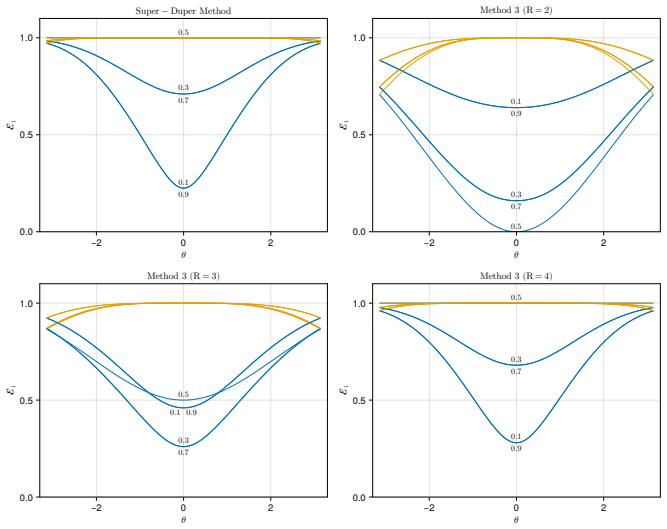
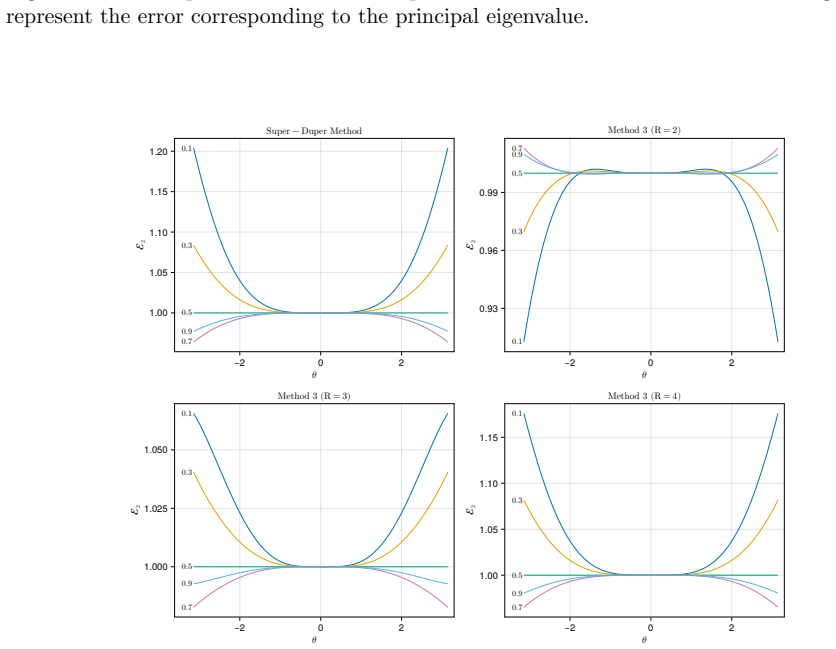
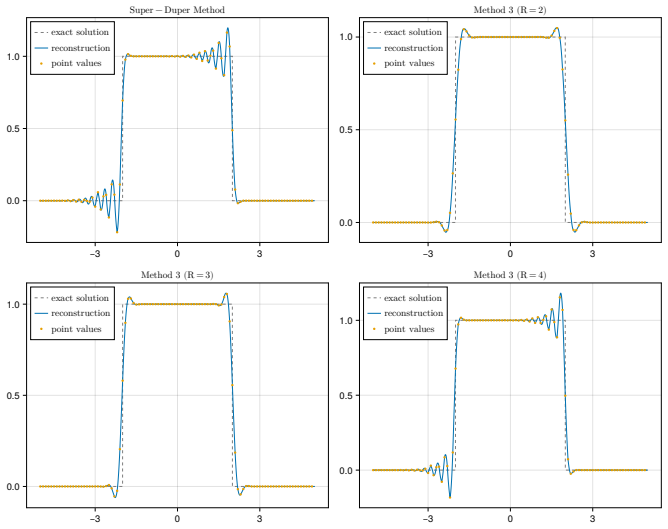
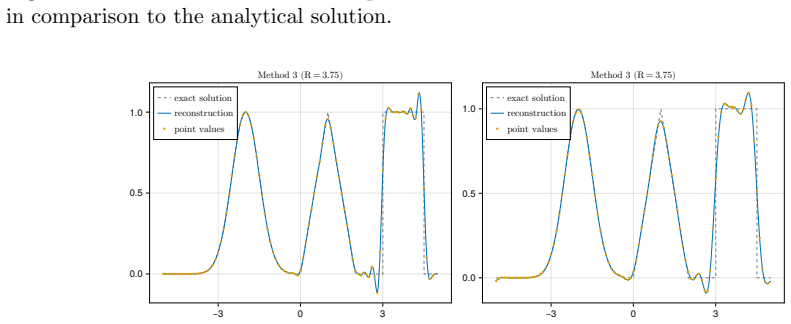
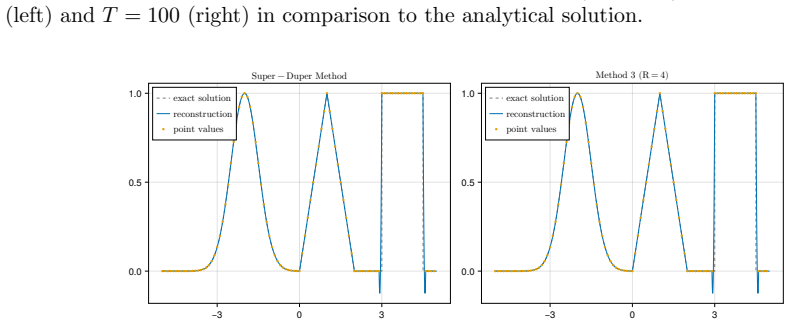
In this work, the traditional third-order Active Flux advection scheme is modified by reformulating the method and introducing additional parameters. The effect of these parameters is studied, leading to schemes with improved dissipative properties. These improvements are validated by numerical experiments.
Editorial analysis
A structured set of objections, weighed in public.
Referee Report
Summary. The manuscript modifies the traditional third-order Active Flux advection scheme by reformulating the update formulas and introducing additional free parameters. It analyzes the effect of these parameters on the scheme's dissipative behavior and claims that suitable choices yield improved dissipation while preserving the original accuracy, with the improvements demonstrated via numerical experiments.
Significance. If the central claim holds, the reformulation and parameter tuning could offer a practical way to control numerical dissipation in Active Flux methods for advection problems, which is relevant for applications requiring low-dissipation transport. The work provides a concrete parameterization and some numerical evidence of benefit, but its significance is reduced by the absence of analytical confirmation that third-order accuracy is retained for arbitrary parameter choices.
major comments (1)
- [Reformulation and parameter study] The manuscript provides no modified-equation analysis or amplification-factor derivation (e.g., in the section describing the reformulated scheme and parameter insertion) to verify that the leading truncation error remains O(Δx³) once the additional parameters are introduced. Without this step, the numerical experiments only illustrate behavior for the tested parameter values rather than establishing structural preservation of third-order accuracy.
minor comments (2)
- [Numerical experiments] The abstract and experimental section omit key details on the specific test cases (e.g., initial conditions, domain, CFL numbers), the procedure used to select the additional parameter values, the quantitative error measures, and the baseline schemes for comparison.
- Notation for the new parameters could be clarified with a dedicated table listing their ranges and the corresponding dissipation metrics observed.
Simulated Author's Rebuttal
We thank the referee for the careful reading and constructive comments on our manuscript. The primary concern is the absence of analytical verification that third-order accuracy is retained after introducing the additional parameters. We address this below and agree that including such an analysis will strengthen the paper.
read point-by-point responses
-
Referee: [Reformulation and parameter study] The manuscript provides no modified-equation analysis or amplification-factor derivation (e.g., in the section describing the reformulated scheme and parameter insertion) to verify that the leading truncation error remains O(Δx³) once the additional parameters are introduced. Without this step, the numerical experiments only illustrate behavior for the tested parameter values rather than establishing structural preservation of third-order accuracy.
Authors: We agree that the current version of the manuscript does not contain a modified-equation analysis or von Neumann amplification-factor derivation to confirm third-order accuracy for arbitrary parameter values. The reformulation was constructed to recover the original Active Flux scheme for specific parameter choices, and the numerical experiments support the expected behavior, but these do not constitute a general proof. In the revised manuscript we will add the requested modified-equation analysis (or equivalent amplification-factor derivation) in the section describing the reformulated scheme to establish that the leading truncation error remains O(Δx³) for admissible parameter ranges. revision: yes
Circularity Check
No circularity: reformulation and numerical validation are independent of inputs
full rationale
The paper reformulates the existing third-order Active Flux scheme, introduces tunable parameters, studies their dissipative effect, and validates the outcome via numerical experiments on test cases. No derivation step reduces a claimed result (such as retained order or improved dissipation) to its own inputs by construction, no fitted parameters are renamed as predictions, and no load-bearing premise collapses to a self-citation chain. The numerical validation supplies external evidence outside the reformulation itself, rendering the central claim self-contained.
Axiom & Free-Parameter Ledger
free parameters (1)
- additional parameters
axioms (1)
- domain assumption The reformulated scheme maintains third-order accuracy and stability of the original Active Flux method
Reference graph
Works this paper leans on
-
[1]
Abgrall, R., Boscheri, W., Liu, Y.: Virtual finite element and hyperbolic problems: The PAMPA algorithm. J. Comput. Phys. (2026) doi: 10.1016/j.jcp.2025.114521
-
[2]
arXiv preprint (2025) doi: 10.48550/arXiv.2506.03291
Barsukow, W.: An active flux method for the Euler equations based on the exact acoustic evolution operator. arXiv preprint (2025) doi: 10.48550/arXiv.2506.03291
-
[3]
Barsukow, W., Hohm, J., Klingenberg C., Roe, P.: The Active Flux Scheme on Cartesian Grids and Its Low Mach Number Limit. J. Sci. Comput. (2019) doi: 10.1007/s10915-019- 01031-z
-
[4]
arXiv preprint (2026) doi: 10.48550/arXiv.2603.18160
Barsukow, W., Klingenberg C., Krotsch, S.: On the equivalence of semi-discrete Active Flux and Discontinuous Galerkin methods and a comparison of their performance. arXiv preprint (2026) doi: 10.48550/arXiv.2603.18160
-
[5]
Chudzik, E., Helzel, C. (2023). A Review of Cartesian Grid Active Flux Methods for Hyperbolic Conservation Laws. In: Franck, E., Fuhrmann, J., Michel-Dansac, V., Navoret, L. (eds) Finite Volumes for Complex Applications X—Volume 1, Elliptic and Parabolic Problems, pp. 93–109, Springer, Cham (2023)
work page 2023
-
[6]
Duan, J., Chandrashekar, P., Klingenberg, C.: Active flux for ideal magnetohydrodynam- ics: A positivity-preserving scheme with the Godunov-Powell source term. arXiv preprint (2025) doi: 10.48550/arXiv.2506.04857 9 −3 0 3 0.0 0.5 1.0 Super−Duper Method −3 0 3 0.0 0.5 1.0 Method 3 (R = 2) −3 0 3 0.0 0.5 1.0 Method 3 (R = 3) −3 0 3 0.0 0.5 1.0 Method 3 (R =...
-
[8]
In:20th AIAA Computational Fluid Dynamics Conference (2011) doi: 10.2514/6.2011-3840
Eymann, T., Roe, P.: Active Flux Schemes for Systems. In:20th AIAA Computational Fluid Dynamics Conference (2011) doi: 10.2514/6.2011-3840
-
[9]
In:21st AIAA Computa- tional Fluid Dynamics Conference (2013) doi: 10.2514/6.2011-382
Eymann, T., Roe, P.: Multidimensional Active Flux Schemes. In:21st AIAA Computa- tional Fluid Dynamics Conference (2013) doi: 10.2514/6.2011-382
-
[10]
Butterworth- Heinemann, Oxford (2007)
Hirsch, C.: Numerical Computation of Internal and External Flows, 2nd ed. Butterworth- Heinemann, Oxford (2007)
work page 2007
-
[11]
Nishikawa, H., Roe, P.: Third-order active-flux scheme for advection diffusion: Hy- perbolic diffusion, boundary condition, and Newton solver. Comput. & Fluids (2016) doi:10.1016/j.compfluid.2015.10.020
-
[12]
Roe, P.: A simple explanation of superconvergence for discontinuous Galerkin solutions to ut +u x = 0. Commun. Comput. Phys. (2017) doi: 10.4208/cicp.OA-2016-0052
-
[13]
In:2018 AIAA Aerospace Sciences Meeting (2018) doi:10.2514/6.2018- 0836
Roe, P., Maeng, J., Fan, D.: Comparing active flux and discontinuous Galerkin methods for compressible flow. In:2018 AIAA Aerospace Sciences Meeting (2018) doi:10.2514/6.2018- 0836
-
[14]
In:AAIA SCITECH 2023 Forum (2023) doi:10.2514/6.2023-1156
Samani, I., Roe, P.: Acoustics on a Coarse Grid. In:AAIA SCITECH 2023 Forum (2023) doi:10.2514/6.2023-1156
-
[15]
Van Leer, B.: Towards the ultimate conservative difference scheme IV: A new approach to numerical convection,” J. Comput. Phys. (1977) doi: 10.1016/0021-9991(77)90095-X
-
[16]
Wolfram Research, Inc., Mathematica, Version 14.3, Champaign, IL, 2025 11
work page 2025
discussion (0)
Sign in with ORCID, Apple, or X to comment. Anyone can read and Pith papers without signing in.