Recognition: 2 theorem links
· Lean TheoremCost-of-Ethics Crisis: Beliefs, Decisions, and Justifications in the Job Searches of Computer Science Students in Canada and the United States
Pith reviewed 2026-05-12 04:04 UTC · model grok-4.3
The pith
Most computer science students prioritize compensation, location, and workplace culture over ethical concerns when choosing jobs.
A machine-rendered reading of the paper's core claim, the machinery that carries it, and where it could break.
Core claim
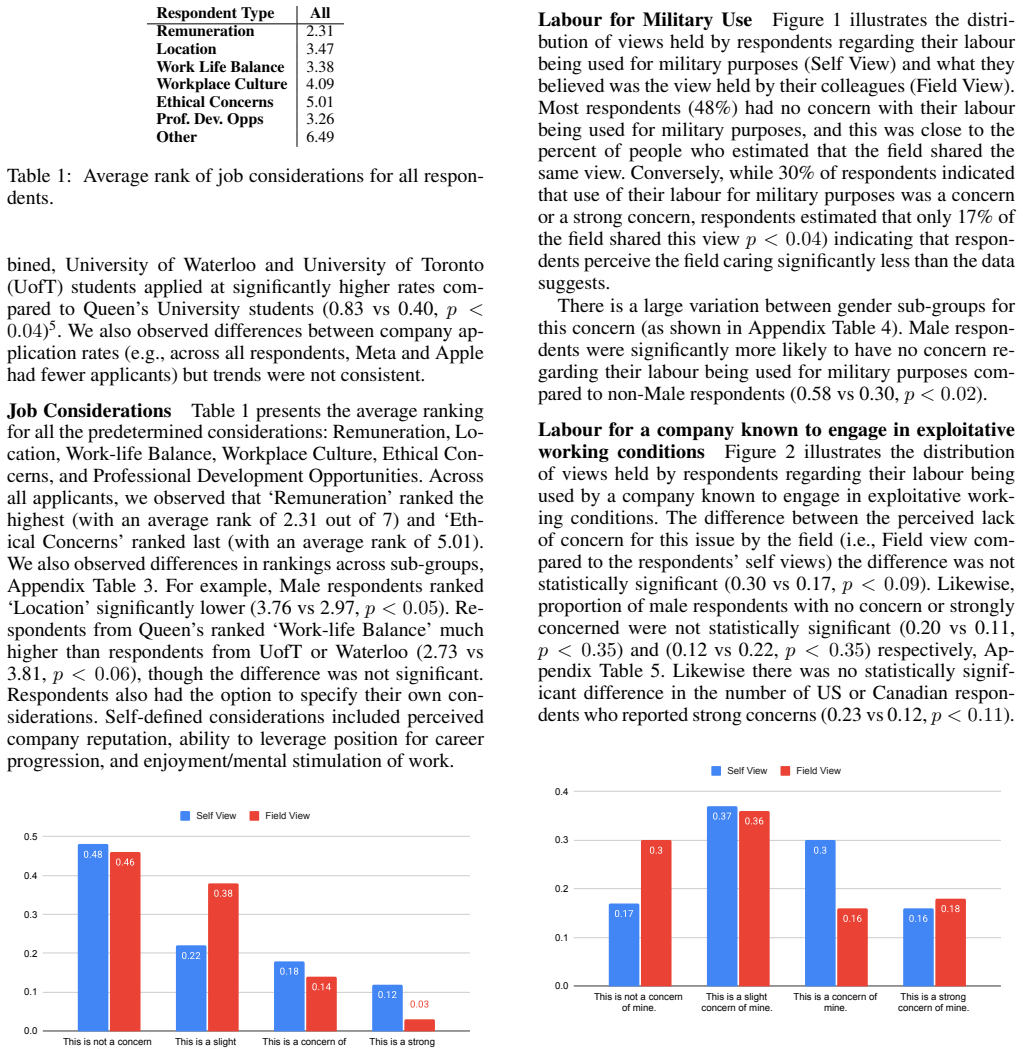
Computer science students and recent graduates place higher priority on compensation, location, and workplace culture than on ethical or social issues during job searches; those who express ethical concerns commonly justify accepting contradictory positions by citing the need to earn money or the perceived impossibility of avoiding unethical employers.
What carries the argument
Self-reported priorities and justifications collected from survey responses about job-search decisions.
If this is right
- Ethics education in computer science may have limited effect on graduates' first major career choices without addressing practical trade-offs.
- Industry norms can persist when new hires accept roles despite their stated reservations.
- Curricula could be updated to include practice with real ethical compromises that arise in employment decisions.
- Educators and employers may need to design interventions that reduce the gap between taught values and observed actions.
Where Pith is reading between the lines
- If rationalizations like financial need become standard, companies may encounter little external pressure to change problematic practices.
- A longitudinal follow-up that records actual job acceptances could check whether expressed concerns predict real behavior.
- Similar patterns of justification might appear in other technical fields where graduates enter industries with known ethical issues.
Load-bearing premise
Self-reported survey answers from 129 participants reflect actual decision processes and beliefs rather than post-hoc rationalizations or social-desirability effects.
What would settle it
Tracking the same participants after the survey to see whether those who voiced ethical concerns actually avoided the companies they flagged as problematic.
Figures


read the original abstract
Workplace norms in computer science have received growing attention due to a series of recent ethical scandals. One type of response has been a push to improve the ethics education provided to computer science students. Evidence for the effectiveness of ethics education remains mixed; some evidence suggests that norms are changing, while gaps between stated values and practice remain. Our focus here is on whether students, who have received some contemporary CS ethics education, are able to effectively apply ethical reasoning to their own decision-making in what is typically the first significant ethical decision of their careers: their job search. Our study examines the ethical decision making of 129 computer science students and recent graduates during their job searches. We find that most students prioritize factors like compensation, location, and workplace culture over ethical and social issues. Even when expressing ethical concerns, respondents often justify taking actions contradicting their moral views through commonly-shared explanations such as desire to make money or the perceived inability to avoid unethical workplaces. This work sheds light on the disconnect between ethics education and real-world CS graduate decision making. We offer insights for evolving curricula to better address practical ethical dilemmas, with implications for educators and industry.
Editorial analysis
A structured set of objections, weighed in public.
Referee Report
Summary. The manuscript reports results from a survey of 129 computer science students and recent graduates in Canada and the United States on their job-search priorities and ethical justifications. The central claims are that most respondents prioritize compensation, location, and workplace culture over ethical or social issues, and that even when ethical concerns are expressed, participants commonly justify contradictory actions via shared rationales such as financial necessity or the perceived impossibility of avoiding unethical employers. The paper positions these findings as evidence of a disconnect between contemporary CS ethics education and real-world decision-making, with implications for curriculum design.
Significance. If the survey data reliably capture decision processes rather than artifacts of elicitation, the work would document a practically important gap between stated ethics training and first-career choices in CS, offering concrete guidance for educators. The study addresses a timely topic with direct relevance to industry hiring and curriculum reform. However, the absence of methodological transparency noted in the abstract and the unaddressed risk of post-hoc rationalization in self-reports substantially weaken the current evidential basis for these claims.
major comments (2)
- [Abstract] Abstract (and implied Methods section): The abstract states clear findings from a survey of 129 respondents but provides no details on sampling method, response rate, question wording, statistical tests, or inter-rater reliability for qualitative coding. This omission is load-bearing because the central claim that 'most students prioritize factors like compensation, location, and workplace culture over ethical and social issues' cannot be evaluated without these elements.
- [Results] Results/Discussion (inferred from abstract): The claim that respondents 'often justify taking actions contradicting their moral views through commonly-shared explanations' rests on qualitative coding whose reliability is not reported. Without inter-rater reliability metrics or description of how contradictions were identified, it is unclear whether the observed patterns reflect stable justifications or post-hoc rationalizations, directly undermining the interpretation offered for the ethics-education disconnect.
minor comments (2)
- [Abstract] The abstract could explicitly note the reliance on self-report data and any steps taken to mitigate social-desirability bias.
- [Introduction] The manuscript would benefit from situating the 129-participant sample size and recruitment channels against prior surveys of CS student ethics attitudes.
Simulated Author's Rebuttal
We thank the referee for the constructive and detailed feedback on our manuscript. We address each major comment below, clarifying existing content in the full paper and outlining specific revisions to improve transparency and address concerns about methodological rigor.
read point-by-point responses
-
Referee: [Abstract] Abstract (and implied Methods section): The abstract states clear findings from a survey of 129 respondents but provides no details on sampling method, response rate, question wording, statistical tests, or inter-rater reliability for qualitative coding. This omission is load-bearing because the central claim that 'most students prioritize factors like compensation, location, and workplace culture over ethical and social issues' cannot be evaluated without these elements.
Authors: We agree that the abstract would benefit from additional methodological context to allow readers to assess the claims more readily. The full manuscript includes a Methods section detailing participant recruitment (via university CS department lists, online forums, and social media targeting Canadian and US CS students/recent graduates), the survey instrument (mix of ranking/Likert items on job priorities and open-ended questions on ethical concerns and justifications), and the analysis (primarily descriptive frequencies supplemented by thematic coding). No formal inferential statistical tests were applied. We will revise the abstract to concisely note the sample size and composition, recruitment approach, and the dual quantitative-qualitative analysis strategy. We will also expand the Methods section with explicit question examples and confirm the absence of response rate tracking (as the survey was distributed via open channels without unique identifiers). revision: yes
-
Referee: [Results] Results/Discussion (inferred from abstract): The claim that respondents 'often justify taking actions contradicting their moral views through commonly-shared explanations' rests on qualitative coding whose reliability is not reported. Without inter-rater reliability metrics or description of how contradictions were identified, it is unclear whether the observed patterns reflect stable justifications or post-hoc rationalizations, directly undermining the interpretation offered for the ethics-education disconnect.
Authors: We will add a detailed description in the Methods section of how contradictions were identified: by systematically comparing each participant's stated ethical concerns (from open-ended responses) against their reported job priorities and actual or intended decisions. Thematic coding followed an inductive approach with iterative refinement of codes for common justifications (e.g., financial necessity, lack of alternatives). The primary coding was performed by one author, with team discussions to resolve ambiguities and ensure consistency; however, formal inter-rater reliability metrics such as Cohen's kappa were not computed. We acknowledge this as a limitation and will explicitly discuss the potential for post-hoc rationalization inherent in self-report data, while noting that the recurrence of similar themes across independent responses lends support to the patterns. A new limitations subsection will be added to the Discussion. revision: partial
Circularity Check
No circularity: empirical survey with no derivations or self-referential reductions
full rationale
The paper reports results from a survey of 129 CS students on job-search priorities and ethical justifications. It contains no equations, fitted parameters, predictions derived from models, or load-bearing self-citations. All claims are direct summaries of participant responses; there is no derivation chain that reduces any result to its own inputs by construction. This is a standard descriptive empirical study whose evidence is external to any internal formalism.
Axiom & Free-Parameter Ledger
axioms (1)
- domain assumption Self-reported survey answers accurately reflect participants' true beliefs, priorities, and justifications rather than social-desirability bias or post-hoc rationalization.
Lean theorems connected to this paper
-
IndisputableMonolith/Cost/FunctionalEquation.leanwashburn_uniqueness_aczel unclear?
unclearRelation between the paper passage and the cited Recognition theorem.
We find that most students prioritize factors like compensation, location, and workplace culture over ethical and social issues. Even when expressing ethical concerns, respondents often justify taking actions contradicting their moral views through commonly-shared explanations such as desire to make money...
-
IndisputableMonolith/Foundation/RealityFromDistinction.leanreality_from_one_distinction unclear?
unclearRelation between the paper passage and the cited Recognition theorem.
Our study examines the ethical decision making of 129 computer science students... survey... qualitative card sort
What do these tags mean?
- matches
- The paper's claim is directly supported by a theorem in the formal canon.
- supports
- The theorem supports part of the paper's argument, but the paper may add assumptions or extra steps.
- extends
- The paper goes beyond the formal theorem; the theorem is a base layer rather than the whole result.
- uses
- The paper appears to rely on the theorem as machinery.
- contradicts
- The paper's claim conflicts with a theorem or certificate in the canon.
- unclear
- Pith found a possible connection, but the passage is too broad, indirect, or ambiguous to say the theorem truly supports the claim.
Reference graph
Works this paper leans on
-
[1]
Patricia S. Abril and Robert Plant. The patent holder's dilemma: Buy, sell, or troll?. Communications of the ACM. 2007. doi:10.1145/1188913.1188915
-
[2]
Deciding equivalances among conjunctive aggregate queries
Sarah Cohen and Werner Nutt and Yehoshua Sagic. Deciding equivalances among conjunctive aggregate queries. doi:10.1145/1219092.1219093
-
[3]
Special issue: Digital Libraries. 1996
work page 1996
-
[4]
Understanding Policy-Based Networking
David Kosiur. Understanding Policy-Based Networking. 2001
work page 2001
-
[7]
The title of book two. 2008. doi:10.1007/3-540-09237-4
-
[8]
Asad Z. Spector. Achieving application requirements. Distributed Systems. 1990. doi:10.1145/90417.90738
-
[9]
Douglass and David Harel and Mark B
Bruce P. Douglass and David Harel and Mark B. Trakhtenbrot. Statecarts in use: structured analysis and object-orientation. Lectures on Embedded Systems. 1998. doi:10.1007/3-540-65193-4_29
-
[10]
Donald E. Knuth. The Art of Computer Programming, Vol. 1: Fundamental Algorithms (3rd. ed.). 1997
work page 1997
-
[11]
Donald E. Knuth. The Art of Computer Programming. 1998
work page 1998
-
[12]
Structured Variational Inference Procedures and their Realizations (as incol)
Dan Geiger and Christopher Meek. Structured Variational Inference Procedures and their Realizations (as incol). Proceedings of Tenth International Workshop on Artificial Intelligence and Statistics, The Barbados
-
[13]
Stan W. Smith. An experiment in bibliographic mark-up: Parsing metadata for XML export. Proceedings of the 3rd. annual workshop on Librarians and Computers. 2010. doi:99.9999/woot07-S422
work page 2010
-
[14]
Catch me, if you can: Evading network signatures with web-based polymorphic worms
Matthew Van Gundy and Davide Balzarotti and Giovanni Vigna. Catch me, if you can: Evading network signatures with web-based polymorphic worms. Proceedings of the first USENIX workshop on Offensive Technologies
-
[15]
Sten Andler. Predicate Path expressions. Proceedings of the 6th. ACM SIGACT-SIGPLAN symposium on Principles of Programming Languages. 1979. doi:10.1145/567752.567774
-
[16]
LOGICS of Programs: AXIOMATICS and DESCRIPTIVE POWER
David Harel. LOGICS of Programs: AXIOMATICS and DESCRIPTIVE POWER. 1978
work page 1978
- [17]
- [18]
-
[19]
Introduction to Bayesian Statistics
Harry Thornburg. Introduction to Bayesian Statistics. 2001
work page 2001
-
[20]
CLIFFORD: a Maple 11 Package for Clifford Algebra Computations, version 11
Rafal Ablamowicz and Bertfried Fauser. CLIFFORD: a Maple 11 Package for Clifford Algebra Computations, version 11. 2007
work page 2007
- [21]
- [22]
- [23]
-
[24]
Dave Novak. Solder man. ACM SIGGRAPH 2003 Video Review on Animation theater Program: Part I - Vol. 145 (July 27--27, 2003). 2003. doi:99.9999/woot07-S422
work page 2003
-
[25]
Interview with Bill Kinder: January 13, 2005
Newton Lee. Interview with Bill Kinder: January 13, 2005. Comput. Entertain. 2005. doi:10.1145/1057270.1057278
-
[26]
The Enabling of Digital Libraries
Bernard Rous. The Enabling of Digital Libraries. Digital Libraries. 2008
work page 2008
-
[28]
(new) Finding minimum congestion spanning trees , journal =
Werneck, Renato and Setubal, Jo\. (new) Finding minimum congestion spanning trees , journal =. doi:10.1145/351827.384253 , acmid = 384253, publisher =
-
[30]
Conti, Mauro and Di Pietro, Roberto and Mancini, Luigi V. and Mei, Alessandro , title =. Inf. Fusion , volume =. 2009 , issn =. doi:10.1016/j.inffus.2009.01.002 , acmid =
-
[31]
Li, Cheng-Lun and Buyuktur, Ayse G. and Hutchful, David K. and Sant, Natasha B. and Nainwal, Satyendra K. , title =. CHI '08 extended abstracts on Human factors in computing systems , year =. doi:10.1145/1358628.1358946 , acmid =
- [32]
-
[33]
Goossens, Michel and Rahtz, S. P. and Moore, Ross and Sutor, Robert S. , title =. 1999 , isbn =
work page 1999
-
[34]
Buss, Jonathan F. and Rosenberg, Arnold L. and Knott, Judson D. , title =. 1987 , source =
work page 1987
-
[35]
CHI '08: CHI '08 extended abstracts on Human factors in computing systems , year =
, note =. CHI '08: CHI '08 extended abstracts on Human factors in computing systems , year =
-
[36]
Algorithms for Closest-Point Problems (Computational Geometry) , year =
Clarkson, Kenneth Lee , advisor =. Algorithms for Closest-Point Problems (Computational Geometry) , year =
-
[37]
SIGCOMM Comput. Commun. Rev. , year =
-
[38]
IEEE TCSC Executive Committee , booktitle =. 2004 , isbn =. doi:http://dx.doi.org/10.1109/ICWS.2004.64 , acmid =
-
[39]
Distributed systems (2nd Ed.) , year =
- [40]
-
[41]
Donald E. Knuth. Seminumerical Algorithms. 1981
work page 1981
-
[42]
E-commerce and cultural values , year =
Kong, Wei-Chang , Title =. E-commerce and cultural values , year =
-
[43]
E-commerce and cultural values , year =
Kong, Wei-Chang , type =. E-commerce and cultural values , year =
-
[44]
Kong, Wei-Chang , editor =. Chapter 9 , booktitle =. 2002 , address =
work page 2002
-
[45]
E-commerce and cultural values , editor =
Kong, Wei-Chang , title =. E-commerce and cultural values , editor =. 2003 , isbn =
work page 2003
-
[46]
E-commerce and cultural values - (InBook-num-in-chap) , chapter =
Kong, Wei-Chang , editor =. E-commerce and cultural values - (InBook-num-in-chap) , chapter =. 2004 , address =
work page 2004
-
[47]
E-commerce and cultural values (Inbook-text-in-chap) , chapter =
Kong, Wei-Chang , editor =. E-commerce and cultural values (Inbook-text-in-chap) , chapter =. 2005 , address =
work page 2005
-
[48]
E-commerce and cultural values (Inbook-num chap) , chapter =
Kong, Wei-Chang , editor =. E-commerce and cultural values (Inbook-num chap) , chapter =. 2006 , address =
work page 2006
-
[49]
Mehdi Saeedi and Morteza Saheb Zamani and Mehdi Sedighi , title =. Microelectron. J. , volume =. 2010 , pages =
work page 2010
-
[50]
Mehdi Saeedi and Morteza Saheb Zamani and Mehdi Sedighi and Zahra Sasanian , title =. J. Emerg. Technol. Comput. Syst. , volume =
-
[51]
Kirschmer, Markus and Voight, John , title =. SIAM J. Comput. , issue_date =. 2010 , issn =. doi:https://doi.org/10.1137/080734467 , acmid =
-
[52]
Hoare, C. A. R. , title =. Structured programming (incoll) , editor =. 1972 , isbn =
work page 1972
-
[53]
History of programming languages I (incoll) , editor =
Lee, Jan , title =. History of programming languages I (incoll) , editor =. 1981 , isbn =. doi:http://doi.acm.org/10.1145/800025.1198348 , acmid =
- [54]
-
[55]
Wenzel, Elizabeth M. , title =. Multimedia interface design (incoll) , year =. doi:10.1145/146022.146089 , acmid =
- [56]
-
[57]
McCracken, Daniel D. and Golden, Donald G. , title =. 1990 , isbn =
work page 1990
-
[58]
The analysis of linear partial differential operators
H. The analysis of linear partial differential operators. 1985 , PAGES =
work page 1985
-
[59]
A. Adya and P. Bahl and J. Padhye and A.Wolman and L. Zhou , title =. Proceedings of the IEEE 1st International Conference on Broadnets Networks (BroadNets'04) , publisher = "IEEE", address = "Los Alamitos, CA", year =
-
[60]
I. F. Akyildiz and W. Su and Y. Sankarasubramaniam and E. Cayirci , title =. Comm. ACM , volume = 38, number = "4", year =
-
[61]
I. F. Akyildiz and T. Melodia and K. R. Chowdhury , title =. Computer Netw. , volume = 51, number = "4", year =
-
[62]
P. Bahl and R. Chancre and J. Dungeon , title =. Proceeding of the 10th International Conference on Mobile Computing and Networking (MobiCom'04) , publisher = "ACM", address = "New York, NY", year =
-
[63]
8 (Special Issue on Sensor Networks)
D. Culler and D. Estrin and M. Srivastava , title =. IEEE Comput. , volume = 37, number = "8 (Special Issue on Sensor Networks)", publisher = "IEEE", address = "Los Alamitos, CA", year =
-
[64]
A. Natarajan and M. Motani and B. de Silva and K. Yap and K. C. Chua , title =. Network Architectures , editor =. 960935712
- [65]
- [66]
-
[67]
Mapping Powerlists onto Hypercubes
Jacob Kornerup. Mapping Powerlists onto Hypercubes. 1994
work page 1994
-
[68]
Automatic Parallelization for Distributed-Memory Multiprocessing Systems
Michael Gerndt. Automatic Parallelization for Distributed-Memory Multiprocessing Systems
-
[69]
J. E. Archer, Jr. and R. Conway and F. B. Schneider. User recovery and reversal in interactive systems. ACM Trans. Program. Lang. Syst
-
[70]
D. D. Dunlop and V. R. Basili. Generalizing specifications for uniformly implemented loops. ACM Trans. Program. Lang. Syst
-
[71]
J. Heering and P. Klint. Towards monolingual programming environments. ACM Trans. Program. Lang. Syst
-
[72]
Donald E. Knuth. The book
-
[73]
E. Korach and D. Rotem and N. Santoro. Distributed algorithms for finding centers and medians in networks. ACM Trans. Program. Lang. Syst
- [74]
-
[75]
F. Nielson. Program transformations in a denotational setting. ACM Trans. Program. Lang. Syst
-
[76]
Brian K. Reid. A high-level approach to computer document formatting. Proceedings of the 7th Annual Symposium on Principles of Programming Languages
-
[77]
Zhou, Gang and Wu, Yafeng and Yan, Ting and He, Tian and Huang, Chengdu and Stankovic, John A. and Abdelzaher, Tarek F. , title =. ACM Trans. Embed. Comput. Syst. , issue_date =. doi:10.1145/1721695.1721705 , acmid = 1721705, publisher =
-
[78]
Institutional members of the Users Group
-
[79]
Boris Veytsman , title =
-
[80]
Bowman, Mic and Debray, Saumya K. and Peterson, Larry L. , title =. ACM Trans. Program. Lang. Syst. , volume =. 1993 , doi =
work page 1993
- [81]
-
[82]
Malcolm Clark. Post Congress Tristesse. TeX90 Conference Proceedings
- [83]
-
[84]
S.L. Salas and Einar Hille. Calculus: One and Several Variable. 1978
work page 1978
discussion (0)
Sign in with ORCID, Apple, or X to comment. Anyone can read and Pith papers without signing in.