Recognition: no theorem link
Rook theory, normal ordering in the q-deformed Ore algebra and the polynomial generalization
Pith reviewed 2026-05-12 03:46 UTC · model grok-4.3
The pith
Normal ordering coefficients in the q-deformed Ore algebra equal mixed rook and file placement numbers on the staircase and Laguerre boards.
A machine-rendered reading of the paper's core claim, the machinery that carries it, and where it could break.
Core claim
For words in the variables X and Y satisfying the commutation relation XY - q YX = μ I + ν Y of the q-deformed generalized Ore algebra, the normal-ordering coefficients admit an interpretation as mixed placements of rooks and files. In particular, the q-deformed Ore-Stirling numbers are the mixed placement numbers on the staircase board and the q-deformed Ore-Lah numbers are the mixed placement numbers on the Laguerre board. This combinatorial interpretation yields recurrence relations for the numbers. The normal-ordered form of the binomial (X + Y)^m is determined explicitly. The same approach extends to the q-deformed polynomial Weyl algebra generated by X and Y with XY - q YX = f(Y) for a
What carries the argument
Mixed placements of rooks and files on the staircase board (for q-deformed Ore-Stirling numbers) and on the Laguerre board (for q-deformed Ore-Lah numbers), which directly enumerate the normal-ordering coefficients.
If this is right
- Recurrence relations for the q-deformed Ore-Stirling and Ore-Lah numbers are obtained by counting how placements on the boards can be built from smaller boards.
- The normal-ordered expansion of the binomial (X + Y)^m is given explicitly in terms of the mixed placement numbers.
- The same combinatorial model defines and studies q-deformed polynomial Stirling and Lah numbers when the commutation relation is XY - q YX = f(Y) for arbitrary polynomial f.
- Properties such as generating functions or explicit formulas for the generalized numbers follow from the placement interpretation.
Where Pith is reading between the lines
- The bijection may extend to other q-deformed commutation relations or to algebras with more generators, producing rook-theoretic models for additional families of deformed combinatorial numbers.
- Different board shapes could correspond to normal ordering in further variants of the Weyl algebra, linking rook theory to a wider class of operator identities.
- The recurrence relations derived combinatorially could be used to obtain new q-identities by specializing the parameters μ and ν or the polynomial f.
Load-bearing premise
The algebraic normal-ordering coefficients admit a direct, weight-preserving bijection with the mixed rook-file placements on the named boards.
What would settle it
For a small explicit word such as XY^2 or (X+Y)^3, compute the normal-ordering coefficient by algebraic expansion and separately count the mixed rook-file placements on the staircase board; any numerical mismatch for generic q, μ, ν disproves the claimed equality.
Figures


read the original abstract
For words in the variables $X$ and $Y$ satisfying the commutation relation of the $q$-deformed generalized Ore algebra, $XY-qYX= \mu I + \nu Y$, we show that the corresponding normal ordering coefficients can be given an interpretation in terms of mixed placements of rooks and files. In particular, the associated $q$-deformed Ore-Stirling and Ore-Lah numbers are treated in detail. We show that the $q$-deformed Ore-Stirling numbers (resp., $q$-deformed Ore-Lah numbers) are given as mixed placement numbers of rooks and files on the staircase board (resp., Laguerre board). Using this combinatorial interpretation, their recurrence relations are derived. In addition, the normal ordered form of the binomial $(X+Y)^m$ in the $q$-deformed generalized Ore algebra is determined. These considerations are then extended to the $q$-deformed polynomial Weyl algebra generated by $X$ and $Y$ satisfying $XY-qYX=f(Y)$ for some polynomial $f\in \mathbb{C}[Y]$. In particular, associated $q$-deformed polynomial Stirling and Lah numbers are introduced and their properties studied. The normal ordered form of the binomial is also extended to the $q$-deformed polynomial Weyl algebra.
Editorial analysis
A structured set of objections, weighed in public.
Referee Report
Summary. The manuscript claims that for the q-deformed generalized Ore algebra satisfying XY - qYX = μI + νY, the normal-ordering coefficients admit a combinatorial interpretation via mixed rook and file placements: specifically, the q-deformed Ore-Stirling numbers count such placements on the staircase board and the q-deformed Ore-Lah numbers count them on the Laguerre board. Recurrence relations are derived from the placements, the normal form of (X+Y)^m is obtained, and the results are extended to the q-deformed polynomial Weyl algebra XY - qYX = f(Y) for polynomial f, introducing associated polynomial Stirling and Lah numbers whose properties are studied.
Significance. If the claimed correspondence holds, the work supplies a concrete rook-theoretic model for normal-ordering coefficients in deformed Ore and Weyl algebras, allowing combinatorial derivation of recurrences and potentially new identities. The polynomial generalization broadens the setting beyond linear commutation relations. The approach is noteworthy for attempting to read algebraic structure directly from board placements, though its impact hinges on the precision of the bijection.
major comments (2)
- [§3] §3 (q-deformed Ore-Stirling numbers): The identification of the algebraic coefficients with mixed rook-file placement numbers on the staircase board is established by showing that both satisfy the same recurrence and initial conditions. However, no explicit weight-preserving bijection is constructed that maps each sequence of commutation applications (with q tracking the number of crossings) to a unique placement; equality therefore rests on uniqueness of recurrence solutions rather than a direct combinatorial correspondence. This is load-bearing for the central claim in the abstract that the numbers 'are given as' the placement counts.
- [§5] §5 (polynomial Weyl algebra extension): When the commutation relation is generalized to XY - qYX = f(Y) for arbitrary polynomial f, the manuscript introduces q-deformed polynomial Stirling and Lah numbers but does not specify how the staircase or Laguerre boards are modified to encode the higher-degree terms in f; the recurrence derivation therefore lacks a corresponding combinatorial model for general f, weakening the extension of the rook-theoretic interpretation.
minor comments (3)
- [§2] The definition of 'mixed placement numbers' (rooks plus files) should include an explicit generating function or weight function in the opening paragraphs of §2 to make the q-exponent tracking transparent.
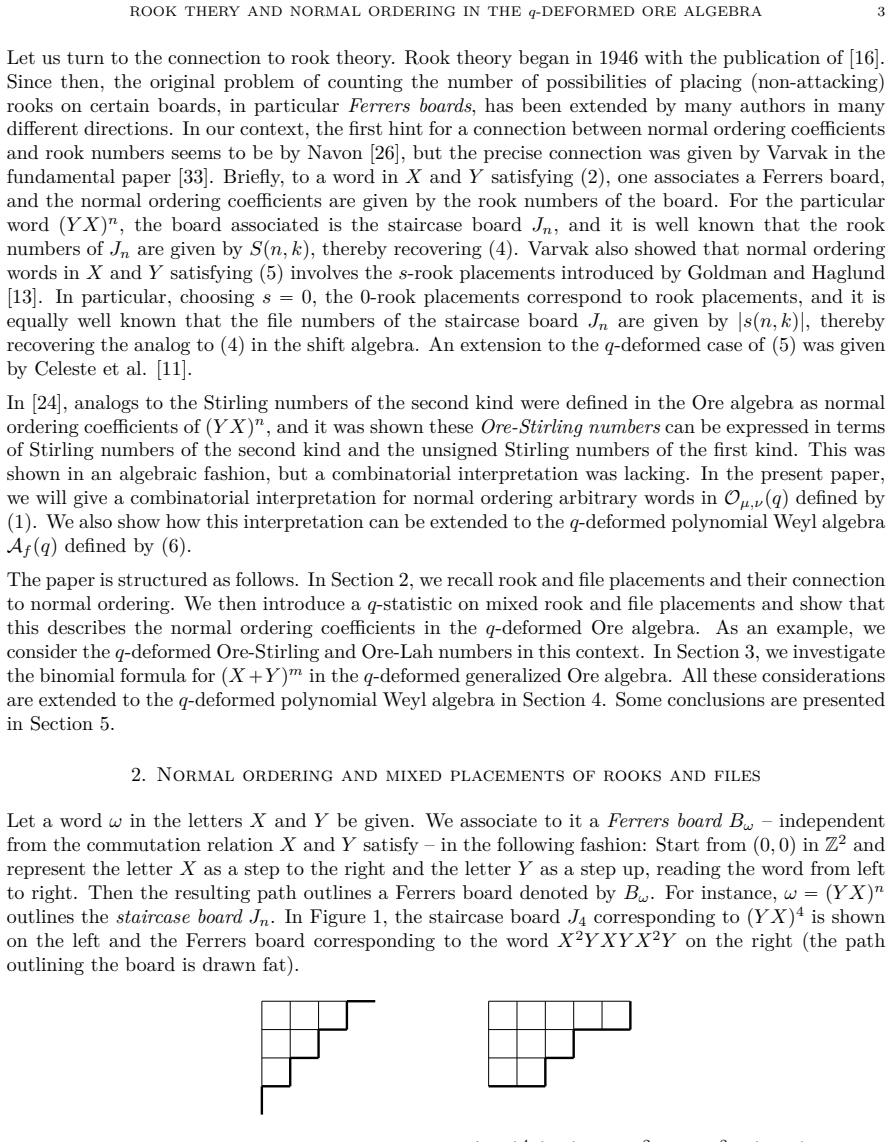
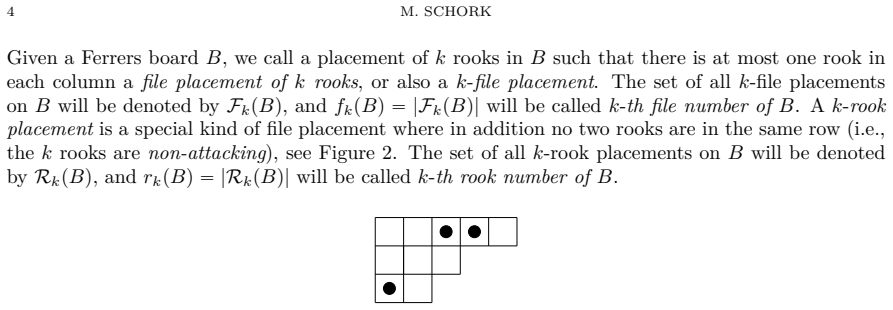
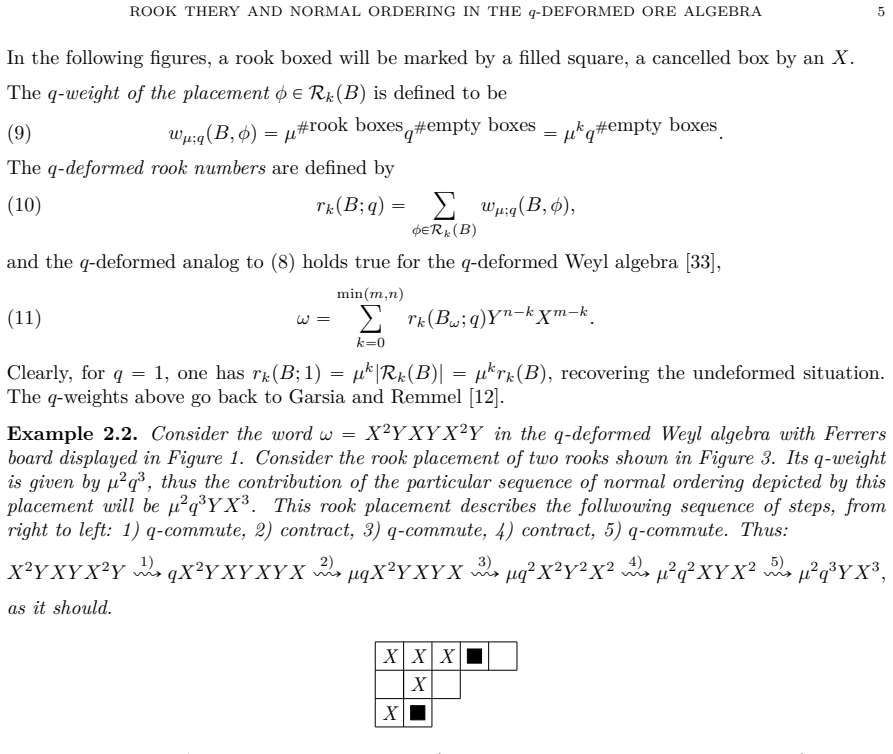
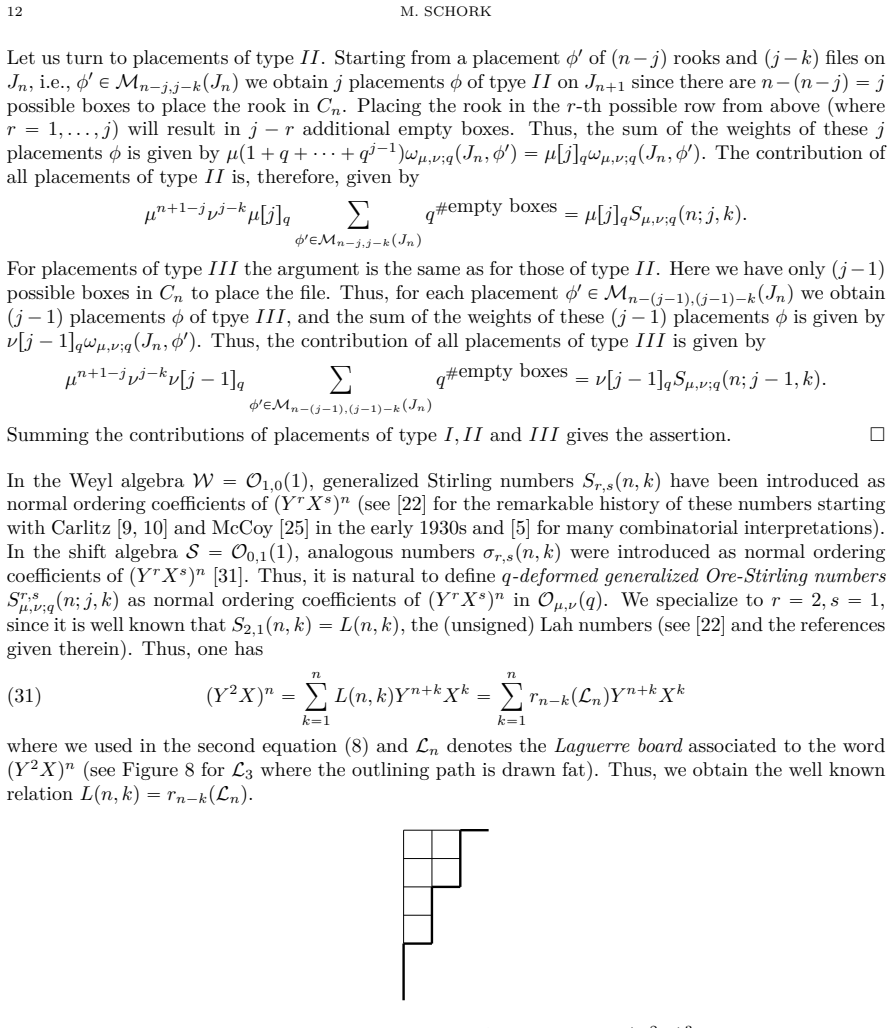
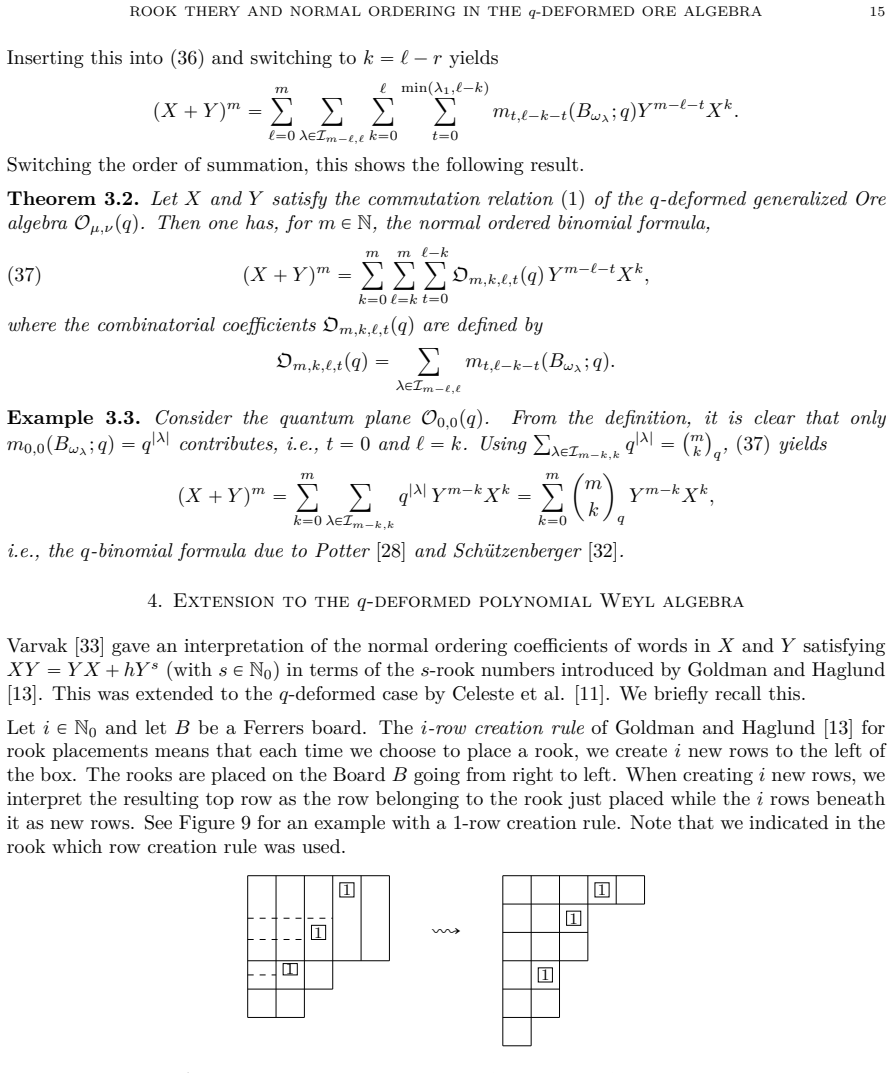
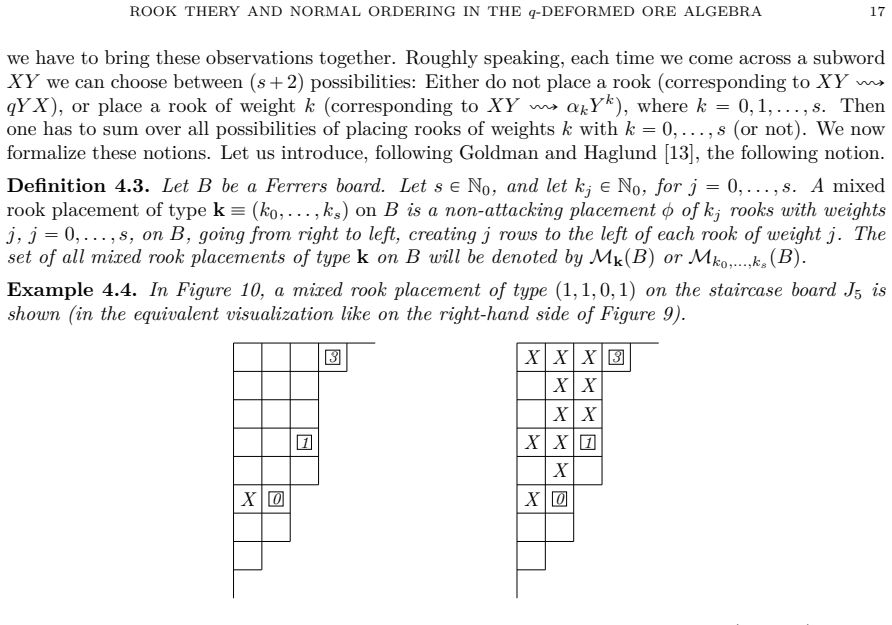
- [Figures 1-2] Figure 1 (staircase board) and Figure 2 (Laguerre board) would benefit from labeling the file placements distinctly from rook placements and indicating the inversion statistic that produces the power of q.
- [§4] The induction proof for the normal form of (X+Y)^m in §4 assumes commutation of certain monomials without enumerating the q-factors arising from each pairwise swap; an expanded base case or small-m verification would clarify the argument.
Simulated Author's Rebuttal
We thank the referee for their thorough review and valuable suggestions. We address each major comment below and indicate the revisions we will make to the manuscript.
read point-by-point responses
-
Referee: [§3] §3 (q-deformed Ore-Stirling numbers): The identification of the algebraic coefficients with mixed rook-file placement numbers on the staircase board is established by showing that both satisfy the same recurrence and initial conditions. However, no explicit weight-preserving bijection is constructed that maps each sequence of commutation applications (with q tracking the number of crossings) to a unique placement; equality therefore rests on uniqueness of recurrence solutions rather than a direct combinatorial correspondence. This is load-bearing for the central claim in the abstract that the numbers 'are given as' the placement counts.
Authors: We acknowledge that our proof of the identification relies on both the algebraic coefficients and the placement numbers satisfying the same recurrence relations with matching initial conditions. This approach is common in combinatorial literature for establishing such equalities. An explicit bijection would indeed offer a more direct combinatorial proof, but we believe the recurrence method sufficiently supports the claim. To better reflect this, we will revise the abstract to use 'admit an interpretation in terms of' instead of 'are given as', and include a brief discussion in Section 3 on the nature of this correspondence. revision: partial
-
Referee: [§5] §5 (polynomial Weyl algebra extension): When the commutation relation is generalized to XY - qYX = f(Y) for arbitrary polynomial f, the manuscript introduces q-deformed polynomial Stirling and Lah numbers but does not specify how the staircase or Laguerre boards are modified to encode the higher-degree terms in f; the recurrence derivation therefore lacks a corresponding combinatorial model for general f, weakening the extension of the rook-theoretic interpretation.
Authors: The section on the polynomial Weyl algebra provides an algebraic generalization where the commutation relation involves an arbitrary polynomial f(Y). The q-deformed polynomial Stirling and Lah numbers are defined through the normal-ordering process in this setting, and their properties are studied algebraically, including recurrences derived from the commutation relations. The explicit rook and file placement models on staircase and Laguerre boards are developed specifically for the linear case f(Y) = μI + νY. For general f, a combinatorial board model would require additional structure to account for higher-degree terms, which is not pursued here. We will add a clarifying paragraph at the beginning of §5 to emphasize that the rook-theoretic interpretation is for the linear commutation relation, while the polynomial extension is algebraic. revision: yes
Circularity Check
No circularity: algebraic coefficients defined via commutation; combinatorial model supplies independent counting via shared recurrences and base cases.
full rationale
The paper first defines the normal-ordering coefficients directly from the commutation relation XY - q YX = μ I + ν Y. It then introduces mixed rook-file placements on the staircase and Laguerre boards as a separate combinatorial model. Equality of the two families is shown by verifying that both satisfy identical recurrences together with matching initial conditions. This is a standard, non-circular proof technique; the combinatorial side is not used to define the algebraic side, nor is any parameter fitted and then relabeled as a prediction. No self-citation chains, ansatz smuggling, or uniqueness theorems imported from prior work by the same author are load-bearing. The derivation remains self-contained against external benchmarks.
Axiom & Free-Parameter Ledger
axioms (2)
- standard math Standard definitions and properties of rook placements on boards (staircase, Laguerre) from classical rook theory.
- domain assumption The commutation relation XY - q YX = μ I + ν Y (or polynomial f(Y)) defines the algebra in which normal ordering is performed.
Reference graph
Works this paper leans on
-
[1]
K. Beauduin, Old and new powerful tools for the normal ordering problem and noncommutative binomials , Enumer. Comb. Appl. 5 (2025), Art. S2R4
work page 2025
-
[2]
G. Benkart, S.A. Lopes and M. Ondrus, A parametric family of subalgebras of the Weyl algebra. II: Irreducible modules, Recent developments in algebraic and combinatorial aspects of representation theory. Contemp. Math. 602, Amer. Math. Soc., Providence, RI (2013), 73–98. ROOK THERY AND NORMAL ORDERING IN THE q-DEFORMED ORE ALGEBRA 25
work page 2013
-
[3]
G. Benkart, S.A. Lopes and M. Ondrus, A parametric family of subalgebras of the Weyl algebra. I: Structure and automorphisms, Trans. Amer. Math. Soc. 367 (2015), 1993–2021
work page 2015
-
[4]
G. Benkart, S.A. Lopes and M. Ondrus, Derivations of a parametric family of subalgebras of the Weyl algebra , J. Algebra 424 (2015), 46–97
work page 2015
-
[5]
P. Blasiak and P. Flajolet, Combinatorial models of creation-annihilation , Sém. Lothar. Combin. 65 (2011), Article B65c
work page 2011
-
[6]
E. Briand, Normal ordering of pU Dqn when DU “ qU D` D` 1 (extended abstract), in Proceedings: XIV Encuentro Andaluz de Matemática Discreta (2025), 14–17
work page 2025
-
[7]
E. Briand, S.A. Lopes and M. Rosas, Normally ordered forms of powers of differential operators and their combi- natorics, J. Pure Appl. Algebra 224 (2020), Article 106312
work page 2020
-
[8]
Burde, On the matrix equation XA ´ AX “ X p, Linear Algebra Appl
D. Burde, On the matrix equation XA ´ AX “ X p, Linear Algebra Appl. 404 (2005), 147–165
work page 2005
-
[9]
Carlitz, On a class of finite sums , Amer
L. Carlitz, On a class of finite sums , Amer. Math. Monthly 37 (1930), 472–479
work page 1930
-
[10]
Carlitz, On arrays of numbers , Amer
L. Carlitz, On arrays of numbers , Amer. J. Math. 54 (1932), 739–752
work page 1932
-
[11]
R.O. Celeste, R.B. Corcino and K.J.M. Gonzales, Two approaches to normal order coefficients , J. Integer Seq. 20 (2017), Article 17.3.5
work page 2017
-
[12]
A.M. Garsia and J.B. Remmel, A combinatorial interpretation of q-derangement and q-Laguerre numbers, European J. Combin. 1 (1980), 47–59
work page 1980
-
[13]
J. Goldman and J. Haglund, Generalized rook polynomials, J. Combin. Theory Ser. A 91 (2000), 509–530
work page 2000
-
[14]
Irving, Prime ideals of Ore extensions over commutative rings
R.S. Irving, Prime ideals of Ore extensions over commutative rings. II , J. Algebra 58 (1979), 399–423
work page 1979
- [15]
-
[16]
I. Kaplansky and J. Riordan, The problem of the rooks and its applications , Duke Math. J. 13 (1946), 259–268
work page 1946
-
[17]
V. Levandovskyy, C. Koutschan and O. Motsak, On two-generated non-commutative algebras subject to the affine relation, in: Computer algebra in scientific computing. 13th international workshop, CASC 2011, Kassel, Germany, September 5–9, 2011. Proceedings, 309–320
work page 2011
-
[18]
Lopes, Noncommutative algebra and representation theory: symmetry, structure & invariants , Commun
S.A. Lopes, Noncommutative algebra and representation theory: symmetry, structure & invariants , Commun. Math. 32 (2024), 63–117
work page 2024
-
[19]
T. Mansour, M. Schork, The commutation relation xy “ qyx ` hf pyq and Newton ’s binomial formula , Ramanujan J. 25 (2011), 405–445
work page 2011
-
[20]
T. Mansour, M. Schork, M. Shattuck, On a new family of generalized Stirling and Bell numbers , Electron. J. Combin. 18 (2011), Article #P77
work page 2011
-
[21]
T. Mansour, M. Schork, M. Shattuck, The generalized Stirling and Bell numbers revisited , J. Integer Seq. 15 (2012), Article 12.8.3
work page 2012
-
[22]
T. Mansour, M. Schork, Commutation relations, normal ordering, and Stirling numbers , CRC Press, Boca Raton, FL (2016)
work page 2016
-
[23]
T. Mansour and M. Schork, On a close relative of the quantum plane , Mediterr. J. Math. 15 (2018), Article 124
work page 2018
-
[24]
T. Mansour and M. Schork, On Ore-Stirling numbers defined by normal ordering in the Ore algebra , Filomat 37 (2023), 6115–6131
work page 2023
-
[25]
McCoy, Expansions of certain differential operators , Tôhoku Math
N.H. McCoy, Expansions of certain differential operators , Tôhoku Math. J. 39 (1934), 181–186
work page 1934
-
[26]
Navon, Combinatorics and fermion algebra , Il Nuovo Cimento 16 (1973), 324–330
A.M. Navon, Combinatorics and fermion algebra , Il Nuovo Cimento 16 (1973), 324–330
work page 1973
-
[27]
R. Patrias and P. Pylyavskyy, Dual filtered graphs , Algebr. Comb. 1 (2018), 441–500
work page 2018
-
[28]
Potter, On the latent roots of quasi-commutative matrices , Amer
H.S.A. Potter, On the latent roots of quasi-commutative matrices , Amer. Math. Monthly 57 (1950), 321–322
work page 1950
-
[29]
Combinatorial aspects of normal ordering of 3-dimensional skew polynomial rings
A. Rubiano and A. Reyes, Combinatorial aspects of normal ordering of 3-dimensional skew polynomial rings , Preprint (2026), arXiv:2605.03094 v1 [math.CO]
work page internal anchor Pith review Pith/arXiv arXiv 2026
-
[30]
Schork, Recent developments in combinatorial aspects of normal ordering , Enumer
M. Schork, Recent developments in combinatorial aspects of normal ordering , Enumer. Comb. Appl. 1 (2021), Article S2S2
work page 2021
-
[31]
Schork, File placements, fractional matchings, and normal ordering , Ann
M. Schork, File placements, fractional matchings, and normal ordering , Ann. Comb. 26 (2022), 857–871
work page 2022
-
[32]
M.P. Schützenberger, Une interprétation de certains solutions de l’équation fonctionnelle: F px ` yq “ F pxqF pyq, C. R. Acad. Sci. Paris 236 (1953), 352–353
work page 1953
-
[33]
Varvak, Rook numbers and the normal ordering problem , J
A. Varvak, Rook numbers and the normal ordering problem , J. Combin. Theory Ser. A 112 (2005), 292–307
work page 2005
-
[34]
Viskov, Expansion in powers of a noncommutative binomial , Proc
O.V. Viskov, Expansion in powers of a noncommutative binomial , Proc. Steklov Inst. Math. 216 (1996), 63–69. 1 Institute for Mathematics, Würzburg University, Emil-Fischer Str. 40, 97074 Würzburg, Germany, matthias.schork@mathematik.uni-wuerzburg.de
work page 1996
discussion (0)
Sign in with ORCID, Apple, or X to comment. Anyone can read and Pith papers without signing in.