Recognition: 2 theorem links
· Lean TheoremLearning Unified Representations of Normalcy for Time Series Anomaly Detection
Pith reviewed 2026-05-12 04:31 UTC · model grok-4.3
The pith
A score-based generative model learns unified normal representations to detect time series anomalies earlier and more accurately
A machine-rendered reading of the paper's core claim, the machinery that carries it, and where it could break.
Core claim
The authors establish that their U²AD framework learns the underlying data distribution of normal samples by utilizing score-based generative modeling with a novel time-dependent score network and a unified training objective that together delineate the manifold of normal data while considering both local and global temporal contexts, with reconstruction performed via a deterministic sampling process using an ordinary differential equation solver.
What carries the argument
Score-based generative modeling with a novel time-dependent score network and unified training objective that delineates the manifold of normal data while accounting for local and global temporal contexts
If this is right
- U²AD outperforms current state-of-the-art methods in detection accuracy on multivariate time series.
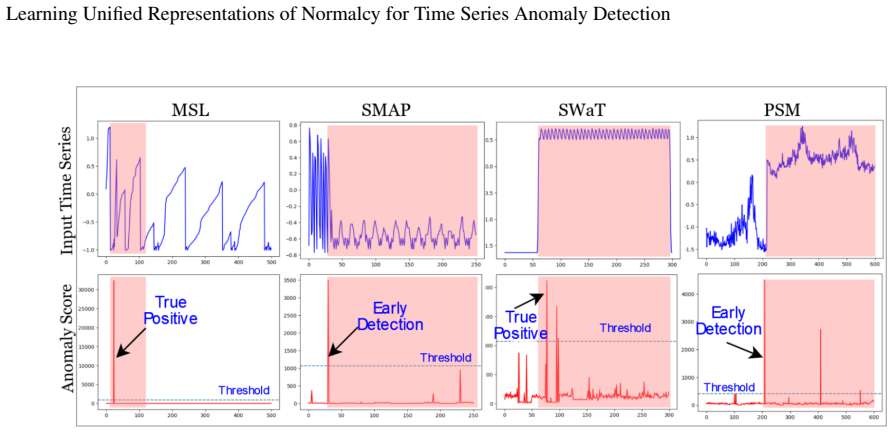
- The approach identifies anomalies at significantly earlier stages of their occurrence.
- Learning the normal data distribution via the proposed network and objective enables better separation from anomalous patterns.
- Deterministic reconstruction with an ODE solver supports precise anomaly flagging after manifold learning.
Where Pith is reading between the lines
- The local-global context handling could make the method adaptable to time series with irregular sampling or varying lengths.
- The unified normal representation might reduce false positives in noisy real-world environments.
- Adapting the time-dependent score network for streaming data could support online anomaly detection applications.
Load-bearing premise
That training a score-based generative model exclusively on normal time series samples will produce a representation distinctly separable from anomalous patterns by incorporating local and global temporal contexts.
What would settle it
If benchmark experiments on standard multivariate time series datasets show that U²AD does not achieve higher detection accuracy or earlier anomaly identification than existing methods, the central performance claims would be disproven.
Figures


read the original abstract
The core challenge in unsupervised anomaly detection is identifying abnormal patterns without prior knowledge of their characteristics. While existing methods have addressed aspects of this problem, they often struggle to learn a robust representation of the normal data distribution that is distinct from anomalous patterns. In this paper, we present a novel framework, Unified Unsupervised Anomaly Detection ($\text{U}^2\text{AD}$), that comprehensively addresses anomaly detection in multivariate time series. Our approach learns the underlying data distribution of normal samples by utilizing score-based generative modeling. We introduce a novel time-dependent score network and a unified training objective that together delineate the manifold of normal data while considering both local and global temporal contexts. Reconstruction is then performed via a deterministic sampling process using an ordinary differential equation solver. Our extensive experimental evaluations demonstrate that $\text{U}^2\text{AD}$ not only outperforms current state-of-the-art methods in detection accuracy but also identifies anomalies at significantly earlier stages of their occurrence.
Editorial analysis
A structured set of objections, weighed in public.
Referee Report
Summary. The paper proposes U²AD, a framework for unsupervised anomaly detection in multivariate time series. It learns the normal data distribution via score-based generative modeling using a novel time-dependent score network and a unified training objective that incorporates both local and global temporal contexts. Reconstruction for anomaly scoring is performed with a deterministic ODE solver. The central claims are that this yields higher detection accuracy than current SOTA methods and identifies anomalies at significantly earlier stages, supported by extensive experiments.
Significance. If the empirical results hold, the work advances score-based generative approaches to time series anomaly detection by explicitly modeling temporal contexts in the normal manifold. The emphasis on earlier detection has clear practical value for monitoring applications. The method follows standard practices in the score-based anomaly detection literature and appears internally consistent.
major comments (1)
- [Experimental section] Experimental section (around the claims of earlier detection): the strongest claim is that anomalies are identified at significantly earlier stages, but the manuscript should explicitly define the timing metric (e.g., lead time in steps or a normalized early-detection score) and show how it is computed uniformly across all baselines to substantiate the cross-method comparison.
minor comments (2)
- [Abstract] Abstract: the claim of outperformance from 'extensive experimental evaluations' would be stronger if the abstract briefly named the datasets, number of baselines, and key metrics (accuracy, early-detection timing) rather than leaving all details to the body.
- [§3] §3 (method): the notation and architecture diagram for the time-dependent score network would benefit from an explicit equation showing how the time embedding is injected, to improve clarity and reproducibility.
Simulated Author's Rebuttal
We thank the referee for the positive assessment of our work and the recommendation for minor revision. The feedback on clarifying the early-detection metric is constructive and will improve the manuscript's clarity and reproducibility. We address the comment below.
read point-by-point responses
-
Referee: [Experimental section] Experimental section (around the claims of earlier detection): the strongest claim is that anomalies are identified at significantly earlier stages, but the manuscript should explicitly define the timing metric (e.g., lead time in steps or a normalized early-detection score) and show how it is computed uniformly across all baselines to substantiate the cross-method comparison.
Authors: We agree that an explicit definition and uniform computation procedure for the early-detection timing metric are required to substantiate the cross-method comparisons. In the revised manuscript, we will add a dedicated paragraph (and supporting equation) in the Experimental Setup subsection of Section 4. The metric will be defined as lead time: for each anomaly instance, the number of time steps between the first detection (when the anomaly score exceeds a fixed, method-agnostic threshold calibrated on validation normal data) and the ground-truth onset of the anomaly. We will specify that this computation is performed identically for all baselines by (i) using the same threshold selection protocol, (ii) applying the same post-processing (e.g., no smoothing unless explicitly part of a baseline), and (iii) averaging lead times only over true-positive detections. Pseudocode and a small illustrative table will be included to ensure transparency. revision: yes
Circularity Check
No significant circularity in derivation chain
full rationale
The paper introduces a score-based generative framework (U²AD) that trains a time-dependent score network on normal time-series samples using a unified objective incorporating local and global context, followed by deterministic ODE-based reconstruction for anomaly scoring. This is a standard unsupervised setup in which the model learns the normal manifold empirically; anomaly separability and earlier detection are reported as experimental outcomes on public datasets against baselines, not as mathematical identities. No equations reduce a claimed result to its own fitted inputs by construction, no uniqueness theorems are imported via self-citation, and no ansatz or renaming of known patterns is presented as a derivation. The central claims rest on empirical validation rather than tautological definitions, placing the work in the normal non-circular category for ML method papers.
Axiom & Free-Parameter Ledger
axioms (2)
- domain assumption Score-based generative modeling can effectively capture the underlying distribution of normal multivariate time series data.
- domain assumption A deterministic sampling process via ODE solver can reconstruct data to identify deviations from the normal manifold.
invented entities (1)
-
time-dependent score network
no independent evidence
Lean theorems connected to this paper
-
IndisputableMonolith/Cost/FunctionalEquation.leanwashburn_uniqueness_aczel unclear?
unclearRelation between the paper passage and the cited Recognition theorem.
We introduce a novel time-dependent score network and a unified training objective that together delineate the manifold of normal data while considering both local and global temporal contexts. Reconstruction is then performed via a deterministic sampling process using an ordinary differential equation solver.
-
IndisputableMonolith/Foundation/BranchSelection.leanbranch_selection unclear?
unclearRelation between the paper passage and the cited Recognition theorem.
Ltotal = LDSM(θ) + λ1 × LRec + λ2 × LVM − λ3 × Γ(ξ, ψ; X; t)
What do these tags mean?
- matches
- The paper's claim is directly supported by a theorem in the formal canon.
- supports
- The theorem supports part of the paper's argument, but the paper may add assumptions or extra steps.
- extends
- The paper goes beyond the formal theorem; the theorem is a base layer rather than the whole result.
- uses
- The paper appears to rely on the theorem as machinery.
- contradicts
- The paper's claim conflicts with a theorem or certificate in the canon.
- unclear
- Pith found a possible connection, but the passage is too broad, indirect, or ambiguous to say the theorem truly supports the claim.
Reference graph
Works this paper leans on
-
[1]
Daehyung Park, Yuuna Hoshi, and Charles C Kemp. A multimodal anomaly detector for robot-assisted feeding using an lstm-based variational autoencoder.IEEE Robotics and Automation Letters, 3(3):1544–1551, 2018
work page 2018
-
[2]
Robust anomaly detection for multivariate time series through stochastic recurrent neural network
Ya Su, Youjian Zhao, Chenhao Niu, Rong Liu, Wei Sun, and Dan Pei. Robust anomaly detection for multivariate time series through stochastic recurrent neural network. InProceedings of the 25th ACM SIGKDD international conference on knowledge discovery & data mining, pages 2828–2837, 2019
work page 2019
-
[3]
Beatgan: Anomalous rhythm detection using adversarially generated time series
Bin Zhou, Shenghua Liu, Bryan Hooi, Xueqi Cheng, and Jing Ye. Beatgan: Anomalous rhythm detection using adversarially generated time series. InIJCAI, volume 2019, pages 4433–4439, 2019
work page 2019
-
[4]
Mad-gan: Multivariate anomaly detection for time series data with generative adversarial networks
Dan Li, Dacheng Chen, Baihong Jin, Lei Shi, Jonathan Goh, and See-Kiong Ng. Mad-gan: Multivariate anomaly detection for time series data with generative adversarial networks. InInternational conference on artificial neural networks, pages 703–716. Springer, 2019
work page 2019
-
[5]
Takehisa Yairi, Naoya Takeishi, Tetsuo Oda, Yuta Nakajima, Naoki Nishimura, and Noboru Takata. A data-driven health monitoring method for satellite housekeeping data based on probabilistic clustering and dimensionality reduction.IEEE Transactions on Aerospace and Electronic Systems, 53(3):1384–1401, 2017
work page 2017
-
[6]
Deep autoencoding gaussian mixture model for unsupervised anomaly detection
Bo Zong, Qi Song, Martin Renqiang Min, Wei Cheng, Cristian Lumezanu, Daeki Cho, and Haifeng Chen. Deep autoencoding gaussian mixture model for unsupervised anomaly detection. InInternational conference on learning representations, 2018. 9 Learning Unified Representations of Normalcy for Time Series Anomaly Detection
work page 2018
-
[7]
Lukas Ruff, Robert Vandermeulen, Nico Goernitz, Lucas Deecke, Shoaib Ahmed Siddiqui, Alexander Binder, Emmanuel Müller, and Marius Kloft. Deep one-class classification. InInternational conference on machine learning, pages 4393–4402. PMLR, 2018
work page 2018
-
[8]
Lifeng Shen, Zhuocong Li, and James Kwok. Timeseries anomaly detection using temporal hierarchical one-class network.Advances in Neural Information Processing Systems, 33:13016–13026, 2020
work page 2020
-
[9]
Anomaly transformer: Time series anomaly detection with association discrepancy,
Jiehui Xu, Haixu Wu, Jianmin Wang, and Mingsheng Long. Anomaly transformer: Time series anomaly detection with association discrepancy.arXiv preprint arXiv:2110.02642, 2021
-
[10]
Zhihao Dai, Ligang He, Shuanghua Yang, and Matthew Leeke. Sarad: Spatial association-aware anomaly detection and diagnosis for multivariate time series.Advances in Neural Information Processing Systems, 37:48371–48410, 2024
work page 2024
-
[11]
Junho Song, Keonwoo Kim, Jeonglyul Oh, and Sungzoon Cho. Memto: Memory-guided transformer for multivariate time series anomaly detection.Advances in Neural Information Processing Systems, 36:57947–57963, 2023
work page 2023
-
[12]
Revisiting time series outlier detection: Definitions and benchmarks
Kwei-Herng Lai, Daochen Zha, Junjie Xu, Yue Zhao, Guanchu Wang, and Xia Hu. Revisiting time series outlier detection: Definitions and benchmarks. InThirty-fifth conference on neural information processing systems datasets and benchmarks track (round 1), 2021
work page 2021
-
[13]
Aapo Hyvärinen and Peter Dayan. Estimation of non-normalized statistical models by score matching.Journal of Machine Learning Research, 6(4), 2005
work page 2005
-
[14]
Sliced score matching: A scalable approach to density and score estimation
Yang Song, Sahaj Garg, Jiaxin Shi, and Stefano Ermon. Sliced score matching: A scalable approach to density and score estimation. InUncertainty in Artificial Intelligence, pages 574–584. PMLR, 2020
work page 2020
-
[15]
Ian Goodfellow, Yoshua Bengio, and Aaron Courville.Deep learning. MIT press, 2016
work page 2016
-
[16]
Zengyi Li, Yubei Chen, and Friedrich T Sommer. Learning energy-based models in high-dimensional spaces with multi-scale denoising score matching.arXiv preprint arXiv:1910.07762, 2019
-
[17]
A kernelized stein discrepancy for goodness-of-fit tests
Qiang Liu, Jason Lee, and Michael Jordan. A kernelized stein discrepancy for goodness-of-fit tests. InInternational conference on machine learning, pages 276–284. PMLR, 2016
work page 2016
-
[18]
Pascal Vincent. A connection between score matching and denoising autoencoders.Neural computation, 23(7):1661–1674, 2011
work page 2011
-
[19]
Crispin W Gardiner et al.Handbook of stochastic methods, volume 3. springer Berlin, 1985
work page 1985
- [20]
-
[21]
Brian DO Anderson. Reverse-time diffusion equation models.Stochastic Processes and their Applications, 12(3):313–326, 1982
work page 1982
-
[22]
Score-Based Generative Modeling through Stochastic Differential Equations
Yang Song, Jascha Sohl-Dickstein, Diederik P Kingma, Abhishek Kumar, Stefano Ermon, and Ben Poole. Score-based generative modeling through stochastic differential equations.arXiv preprint arXiv:2011.13456, 2020
work page internal anchor Pith review Pith/arXiv arXiv 2011
-
[23]
Attention is all you need.Advances in neural information processing systems, 30, 2017
Ashish Vaswani, Noam Shazeer, Niki Parmar, Jakob Uszkoreit, Llion Jones, Aidan N Gomez, Łukasz Kaiser, and Illia Polosukhin. Attention is all you need.Advances in neural information processing systems, 30, 2017
work page 2017
-
[24]
Dimitra Maoutsa, Sebastian Reich, and Manfred Opper. Interacting particle solutions of fokker–planck equations through gradient–log–density estimation.Entropy, 22(8):802, 2020
work page 2020
-
[25]
Detecting spacecraft anomalies using lstms and nonparametric dynamic thresholding
Kyle Hundman, Valentino Constantinou, Christopher Laporte, Ian Colwell, and Tom Soderstrom. Detecting spacecraft anomalies using lstms and nonparametric dynamic thresholding. InProceedings of the 24th ACM SIGKDD international conference on knowledge discovery & data mining, pages 387–395, 2018
work page 2018
-
[26]
Swat: A water treatment testbed for research and training on ics security
Aditya P Mathur and Nils Ole Tippenhauer. Swat: A water treatment testbed for research and training on ics security. In2016 international workshop on cyber-physical systems for smart water networks (CySWater), pages 31–36. IEEE, 2016
work page 2016
-
[27]
A dataset to support research in the design of secure water treatment systems
Jonathan Goh, Sridhar Adepu, Khurum Nazir Junejo, and Aditya Mathur. A dataset to support research in the design of secure water treatment systems. InCritical Information Infrastructures Security: 11th International Conference, CRITIS 2016, Paris, France, October 10–12, 2016, Revised Selected Papers 11, pages 88–99. Springer, 2017
work page 2016
-
[28]
Practical approach to asynchronous multivariate time series anomaly detection and localization
Ahmed Abdulaal, Zhuanghua Liu, and Tomer Lancewicki. Practical approach to asynchronous multivariate time series anomaly detection and localization. InProceedings of the 27th ACM SIGKDD conference on knowledge discovery & data mining, pages 2485–2494, 2021. 10 Learning Unified Representations of Normalcy for Time Series Anomaly Detection
work page 2021
-
[29]
Zhihan Li, Youjian Zhao, Jiaqi Han, Ya Su, Rui Jiao, Xidao Wen, and Dan Pei. Multivariate time series anomaly detection and interpretation using hierarchical inter-metric and temporal embedding. InProceedings of the 27th ACM SIGKDD conference on knowledge discovery & data mining, pages 3220–3230, 2021
work page 2021
-
[30]
Hongzuo Xu, Guansong Pang, Yijie Wang, and Yongjun Wang. Deep isolation forest for anomaly detection.IEEE Transactions on Knowledge and Data Engineering, 35(12):12591–12604, 2023
work page 2023
-
[31]
Shreshth Tuli, Giuliano Casale, and Nicholas R Jennings. Tranad: Deep transformer networks for anomaly detection in multivariate time series data.arXiv preprint arXiv:2201.07284, 2022
-
[32]
Yiyuan Yang, Chaoli Zhang, Tian Zhou, Qingsong Wen, and Liang Sun. Dcdetector: Dual attention contrastive representation learning for time series anomaly detection.arXiv preprint arXiv:2306.10347, 2023
-
[33]
Yuhang Chen, Chaoyun Zhang, Minghua Ma, Yudong Liu, Ruomeng Ding, Bowen Li, Shilin He, Saravan Rajmohan, Qingwei Lin, and Dongmei Zhang. Imdiffusion: Imputed diffusion models for multivariate time series anomaly detection.arXiv preprint arXiv:2307.00754, 2023
-
[34]
arXiv preprint arXiv:2210.02186 , year=
Haixu Wu, Tengge Hu, Yong Liu, Hang Zhou, Jianmin Wang, and Mingsheng Long. Timesnet: Temporal 2d-variation modeling for general time series analysis.arXiv preprint arXiv:2210.02186, 2022
-
[35]
John Paparrizos, Paul Boniol, Themis Palpanas, Ruey S Tsay, Aaron Elmore, and Michael J Franklin. V olume Under the Surface: A New Accuracy Evaluation Measure for Time-Series Anomaly Detection.Proceedings of the VLDB Endowment, 15(11):2774–2787, 2022
work page 2022
-
[36]
Reward once, penalize once: Rectifying time series anomaly detection
Keval Doshi, Shatha Abudalou, and Yasin Yilmaz. Reward once, penalize once: Rectifying time series anomaly detection. In2022 International Joint Conference on Neural Networks (IJCNN), pages 1–8. IEEE, 2022
work page 2022
-
[37]
Marco Fraccaro, Søren Kaae Sønderby, Ulrich Paquet, and Ole Winther. Sequential neural models with stochastic layers.Advances in neural information processing systems, 29, 2016
work page 2016
-
[38]
Failure detection in assembly: Force signature analysis
Alberto Rodriguez, David Bourne, Mathew Mason, Gregory F Rossano, and JianJun Wang. Failure detection in assembly: Force signature analysis. In2010 IEEE International Conference on Automation Science and Engineering, pages 210–215. IEEE, 2010
work page 2010
-
[39]
A multimodal execution monitor with anomaly classification for robot-assisted feeding
Daehyung Park, Hokeun Kim, Yuuna Hoshi, Zackory Erickson, Ariel Kapusta, and Charles C Kemp. A multimodal execution monitor with anomaly classification for robot-assisted feeding. In2017 IEEE/RSJ International Conference on Intelligent Robots and Systems (IROS), pages 5406–5413. IEEE, 2017
work page 2017
-
[40]
Tanogan: Time series anomaly detection with generative adversarial networks
Md Abul Bashar and Richi Nayak. Tanogan: Time series anomaly detection with generative adversarial networks. In2020 IEEE Symposium Series on Computational Intelligence (SSCI), pages 1778–1785. IEEE, 2020
work page 2020
-
[41]
Usad: Unsupervised anomaly detection on multivariate time series
Julien Audibert, Pietro Michiardi, Frédéric Guyard, Sébastien Marti, and Maria A Zuluaga. Usad: Unsupervised anomaly detection on multivariate time series. InProceedings of the 26th ACM SIGKDD international conference on knowledge discovery & data mining, pages 3395–3404, 2020
work page 2020
-
[42]
Chuxu Zhang, Dongjin Song, Yuncong Chen, Xinyang Feng, Cristian Lumezanu, Wei Cheng, Jingchao Ni, Bo Zong, Haifeng Chen, and Nitesh V Chawla. A deep neural network for unsupervised anomaly detection and diagnosis in multivariate time series data. InProceedings of the AAAI conference on artificial intelligence, volume 33, pages 1409–1416, 2019
work page 2019
-
[43]
Tadgan: Time series anomaly detection using generative adversarial networks
Alexander Geiger, Dongyu Liu, Sarah Alnegheimish, Alfredo Cuesta-Infante, and Kalyan Veeramachaneni. Tadgan: Time series anomaly detection using generative adversarial networks. In2020 ieee international conference on big data (big data), pages 33–43. IEEE, 2020
work page 2020
-
[44]
Lof: identifying density-based local outliers
Markus M Breunig, Hans-Peter Kriegel, Raymond T Ng, and Jörg Sander. Lof: identifying density-based local outliers. InProceedings of the 2000 ACM SIGMOD international conference on Management of data, pages 93–104, 2000
work page 2000
-
[45]
Deep autoencoding gaussian mixture model for unsupervised anomaly detection
Bo Zong, Qi Song, Martin Renqiang Min, Wei Cheng, Cristian Lumezanu, Dae ki Cho, and Haifeng Chen. Deep autoencoding gaussian mixture model for unsupervised anomaly detection. InInternational Conference on Learning Representations, 2018
work page 2018
-
[46]
Liangwei Zhang, Jing Lin, and Ramin Karim. Adaptive kernel density-based anomaly detection for nonlinear systems.Knowledge-Based Systems, 139:50–63, 2018
work page 2018
-
[47]
Support vector data description.Machine learning, 54:45–66, 2004
David MJ Tax and Robert PW Duin. Support vector data description.Machine learning, 54:45–66, 2004
work page 2004
-
[48]
Jonathan Ho, Ajay Jain, and Pieter Abbeel. Denoising diffusion probabilistic models.Advances in neural information processing systems, 33:6840–6851, 2020
work page 2020
-
[49]
Yusuke Tashiro, Jiaming Song, Yang Song, and Stefano Ermon. Csdi: Conditional score-based diffusion models for probabilistic time series imputation.Advances in Neural Information Processing Systems, 34:24804–24816, 2021. 11 Learning Unified Representations of Normalcy for Time Series Anomaly Detection
work page 2021
-
[50]
Autoregressive denoising diffusion models for multivariate probabilistic time series forecasting
Kashif Rasul, Calvin Seward, Ingmar Schuster, and Roland V ollgraf. Autoregressive denoising diffusion models for multivariate probabilistic time series forecasting. InInternational Conference on Machine Learning, pages 8857–8868. PMLR, 2021
work page 2021
-
[51]
Yan Li, Xinjiang Lu, Yaqing Wang, and Dejing Dou. Generative time series forecasting with diffusion, denoise, and disentanglement.Advances in Neural Information Processing Systems, 35:23009–23022, 2022
work page 2022
-
[52]
Madsgm: Multivariate anomaly detection with score-based generative models
Haksoo Lim, Sewon Park, Minjung Kim, Jaehoon Lee, Seonkyu Lim, and Noseong Park. Madsgm: Multivariate anomaly detection with score-based generative models. InProceedings of the 32nd ACM International Conference on Information and Knowledge Management, pages 1411–1420, 2023
work page 2023
-
[53]
Multi-resolution decomposable diffusion model for non- stationary time series anomaly detection
Guojin Zhong, Jin Yuan, Zhiyong Li, Long Chen, et al. Multi-resolution decomposable diffusion model for non- stationary time series anomaly detection. InThe Thirteenth International Conference on Learning Representations, 2025
work page 2025
-
[54]
Adam Paszke, Sam Gross, Francisco Massa, Adam Lerer, James Bradbury, Gregory Chanan, Trevor Killeen, Zeming Lin, Natalia Gimelshein, Luca Antiga, et al. Pytorch: An imperative style, high-performance deep learning library.Advances in neural information processing systems, 32, 2019
work page 2019
-
[55]
Adam: A Method for Stochastic Optimization
Diederik P Kingma and Jimmy Ba. Adam: A method for stochastic optimization.arXiv preprint arXiv:1412.6980, 2014
work page internal anchor Pith review Pith/arXiv arXiv 2014
-
[56]
Unsupervised anomaly detection via variational auto-encoder for seasonal kpis in web applications
Haowen Xu, Wenxiao Chen, Nengwen Zhao, Zeyan Li, Jiahao Bu, Zhihan Li, Ying Liu, Youjian Zhao, Dan Pei, Yang Feng, et al. Unsupervised anomaly detection via variational auto-encoder for seasonal kpis in web applications. InProceedings of the 2018 world wide web conference, pages 187–196, 2018
work page 2018
-
[57]
Dennis Wagner, Tobias Michels, Florian CF Schulz, Arjun Nair, Maja Rudolph, and Marius Kloft. Timesead: Benchmarking deep multivariate time-series anomaly detection.Transactions on Machine Learning Research, 2023
work page 2023
-
[58]
Astha Garg, Wenyu Zhang, Jules Samaran, Ramasamy Savitha, and Chuan-Sheng Foo. An evaluation of anomaly detection and diagnosis in multivariate time series.IEEE Transactions on Neural Networks and Learning Systems, 33(6):2508–2517, 2021
work page 2021
-
[59]
Hongzuo Xu, Yijie Wang, Songlei Jian, Qing Liao, Yongjun Wang, and Guansong Pang. Calibrated one-class classification for unsupervised time series anomaly detection.arXiv preprint arXiv:2207.12201, 2022
-
[60]
Fei Tony Liu, Kai Ming Ting, and Zhi-Hua Zhou. Isolation forest. In2008 eighth ieee international conference on data mining, pages 413–422. IEEE, 2008
work page 2008
-
[61]
Neural Contextual Anomaly Detection for Time Series
Chris U Carmona, François-Xavier Aubet, Valentin Flunkert, and Jan Gasthaus. Neural contextual anomaly detection for time series.arXiv preprint arXiv:2107.07702, 2021
-
[62]
U-net: Convolutional networks for biomedical image seg- mentation
Olaf Ronneberger, Philipp Fischer, and Thomas Brox. U-net: Convolutional networks for biomedical image seg- mentation. InMedical Image Computing and Computer-Assisted Intervention–MICCAI 2015: 18th International Conference, Munich, Germany, October 5-9, 2015, Proceedings, Part III 18, pages 234–241. Springer, 2015
work page 2015
-
[63]
Robert Tibshirani, Guenther Walther, and Trevor Hastie. Estimating the number of clusters in a data set via the gap statistic.Journal of the Royal Statistical Society: Series B (Statistical Methodology), 63(2):411–423, 2001. 12 Learning Unified Representations of Normalcy for Time Series Anomaly Detection APPENDIX A Related Work Anomaly Detection in Multi...
-
[64]
Softmax(−Γ(ξ, ψ))⊙ ∥x i −˜xi∥2
-
[65]
Softmax(−Γ(ξ, ψ))⊙ ∥x i −˜xi∥2 +∥s θ(˜xi)−c∥ 2 Throughout our experiments, we observed distinct performance trends among various Anomaly Criteria. Anomaly Criterion-1 is standard reconstruction error, and Anomaly Criterion-2 is volume minimization error [ 7]. Anomaly Criterion-3 is similar to criterion from Anomaly Transformer [ 9]. Notably, during the in...
discussion (0)
Sign in with ORCID, Apple, or X to comment. Anyone can read and Pith papers without signing in.