Recognition: no theorem link
Nullspace-based Fault Diagnosis for Closed-Loop Mechatronic Systems with Application to Semiconductor Equipment
Pith reviewed 2026-05-12 02:47 UTC · model grok-4.3
The pith
Nullspace-based fault diagnosis conditions can be tailored for closed-loop linear mechatronic systems to detect and isolate actuator and sensor faults.
A machine-rendered reading of the paper's core claim, the machinery that carries it, and where it could break.
Core claim
The authors derive tailored FDI synthesis conditions based on the nullspace method that account for the closed-loop dynamics of linear mechatronic systems subject to actuator and sensor faults, and validate them through application to a large-scale prototype wafer stage with experimental results.
What carries the argument
The nullspace-based FDI synthesis conditions, adapted to handle closed-loop aspects and specific fault types in linear systems.
Load-bearing premise
That the mechatronic systems can be adequately modeled as linear and that the closed-loop dynamics permit direct application of the nullspace-based FDI synthesis conditions without significant unmodeled effects.
What would settle it
If experiments on the wafer stage show that the tailored conditions fail to detect or isolate injected faults accurately, or if unmodeled dynamics lead to frequent false positives in fault detection.
Figures


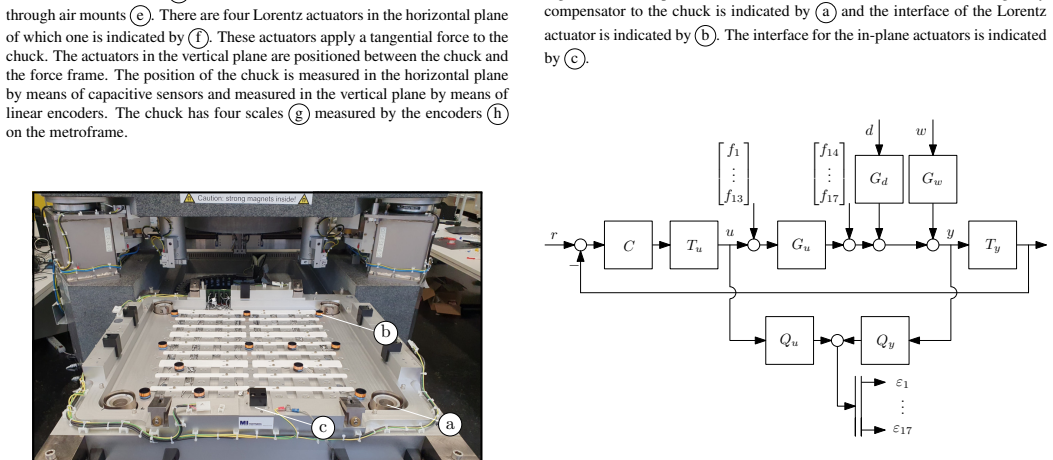


read the original abstract
Fault detection and isolation (FDI) systems are critical for modern mechatronic production equipment, as their continuous operation is heavily dependent on the ability to detect and isolate faults in a timely and efficient manner. The aim of this paper is to address closed-loop aspects for linear systems and enable the application of well-known nullspace-based FDI synthesis conditions to mechatronic systems subject to actuator and sensor faults. These tailored FDI synthesis conditions are applied to a large-scale prototype wafer stage, showcasing the proposed approach through real experiments, thereby underlining the usefulness of the derived synthesis conditions for a wide range of production machines and scientific instruments.
Editorial analysis
A structured set of objections, weighed in public.
Referee Report
Summary. The paper derives tailored nullspace-based FDI synthesis conditions for closed-loop linear mechatronic systems subject to actuator and sensor faults. These conditions are then applied to a large-scale prototype wafer stage, with validation provided through real experiments to demonstrate usefulness for production machines and scientific instruments.
Significance. If the synthesis conditions correctly incorporate closed-loop dynamics and the experimental results robustly confirm fault detection/isolation performance, the work would provide a practical extension of standard nullspace FDI methods to high-precision mechatronic equipment, with direct relevance to semiconductor manufacturing reliability.
major comments (1)
- The central experimental claim (application and validation on the wafer-stage prototype) rests on the assumption that the closed-loop system is adequately linear and that fault signatures are not significantly distorted by unmodeled effects. The manuscript should include explicit model-validation residuals, closed-loop vs. open-loop fault-signature comparisons, and quantitative detection/isolation rates under operating conditions to substantiate that the linear FDI conditions apply directly.
minor comments (1)
- Abstract: the phrasing 'tailored FDI synthesis conditions' is repeated without a concise statement of the specific modifications made to the standard nullspace method for closed-loop systems.
Simulated Author's Rebuttal
We thank the referee for the constructive feedback and positive evaluation of the work's relevance to semiconductor manufacturing. We address the major comment on experimental validation below, incorporating revisions where feasible while noting practical constraints of the prototype setup.
read point-by-point responses
-
Referee: The central experimental claim (application and validation on the wafer-stage prototype) rests on the assumption that the closed-loop system is adequately linear and that fault signatures are not significantly distorted by unmodeled effects. The manuscript should include explicit model-validation residuals, closed-loop vs. open-loop fault-signature comparisons, and quantitative detection/isolation rates under operating conditions to substantiate that the linear FDI conditions apply directly.
Authors: We agree that stronger substantiation of the linearity assumption would enhance the experimental section. In the revised manuscript we have added explicit model-validation residuals (comparing measured closed-loop responses against the identified linear model) and quantitative detection/isolation rates (true-positive/false-positive percentages) under representative operating conditions. Direct closed-loop versus open-loop fault-signature comparisons cannot be performed experimentally, as the wafer-stage prototype is operated exclusively in closed-loop mode for safety, stability, and precision reasons; open-loop excitation would risk mechanical damage and is outside the intended application domain. To address the spirit of the request we have instead included simulation-based comparisons of fault signatures with and without the closed-loop controller, confirming that the derived nullspace conditions correctly account for the closed-loop dynamics. revision: partial
Circularity Check
No circularity in derivation; synthesis conditions derived from standard FDI theory and applied experimentally
full rationale
The paper's core contribution is extending nullspace-based FDI synthesis conditions to handle closed-loop aspects for linear mechatronic systems with actuator/sensor faults. The abstract and description indicate these conditions are derived from established FDI methods and then validated on a wafer-stage prototype via real experiments. No equations or steps reduce by construction to fitted parameters, self-definitions, or load-bearing self-citations. The derivation chain remains self-contained against external FDI benchmarks, with the experimental application serving as independent validation rather than a tautology. Linearity assumptions are noted as a modeling choice but do not create circularity in the claimed results.
Axiom & Free-Parameter Ledger
axioms (2)
- domain assumption The mechatronic systems are linear time-invariant
- domain assumption Closed-loop dynamics can be incorporated into the FDI synthesis without loss of the nullspace properties
Reference graph
Works this paper leans on
-
[1]
Classens, K. and Heemels, W. P. M. H. and Oomen, T. , booktitle =. doi:10.1109/DTPI52967.2021.9540144 , isbn =
-
[2]
Classens, Koen , year =. Fault
-
[3]
Gao, Zhiwei and Cecati, Carlo and Ding, Steven X. , year =. IEEE Trans. Ind. Electron , title =. doi:10.1109/TIE.2015.2417501 , issn =
-
[4]
Hwang, I. and Kim, S. and Kim, Y. and Seah, C. E. , year =. IEEE Trans. Control Syst. Technol. , title =. doi:10.1109/TCST.2009.2026285 , issn =
-
[5]
Isermann, Rolf , year =. Annu. Rev. Control , title =. doi:10.1016/j.arcontrol.2004.12.002 , issn =
-
[6]
Frank, P. M. and Ding, X. , title =. J. Process Control , year =. doi:10.1016/S0301-4770(08)60756-3 , issn =
-
[7]
Zhang, Ping and Ding, Steven X. , journal =. An Integrated Trade-off Design of Observer Based Fault Detection Systems , doi =
-
[8]
Wang, J. L. and Yang, G. and Liu, J. , journal =. An. doi:10.1016/j.automatica.2007.02.019 , issn =
-
[9]
Gertler, J. , booktitle =. Diagnosing. doi:10.1109/ACC.1995.529780 , pages =
-
[10]
Classens, K. and Mostard, M. and van de Wijdeven, J. and Heemels, W. P. M. H. and Oomen, T. , booktitle =. doi:10.1016/j.ifacol.2022.11.271 , title =
- [11]
-
[12]
van der Hulst, M. and Gonz. Mech. Syst. Signal Process. , year =. doi:10.1016/j.ymssp.2026.113948 , pages =
-
[13]
Ding, S. X. and Jeinsch, T. and Frank, P. M. and Ding, E. L. , title =. Int. J. Adapt. Control Signal Process. , keywords =. doi:10.1002/1099-1115(200011)14:7<725::AID-ACS618>3.0.CO;2-Q , pages =
-
[14]
Henry, D. , journal =. Theories for Design and Analysis of Robust. doi:10.1016/j.jfranklin.2020.11.006 , issn =
-
[15]
and Xie, Xiaochen and Luo, Hao , journal =
Yin, Shen and Ding, Steven X. and Xie, Xiaochen and Luo, Hao , journal =. A. doi:10.1109/TIE.2014.2301773 , issn =
-
[16]
Lei, Yaguo and Yang, Bin and Jiang, Xinwei and Jia, Feng and Li, Naipeng and Nandi, Asoke K. , journal =. Applications of Machine Learning to Machine Fault Diagnosis:. doi:10.1016/j.ymssp.2019.106587 , issn =
-
[17]
Varga, Andreas , year =. Springer , file =. doi:10.1007/978-3-031-35767-1 , publisher =
-
[18]
Varga, Andreas , year =. Annu. Rev. Control , title =. doi:10.1016/j.arcontrol.2013.03.001 , number =
-
[19]
Travé-Massuyès, L. , journal =. Bridging control and artificial intelligence theories for diagnosis:. doi:10.1016/j.engappai.2013.09.018 , issn =
- [20]
-
[21]
In: ACC (2021).https://doi.org/10
Classens, K. and Heemels, W. P. M. H. and Oomen, T. , booktitle =. doi:10.23919/ACC50511.2021.9482785 , isbn =
- [22]
-
[23]
On Computing Achievable Fault Signatures , doi =
Varga, Andras , journal =. On Computing Achievable Fault Signatures , doi =
-
[24]
On Computing Nullspace Bases — a Fault Detection Perspective , doi =
Varga, Andras , journal =. On Computing Nullspace Bases — a Fault Detection Perspective , doi =
-
[25]
Kimura, H. , journal =. Geometric Structure of Observers for Linear Feedback Control Laws , doi =
-
[26]
Varga, A. , booktitle =. Reliable Algorithms for Computing Minimal Dynamic Covers , doi =
-
[27]
Zhou, K. and Doyle, J. and Glover, K. , title =. doi:10.1016/s0005-1098(97)00132-5 , publisher =
-
[28]
Proceedings of the IEEE Conference on Decision and Control , keywords =
Liu, Nike and Zhou, Kemin , booktitle =. Proceedings of the IEEE Conference on Decision and Control , keywords =. 2007 , title =. doi:10.1109/CDC.2007.4434123 , eventtitle =
-
[29]
doi:10.1109/CDC.2011.6160723 , booktitle =
Glover, Keith and Varga, Andras , title =. doi:10.1109/CDC.2011.6160723 , booktitle =
-
[30]
Pintelon, Rik and Schoukens, Johan , year =. System
-
[31]
Gonz. Identification of. doi:10.1016/j.automatica.2024.112013 , journal =
-
[32]
Closed-Loop Issues in System Identification , doi =. Annu. Rev. Control , keywords =
-
[33]
Rezamand, M. and Kordestani, R. and Carriveau, R. and Ting, D.S.K. and Saif, M , title =. IEEE Sens. J. , year =. doi:10.1109/JSEN.2019.2948997 , pages =
-
[34]
Neupane, D. and Bouadjenek, M.R. and Dazeley, R. and Aryal, S. , title =. Neurocomputing , year =. doi:10.1016/j.neucom.2025.129588 , pages =
-
[35]
Lei, Y. and Li, N. and Guo, L. and Ningbo, L. and Tan, T. and Lin, J. , title =. Mech. Syst. Signal Process. , year =. doi:10.1016/j.ymssp.2017.11.016 , pages =
-
[36]
Mian, Z. and Deng, X. and Dongg, X. and Tian, Y. and Cao, T. and Chen, K. and Al Jaber, T. , title =. Eng. Appl. Artif. Intell. , year =. doi:10.1016/j.engappai.2023.107357 , pages =
-
[37]
Leite, D. and Andrade, E. and Rativa, D. and Maciel, A.M.A. , title =. Sensors , year =. doi:10.3390/s25010060 , pages =
-
[38]
Li, W. and Li, H. and Gu, S. and Chen, T. , title =. Control Eng. Pract. , year =. doi:10.1016/j.conengprac.2020.104637 , pages =
-
[39]
Wilhelm, Y. and Reimann, P. and Gauchel, W. and Mitschang, B. , title =. Procedia CIRP , year =. doi:10.1016/j.procir.2021.03.041 , pages =
discussion (0)
Sign in with ORCID, Apple, or X to comment. Anyone can read and Pith papers without signing in.