Recognition: 2 theorem links
· Lean TheoremNeural enrichment finite element method: A hybrid framework for problems with strong oscillations or interface problems
Pith reviewed 2026-05-12 03:44 UTC · model grok-4.3
The pith
Neural networks trained via the Ritz functional enrich finite element spaces to reduce degrees of freedom for oscillating and interface problems.
A machine-rendered reading of the paper's core claim, the machinery that carries it, and where it could break.
Core claim
The central discovery is that neural networks can be integrated as enrichment functions in the stable generalized finite element method and trained heuristically with the Ritz functional to form local subspaces offering better approximation. This approach reduces the degrees of freedom substantially while needing little prior problem knowledge. For interface problems the analysis establishes optimal convergence without imposing extra regularity conditions on the solution.
What carries the argument
Neural network enrichment functions within the stable generalized finite element method framework, trained by minimizing the Ritz functional to adaptively improve local approximations.
If this is right
- Superior local subspaces lead to fewer degrees of freedom for equivalent accuracy in oscillating or interface problems.
- Residual-based error estimators are both reliable and efficient for smooth problems.
- Optimal convergence is achieved for interface problems without additional regularity assumptions.
- Only minimal a priori knowledge is needed to define the enrichment functions.
Where Pith is reading between the lines
- This suggests that heuristic neural network training can substitute for problem-specific hand-crafted enrichment functions in generalized finite element methods.
- The method may extend naturally to problems where interfaces or oscillations are not known in advance.
- Combining this with existing adaptive refinement techniques could yield further computational savings.
Load-bearing premise
Neural networks trained heuristically via the Ritz functional will reliably produce enrichment functions that improve approximation properties and maintain stability without introducing new instabilities or requiring problem-specific tuning beyond the stated minimal a priori knowledge.
What would settle it
An experiment on a standard interface problem where the observed convergence rate is suboptimal or the residual error estimator does not provide reliable bounds.
Figures



read the original abstract
We propose a hybrid method, the Neural Enrichment Finite Element Method (NEFEM), designed for problems involving strong oscillations or interface problems with weak discontinuities. This method is based on the stable generalized finite element method (SGFEM) framework, wherein neural networks (NNs) are introduced as enrichment functions for adaptivity, and the Ritz functional is applied for the training process. This works makes two main contributions. First, the method constructs local subspaces with superior approximation properties, significantly reducing the required number of degrees of freedom (DoFs). Second, minimal \emph{a priori} knowledge is required to define enrichment functions, as the NNs evolve heuristically during training. Furthermore, for smooth problems, we provide a residual-based error estimator and prove both its reliability and efficiency. For interface problems, a theoretical analysis on the optimal convergence of the SGFEM is studied, notably without imposing additional regularity assumptions. These analytic results guide the network architecture design and training strategies. The performance and effectiveness of the proposed method is validated through several numerical experiments.
Editorial analysis
A structured set of objections, weighed in public.
Referee Report
Summary. The paper proposes the Neural Enrichment Finite Element Method (NEFEM), a hybrid SGFEM framework that uses neural networks as enrichment functions trained heuristically via the Ritz functional. It claims that this constructs local subspaces with superior approximation properties, significantly reducing DoFs for problems with strong oscillations or weak-discontinuity interfaces. For smooth problems, a residual-based a posteriori error estimator is derived and proved reliable and efficient; for interface problems, an optimal convergence analysis of the SGFEM is given without additional regularity assumptions on the solution. These results are said to guide NN architecture and training, with numerical experiments validating performance.
Significance. If the central claims hold, the work would be significant for adaptively enriching FEM spaces in oscillatory and interface problems while requiring only minimal a priori knowledge. The combination of a proved residual estimator for smooth cases and an optimal-convergence result for interfaces that avoids extra regularity assumptions would be a notable theoretical contribution, alongside the practical DoF reduction demonstrated numerically.
major comments (3)
- [theoretical analysis section for interface problems] The SGFEM optimal-convergence analysis for interface problems (abstract and the section presenting the theoretical analysis) requires the enrichment functions to satisfy specific conditions such as controlled linear independence from the FE basis, bounded norms in the enriched space, and reproduction of interface jumps without ill-conditioning. However, the NNs are produced by heuristic training on the Ritz functional with only minimal a priori knowledge (described in the method and training sections); no verification is provided that the trained networks satisfy these load-bearing assumptions, so the theoretical rates may not transfer to the implemented NEFEM.
- [error estimator section] The reliability and efficiency proof for the residual estimator (abstract and the section on error estimation for smooth problems) is stated for the hybrid method, but the estimator derivation appears to treat the enrichments as fixed after training. Since the NNs evolve during the Ritz-based training process, additional analysis is needed to confirm that the estimator remains reliable when the enrichment subspace is itself the output of an optimization loop.
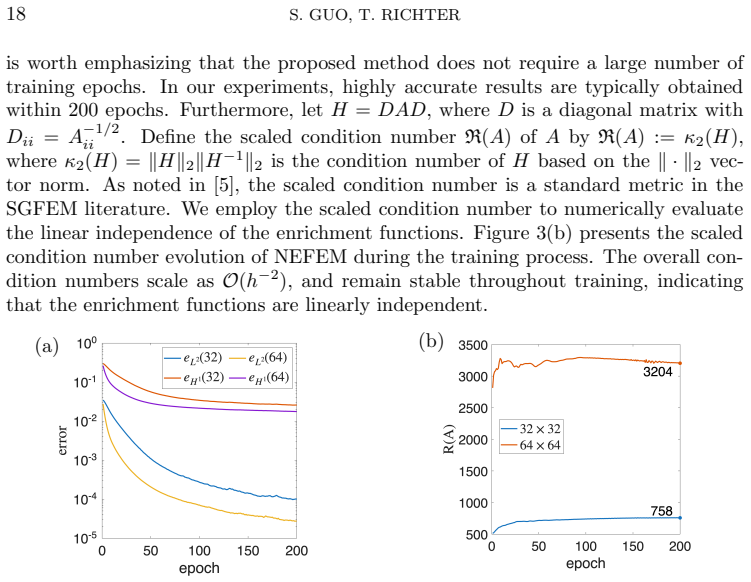
- [numerical experiments section] Numerical experiments are invoked to validate DoF reduction and optimal rates, but without explicit checks (e.g., condition-number monitoring or linear-independence metrics) that the trained enrichments satisfy the stability hypotheses used in the SGFEM theory, the experiments remain empirical and do not close the gap between heuristic training and the required enrichment properties.
minor comments (2)
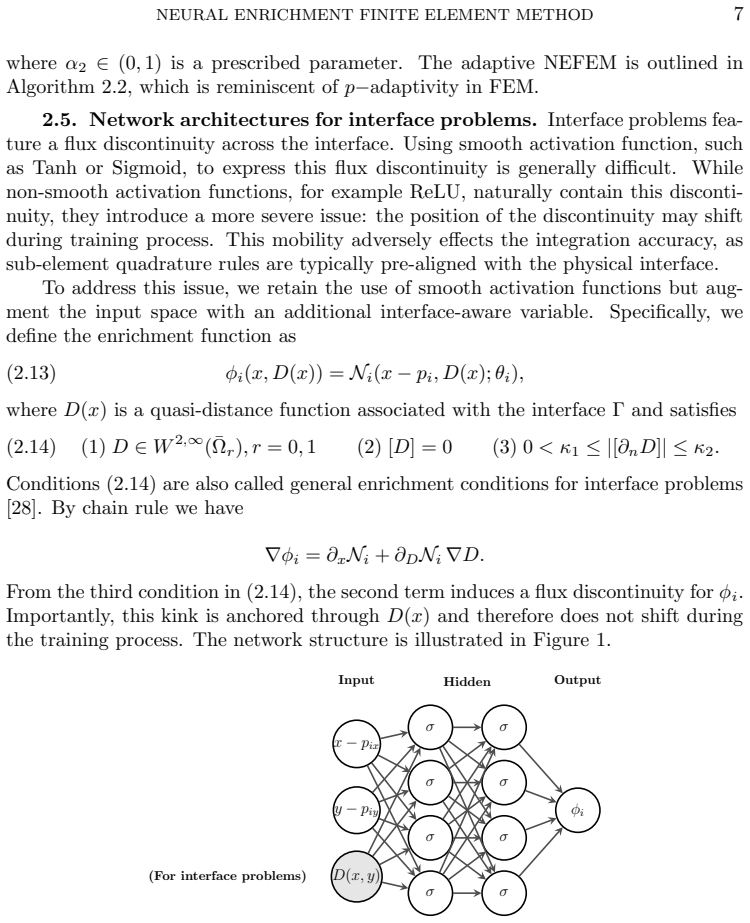
- [method section] Clarify the precise network architecture choices (depth, width, activation) and how they are guided by the analytic results, as the abstract states they are guided but the connection is not detailed.
- [theoretical analysis section] The abstract claims 'optimal convergence' for interfaces without extra regularity; state the precise rate (e.g., O(h) in energy norm) and the norm in which it is proved.
Simulated Author's Rebuttal
We thank the referee for the careful reading and constructive comments. The observations correctly identify the need to more explicitly connect the heuristic NN training to the stability assumptions in the SGFEM theory and to clarify the separation between training and error estimation. We address each point below and indicate the planned revisions.
read point-by-point responses
-
Referee: [theoretical analysis section for interface problems] The SGFEM optimal-convergence analysis for interface problems (abstract and the section presenting the theoretical analysis) requires the enrichment functions to satisfy specific conditions such as controlled linear independence from the FE basis, bounded norms in the enriched space, and reproduction of interface jumps without ill-conditioning. However, the NNs are produced by heuristic training on the Ritz functional with only minimal a priori knowledge (described in the method and training sections); no verification is provided that the trained networks satisfy these load-bearing assumptions, so the theoretical rates may not transfer to the implemented NEFEM.
Authors: We thank the referee for this observation. The optimal-convergence analysis is carried out for the SGFEM under the standard assumptions that the enrichment functions are linearly independent from the FE basis, have bounded norms in the enriched space, and reproduce the interface jumps without ill-conditioning. These hypotheses are stated in the analysis section. The NEFEM training procedure is designed to produce enrichments that approximate the solution well and, in practice, satisfy these conditions for the problems considered. However, we do not supply a rigorous proof that every trained network meets the assumptions exactly, since the training is heuristic. In the revised manuscript we will add an explicit paragraph in the theoretical section restating the assumptions and their necessity, together with a discussion of how the Ritz training targets them. We will also include numerical checks (condition numbers and linear-independence metrics) in the experiments to confirm that the trained enrichments satisfy the hypotheses in the reported cases. revision: partial
-
Referee: [error estimator section] The reliability and efficiency proof for the residual estimator (abstract and the section on error estimation for smooth problems) is stated for the hybrid method, but the estimator derivation appears to treat the enrichments as fixed after training. Since the NNs evolve during the Ritz-based training process, additional analysis is needed to confirm that the estimator remains reliable when the enrichment subspace is itself the output of an optimization loop.
Authors: The residual estimator is derived for the hybrid space once the neural-network enrichments have been obtained. The Ritz-functional training is a preprocessing step that determines the enrichment functions; after convergence of this step the enriched finite-element space is fixed. The standard residual analysis then applies directly to this fixed space, yielding the stated reliability and efficiency. We will revise the error-estimation section to describe the two-stage procedure (training followed by solution and estimation) and add a clarifying remark that the proofs concern the converged, fixed enrichment subspace. No further analysis is required within the current framework, as training does not continue during the error-estimation phase. revision: yes
-
Referee: [numerical experiments section] Numerical experiments are invoked to validate DoF reduction and optimal rates, but without explicit checks (e.g., condition-number monitoring or linear-independence metrics) that the trained enrichments satisfy the stability hypotheses used in the SGFEM theory, the experiments remain empirical and do not close the gap between heuristic training and the required enrichment properties.
Authors: We agree that explicit verification of the stability hypotheses would strengthen the link between the numerical results and the theory. In the revised manuscript we will augment the numerical experiments section with condition-number monitoring of the enriched stiffness matrices and quantitative linear-independence metrics between the neural enrichments and the standard FE basis, presented for the interface-problem examples. These diagnostics will provide direct evidence that the trained networks satisfy the required properties in the tested cases. revision: yes
Circularity Check
No significant circularity; NEFEM builds on established SGFEM theory and standard NN training without self-referential reductions
full rationale
The derivation relies on the pre-existing SGFEM framework for stability and convergence analysis, with NNs introduced as enrichment functions trained via the Ritz functional. The paper states it provides a residual-based error estimator with proven reliability and efficiency for smooth problems, plus a theoretical analysis of optimal SGFEM convergence for interface problems without additional regularity assumptions. These analytic results are presented as guiding network design rather than being derived from the NN outputs themselves. No equations or steps in the abstract reduce the claimed DoF reduction or approximation properties to quantities defined by the same fitting process. The method is self-contained against external benchmarks (SGFEM literature and standard Ritz training), with performance validated numerically rather than forced by construction. This matches the default expectation of no circularity.
Axiom & Free-Parameter Ledger
free parameters (1)
- Neural network architecture and training hyperparameters
axioms (2)
- standard math Standard Sobolev-space assumptions and finite-element approximation theory hold for the error analysis.
- domain assumption Neural networks possess sufficient universal approximation capability to serve as effective enrichment functions for the target function spaces.
Lean theorems connected to this paper
-
IndisputableMonolith/Cost/FunctionalEquationwashburn_uniqueness_aczel unclearthe Ritz functional J(u)≤J(v):=½a(v,v)−f(v) ... loss function L(u_h;θ)=½cᵀ(θ)A(θ)c(θ)−cᵀ(θ)F(θ)
-
IndisputableMonolith/Foundation/AlexanderDualityalexander_duality_circle_linking unclearTheorem 3.12 ... optimal energy-norm convergence O(h) ... without imposing additional regularity assumptions
Reference graph
Works this paper leans on
-
[1]
The finite element method for elliptic equations with discontinuous coefficients , author=. Computing , volume=. 1970 , publisher=
work page 1970
-
[2]
Convergence of a multiscale finite element method for elliptic problems with rapidly oscillating coefficients , author=. Math. Comput. , volume=
-
[3]
A locally modified parametric finite element method for interface problems , author=. SIAM J. Numer. Anal. , volume=. 2014 , publisher=
work page 2014
-
[4]
Strongly stable generalized finite element method: Application to interface problems , author=. Comput. Methods Appl. Mech. Engrg. , volume=. 2017 , publisher=
work page 2017
- [5]
-
[6]
A cut finite element method for a Stokes interface problem , author=. Appl. Numer. Math , volume=. 2014 , publisher=
work page 2014
-
[7]
An unfitted finite element method, based on Nitsche’s method, for elliptic interface problems , author=. Comput. Methods Appl. Mech. Engrg. , volume=. 2002 , publisher=
work page 2002
-
[8]
The generalized finite element method , author=. Comput. Methods Appl. Mech. Engrg. , volume=. 2001 , publisher=
work page 2001
-
[9]
The partition of unity finite element method: basic theory and applications , author=. Comput. Methods Appl. Mech. Engrg. , volume=. 1996 , publisher=
work page 1996
-
[10]
Stable generalized finite element method (SGFEM) for three-dimensional crack problems , author=. Numer. Math. , volume=. 2022 , publisher=
work page 2022
-
[11]
General enrichments of stable GFEM for interface problems: Theory and extreme learning machine construction , author=. Appl. Numer. Math , volume=. 2025 , publisher=
work page 2025
-
[12]
Improved enrichments and numerical integrations in SGFEM for interface problems , author=. J. Comput. Appl. Math. , volume=. 2024 , publisher=
work page 2024
- [13]
-
[14]
A multiscale finite element method for elliptic problems in composite materials and porous media , author=. J. Comput. Phys. , volume=. 1997 , publisher=
work page 1997
-
[15]
The deep Ritz method: a deep learning-based numerical algorithm for solving variational problems , author=. Commun. Math. Stat. , volume=. 2018 , publisher=
work page 2018
-
[16]
Physics-informed neural networks: A deep learning framework for solving forward and inverse problems involving nonlinear partial differential equations , author=. J. Comput. Phys. , volume=. 2019 , publisher=
work page 2019
-
[17]
Weak adversarial networks for high-dimensional partial differential equations , author=. J. Comput. Phys. , volume=. 2020 , publisher=
work page 2020
-
[18]
N-adaptive ritz method: A neural network enriched partition of unity for boundary value problems , author=. Comput. Methods Appl. Mech. Engrg. , volume=. 2024 , publisher=
work page 2024
-
[20]
Stable generalized finite element method (SGFEM) , author=. Comput. Methods Appl. Mech. Engrg. , volume=. 2012 , publisher=
work page 2012
-
[21]
An r-adaptive finite element method using neural networks for parametric self-adjoint elliptic problems , author=. J. Comput. Phys. , pages=. 2025 , publisher=
work page 2025
-
[22]
Strongly stable generalized finite element method (SSGFEM) for a non-smooth interface problem , author=. Comput. Methods Appl. Mech. Engrg. , volume=. 2019 , publisher=
work page 2019
-
[23]
An introductory review on a posteriori error estimation in finite element computations , author=. SIAM Review , volume=. 2023 , publisher=
work page 2023
-
[24]
A posteriori error estimation and adaptive mesh-refinement techniques , author=. J. Comput. Appl. Math. , volume=. 1994 , publisher=
work page 1994
-
[25]
Adaptive activation functions accelerate convergence in deep and physics-informed neural networks , author=. J. Comput. Phys. , volume=. 2020 , publisher=
work page 2020
-
[26]
Symmetric and asymmetric Gauss and Gauss--Lobatto quadrature rules for triangles and their applications to high-order finite element analyses , author=. J. Comput. Appl. Math. , volume=. 2024 , publisher=
work page 2024
-
[27]
M. S. Alnaes and J. Blechta and J. Hake and A. Johansson and B. Kehlet and A. Logg and C.N. Richardson and J. Ring and M. E. Rognes and G. N. Wells , journal =. The. 2015 , volume =
work page 2015
-
[28]
M. S. Alnaes and A. Logg and K. B. ACM Trans. Math. Software , title =. 2014 , volume =
work page 2014
-
[29]
FEM-MsFEM hybrid method for the Stokes-Darcy model , author=. J. Comput. Phys. , volume=. 2025 , publisher=
work page 2025
-
[32]
U. Kapustsin and U. Kaya and T. Richter , journal =. A hybrid finite element/neural network solver and its application to the Poisson problem , year =
-
[33]
D. Aballay, F. Fuentes, V. Iligaray, \'A . J. Omella, D. Pardo, M. A. S \'a nchez, I. Tapia, and C. Uriarte , An r-adaptive finite element method using neural networks for parametric self-adjoint elliptic problems , J. Comput. Phys., (2025), p. 114447
work page 2025
-
[34]
M. S. Alnaes, J. Blechta, J. Hake, A. Johansson, B. Kehlet, A. Logg, C. Richardson, J. Ring, M. E. Rognes, and G. N. Wells , The FEniCS project version 1.5 , Arch. Numer. Software, 3 (2015)
work page 2015
-
[35]
M. S. Alnaes, A. Logg, K. B. lgaard, M. E. Rognes, and G. N. Wells , Unified form language: A domain-specific language for weak formulations of partial differential equations , ACM Trans. Math. Software, 40 (2014)
work page 2014
-
[36]
I. Babu s ka , The finite element method for elliptic equations with discontinuous coefficients , Computing, 5 (1970), pp. 207--213
work page 1970
-
[37]
I. Babu s ka and U. Banerjee , Stable generalized finite element method (sgfem) , Comput. Methods Appl. Mech. Engrg., 201 (2012), pp. 91--111
work page 2012
-
[38]
I. Babu s ka, U. Banerjee, and K. Kergrene , Strongly stable generalized finite element method: Application to interface problems , Comput. Methods Appl. Mech. Engrg., 327 (2017), pp. 58--92
work page 2017
-
[39]
J. Baek, Y. Wang, and J.-S. Chen , N-adaptive ritz method: A neural network enriched partition of unity for boundary value problems , Comput. Methods Appl. Mech. Engrg., 428 (2024), p. 117070
work page 2024
-
[40]
L. Chamoin and F. Legoll , An introductory review on a posteriori error estimation in finite element computations , SIAM Review, 65 (2023), pp. 963--1028
work page 2023
-
[41]
C. Cui, Q. Zhang, U. Banerjee, and I. Babu s ka , Stable generalized finite element method (sgfem) for three-dimensional crack problems , Numer. Math., 152 (2022), pp. 475--509
work page 2022
-
[42]
S. Frei and T. Richter , A locally modified parametric finite element method for interface problems , SIAM J. Numer. Anal., 52 (2014), pp. 2315--2334
work page 2014
-
[43]
Fries , A corrected xfem approximation without problems in blending elements , Internat
T.-P. Fries , A corrected xfem approximation without problems in blending elements , Internat. J. Numer. Methods Engrg., 75 (2008), pp. 503--532
work page 2008
-
[44]
T.-P. Fries and T. Belytschko , The extended/generalized finite element method: an overview of the method and its applications , Internat. J. Numer. Methods Engrg., 84 (2010), pp. 253--304
work page 2010
-
[45]
W. Gong, H. Li, and Q. Zhang , Improved enrichments and numerical integrations in sgfem for interface problems , J. Comput. Appl. Math., 438 (2024), p. 115540
work page 2024
-
[46]
A. Hansbo and P. Hansbo , An unfitted finite element method, based on nitsche’s method, for elliptic interface problems , Comput. Methods Appl. Mech. Engrg., 191 (2002), pp. 5537--5552
work page 2002
- [47]
-
[48]
Y. Hong, W. Zhang, L. Zhao, and H. Zheng , Fem-msfem hybrid method for the stokes-darcy model , J. Comput. Phys., 532 (2025), p. 113952
work page 2025
- [49]
-
[50]
T. Y. Hou and X.-H. Wu , A multiscale finite element method for elliptic problems in composite materials and porous media , J. Comput. Phys., 134 (1997), pp. 169--189
work page 1997
-
[51]
A. D. Jagtap, K. Kawaguchi, and G. E. Karniadakis , Adaptive activation functions accelerate convergence in deep and physics-informed neural networks , J. Comput. Phys., 404 (2020), p. 109136
work page 2020
-
[52]
U. Kapustsin, U. Kaya, and T. Richter , A hybrid finite element/neural network solver and its application to the poisson problem , 2023, https://doi.org/10.1002/pamm.202300135, http://arxiv.org/abs/2307.00947
- [53]
-
[54]
N. Margenberg, D. Hartmann, C. Lessig, and T. Richter , A neural network multigrid solver for the navier-stokes equations , Journal of Computational Physics, 460 (2022), p. 110983, https://doi.org/10.1016/j.jcp.2022.110983, https://arxiv.org/abs/2008.11520
-
[55]
N. Margenberg, R. Jendersie, C. Lessig, and T. Richter , Dnn-mg: A hybrid neural network/finite element method with applications to 3d simulations of the navier-stokes equations , Computer Methods in Applied Mechanics and Engineering, 420 (2024), p. 116692, https://doi.org/10.1016/j.cma.2023.116692
-
[56]
J. M. Melenk and I. Babu s ka , The partition of unity finite element method: basic theory and applications , Comput. Methods Appl. Mech. Engrg., 139 (1996), pp. 289--314
work page 1996
- [57]
-
[58]
T. Strouboulis, K. Copps, and I. Babu s ka , The generalized finite element method , Comput. Methods Appl. Mech. Engrg., 190 (2001), pp. 4081--4193
work page 2001
-
[59]
Verf \"u rth , A posteriori error estimation and adaptive mesh-refinement techniques , J
R. Verf \"u rth , A posteriori error estimation and adaptive mesh-refinement techniques , J. Comput. Appl. Math., 50 (1994), pp. 67--83
work page 1994
-
[60]
D. Wang, H. Li, and Q. Zhang , General enrichments of stable gfem for interface problems: Theory and extreme learning machine construction , Appl. Numer. Math, 214 (2025), pp. 143--159
work page 2025
- [61]
- [62]
-
[63]
Y. Zang, G. Bao, X. Ye, and H. Zhou , Weak adversarial networks for high-dimensional partial differential equations , J. Comput. Phys., 411 (2020), p. 109409
work page 2020
- [64]
discussion (0)
Sign in with ORCID, Apple, or X to comment. Anyone can read and Pith papers without signing in.