Recognition: 2 theorem links
· Lean TheoremA dyadic construction of a three-dimensional attractive point interaction Markov family
Pith reviewed 2026-05-12 03:36 UTC · model grok-4.3
The pith
Iterated Doob transforms along dyadic partitions construct a Markov family for three-dimensional attractive point interactions.
A machine-rendered reading of the paper's core claim, the machinery that carries it, and where it could break.
Core claim
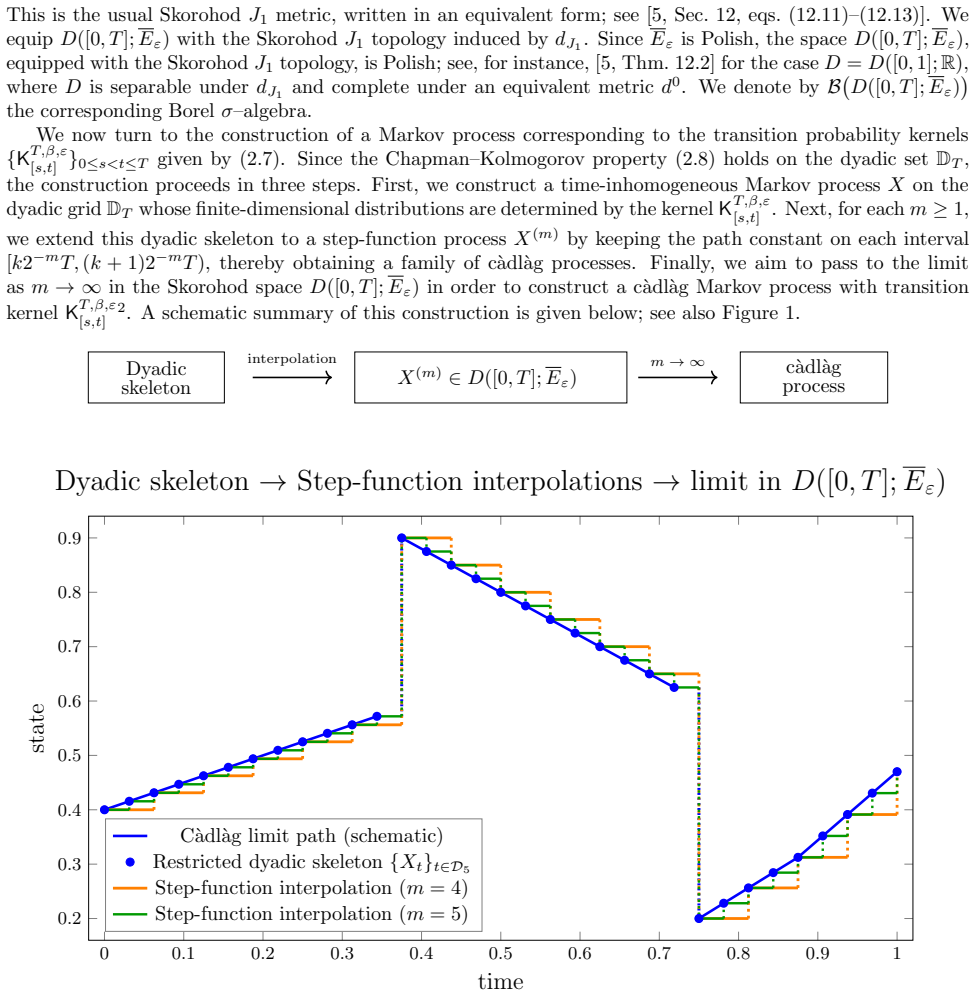
By iterating the Doob-transforms of the fundamental solution of the corresponding singular heat equation on the punctured domain E_ε, sub-probability kernels are obtained along finite partitions. Refinement along global dyadic partitions produces a limiting sub-probability kernel, which is extended to a transition probability kernel on an enlarged space obtained by adjoining a cemetery state. These kernels determine a time-inhomogeneous Markov process on the set of dyadic times, and its step-function interpolations yield càdlàg processes with consistent finite-dimensional distributions and partial tightness properties.
What carries the argument
Iterated Doob-transforms of the fundamental solution to the singular heat equation on the punctured domain, refined along global dyadic partitions to a limiting kernel.
If this is right
- The kernels determine a time-inhomogeneous Markov process on the set of dyadic times.
- Step-function interpolations of the process are càdlàg.
- The interpolated processes have consistent finite-dimensional distributions.
- The processes satisfy partial tightness properties.
- The construction respects the survival constraint on the punctured domain.
Where Pith is reading between the lines
- The dyadic construction supplies the necessary kernels for analyzing the continuous-time limit of the interpolated processes.
- Adjoining the cemetery state encodes the effect of the attractive interaction as possible killing or absorption.
- The partial tightness may be used as a starting point for proving convergence in the Skorokhod topology once the mesh tends to zero.
Load-bearing premise
The fundamental solution to the singular heat equation on the punctured domain exists and is regular enough that the iterated Doob-transformed kernels converge under dyadic refinement as the partition mesh tends to zero.
What would settle it
If the iterated sub-probability kernels fail to converge to a non-trivial limit when the global dyadic partitions are refined to mesh zero, the claimed limiting kernel and the resulting Markov family do not exist.
Figures
read the original abstract
We discuss a probabilistic framework associated with the three-dimensional attractive point interaction under a survival constraint on the punctured domain $E_\varepsilon=\{x\in\mathbb R^3: |x|>\varepsilon\}$. By iterating the Doob-transforms of the fundamental solution of the corresponding singular heat equation, we obtain sub-probability kernels along finite partitions which yield a limiting sub-probability kernel via refinement along global dyadic partitions, and we extend this limit to a transition probability kernel on an enlarged space obtained by adjoining a cemetery state. These kernels determine a time-inhomogeneous Markov process on the set of dyadic times, and its step-function interpolations yield c\`adl\`ag processes with consistent finite-dimensional distributions and partial tightness properties. The analysis of the continuous-time limit of the interpolated processes, as well as the limiting procedure $\varepsilon\downarrow 0$, which recovers the process associated with the three-dimensional point interaction, is deferred to future work.
Editorial analysis
A structured set of objections, weighed in public.
Referee Report
Summary. The manuscript constructs a time-inhomogeneous Markov process on dyadic times for the three-dimensional attractive point interaction under a survival constraint on the punctured domain E_ε. It proceeds by iterating Doob transforms of the fundamental solution to the singular heat equation to produce sub-probability kernels on finite partitions, obtains a limiting sub-probability kernel by refinement along global dyadic partitions, adjoins a cemetery state to yield a transition probability kernel, and verifies that the resulting process has step-function interpolations with consistent finite-dimensional distributions and partial tightness properties. The continuous-time limit of the interpolations and the limit ε↓0 are explicitly deferred to future work.
Significance. If the dyadic construction holds, the work supplies a concrete, explicit probabilistic approximation scheme for singular attractive interactions in three dimensions via iterated Doob transforms and dyadic refinement. This is a useful intermediate step toward rigorous Markov processes for point interactions, with potential applications in stochastic analysis and quantum mechanics. The explicit use of global dyadic partitions and the verification of f.d.d. consistency plus partial tightness are concrete strengths that could support the deferred limits.
major comments (1)
- The convergence of the iterated Doob-transformed kernels to a limiting sub-probability kernel as the mesh of the global dyadic partitions tends to zero is load-bearing for the central construction. The manuscript invokes direct estimates on the kernels for this step; explicit bounds or a reference to the precise lemma establishing the limit (including any dependence on ε) should be highlighted to confirm the argument does not rely on unstated regularity of the fundamental solution beyond what is assumed.
minor comments (2)
- The abstract and introduction should clarify the precise meaning of 'partial tightness' for the step-function interpolations, as this property is invoked to support the dyadic-time process but its relation to standard tightness criteria is not immediately transparent.
- Notation for the sub-probability kernels, the Doob-transformed objects, and the cemetery-augmented space should be checked for consistency across sections; minor inconsistencies in the use of P versus sub-probability symbols could confuse readers.
Simulated Author's Rebuttal
We thank the referee for their positive evaluation and for identifying a point that will improve the clarity of the central argument. We address the major comment below and will revise the manuscript accordingly.
read point-by-point responses
-
Referee: The convergence of the iterated Doob-transformed kernels to a limiting sub-probability kernel as the mesh of the global dyadic partitions tends to zero is load-bearing for the central construction. The manuscript invokes direct estimates on the kernels for this step; explicit bounds or a reference to the precise lemma establishing the limit (including any dependence on ε) should be highlighted to confirm the argument does not rely on unstated regularity of the fundamental solution beyond what is assumed.
Authors: We agree that the convergence under dyadic refinement is load-bearing. The manuscript establishes this limit via direct estimates on the iterated kernels that follow from the properties of the fundamental solution to the singular heat equation on the punctured domain (as stated in the setup). We will revise the relevant section to explicitly reference the precise lemma or proposition containing these estimates, state the resulting bounds, and note their dependence on ε. This will make clear that the argument uses only the regularity already assumed for the fundamental solution and does not invoke additional unstated properties. revision: yes
Circularity Check
No significant circularity; construction is self-contained
full rationale
The paper builds the dyadic-time Markov kernels explicitly from the fundamental solution of the singular heat equation on E_ε via iterated Doob transforms, obtains the mesh-zero limit along global dyadic partitions by direct kernel estimates, adjoins a cemetery state to produce a transition kernel, and verifies consistency of finite-dimensional distributions plus partial tightness for the step-function interpolations. These steps rest on the stated assumptions of heat-kernel existence/regularity and kernel convergence under refinement, without any reduction of the target objects to fitted parameters, self-definitions, or load-bearing self-citations. The continuous-time and ε↓0 limits are explicitly deferred, so the claims made here remain independent of the deferred parts.
Axiom & Free-Parameter Ledger
axioms (2)
- domain assumption Existence and positivity properties of the fundamental solution to the singular heat equation on E_ε
- standard math Doob transforms preserve the sub-Markov property and allow consistent refinement
Lean theorems connected to this paper
-
IndisputableMonolith/Foundation/AlexanderDuality.leanalexander_duality_circle_linking unclearBy iterating the Doob-transforms of the fundamental solution of the corresponding singular heat equation, we obtain sub-probability kernels along finite partitions which yield a limiting sub-probability kernel via refinement along global dyadic partitions
-
IndisputableMonolith/Cost/FunctionalEquation.leanwashburn_uniqueness_aczel unclearp_{T,β}^{s,t}(x,y) := [1+Q^β_{T-t}(y)]/[1+Q^β_{T-s}(x)] P^β_{t-s}(x,y)
Reference graph
Works this paper leans on
-
[1]
M. Abramowitz, I. E. Stegun:Handbook of Mathematical Functions, U.S. National Bureau of Standards, Washington DC (1965)
work page 1965
-
[2]
S. Albeverio, Z. Brze´ zniak, L. D¸ abrowski:Fundamental solution of the heat and Schr¨ odinger equations with a point interaction, J. Funct. Anal.120, 220–254 (1995)
work page 1995
-
[3]
S. Albeverio, G. Gesztesy, R. Høegh-Krohn, H. Holden:Solvable Models in Quantum Mechanics, 2nd edition, AMS Chelsea Publishing, Providence (1988)
work page 1988
-
[4]
S. Albeverio, R. Høegh-Krohn, L. Streit:Energy forms, Hamiltonians, and distorted Brownian paths, J. Math. Phys.18, 907–917 (1998)
work page 1998
-
[5]
Billingsley:Convergence of Probability Measures, 2nd ed., John Wiley & Sons, New York (1999)
P. Billingsley:Convergence of Probability Measures, 2nd ed., John Wiley & Sons, New York (1999)
work page 1999
-
[6]
F. Caravenna, R. Sun, N. Zygouras:The critical 2d stochastic heat flow, Invent. Math.233, 325–460 (2023)
work page 2023
-
[7]
Y.-T. Chen:The critical 2D delta-Bose gas as mixed-order asymptotics of planar Brownian motion, arXiv:2105.05154 (2021)
-
[8]
Chen:Two-dimensional delta-Bose gas: Skew-product relative motions, Ann
Y.-T. Chen:Two-dimensional delta-Bose gas: Skew-product relative motions, Ann. Appl. Probab.35, 3150–3214 (2025)
work page 2025
- [9]
- [10]
-
[11]
P. D’Ancona, V. Pierfelice, A. Teta:Dispersive estimate for the Schr¨ odinger equation with point interac- tions, Math. Methods Appl. Sci.29, 309–323 (2006)
work page 2006
-
[12]
K. Fleischmann, C. Mueller:Super-Brownian motion with extra birth at one point, SIAM J. Math. Anal. 36, 740–772 (2005)
work page 2005
-
[13]
Fukushima:On a stochastic calculus related to Dirichlet forms and distorted Brownian motion, Phys
M. Fukushima:On a stochastic calculus related to Dirichlet forms and distorted Brownian motion, Phys. Rep.77, 255–262 (1982)
work page 1982
-
[14]
Y. Gu, J. Quastel, L. Tsai:Moments of the 2d SHE at criticality, Prob. Math. Phys.2, 179–219 (2021)
work page 2021
- [15]
-
[16]
Jin:Brownian motion with singular time-dependent drift, J
P. Jin:Brownian motion with singular time-dependent drift, J. Theor. Probab.30, 1499–1538 (2017)
work page 2017
-
[17]
A. S. Kechris:Classical Descriptive Set Theory, Graduate Texts in Mathematics156, Springer-Verlag, New York (1995). 46
work page 1995
-
[18]
D. Kinzebulatov, K. R. Madou:Stochastic equations with time-dependent singular drift, J. Differ. Equ. 337, 255–293 (2022)
work page 2022
-
[19]
N. V. Krylov, M. R¨ ockner:Strong solutions of stochastic equations with singular time dependent drift, Probab. Theory Relat. Fields131, 154–196 (2005)
work page 2005
-
[20]
Mian:On planar Brownian motion singularly tilted through a point potential, Ph.D
B. Mian:On planar Brownian motion singularly tilted through a point potential, Ph.D. thesis, The Univer- sity of Mississippi (2025)
work page 2025
-
[21]
Mian:Planar diffusions with a point interaction on a finite time horizon, arXiv:2601.17306 (2026)
B. Mian:Planar diffusions with a point interaction on a finite time horizon, arXiv:2601.17306 (2026)
-
[22]
J. Shin, G. Trutnau:On the stochastic regularity of distorted Brownian motions, Trans. Am. Math. Soc. 369, 7883–7915 (2017)
work page 2017
-
[23]
X. Zhang:Stochastic homeomorphism flows of SDEs with singular drifts and Sobolev diffusion coefficients, Electron. J. Probab.16, 1096–1116 (2011). 47
work page 2011
discussion (0)
Sign in with ORCID, Apple, or X to comment. Anyone can read and Pith papers without signing in.