Recognition: 2 theorem links
· Lean TheoremCooling of Isolated Neutron Stars with Hyperon-mixed Kaon-Condensation Matter
Pith reviewed 2026-05-12 03:10 UTC · model grok-4.3
The pith
Strong proton superconductivity at high densities allows kaon-induced Urca processes to dominate cooling in massive neutron stars.
A machine-rendered reading of the paper's core claim, the machinery that carries it, and where it could break.
Core claim
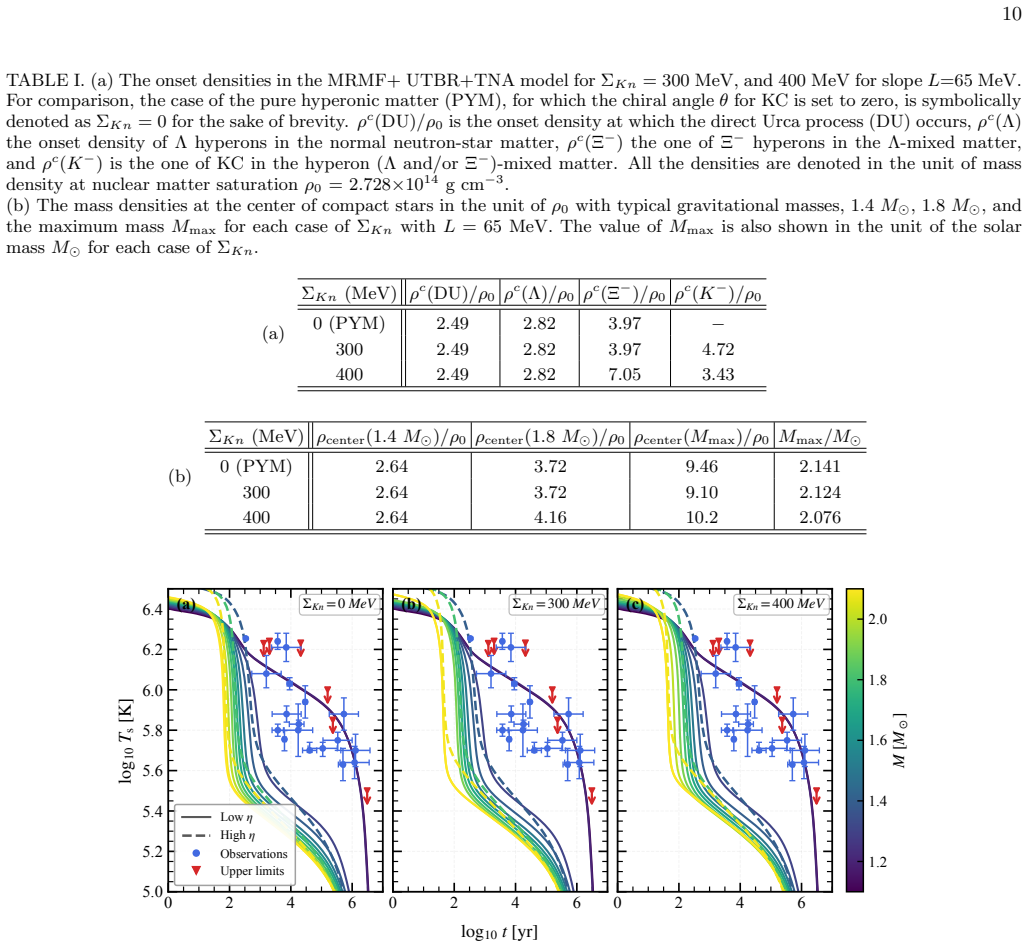
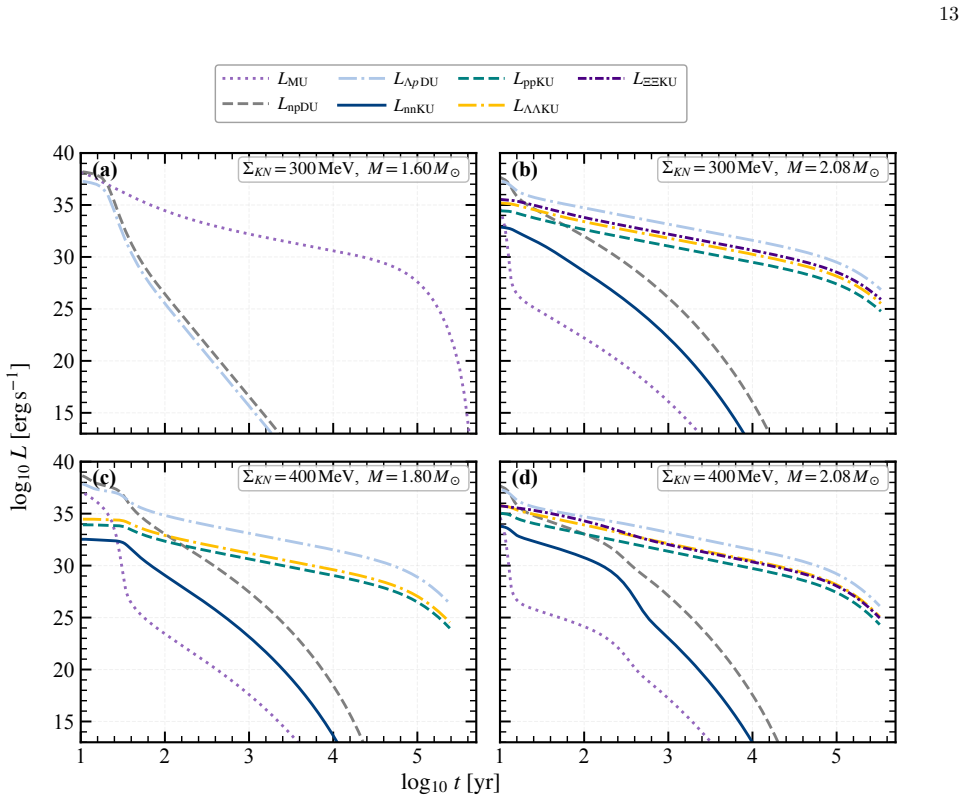
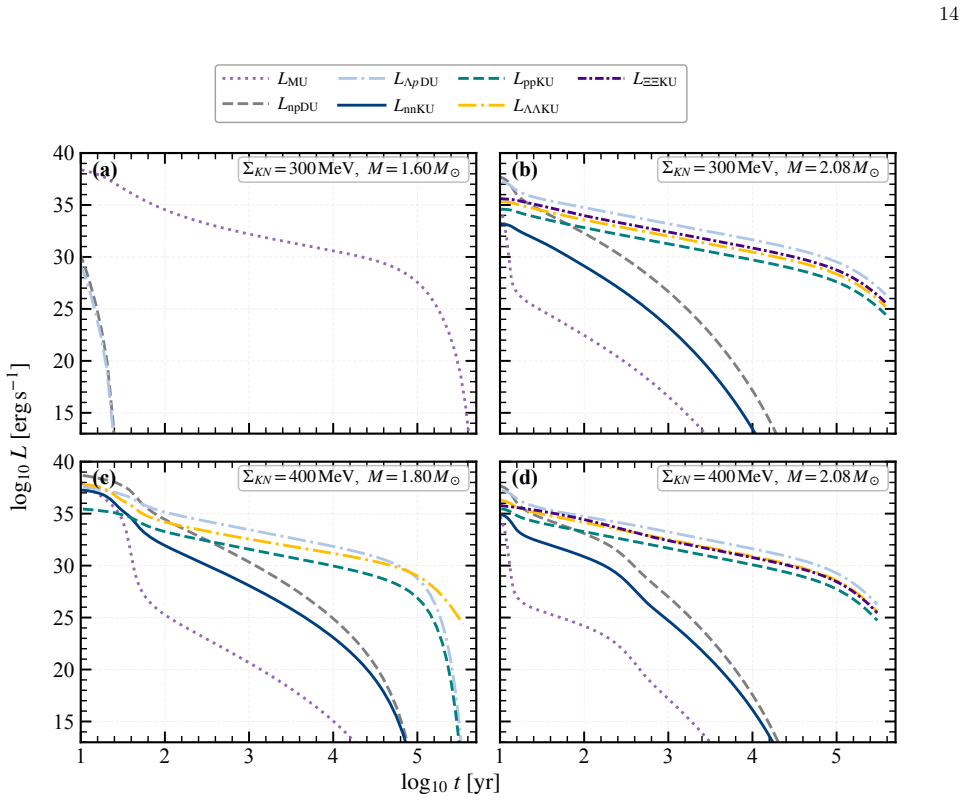
In the minimal relativistic mean-field model supplemented by chiral SU(3) dynamics for kaon condensation and a three-baryon force, the authors find that nucleonic direct Urca processes operate at stellar masses greater than or equal to 1.3 solar masses and produce rapid cooling that hides strangeness unless superfluidity intervenes. If the proton 1S0 superconductivity is strong enough at high densities to reach critical temperatures around 10^10 K, the nucleon and hyperon direct Urca processes are fully suppressed, allowing kaon-induced Urca processes to set the cooling rate of massive stars and reproduce the low temperatures of several observed cold isolated neutron stars, thereby providing
What carries the argument
The density-dependent proton 1S0 pairing gap that suppresses nucleon and hyperon direct Urca neutrino emission at the high densities where hyperons and kaons coexist, thereby elevating kaon-induced Urca processes to the dominant cooling channel.
If this is right
- Kaon condensation becomes visible in cooling observations only when proton superconductivity is strong at high densities.
- The model accounts for the low temperatures of several recently identified cold isolated neutron stars.
- Strangeness in the core can leave an observable imprint on neutron-star cooling curves under the stated pairing conditions.
- Without strong high-density proton superconductivity, any signature of hyperons and kaons is erased by rapid nucleon Urca cooling.
Where Pith is reading between the lines
- Future temperature measurements of a range of neutron star masses could map the density threshold where kaon Urca takes over.
- Similar suppression mechanisms might apply to other exotic phases if their associated pairing gaps extend to high density.
- The scenario predicts a mass window above which cold surfaces appear, offering a testable distinction from purely nucleonic cooling models.
Load-bearing premise
The proton 1S0 superconductivity gap remains large enough at the high densities of hyperons and kaons to suppress all faster direct Urca processes involving nucleons and hyperons.
What would settle it
Detection of a neutron star above 1.5 solar masses whose observed temperature is inconsistent with kaon-Urca cooling, or direct evidence that the proton pairing gap closes below the densities of kaon condensation.
Figures






read the original abstract
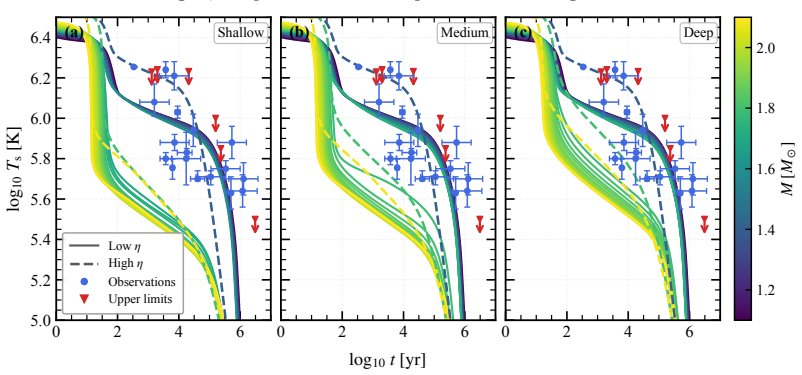
We investigate the thermal evolution of isolated neutron stars containing hyperon--mixed kaon--condensed matter, focusing on the role of proton superconductivity. The equation of state utilized for cooling calculation is based upon the minimal relativistic mean--field framework supplemented by chiral SU(3) dynamics for kaon condensation with an additional component on the three-baryon force, which ensures stiffness at high densities enough to meet astrophysical constraints on neutron-star masses and radii. We show that the nucleonic direct Urca processes operate at relatively low stellar masses ($M \gtrsim 1.3\,M_\odot$), erasing any observable signature of strangeness in the absence of superfluidity. However, if the proton $^1{\rm S}_0$ superconductivity works, because of suppression of fast neutrino cooling processes, the cooling scenario could become relevant with the strangeness, depending on the density regions of the pairing gap. In particular, if the proton superconductivity is so strong in high-density regions ($T_{c,p}\sim10^{10}~{\rm K}$), the nucleon and hyperon direct Urca processes shut down, which makes the kaon-induced Urca processes dominant in massive neutron stars. This scenario is in good agreement with several cold isolated neutron stars identified recently. Hence, we suggest that strong proton superconductivity can render kaon condensation observationally visible through cold neutron-star observations, providing a potential signature of strangeness in dense matter.
Editorial analysis
A structured set of objections, weighed in public.
Referee Report
Summary. The paper investigates the thermal evolution of isolated neutron stars with hyperon-mixed kaon-condensed matter. Using a minimal RMF EOS supplemented by chiral SU(3) kaon dynamics and three-baryon repulsion to satisfy mass-radius constraints, it shows that nucleonic direct Urca operates for M ≳ 1.3 M_⊙ and erases strangeness signatures without superfluidity. With strong proton ^1S_0 superconductivity (T_{c,p} ∼ 10^{10} K at high density), nucleon and hyperon DU are suppressed, allowing kaon-induced Urca to dominate in massive stars and match observations of several cold isolated neutron stars.
Significance. If the result holds, the work identifies a potential observational signature of strangeness (kaon condensation) in dense matter via the cooling of massive neutron stars, provided proton superconductivity is sufficiently strong at the relevant densities. The EOS construction is a strength, as it incorporates three-baryon forces to remain consistent with astrophysical mass and radius bounds while enabling the kaon phase.
major comments (2)
- [Discussion of proton superconductivity and cooling calculations] The central claim that kaon-induced Urca becomes dominant (and matches cold NS data) requires the proton ^1S_0 gap to remain large enough at densities ≳2–3ρ_0 to fully quench nucleon and hyperon direct Urca. This gap density dependence is introduced as an external phenomenological input rather than derived from the RMF + chiral SU(3) Lagrangian used for the EOS; no consistent microscopic pairing calculation is shown. This assumption is load-bearing for the suppression mechanism and the resulting cooling scenario.
- [Comparison with observations] The stated agreement with 'several cold isolated neutron stars identified recently' is presented without specifying the stars, the quantitative fitting procedure, error bars on the cooling curves, or whether parameter adjustments were made post-hoc to achieve the match. This weakens the robustness of the observational support for the kaon-Urca dominance scenario.
minor comments (2)
- [Abstract] The abstract refers to 'depending on the density regions of the pairing gap' but does not quote the explicit functional form or parameter values adopted for T_{c,p}(ρ) in the numerical cooling runs.
- [EOS construction] Clarify the specific parameter choices for the three-baryon force that enforce stiffness at high density; tabulate the resulting maximum mass and radius for the EOS variants used.
Simulated Author's Rebuttal
We thank the referee for the careful and constructive review of our manuscript. We address each major comment point by point below, providing clarifications and indicating revisions made to strengthen the presentation.
read point-by-point responses
-
Referee: [Discussion of proton superconductivity and cooling calculations] The central claim that kaon-induced Urca becomes dominant (and matches cold NS data) requires the proton ^1S_0 gap to remain large enough at densities ≳2–3ρ_0 to fully quench nucleon and hyperon direct Urca. This gap density dependence is introduced as an external phenomenological input rather than derived from the RMF + chiral SU(3) Lagrangian used for the EOS; no consistent microscopic pairing calculation is shown. This assumption is load-bearing for the suppression mechanism and the resulting cooling scenario.
Authors: We acknowledge that the proton ^1S_0 gap is treated as a phenomenological input, consistent with standard practice in neutron-star cooling studies where a fully microscopic pairing calculation within the same RMF + chiral SU(3) framework (including hyperons and kaon condensation) would require substantial additional formalism and is beyond the present scope. Our adopted high-density gap value (T_{c,p} ∼ 10^{10} K) draws from prior literature on strong proton superconductivity. In the revised manuscript we have added an expanded discussion of gap uncertainties at high density, cited supporting microscopic calculations from the literature, and included new cooling curves for a range of gap strengths to demonstrate that kaon-Urca dominance holds whenever the gap remains sufficiently large to suppress nucleon/hyperon DU. This makes the dependence on the assumption explicit and testable. revision: partial
-
Referee: [Comparison with observations] The stated agreement with 'several cold isolated neutron stars identified recently' is presented without specifying the stars, the quantitative fitting procedure, error bars on the cooling curves, or whether parameter adjustments were made post-hoc to achieve the match. This weakens the robustness of the observational support for the kaon-Urca dominance scenario.
Authors: We thank the referee for highlighting this omission. The revised manuscript now explicitly names the cold isolated neutron stars under consideration (drawing from recent X-ray observations of sources with low effective temperatures), presents cooling curves with shaded uncertainty bands arising from EOS parameter variations, and states that no post-hoc tuning of the gap or other parameters was performed to fit the data—the EOS parameters remain fixed by the mass-radius constraints already imposed. The comparison is therefore shown to be consistent within the reported observational and theoretical uncertainties. revision: yes
Circularity Check
No significant circularity; derivation is self-contained under stated assumptions
full rationale
The paper constructs its EOS independently via minimal RMF supplemented by chiral SU(3) kaon dynamics plus three-baryon repulsion to satisfy mass-radius constraints. Cooling curves are then computed for different proton ^1S_0 gap assumptions treated as external inputs. The central statement is conditional ('if the proton superconductivity is so strong in high-density regions (T_{c,p}∼10^{10} K)'), showing that kaon-induced Urca can dominate and match some cold NS observations. This is an exploration of scenarios, not a fitted prediction or self-defined result. No quoted step reduces the outcome to the inputs by construction, and no self-citation chain or ansatz smuggling bears the load of the claim. The work remains self-contained against external benchmarks.
Axiom & Free-Parameter Ledger
free parameters (2)
- proton superconductivity critical temperature T_{c,p} =
~10^{10} K
- RMF and three-baryon force parameters
axioms (2)
- domain assumption Minimal relativistic mean-field framework supplemented by chiral SU(3) dynamics for kaon condensation
- domain assumption Proton ^1S_0 pairing gap exists and its density dependence allows strong suppression at high densities
invented entities (2)
-
Hyperon-mixed kaon-condensed matter
no independent evidence
-
Kaon-induced Urca processes
no independent evidence
Lean theorems connected to this paper
-
IndisputableMonolith/Cost/FunctionalEquation.leanwashburn_uniqueness_aczel (J uniquely forced by Aczél functional equation) unclear?
unclearRelation between the paper passage and the cited Recognition theorem.
The equation of state utilized for cooling calculation is based upon the minimal relativistic mean-field framework supplemented by chiral SU(3) dynamics for kaon condensation with an additional component on the three-baryon force... if the proton superconductivity is so strong in high-density regions (Tc,p∼10^10 K), the nucleon and hyperon direct Urca processes shut down, which makes the kaon-induced Urca processes dominant
-
IndisputableMonolith/Foundation/RealityFromDistinction.leanreality_from_one_distinction unclear?
unclearRelation between the paper passage and the cited Recognition theorem.
We utilize the same three phenomenological models for 1S0 proton SF as theirs: shallow, medium, and deep... Tc,p(ρ) seems to be responsible for the observational visibility of KC
What do these tags mean?
- matches
- The paper's claim is directly supported by a theorem in the formal canon.
- supports
- The theorem supports part of the paper's argument, but the paper may add assumptions or extra steps.
- extends
- The paper goes beyond the formal theorem; the theorem is a base layer rather than the whole result.
- uses
- The paper appears to rely on the theorem as machinery.
- contradicts
- The paper's claim conflicts with a theorem or certificate in the canon.
- unclear
- Pith found a possible connection, but the passage is too broad, indirect, or ambiguous to say the theorem truly supports the claim.
Reference graph
Works this paper leans on
-
[1]
Kaon dynamics in chiral symmetry and baryon-meson interaction in the minimal RMF The Y+K phase is composed of kaon condensates and hyperon-mixed baryonic matter together with leptons, being kept in beta equilibrium, charge neutrality, and baryon number conservation. In the following, we simply take into account protons, neutrons, Λ, Σ −, and Ξ − hy- peron...
-
[2]
(4), there is no extra term with nonlinear self-interacting meson potentials
Three-baryon forces In Eq. (4), there is no extra term with nonlinear self-interacting meson potentials. Instead, many-body baryon interactions, which should be relevant to the stiff- ness of the EoS in high densities, are introduced by the phenomenological three-baryon forces in the present framework. The energy contribution from the three-baryon repul- ...
-
[3]
TheU TNA(r;n B) depends upon not only density but also 4 isospin⃗ τ1 ·⃗ τ2 with Pauli matrices⃗ τi
Three-nucleon attractive force To simulate the attractive contribution from the TNA to the binding energy forn B ≲n 0 , we adopt the density- dependent effective two-body potential by Nishizaki, Takatsuka and Hiura [45], UTNA(r;n B) =V anB exp(−ηanB) exp −(r/λa)2 (⃗ τ1·⃗ τ2)2 , (8) where the range parameterλ a is fixed to be 2.0 fm. TheU TNA(r;n B) depend...
-
[4]
Energy density expression for the (Y+K) phase The total energy densityEis given by E=E K +E B,M +E(UTBR) +E(TNA) +E leptons .(9) From (2) and (4) one obtains EK = 1 2(µKfsinθ) 2 +f 2m2 K(1−cosθ),(10) EB,M = X b 2 (2π)3 Z |p|≤pF (b) d3|p|(|p|2 +M ∗2 b )1/2 + 1 2 m2 σσ2 +m 2 σ∗ σ∗2 + 1 2 m2 ωω2 0 +m 2 ρR2 0 +m 2 ϕϕ2 0 ,(11) where baryons (b) are occupied ov...
-
[5]
Ground-state conditions The ground state energy for the Y+K phase is ob- tained under the charge neutrality, baryon number, and β-equilibrium conditions. The charge neutrality condi- tion is written as nQ =n p −n Σ− −n Ξ− −n K− −n e −n µ = 0,(16) wheren Q denotes the total negative charge density,n K− is the number density of KC and is given from kaon par...
-
[6]
Determination of parameters Meson-nucleon coupling constants from saturation properties in symmetric nuclear matter The empirical nuclear saturation densityn 0 is set to 0.16 fm −3. Then the meson-nucleon coupling constants, gσN ,g ωN ,g ρN, the meson mean-fields atn 0,⟨σ⟩ 0,⟨ω 0⟩0, and the parametersγ a,η a in TNA are determined from the saturation prope...
-
[7]
Meson-hyperon coupling constants For the description of hyperon-mixed matter, we set the values of the meson-hyperon coupling constants to obtain the hyperon-nucleon and hyperon-hyperon inter- actions in the MRMF. The vector meson couplings for hyperons (Y) are ob- tained from the vector-nucleon couplingsg ωN ,g ρN,g ϕN through the SU(6) symmetry relation...
work page 1905
- [8]
- [9]
- [10]
- [11]
- [12]
- [13]
- [14]
- [15]
-
[16]
D. B. Kaplan and A. E. Nelson, Physics Letters B175, 57 (1986)
work page 1986
-
[17]
T. Muto, R. Tamagaki, and T. Tatsumi, Prog. Theor. Phys.Supplement112, 159 (1993)
work page 1993
-
[18]
C. H. Lee, Phys. Rep.275, 255 (1996)
work page 1996
-
[19]
N. K. Glendenning, ed.,Compact stars : nuclear physics (2000)
work page 2000
-
[20]
L. Tolos and L. Fabbietti, Progress in Particle and Nuclear Physics112, 103770 (2020), arXiv:2002.09223 [nucl-ex]
- [21]
-
[22]
T. Yamazaki, A. Dot´ e, and Y. Akaishi, Phys. Lett. B 587, 167–174 (2004)
work page 2004
- [23]
-
[24]
Y.Sada et al., Prog. Theor. Exp. Phys.2016, 051D01 (2016)
work page 2016
-
[25]
S. Ajimura et al. (PARC E15 collaboration), Phys. Lett.B 789, 620 (2019), arXiv:1805.12275 [nucl-ex]
- [26]
- [27]
- [28]
- [29]
- [30]
- [31]
- [32]
- [33]
-
[34]
V. Baruah Thapa, M. Sinha, J. Jie Li, and A. Se- drakian, arXiv e-prints , arXiv:2102.08787 (2021), arXiv:2102.08787 [astro-ph.HE]
- [35]
- [36]
- [37]
- [38]
- [39]
-
[40]
K. Hebeler, Phys. Rep.890, 1 (2021), arXiv:2002.09548 [nucl-th]
-
[41]
S. Tsuruta, J. Sadino, A. Kobelski, M. A. Teter, A. C. Liebmann, T. Takatsuka, K. Nomoto, and H. Umeda, Astrophys. J.691, 621 (2009)
work page 2009
-
[42]
R. Negreiros, L. Tolos, M. Centelles, A. Ramos, and V. Dexheimer, Astrophys. J.863, 104 (2018), arXiv:1804.00334 [astro-ph.HE]
- [43]
- [44]
- [45]
-
[46]
G. E. Brown, K. Kubodera, D. Page, and P. Pizzochero, Phys. Rev. D37, 2042 (1988)
work page 2042
- [47]
-
[48]
Y. Lim, C. H. Hyun, and C.-H. Lee, Journal of Korean Physical Society74, 547 (2019)
work page 2019
- [49]
- [50]
-
[51]
T. Takatsuka, S. Nishizaki, and R. Tamagaki, AIP Con- ference Proceedings1011, 209 (2008)
work page 2008
-
[52]
S. Nishizaki, T. Takatsuka, and J. Hiura, Prog. Theor. Phys.92, 93 (1994)
work page 1994
- [53]
- [54]
-
[55]
J. M. Lattimer and M. Prakash, Phys. Rep.621, 127–164 (2016)
work page 2016
- [56]
-
[57]
J. Schaffner, C. Dover, A. Gal, C. Greiner, D. Millener, and H. St¨ ocker, Ann.Phys.235, 35 (1994)
work page 1994
-
[58]
A. Gal, E. Hungerford, and D. Millener, Rev. Mod. Phys. 88, 035004 (2016)
work page 2016
- [59]
-
[60]
J. M. Lattimer, C. J. Pethick, M. Prakash, and P. Haensel, Phys. Rev. Lett.66, 2701 (1991)
work page 1991
- [61]
-
[62]
Y. Lim, C. H. Hyun, and C.-H. Lee, Int. J. Mod. Phys. E 26, 1750015-328 (2017)
work page 2017
- [63]
- [64]
-
[65]
M. Prakash, M. Prakash, J. M. Lattimer, and C. J. Pethick, Astrophys. J. Lett.390, L77 (1992)
work page 1992
- [66]
- [67]
-
[68]
V. Thorsson, M. Prakash, T. Tatsumi, and C. J. Pethick, Phys. Rev. D52, 3739 (1995), arXiv:nucl-th/9502004 [nucl-th]
- [69]
- [70]
- [71]
- [72]
- [73]
-
[74]
D. Page, NSCool: Neutron star cooling code, Astro- physics Source Code Library, record ascl:1609.009 (2016), ascl:1609.009
work page 2016
- [75]
-
[76]
A. Dohi, H. Liu, T. Noda, and M.-A. Hashimoto, Int. J. Mod. Phys. E31, 2250006 (2022), https://doi.org/10.1142/S0218301322500069
- [77]
- [78]
- [79]
- [80]
discussion (0)
Sign in with ORCID, Apple, or X to comment. Anyone can read and Pith papers without signing in.