Recognition: 2 theorem links
· Lean TheoremThe variation of zeros of the Miller basis
Pith reviewed 2026-05-12 03:59 UTC · model grok-4.3
The pith
Zeros of Miller basis modular forms lie on the unit arc or a log Szegő curve depending on the ratio δ = m/ℓ.
A machine-rendered reading of the paper's core claim, the machinery that carries it, and where it could break.
Core claim
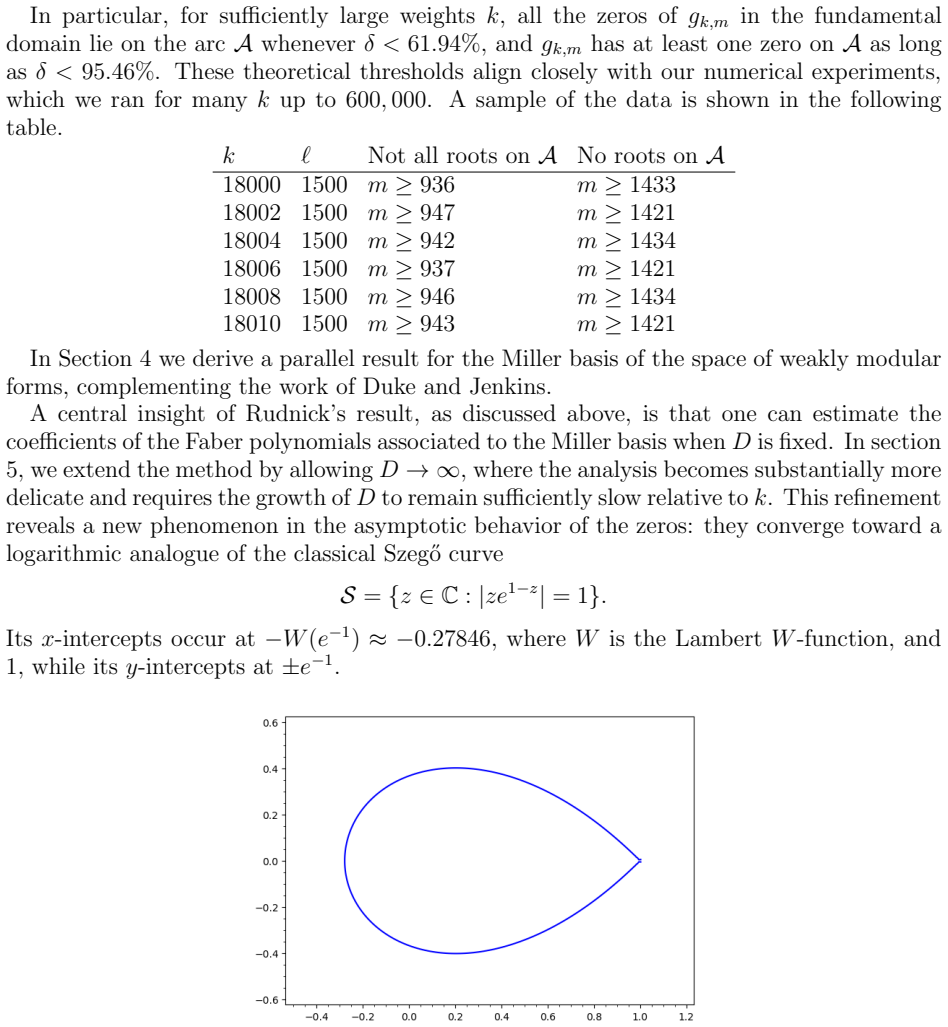
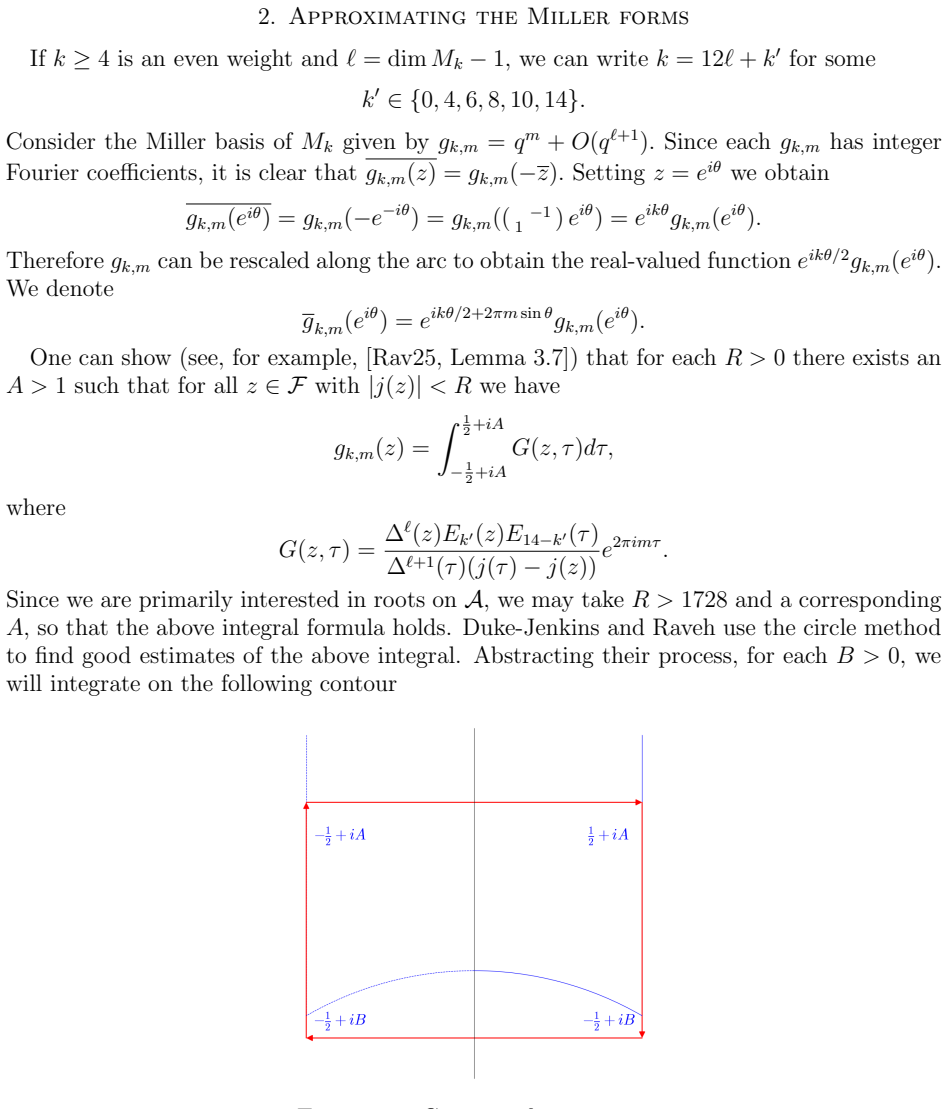
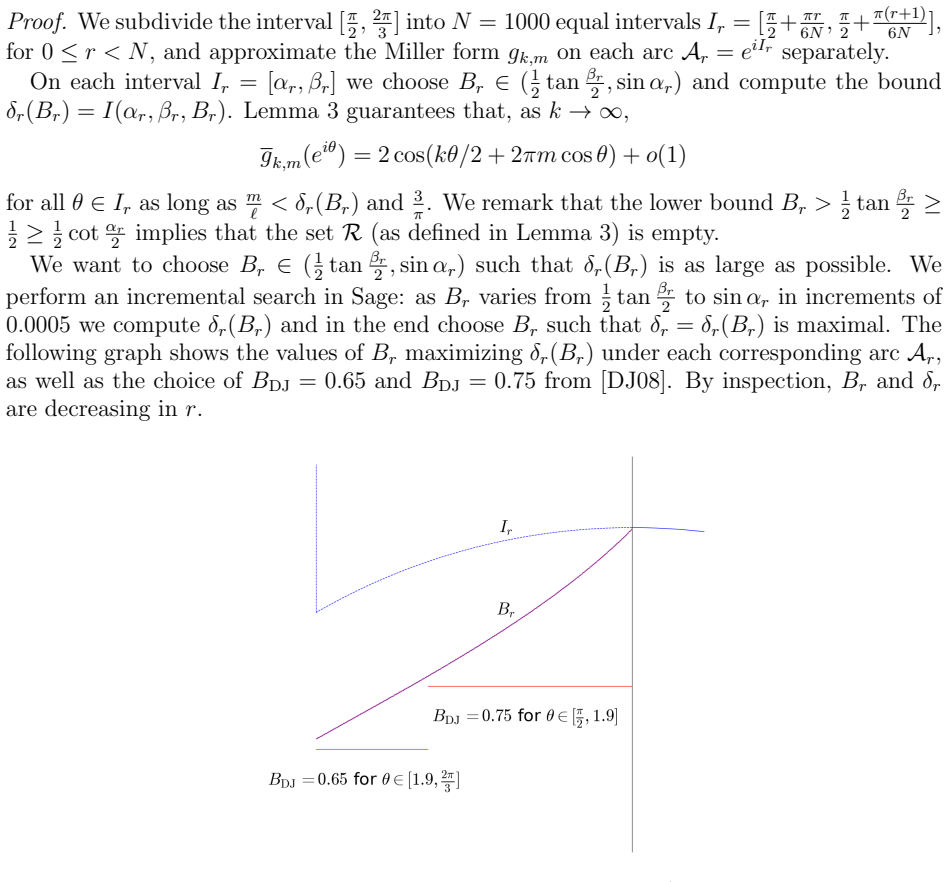
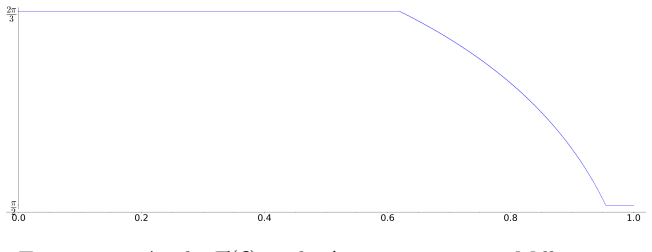
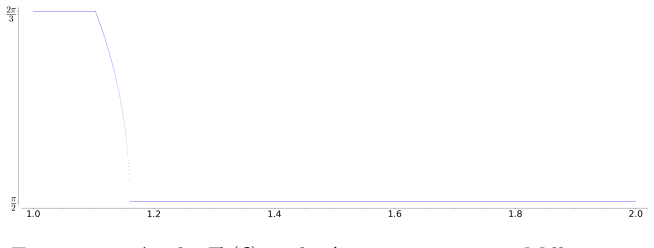
We exhibit a connection between the variation of zeros in the Miller basis of modular forms q^m + O(q^{ℓ+1}) and a logarithmic version S_δ of the Szegő curve, where δ = m/ℓ. When δ < 0.6194 we show that all the zeros are on the unit arc for k ≫ 0, while if δ is asymptotically close to 1, we show that all the zeros lie on S_δ. In general, we posit that for all δ, the zeros are located on the union of the unit arc and the log Szegő curve, obtaining a partial result, and find conjectural thresholds for m/ℓ with all zeros on the unit arc, and no zeros on the arc. Finally, we enumerate all algebraic zeros of Miller forms up to ℓ-m ≤ 25.
What carries the argument
The logarithmic Szegő curve S_δ defined by the ratio δ = m/ℓ, which determines the limiting locus of the zeros of the Miller basis forms.
If this is right
- When δ is less than about 0.6194, all zeros of the Miller forms remain on the unit arc for all sufficiently large weights.
- When δ is asymptotically close to 1, the zeros of the Miller forms lie entirely on the logarithmic Szegő curve S_δ.
- There exist conjectural threshold values of δ that mark the change from all zeros on the unit arc to none on the arc.
- All algebraic zeros among Miller forms with ℓ − m at most 25 can be listed explicitly.
- A partial proof supports the claim that zeros always lie on the union of the unit arc and S_δ.
Where Pith is reading between the lines
- The same ratio-based description may apply to zero loci in other explicit bases of modular forms.
- The complete list of algebraic zeros for small cases could be used to study associated Galois representations or L-values.
- Systematic numerical checks at intermediate values of δ could tighten the conjectural thresholds.
- The method might extend to q-expansions with more than two leading terms or to forms on higher-genus curves.
Load-bearing premise
The positions of the zeros are governed only by the ratio δ together with the large-weight asymptotic behavior, without extra terms in the q-expansion moving them elsewhere.
What would settle it
Numerically locate all zeros of a Miller basis form with δ = 0.5 and weight k = 200, then check whether every zero lies exactly on the unit circle.
Figures





read the original abstract
We exhibit a connection between the variation of zeros in the Miller basis of modular forms $q^m+O(q^{\ell+1})$ and a logarithmic version $\mathcal{S}_\delta$ of the Szeg\H{o} curve, where $\delta=m/\ell$. When $\delta<0.6194$ we show that all the zeros are on the unit arc for $k\gg 0$, while if $\delta$ is asymptotically close to 1, we show that all the zeros lie on $\mathcal{S}_{\delta}$. In general, we posit that for all $\delta$, the zeros are located on the union of the unit arc and the log Szeg\H{o} curve, obtaining a partial result, and find conjectural thresholds for $m/\ell$ with all zeros on the unit arc, and no zeros on the arc. Finally, we enumerate all algebraic zeros of Miller forms up to $\ell-m\leq 25$.
Editorial analysis
A structured set of objections, weighed in public.
Referee Report
Summary. The paper studies the zeros of the Miller basis elements in spaces of modular forms, which admit q-expansions of the form q^m + O(q^{ℓ+1}) with parameter δ = m/ℓ. It connects the zero loci to a logarithmic variant S_δ of the Szegő curve. Rigorous proofs are given that all zeros lie on the unit arc when δ < 0.6194 and k ≫ 0, and that all zeros lie on S_δ when δ is asymptotically close to 1. The authors conjecture that for general δ the zeros lie on the union of the unit arc and S_δ, obtain a partial result toward this, state conjectural thresholds separating regimes with all zeros on the arc versus none on the arc, and computationally enumerate all algebraic zeros for ℓ − m ≤ 25.
Significance. If the results hold, the work provides a new analytic link between zero distributions of a distinguished basis of modular forms and classical Szegő curves in logarithmic form. The rigorous proofs for the two extreme regimes of δ, together with the explicit computational enumeration of algebraic zeros, constitute concrete strengths; these are parameter-free in the sense that they derive directly from the definition of δ and the q-expansion shape without fitted constants.
major comments (2)
- [Section on asymptotic analysis for general δ (near the statement of the partial result)] The partial result toward the general conjecture (zeros on the union of the unit arc and S_δ) rests on large-k asymptotic analysis of the Miller basis expansions. This analysis lacks uniform error bounds on the O(q^{ℓ+1}) remainder that hold across the full range of intermediate δ; without such uniformity the extension from the extreme regimes to the posited union cannot be considered load-bearing for the central claim.
- [The paragraph defining S_δ and the subsequent theorem for δ asymptotically close to 1] The definition of the logarithmic Szegő curve S_δ is introduced directly from δ, but the justification that it accurately captures the zero loci for δ near 1 relies on coefficient growth estimates whose uniformity in δ is not established; this is load-bearing for the claim that all zeros lie on S_δ in that regime.
minor comments (2)
- [Abstract] The abstract uses both 'log Szegő curve' and 'logarithmic version S_δ of the Szegő curve'; consistent terminology throughout the text would improve readability.
- [The final enumeration section] The computational enumeration up to ℓ − m ≤ 25 is presented without an explicit statement of the precision or software used to locate the algebraic zeros; adding this would strengthen the supporting data.
Simulated Author's Rebuttal
We thank the referee for the careful reading of the manuscript and for highlighting the strengths of the rigorous results in the extreme regimes of δ together with the computational enumeration. We address each major comment below with clarifications on the scope of our claims and indicate the revisions we will make.
read point-by-point responses
-
Referee: [Section on asymptotic analysis for general δ (near the statement of the partial result)] The partial result toward the general conjecture (zeros on the union of the unit arc and S_δ) rests on large-k asymptotic analysis of the Miller basis expansions. This analysis lacks uniform error bounds on the O(q^{ℓ+1}) remainder that hold across the full range of intermediate δ; without such uniformity the extension from the extreme regimes to the posited union cannot be considered load-bearing for the central claim.
Authors: The manuscript explicitly labels this as a partial result and does not claim that the asymptotic analysis establishes the full conjecture for all intermediate δ. The large-k analysis is used only to obtain supporting evidence in certain subranges where the remainder can be controlled for fixed δ. We agree that the lack of fully uniform bounds across all intermediate δ limits the strength of this evidence. In the revision we will add a clarifying paragraph stating the precise conditions under which the O(q^{ℓ+1}) terms are estimated and explicitly note that uniformity over the entire interval of δ is not claimed. This does not alter the rigorous theorems for the extreme regimes. revision: partial
-
Referee: [The paragraph defining S_δ and the subsequent theorem for δ asymptotically close to 1] The definition of the logarithmic Szegő curve S_δ is introduced directly from δ, but the justification that it accurately captures the zero loci for δ near 1 relies on coefficient growth estimates whose uniformity in δ is not established; this is load-bearing for the claim that all zeros lie on S_δ in that regime.
Authors: The theorem is stated only for δ asymptotically close to 1, and the coefficient growth estimates are obtained under this asymptotic assumption, which permits uniformity within a sufficiently small neighborhood of δ = 1. The definition of S_δ is obtained by direct logarithmic transformation of the classical Szegő curve and does not itself require additional uniformity. To make the justification fully explicit we will insert a short lemma verifying that the relevant growth bounds hold uniformly for δ in the stated asymptotic regime. This revision will be included in the next version. revision: yes
Circularity Check
No significant circularity; derivation relies on independent asymptotic analysis and explicit definitions.
full rationale
The paper defines the Miller basis explicitly as forms with q-expansion q^m + O(q^{ℓ+1}) and introduces the logarithmic Szegő curve S_δ directly from the ratio δ = m/ℓ. The main results consist of analytic proofs that zeros lie on the unit arc for δ < 0.6194 (large k) and on S_δ when δ is near 1, plus a partial result and conjecture for the union, supported by explicit enumeration of algebraic zeros up to ℓ-m ≤ 25. No step reduces a claimed prediction to a fitted input by construction, nor does any load-bearing premise collapse to a self-citation or self-definitional loop. The asymptotic arguments and curve definition are presented as independent of the zero loci they describe.
Axiom & Free-Parameter Ledger
axioms (1)
- domain assumption Standard analytic properties of modular forms of weight k and their q-expansions hold for large k.
invented entities (1)
-
logarithmic version S_δ of the Szegő curve
no independent evidence
Lean theorems connected to this paper
-
IndisputableMonolith/Cost/FunctionalEquationwashburn_uniqueness_aczel unclear?
unclearRelation between the paper passage and the cited Recognition theorem.
gk,m(e^{iθ}) = 2 cos(2π m cos θ + k θ/2) + o(1) for δ < I(α,β,B)
-
IndisputableMonolith/Foundation/AlexanderDualityalexander_duality_circle_linking unclear?
unclearRelation between the paper passage and the cited Recognition theorem.
zeros asymptotically approach S_δ = L± − (1/(2π)) log|1−δ|
What do these tags mean?
- matches
- The paper's claim is directly supported by a theorem in the formal canon.
- supports
- The theorem supports part of the paper's argument, but the paper may add assumptions or extra steps.
- extends
- The paper goes beyond the formal theorem; the theorem is a base layer rather than the whole result.
- uses
- The paper appears to rely on the theorem as machinery.
- contradicts
- The paper's claim conflicts with a theorem or certificate in the canon.
- unclear
- Pith found a possible connection, but the passage is too broad, indirect, or ambiguous to say the theorem truly supports the claim.
Reference graph
Works this paper leans on
-
[1]
Orders in quadratic imaginary fields of small class number , author=. preprint , pages=
-
[2]
Watkins, Mark , TITLE =. Math. Comp. , FJOURNAL =. 2004 , NUMBER =. doi:10.1090/S0025-5718-03-01517-5 , URL =
-
[3]
Serre, Jean-Pierre , TITLE =. 1997 , PAGES =. doi:10.1007/978-3-663-10632-6 , URL =
-
[4]
Kohnen, Winfried , TITLE =. Comment. Math. Univ. St. Pauli , FJOURNAL =. 2003 , NUMBER =
work page 2003
-
[5]
Brisebarre, Nicolas and Philibert, Georges , TITLE =. J. Ramanujan Math. Soc. , FJOURNAL =. 2005 , NUMBER =
work page 2005
-
[6]
Szeg. \". Sitzungsberichte der Berliner Mathematischen Gesellschaft , year =
-
[7]
Gardy, Dani\`ele , TITLE =. Discrete Math. , FJOURNAL =. 1995 , NUMBER =. doi:10.1016/0012-365X(94)00133-4 , URL =
-
[8]
Heim, Bernhard and Neuhauser, Markus , TITLE =. Ramanujan J. , FJOURNAL =. 2022 , NUMBER =. doi:10.1007/s11139-022-00563-7 , URL =
-
[9]
Rudnick, Ze\'ev , TITLE =. Mathematika , FJOURNAL =. 2024 , NUMBER =
work page 2024
- [10]
-
[11]
Raveh, Roei , TITLE =. Res. Number Theory , FJOURNAL =. 2025 , NUMBER =. doi:10.1007/s40993-025-00679-x , URL =
-
[12]
Rudnick, Ze\'ev , TITLE =. Int. Math. Res. Not. , FJOURNAL =. 2005 , NUMBER =. doi:10.1155/IMRN.2005.2059 , URL =
-
[13]
Ghosh, Amit and Sarnak, Peter , TITLE =. J. Eur. Math. Soc. (JEMS) , FJOURNAL =. 2012 , NUMBER =. doi:10.4171/JEMS/308 , URL =
-
[14]
Duke, W. and Jenkins, Paul , TITLE =. Pure Appl. Math. Q. , FJOURNAL =. 2008 , NUMBER =. doi:10.4310/PAMQ.2008.v4.n4.a15 , URL =
-
[15]
Rankin, F. K. C. and Swinnerton-Dyer, H. P. F. , TITLE =. Bull. London Math. Soc. , FJOURNAL =. 1970 , PAGES =. doi:10.1112/blms/2.2.169 , URL =
-
[16]
Jennings-Shaffer, Chris and Swisher, Holly , TITLE =. RInt. J. Number Theory , FJOURNAL =. 2014 , NUMBER =
work page 2014
-
[17]
Nicolas Brisebarre and Georges Philibert, Effective lower and upper bounds for the F ourier coefficients of powers of the modular invariant j , J. Ramanujan Math. Soc. 20 (2005), no. 4, 255--282. 2193216
work page 2005
-
[18]
W. Duke and Paul Jenkins, On the zeros and coefficients of certain weakly holomorphic modular forms, Pure Appl. Math. Q. 4 (2008), no. 4, 1327--1340. 2441704
work page 2008
-
[19]
Bernhard Heim and Markus Neuhauser, Asymptotic expansion of F ourier coefficients of reciprocals of E isenstein series , Ramanujan J. 58 (2022), no. 3, 871--887. 4441539
work page 2022
-
[20]
Chris Jennings-Shaffer and Holly Swisher, A note on the transcendence of zeros of a certain family of weakly holomorphic forms, RInt. J. Number Theory 10 (2014), no. 2, 309--317
work page 2014
-
[21]
Janis Klaise, Orders in quadratic imaginary fields of small class number, preprint (2012), 2
work page 2012
-
[22]
Winfried Kohnen, Transcendence of zeros of E isenstein series and other modular functions , Comment. Math. Univ. St. Pauli 52 (2003), no. 1, 55--57. 1993952
work page 2003
-
[23]
Roei Raveh, On the zeros of the M iller basis of cusp forms , Res. Number Theory 11 (2025), no. 4, Paper No. 96, 32. 4978581
work page 2025
-
[24]
F. K. C. Rankin and H. P. F. Swinnerton-Dyer, On the zeros of E isenstein series , Bull. London Math. Soc. 2 (1970), 169--170. 260674
work page 1970
-
[25]
Ze\'ev Rudnick, Zeros of modular forms and F aber polynomials , Mathematika 70 (2024), no. 2, Paper No. e12244, 12. 4717387
work page 2024
-
[26]
Vieweg & Sohn, Braunschweig, 1997, With a foreword by Brown and Serre
Jean-Pierre Serre, Lectures on the M ordell- W eil theorem , third ed., Aspects of Mathematics, Friedr. Vieweg & Sohn, Braunschweig, 1997, With a foreword by Brown and Serre. 1757192
work page 1997
-
[27]
G\' a bor Szeg o , \" U ber eine eigenschaft der exponentialreihe , Sitzungsberichte der Berliner Mathematischen Gesellschaft 23 (1924), 50--64
work page 1924
-
[28]
The Sage Developers , S agemath, the S age M athematics S oftware S ystem ( V ersion 8.7) , 2019, https://www.sagemath.org
work page 2019
-
[29]
Mark Watkins, Class numbers of imaginary quadratic fields, Math. Comp. 73 (2004), no. 246, 907--938. 2031415
work page 2004
discussion (0)
Sign in with ORCID, Apple, or X to comment. Anyone can read and Pith papers without signing in.