Recognition: 2 theorem links
· Lean TheoremMarrying Generative Model of Healthcare Events with Digital Twin of Social Determinants of Health for Disease Reasoning
Pith reviewed 2026-05-12 02:31 UTC · model grok-4.3
The pith
A conditioned latent diffusion model with ICD-coded social determinants proxies enables better in silico simulation of personalized disease trajectories from multi-organ imaging and event data.
A machine-rendered reading of the paper's core claim, the machinery that carries it, and where it could break.
Core claim
The authors claim that a conditioned latent diffusion framework, which pairs a geometric diffusion model for the temporal evolution of brain connectivity graphs with standard diffusion models for tabular data from heart, liver, and kidney, when married to digitalized ICD-coded SDoH proxies, produces more accurate generative modeling of future disease trajectories than prior autoregressive event models or imaging-only generative baselines.
What carries the argument
A geometric diffusion model that characterizes the temporal evolution of complex data representations such as brain networks encoded as graphs, run in parallel with diffusion models for tabular organ data and conditioned on digital SDoH proxies.
If this is right
- The model supports simulated intervention by altering SDoH proxy values and generating corresponding changes in predicted disease sequences.
- It improves performance over state-of-the-art autoregressive models for healthcare events and generative baselines for imaging traits.
- The framework connects multi-organ sensor measurements directly to tokenized medical histories for more complete disease reasoning.
- It enables in silico exploration of how social factors influence future disease trajectories at the individual level.
Where Pith is reading between the lines
- If the ICD proxies prove adequate, the same conditioning mechanism could be applied to test hypothetical public-health interventions before they are deployed.
- The model offers a concrete route to quantify how shifts in social determinants would alter predicted organ-level and event-level outcomes across demographic groups.
- Replacing the ICD proxies with direct survey or sensor-based SDoH measures would provide an immediate next validation step on the same dataset.
Load-bearing premise
That ICD-coded proxies from chapters Z and V-Y in ICD-10 are sufficient to represent social determinants of health for accurate personalized disease modeling and intervention simulation.
What would settle it
A controlled ablation on the same UK Biobank split showing that removing the SDoH proxy conditioning produces no measurable drop in next-event prediction accuracy or trajectory realism would falsify the central claim.
Figures




read the original abstract
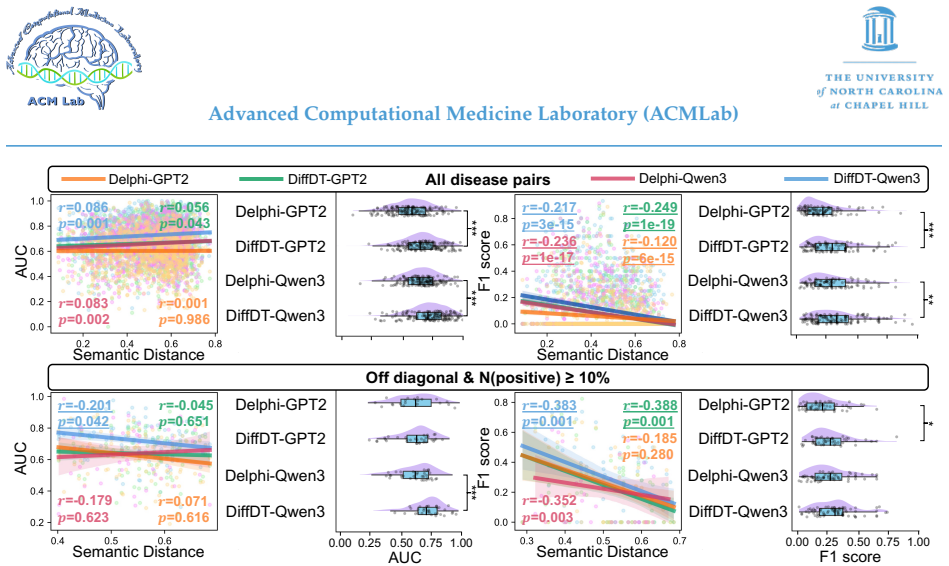
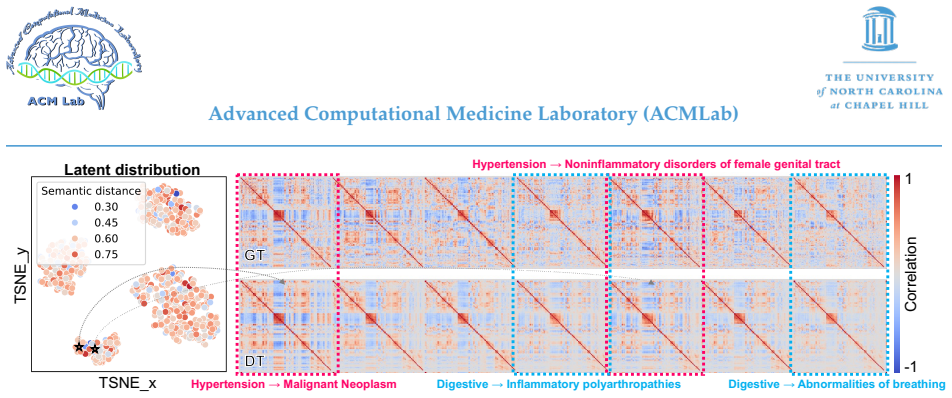
Despite the central role of sensor-derived measurements such as imaging traits and plasma biomarkers in biomedical research and clinical practice, existing generative models for disease prediction largely depend on event-level representations from hospital and registry data. Given the multi-factorial nature of human disease, the absence of explicit modeling of social determinants of health (SDoH), even in the limited form of ICD-coded proxies (chapters Z and V--Y in ICD-10), limits the capacity for personalized disease modeling and clinical decision support. To address this limitation, we propose a generative model with ICD-coded proxies of SDoH for \textit{in silico} modeling of disease reasoning, a conditioned latent diffusion framework that establishes the connection between multi-organ sensor data with tokenized healthcare events. Specifically, we introduce a novel geometric diffusion model to characterize the temporal evolution of complex data representation such as brain networks (region-to-region connectivity encoded in a graph), in parallel with diffusion models for tabular data from other organ systems. Together, we integrate the generative model with digitalized SDoH proxies (coined \modelname{}) for simulated intervention and reasoning of future disease trajectories. We conduct extensive experiments on the UK Biobank (UKB) dataset, which contains organ-specific imaging traits, including brain (44,834), heart (23,987), liver (28,722), and kidney (32,155), along with nearly 500k medical history sequences (age range: 25$\sim$89 years). Our \modelname{} achieves significant improvements over state-of-the-art human disease autoregressive models and imaging trait generative baselines.
Editorial analysis
A structured set of objections, weighed in public.
Referee Report
Summary. The manuscript proposes a conditioned latent diffusion framework (modelname) that integrates a geometric diffusion model for the temporal evolution of brain networks (as graphs) with tabular diffusion models for multi-organ imaging traits (brain, heart, liver, kidney), conditioned on tokenized ICD-10 proxies of social determinants of health drawn from chapters Z and V-Y. This is claimed to enable in silico disease reasoning and simulated interventions on future trajectories, with the full model evaluated on UK Biobank data comprising organ-specific imaging traits (e.g., 44,834 brain, 23,987 heart) and nearly 500k medical history sequences, reporting significant improvements over autoregressive human disease models and imaging trait generative baselines.
Significance. If the quantitative gains are robust, attributable to the SDoH conditioning, and the ICD proxies are shown to add unique signal, the work could meaningfully advance generative modeling in healthcare by linking sensor-derived traits with social factors for personalized trajectory simulation. The parallel geometric and tabular diffusion components address a genuine gap in handling mixed data types, but the significance hinges on whether the proxy-based digital twin meaningfully extends beyond existing event and imaging data.
major comments (3)
- [Abstract] Abstract: the central claim of 'significant improvements' over SOTA autoregressive and imaging baselines is load-bearing for the paper's contribution, yet the abstract supplies no numerical metrics, error bars, baseline names, ablation results, or statistical tests; without these, the performance lift cannot be evaluated or attributed to the SDoH integration versus the diffusion components alone.
- [Methods] SDoH proxy construction (Methods section describing tokenized ICD proxies): chapters Z and V-Y capture only selected health-status and external-cause factors and are described as 'limited form' proxies, but UK Biobank contains richer continuous questionnaire data on education, income, housing, and neighborhood exposures; if these proxies are sparse or incomplete, any reported gains may not stem from the claimed digital twin of SDoH, weakening the personalized intervention simulation claim.
- [Experiments] Experiments / Results: no ablation isolating the contribution of the SDoH conditioning (e.g., model with vs. without Z/V-Y tokens) is referenced, so it remains unclear whether the geometric diffusion on brain graphs or tabular diffusion on organ traits drives the improvements rather than the SDoH component; this is required to substantiate the 'marrying' of the two elements.
minor comments (3)
- [Abstract] Abstract: 'digitalized SDoH proxies' should read 'digitized' for standard terminology.
- [Abstract] Abstract: the placeholder 'modelname' appears throughout; replace with the actual coined name for consistency.
- [Abstract] Abstract: the age range '25~89 years' uses an approximate symbol; clarify exact range and any inclusion criteria for the 500k sequences.
Simulated Author's Rebuttal
We thank the referee for the constructive and detailed feedback, which has identified areas where the manuscript can be strengthened. We address each major comment below and outline the revisions we will implement.
read point-by-point responses
-
Referee: [Abstract] Abstract: the central claim of 'significant improvements' over SOTA autoregressive and imaging baselines is load-bearing for the paper's contribution, yet the abstract supplies no numerical metrics, error bars, baseline names, ablation results, or statistical tests; without these, the performance lift cannot be evaluated or attributed to the SDoH integration versus the diffusion components alone.
Authors: We agree that the abstract would be more informative with explicit quantitative support for the performance claims. The Experiments section provides the full set of metrics, baselines (including autoregressive human disease models and imaging trait generative baselines), error bars, and statistical comparisons. In the revised manuscript, we will update the abstract to include key numerical results (e.g., specific percentage improvements in trajectory prediction or generation fidelity) and reference the relevant tables, enabling readers to evaluate the gains directly. revision: yes
-
Referee: [Methods] SDoH proxy construction (Methods section describing tokenized ICD proxies): chapters Z and V-Y capture only selected health-status and external-cause factors and are described as 'limited form' proxies, but UK Biobank contains richer continuous questionnaire data on education, income, housing, and neighborhood exposures; if these proxies are sparse or incomplete, any reported gains may not stem from the claimed digital twin of SDoH, weakening the personalized intervention simulation claim.
Authors: We appreciate this observation and note that the manuscript already characterizes the ICD-10 proxies (chapters Z and V-Y) as a 'limited form' of SDoH. These proxies were selected because they are consistently available and tokenizable from the nearly 500k medical history sequences, allowing direct integration into the conditioned diffusion framework. While UK Biobank questionnaires provide additional continuous SDoH variables, they are not uniformly available across the imaging cohort and would require separate handling. We will revise the Methods section to report proxy coverage statistics, clarify the rationale for the ICD-based approach, and add a limitations discussion on extending to richer questionnaire data in future work. revision: partial
-
Referee: [Experiments] Experiments / Results: no ablation isolating the contribution of the SDoH conditioning (e.g., model with vs. without Z/V-Y tokens) is referenced, so it remains unclear whether the geometric diffusion on brain graphs or tabular diffusion on organ traits drives the improvements rather than the SDoH component; this is required to substantiate the 'marrying' of the two elements.
Authors: We concur that an explicit ablation isolating the SDoH conditioning is needed to substantiate the contribution of the digital twin component. The current results compare the full model against external baselines lacking SDoH tokens, but we will add an internal ablation in the revised manuscript: performance of the complete framework versus the same architecture trained without the Z/V-Y tokens. This will quantify the incremental effect of the SDoH conditioning on top of the geometric and tabular diffusion components. revision: yes
Circularity Check
No significant circularity detected; claims rest on empirical evaluation rather than self-referential definitions
full rationale
The paper proposes a conditioned latent diffusion model integrating geometric diffusion on brain graphs with tabular diffusion on organ imaging traits, conditioned on tokenized ICD-10 Z/V-Y proxies for SDoH. No equations, derivations, or model definitions are shown that reduce any claimed prediction or performance gain to fitted parameters by construction, nor are there load-bearing self-citations, uniqueness theorems imported from prior author work, or ansatzes smuggled via citation. The central claims of improvement over autoregressive and imaging baselines are presented as results of experiments on the UK Biobank dataset (with specific sample sizes for imaging traits and ~500k sequences), without evidence that the reported gains are forced by the model architecture itself or by re-labeling of inputs. This is the most common honest finding for a high-level methods paper whose derivation chain is not yet inspectable at the equation level.
Axiom & Free-Parameter Ledger
axioms (1)
- domain assumption ICD-coded proxies from chapters Z and V-Y adequately capture social determinants of health for disease reasoning
invented entities (1)
-
digital twin of SDoH (modelname)
no independent evidence
Lean theorems connected to this paper
-
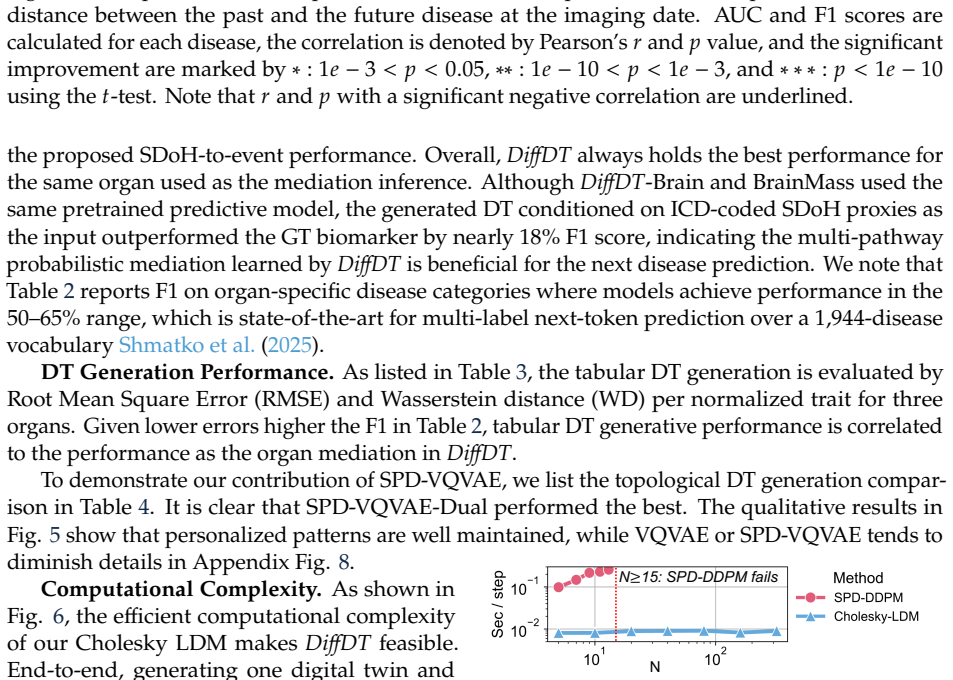
IndisputableMonolith/Cost/FunctionalEquation.leanwashburn_uniqueness_aczel unclearconditioned latent diffusion framework... geometric diffusion model... Cholesky LDM... SPD-VQVAE
-
IndisputableMonolith/Foundation/RealityFromDistinction.leanreality_from_one_distinction unclearno mention of recognition cost, phi-ladder, or 8-tick period
Reference graph
Works this paper leans on
-
[1]
Proceedings of the 42nd International Conference on Machine Learning , year=
Diffusion Counterfactual Generation with Semantic Abduction , author=. Proceedings of the 42nd International Conference on Machine Learning , year=
-
[2]
Advances in Neural Information Processing Systems , volume=
Causal effect inference with deep latent-variable models , author=. Advances in Neural Information Processing Systems , volume=
-
[3]
arXiv preprint arXiv:2507.09105 , year=
Hybrid Autoregressive-Diffusion Model for Real-Time Streaming Sign Language Production , author=. arXiv preprint arXiv:2507.09105 , year=
-
[4]
Hybridvla: Collaborative diffusion and autoregression in a unified vision-language-action model
HybridVLA: Collaborative Diffusion and Autoregression in a Unified Vision-Language-Action Model , author=. arXiv preprint arXiv:2503.10631 , year=
-
[5]
The lifespan human connectome project in aging: an overview , author=. Neuroimage , volume=. 2019 , publisher=
work page 2019
-
[6]
The WU-Minn human connectome project: an overview , author=. Neuroimage , volume=. 2013 , publisher=
work page 2013
-
[7]
Natural language processing to identify patients with cognitive impairment , author=. medRxiv , pages=. 2022 , publisher=
work page 2022
-
[8]
QSIPrep: an integrative platform for preprocessing and reconstructing diffusion MRI data , author=. Nature methods , volume=. 2021 , publisher=
work page 2021
-
[9]
fMRIPrep: a robust preprocessing pipeline for functional MRI , author=. Nature methods , volume=. 2019 , publisher=
work page 2019
-
[10]
Language models are unsupervised multitask learners , author=. OpenAI blog , volume=
-
[11]
Journal of machine learning research , volume=
Visualizing data using t-SNE , author=. Journal of machine learning research , volume=
-
[12]
Nature communications , volume=
Shared and unique brain network features predict cognitive, personality, and mental health scores in the ABCD study , author=. Nature communications , volume=. 2022 , publisher=
work page 2022
-
[13]
International Conference on Medical image computing and computer-assisted intervention , pages=
U-net: Convolutional networks for biomedical image segmentation , author=. International Conference on Medical image computing and computer-assisted intervention , pages=. 2015 , organization=
work page 2015
-
[14]
NeuroPath: A Neural Pathway Transformer for Joining the Dots of Human Connectomes , volume =
Wei, Ziquan and Dan, Tingting and Ding, Jiaqi and Wu, Guorong , booktitle =. NeuroPath: A Neural Pathway Transformer for Joining the Dots of Human Connectomes , volume =. doi:10.52202/079017-2166 , pages =
-
[15]
arXiv preprint arXiv:2510.18910 , year=
Large Connectome Model: An fMRI Foundation Model of Brain Connectomes Empowered by Brain-Environment Interaction in Multitask Learning Landscape , author=. arXiv preprint arXiv:2510.18910 , year=
-
[16]
Advances in Neural Information Processing Systems (NeurIPS 2025) , year=
BrainMoE: Cognition Joint Embedding via Mixture-of-Expert Towards Robust Brain Foundation Model , author=. Advances in Neural Information Processing Systems (NeurIPS 2025) , year=
work page 2025
-
[17]
IEEE transactions on medical imaging , volume=
Brainmass: Advancing brain network analysis for diagnosis with large-scale self-supervised learning , author=. IEEE transactions on medical imaging , volume=. 2024 , publisher=
work page 2024
-
[18]
Score-Based Generative Modeling through Stochastic Differential Equations
Score-based generative modeling through stochastic differential equations , author=. arXiv preprint arXiv:2011.13456 , year=
work page internal anchor Pith review Pith/arXiv arXiv 2011
-
[19]
Tabdiff: a multi-modal diffusion model for tabular data generation , author=. arXiv e-prints , pages=
-
[20]
Advances in Neural Information Processing Systems , volume=
Brain-jepa: Brain dynamics foundation model with gradient positioning and spatiotemporal masking , author=. Advances in Neural Information Processing Systems , volume=
-
[21]
BrainLM: A foundation model for brain activity recordings , author=. bioRxiv , pages=. 2023 , publisher=
work page 2023
-
[22]
Life sciences, society and policy , volume=
The use of digital twins in healthcare: socio-ethical benefits and socio-ethical risks , author=. Life sciences, society and policy , volume=. 2021 , publisher=
work page 2021
-
[23]
CPT: Pharmacometrics & Systems Pharmacology , volume=
Virtual clinical trials: a tool for predicting patients who may benefit from treatment beyond progression with pembrolizumab in non-small cell lung cancer , author=. CPT: Pharmacometrics & Systems Pharmacology , volume=. 2023 , publisher=
work page 2023
-
[24]
Biochimica et Biophysica Acta (BBA)-Reviews on Cancer , volume=
The case for AI-driven cancer clinical trials--The efficacy arm in silico , author=. Biochimica et Biophysica Acta (BBA)-Reviews on Cancer , volume=. 2021 , publisher=
work page 2021
-
[25]
Investigating optimal chemotherapy options for osteosarcoma patients through a mathematical model , author=. Cells , volume=. 2021 , publisher=
work page 2021
-
[26]
Current Opinion in Chemical Engineering , volume=
Bioprocess digital twins of mammalian cell culture for advanced biomanufacturing , author=. Current Opinion in Chemical Engineering , volume=. 2021 , publisher=
work page 2021
-
[27]
NPJ digital medicine , volume=
Health digital twins as tools for precision medicine: Considerations for computation, implementation, and regulation , author=. NPJ digital medicine , volume=. 2022 , publisher=
work page 2022
-
[28]
Personal digital twin: a close look into the present and a step towards the future of personalised healthcare industry , author=. Sensors , volume=. 2022 , publisher=
work page 2022
-
[29]
Advances in Neural Information Processing Systems , volume=
Riemannian diffusion models , author=. Advances in Neural Information Processing Systems , volume=
-
[30]
Advances in neural information processing systems , volume=
Riemannian score-based generative modelling , author=. Advances in neural information processing systems , volume=
-
[31]
The Thirty-ninth Annual Conference on Neural Information Processing Systems , year=
Riemannian Flow Matching for Brain Connectivity Matrices via Pullback Geometry , author=. The Thirty-ninth Annual Conference on Neural Information Processing Systems , year=
-
[32]
SIAM Journal on Matrix Analysis and Applications , volume=
Riemannian geometry of symmetric positive definite matrices via Cholesky decomposition , author=. SIAM Journal on Matrix Analysis and Applications , volume=. 2019 , publisher=
work page 2019
- [33]
-
[34]
Automated anatomical labelling atlas 3 , author=. Neuroimage , volume=. 2020 , publisher=
work page 2020
-
[35]
Proceedings of the IEEE/CVF conference on computer vision and pattern recognition , pages=
High-resolution image synthesis with latent diffusion models , author=. Proceedings of the IEEE/CVF conference on computer vision and pattern recognition , pages=
-
[36]
Qwen3 technical report , author=. arXiv preprint arXiv:2505.09388 , year=
work page internal anchor Pith review Pith/arXiv arXiv
-
[37]
Ethan Steinberg and Jason Alan Fries and Yizhe Xu and Nigam Shah , booktitle=. 2024 , url=
work page 2024
-
[38]
Journal of the American Medical Informatics Association , volume=
International classification of diseases, clinical modification and procedure coding system: descriptive overview of the next generation HIPAA code sets , author=. Journal of the American Medical Informatics Association , volume=. 2010 , publisher=
work page 2010
-
[39]
The development, evolution, and modifications of ICD-10: challenges to the international comparability of morbidity data , author=. Medical care , volume=. 2010 , publisher=
work page 2010
-
[40]
American Journal of Neuroradiology , volume=
ICD-10: history and context , author=. American Journal of Neuroradiology , volume=. 2016 , publisher=
work page 2016
-
[41]
Proceedings of the AAAI conference on artificial intelligence , volume=
Spd-ddpm: Denoising diffusion probabilistic models in the symmetric positive definite space , author=. Proceedings of the AAAI conference on artificial intelligence , volume=
-
[42]
Learning the natural history of human disease with generative transformers , author=. Nature , pages=. 2025 , publisher=
work page 2025
-
[43]
Advances in neural information processing systems , volume=
Attention is all you need , author=. Advances in neural information processing systems , volume=
-
[44]
Mathematical modelling of the human cardiovascular system: data, numerical approximation, clinical applications , author=. 2019 , publisher=
work page 2019
-
[45]
Digital twins: past, present, and future , author=. The digital twin , pages=. 2023 , publisher=
work page 2023
-
[46]
The american biology teacher , volume=
Nothing in biology makes sense except in the light of evolution , author=. The american biology teacher , volume=. 2013 , publisher=
work page 2013
-
[47]
From brain--environment connections to temporal dynamics and social interaction: principles of human brain function , author=. Neuron , volume=. 2017 , publisher=
work page 2017
-
[48]
Nature Human Behaviour , volume=
Replicable brain--phenotype associations require large-scale neuroimaging data , author=. Nature Human Behaviour , volume=. 2023 , publisher=
work page 2023
-
[49]
Meta-matching as a simple framework to translate phenotypic predictive models from big to small data , author=. Nature neuroscience , volume=. 2022 , publisher=
work page 2022
-
[50]
Genotype-by-environment interactions inferred from genetic effects on phenotypic variability in the UK Biobank , author=. Science advances , volume=. 2019 , publisher=
work page 2019
-
[51]
Biological psychiatry , volume=
Triple interactions between the environment, brain, and behavior in children: An ABCD study , author=. Biological psychiatry , volume=. 2024 , publisher=
work page 2024
-
[52]
Translational neurodegeneration , volume=
Neuroimaging in the early diagnosis of neurodegenerative disease , author=. Translational neurodegeneration , volume=. 2012 , publisher=
work page 2012
-
[53]
A review on neuroimaging studies of genetic and environmental influences on early brain development , author=. Neuroimage , volume=. 2019 , publisher=
work page 2019
-
[54]
The UK Biobank resource with deep phenotyping and genomic data , author=. Nature , volume=. 2018 , publisher=
work page 2018
-
[55]
Advances in Neural Information Processing Systems , volume=
Data-driven network neuroscience: On data collection and benchmark , author=. Advances in Neural Information Processing Systems , volume=
-
[56]
Advances in Neural Information Processing Systems , volume=
Flex-moe: Modeling arbitrary modality combination via the flexible mixture-of-experts , author=. Advances in Neural Information Processing Systems , volume=
-
[57]
proceedings of Medical Image Computing and Computer Assisted Intervention -- MICCAI 2025 , year =
Wei, Ziquan and Dan, Tingting and Wu, Guorong , title =. proceedings of Medical Image Computing and Computer Assisted Intervention -- MICCAI 2025 , year =
work page 2025
-
[58]
Frontiers in Neuroscience , volume=
A pairwise functional connectivity similarity measure method based on few-shot learning for early MCI detection , author=. Frontiers in Neuroscience , volume=. 2022 , publisher=
work page 2022
-
[59]
arXiv preprint arXiv:2405.15278 , year=
Mindshot: Brain decoding framework using only one image , author=. arXiv preprint arXiv:2405.15278 , year=
-
[60]
IEEE transactions on medical imaging , volume=
Braingb: a benchmark for brain network analysis with graph neural networks , author=. IEEE transactions on medical imaging , volume=. 2022 , publisher=
work page 2022
-
[61]
Medical Image Analysis , volume=
Brain networks and intelligence: A graph neural network based approach to resting state fmri data , author=. Medical Image Analysis , volume=. 2025 , publisher=
work page 2025
-
[62]
Connectome-based predictive modeling of fluid intelligence: evidence for a global system of functionally integrated brain networks , author=. Cerebral Cortex , volume=. 2023 , publisher=
work page 2023
-
[63]
Advances in Neural Information Processing Systems , volume=
Brain network transformer , author=. Advances in Neural Information Processing Systems , volume=
-
[64]
Advances in Neural Information Processing Systems , volume=
NeuroPath: A Neural Pathway Transformer for Joining the Dots of Human Connectomes , author=. Advances in Neural Information Processing Systems , volume=
-
[65]
Semi-Supervised Classification with Graph Convolutional Networks
Semi-supervised classification with graph convolutional networks , author=. arXiv preprint arXiv:1609.02907 , year=
work page internal anchor Pith review Pith/arXiv arXiv
-
[66]
Medical Image Analysis , volume=
Braingnn: Interpretable brain graph neural network for fmri analysis , author=. Medical Image Analysis , volume=. 2021 , publisher=
work page 2021
-
[67]
Medical Image Analysis , volume=
BolT: Fused window transformers for fMRI time series analysis , author=. Medical Image Analysis , volume=. 2023 , publisher=
work page 2023
-
[68]
Proceedings of the IEEE/CVF Conference on Computer Vision and Pattern Recognition , pages=
Self-supervised learning from images with a joint-embedding predictive architecture , author=. Proceedings of the IEEE/CVF Conference on Computer Vision and Pattern Recognition , pages=
-
[69]
Nature Reviews Immunology , volume=
Early-life interactions between the microbiota and immune system: impact on immune system development and atopic disease , author=. Nature Reviews Immunology , volume=. 2023 , publisher=
work page 2023
-
[70]
Advances in neural information processing systems , volume=
Denoising diffusion probabilistic models , author=. Advances in neural information processing systems , volume=
discussion (0)
Sign in with ORCID, Apple, or X to comment. Anyone can read and Pith papers without signing in.