Recognition: no theorem link
LLM Agents Enable User-Governed Personalization Beyond Platform Boundaries
Pith reviewed 2026-05-12 02:34 UTC · model grok-4.3
The pith
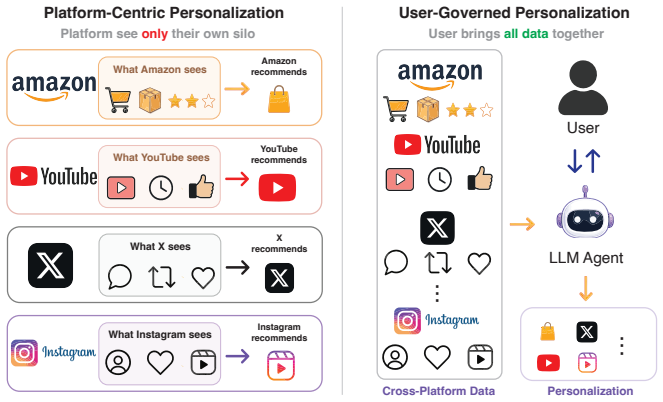
Users can outperform single-platform personalization by using off-the-shelf LLM agents to integrate their own cross-platform and offline data exports.
A machine-rendered reading of the paper's core claim, the machinery that carries it, and where it could break.
Core claim
Large language model agents enable user-governed personalization by allowing users to aggregate and reason over their own heterogeneous data exports from multiple platforms plus offline sources, producing actionable outputs that exceed the capabilities of any individual platform's limited view.
What carries the argument
Off-the-shelf LLM agents that ingest and synthesize users' cross-platform data exports to generate integrated personalization without platform mediation.
If this is right
- Users gain the ability to use their complete personal context for recommendations without sharing raw data with any service.
- Personalization decisions move from platform algorithms to user-directed agent processes.
- Data barriers between competing services become less restrictive for individual users.
- New system designs can focus on agent reliability and safe data handling rather than platform data collection.
Where Pith is reading between the lines
- Improved data export formats and APIs would make agent-based integration more reliable and widespread.
- The model could incorporate offline personal records under strict user control, extending beyond digital traces.
- Platform incentives might shift away from exclusive data ownership toward supporting user agents.
Load-bearing premise
Off-the-shelf LLM agents can reliably integrate and reason over heterogeneous personal data exports without significant errors or privacy leaks.
What would settle it
A user study in which recommendations generated by the LLM agent on real exported data score lower in relevance and accuracy than the outputs from the original single-platform models on matched tasks.
Figures
read the original abstract
Personalization today is fundamentally platform-centric: services build user representations from the behavioral fragments they observe. Yet no platform can construct a complete picture of the user, as competitive incentives, legal constraints, user privacy concerns, and epistemic limits create persistent data barriers. This paper argues for a shift from platform-centric personalization to user-governed personalization, where only the user can integrate fragmented contexts across platforms and the offline world. The key asymmetry lies in data access: only users can aggregate their own cross-platform and offline information. Large language model (LLM) agents make such integration practically feasible for the first time by enabling reasoning over heterogeneous personal data and transforming users' cross-context information into actionable personalization capabilities. We provide proof-of-concept evidence that users equipped with cross-platform data exports and an off-the-shelf LLM agent can outperform single-platform personalization baselines. We conclude by outlining a research agenda for building scalable user-governed personalization systems.
Editorial analysis
A structured set of objections, weighed in public.
Referee Report
Summary. The paper argues that personalization is inherently limited by platform-centric data collection due to competitive, legal, and privacy barriers, preventing any single service from building a complete user model. It proposes a shift to user-governed personalization, where individuals use their own cross-platform data exports (e.g., activity logs, notes, location histories) aggregated via off-the-shelf LLM agents to enable superior, context-aware personalization beyond any platform's reach. The central claim is supported by a proof-of-concept demonstration that such user-controlled LLM agents can outperform single-platform baselines, followed by an outline of a research agenda for scalable implementations.
Significance. If the proof-of-concept claim holds under rigorous testing, the work could meaningfully advance information retrieval and personalization research by reframing the problem around user-side data integration and LLM reasoning capabilities. It highlights an asymmetry in data access that platforms cannot replicate and identifies practical pathways for privacy-preserving cross-context systems. The explicit research agenda is a positive element, as it surfaces open questions in scalability, error handling, and system design that could guide follow-on empirical studies.
major comments (2)
- [Proof-of-Concept section] The proof-of-concept evidence for the headline claim (users with cross-platform exports and LLM agents outperforming single-platform baselines) is presented only at a high level without any description of the experimental protocol. No details are given on the downstream tasks evaluated, the specific data exports used, the prompting or agent architecture, the single-platform baselines, the quantitative metrics, or any error analysis for integration accuracy or hallucination rates. This absence directly undermines evaluation of the central performance claim.
- [Introduction and Proof-of-Concept] The manuscript does not provide any analysis or safeguards addressing the reliability of off-the-shelf LLM agents when fusing heterogeneous personal data (JSON logs, text, location histories). Without controlled measurements of factual errors, mis-integration, or data retention/leakage risks, the feasibility argument for user-governed personalization rests on an untested assumption that is load-bearing for the proposed asymmetry.
minor comments (2)
- [Introduction] The abstract and introduction would benefit from explicit citations to prior work on cross-platform data portability (e.g., GDPR data export studies) and LLM agent frameworks for personal data reasoning to better situate the contribution.
- [Introduction] Notation for 'user-governed personalization' is introduced without a formal definition or comparison table against related concepts such as federated personalization or personal data stores; a brief clarifying paragraph would improve readability.
Simulated Author's Rebuttal
We thank the referee for the detailed and constructive comments. We agree that the proof-of-concept requires substantially more detail to support the central claims and that reliability considerations for LLM agents must be addressed explicitly. We will make major revisions to expand these sections accordingly while preserving the paper's focus on the conceptual shift to user-governed personalization.
read point-by-point responses
-
Referee: [Proof-of-Concept section] The proof-of-concept evidence for the headline claim (users with cross-platform exports and LLM agents outperforming single-platform baselines) is presented only at a high level without any description of the experimental protocol. No details are given on the downstream tasks evaluated, the specific data exports used, the prompting or agent architecture, the single-platform baselines, the quantitative metrics, or any error analysis for integration accuracy or hallucination rates. This absence directly undermines evaluation of the central performance claim.
Authors: We agree that the proof-of-concept is currently described at a high level without sufficient experimental details. This was a deliberate choice to keep the manuscript focused on the broader vision rather than a full empirical evaluation, but we recognize that it weakens the support for the performance claim. In the revised manuscript we will expand the Proof-of-Concept section with a complete description of the experimental protocol, including the specific downstream tasks (e.g., personalized search and recommendation scenarios), the concrete data exports used (e.g., JSON activity logs, text notes, and location histories), the off-the-shelf LLM agent architecture and prompting approach, the single-platform baselines, the quantitative metrics, and an error analysis covering integration accuracy and hallucination handling. revision: yes
-
Referee: [Introduction and Proof-of-Concept] The manuscript does not provide any analysis or safeguards addressing the reliability of off-the-shelf LLM agents when fusing heterogeneous personal data (JSON logs, text, location histories). Without controlled measurements of factual errors, mis-integration, or data retention/leakage risks, the feasibility argument for user-governed personalization rests on an untested assumption that is load-bearing for the proposed asymmetry.
Authors: We acknowledge that the manuscript does not currently include analysis or safeguards for LLM reliability when fusing heterogeneous personal data. The feasibility argument therefore relies on an assumption that requires explicit qualification. In the revision we will add a new subsection (either within Proof-of-Concept or as a dedicated Limitations discussion) that qualitatively analyzes known risks of factual errors, mis-integration, and data leakage, proposes practical user-side safeguards such as verification prompts and local processing, and notes that rigorous controlled measurements of these issues remain open questions to be addressed in the research agenda. revision: yes
Circularity Check
No circularity: conceptual argument with illustrative POC, no derivations or self-referential reductions
full rationale
The paper advances a conceptual position that only users can aggregate cross-platform data and that off-the-shelf LLM agents make such integration feasible, supported by a proof-of-concept. The provided text contains no equations, fitted parameters, derivations, or mathematical claims. No self-citations are used to justify uniqueness theorems or to smuggle in ansatzes. The central asymmetry argument and POC are presented as external evidence rather than results that reduce to the paper's own inputs by construction. This is a standard non-finding for a position paper without quantitative modeling.
Axiom & Free-Parameter Ledger
axioms (1)
- domain assumption LLM agents can effectively integrate and reason over heterogeneous personal data from multiple platforms and offline sources.
invented entities (1)
-
user-governed personalization
no independent evidence
Reference graph
Works this paper leans on
-
[1]
Gediminas Adomavicius and Alexander Tuzhilin. Personalization technologies: a process- oriented perspective.Communications of the ACM, 48(10):83–90, 2005
work page 2005
-
[2]
Gediminas Adomavicius and Alexander Tuzhilin. Toward the next generation of recommender systems: A survey of the state-of-the-art and possible extensions.IEEE transactions on knowledge and data engineering, 17(6):734–749, 2005
work page 2005
-
[3]
Context-aware recommender systems
Gediminas Adomavicius and Alexander Tuzhilin. Context-aware recommender systems. In Recommender systems handbook, pages 217–253. Springer, 2010
work page 2010
-
[4]
Anthropic. Claude code overview. https://code.claude.com/docs/en/overview, n.d. Accessed: 2026-05-03
work page 2026
-
[5]
Introducing apple intelligence for iphone, ipad, and mac
Apple Inc. Introducing apple intelligence for iphone, ipad, and mac. https://www.apple.com/newsroom/2024/06/ introducing-apple-intelligence-for-iphone-ipad-and-mac/ , June 2024. Ac- cessed: 2026-05-03
work page 2024
-
[6]
Brooke Auxier, Lee Rainie, Monica Anderson, Andrew Perrin, Madhu Kumar, and Erica Turner. Americans and privacy: Concerned, confused and feeling lack of control over their personal information. pew research center.Retrieved August, 22:2023, 2019
work page 2023
-
[7]
Shlomo Berkovsky, Tsvi Kuflik, and Francesco Ricci. Mediation of user models for en- hanced personalization in recommender systems.User Modeling and User-Adapted Interaction, 18(3):245–286, 2008
work page 2008
-
[8]
California consumer privacy act of 2018, cal
California State Legislature. California consumer privacy act of 2018, cal. civ. code § 1798.100 et seq. https://leginfo.legislature.ca.gov/faces/codes_displayText.xhtml? division=3.&part=4.&lawCode=CIV&title=1.81.5, 2018. Accessed: 2026-05-03
work page 2018
-
[9]
Cross- domain recommender systems
Iván Cantador, Ignacio Fernández-Tobías, Shlomo Berkovsky, and Paolo Cremonesi. Cross- domain recommender systems. InRecommender systems handbook, pages 919–959. Springer, 2015
work page 2015
-
[10]
Wide & deep learning for recommender systems
Heng-Tze Cheng, Levent Koc, Jeremiah Harmsen, Tal Shaked, Tushar Chandra, Hrishi Aradhye, Glen Anderson, Greg Corrado, Wei Chai, Mustafa Ispir, et al. Wide & deep learning for recommender systems. InProceedings of the 1st workshop on deep learning for recommender systems, pages 7–10, 2016
work page 2016
-
[11]
Deep neural networks for youtube recommenda- tions
Paul Covington, Jay Adams, and Emre Sargin. Deep neural networks for youtube recommenda- tions. InProceedings of the 10th ACM conference on recommender systems, pages 191–198, 2016
work page 2016
-
[12]
Commission finds apple and meta in breach of the digital mar- kets act
European Commission. Commission finds apple and meta in breach of the digital mar- kets act. https://ec.europa.eu/commission/presscorner/detail/en/ip_25_1085, April 2025. Press release. Accessed: 2026-05-03
work page 2025
-
[13]
European Parliament and Council of the European Union. Regulation (eu) 2016/679 of the european parliament and of the council of 27 april 2016 on the protection of natural persons with regard to the processing of personal data and on the free movement of such data, and repealing directive 95/46/ec (general data protection regulation). https://eur-lex.euro...
work page 2016
-
[14]
European Parliament and Council of the European Union. Regulation (eu) 2022/1925 of the european parliament and of the council of 14 september 2022 on contestable and fair markets in the digital sector (digital markets act). https://eur-lex.europa.eu/eli/reg/2022/ 1925/oj, October 2022. Official Journal of the European Union, L265, pp. 1–66. Accessed: 202...
work page 2022
-
[15]
European Parliament and Council of the European Union. Regulation (eu) 2023/2854 of the european parliament and of the council of 13 december 2023 on harmonised rules on fair access to and use of data and amending regulation (eu) 2017/2394 and directive (eu) 2020/1828 (data act). https://eur-lex.europa.eu/eli/reg/2023/2854/oj, December 2023. Official Jour...
work page 2023
-
[16]
Haiyan Fan and Marshall Scott Poole. What is personalization? perspectives on the design and implementation of personalization in information systems.Journal of Organizational Computing and Electronic Commerce, 16(3-4):179–202, 2006
work page 2006
-
[17]
Damien Geradin, Konstantina Bania, and Theano Karanikioti. The interplay between the digital markets act and the general data protection regulation.Available at SSRN 4203907, 2022
work page 2022
-
[18]
David Goldberg, David Nichols, Brian M Oki, and Douglas Terry. Using collaborative filtering to weave an information tapestry.Communications of the ACM, 35(12):61–70, 1992
work page 1992
-
[19]
Robert Wayne Gregory, Ola Henfridsson, Evgeny Kaganer, and Harris Kyriakou. The role of artificial intelligence and data network effects for creating user value.Academy of management review, 46(3):534–551, 2021
work page 2021
-
[20]
Bridging Language and Items for Retrieval and Recommendation: Benchmarking LLMs as Semantic Encoders
Yupeng Hou, Jiacheng Li, Zhankui He, An Yan, Xiusi Chen, and Julian McAuley. Bridging language and items for retrieval and recommendation.arXiv preprint arXiv:2403.03952, 2024
work page internal anchor Pith review Pith/arXiv arXiv 2024
-
[21]
Large language models are zero-shot rankers for recommender systems
Yupeng Hou, Junjie Zhang, Zihan Lin, Hongyu Lu, Ruobing Xie, Julian McAuley, and Wayne Xin Zhao. Large language models are zero-shot rankers for recommender systems. In European conference on information retrieval, pages 364–381. Springer, 2024
work page 2024
-
[22]
Collaborative filtering for implicit feedback datasets
Yifan Hu, Yehuda Koren, and Chris V olinsky. Collaborative filtering for implicit feedback datasets. In2008 Eighth IEEE international conference on data mining, pages 263–272. Ieee, 2008
work page 2008
-
[23]
Jon Kleinberg, Sendhil Mullainathan, and Manish Raghavan. The challenge of understanding what users want: Inconsistent preferences and engagement optimization.Management science, 70(9):6336–6355, 2024
work page 2024
-
[24]
User modeling and user-adapted interaction
Alfred Kobsa. User modeling and user-adapted interaction. InConference companion on Human factors in computing systems, pages 415–416, 1994
work page 1994
-
[25]
Matrix factorization techniques for recom- mender systems.Computer, 42(8):30–37, 2009
Yehuda Koren, Robert Bell, and Chris V olinsky. Matrix factorization techniques for recom- mender systems.Computer, 42(8):30–37, 2009
work page 2009
-
[26]
Kevin Kuo, Chhavi Yadav, and Virginia Smith. Research in collaborative learning does not serve cross-silo federated learning in practice.arXiv preprint arXiv:2510.12595, 2025
-
[27]
Jiacheng Lin, Tian Wang, and Kun Qian. Rec-r1: Bridging generative large language models and user-centric recommendation systems via reinforcement learning.Transactions on Machine Learning Research, 2025
work page 2025
-
[28]
Greg Linden, Brent Smith, and Jeremy York. Amazon. com recommendations: Item-to-item collaborative filtering.IEEE Internet computing, 7(1):76–80, 2003
work page 2003
-
[29]
Federated learning and free-riding in a competitive market.arXiv preprint arXiv:2410.12723, 2024
Jiajun Meng, Jing Chen, Dongfang Zhao, and Lin Liu. Federated learning and free-riding in a competitive market.arXiv preprint arXiv:2410.12723, 2024
-
[30]
Proof-of-concept for private local-to- cloud llm chat via trusted execution environments
Avanika Narayan, Dan Biderman, and Christopher Re. Proof-of-concept for private local-to- cloud llm chat via trusted execution environments. InES-FoMo III: 3rd Workshop on Efficient Systems for Foundation Models, 2025
work page 2025
-
[31]
Maxim Naumov, Dheevatsa Mudigere, Hao-Jun Michael Shi, Jianyu Huang, Narayanan Sun- daraman, Jongsoo Park, Xiaodong Wang, Udit Gupta, Carole-Jean Wu, Alisson G Azzolini, et al. Deep learning recommendation model for personalization and recommendation systems. arXiv preprint arXiv:1906.00091, 2019. 12
-
[32]
Nvidia announces dgx spark and dgx sta- tion personal ai computers
NVIDIA Corporation. Nvidia announces dgx spark and dgx sta- tion personal ai computers. https://nvidianews.nvidia.com/news/ nvidia-announces-dgx-spark-and-dgx-station-personal-ai-computers , March
-
[34]
OpenAI. Introducing codex. https://openai.com/index/introducing-codex/, May
-
[35]
Accessed: 2026-05-03
work page 2026
-
[36]
Geoffrey G Parker, Marshall W Van Alstyne, and Sangeet Paul Choudary.Platform revolution: How networked markets are transforming the economy and how to make them work for you. WW Norton & Company, 2016
work page 2016
-
[37]
Google i/o 2025: Sundar pichai’s opening keynote
Sundar Pichai. Google i/o 2025: Sundar pichai’s opening keynote. https://blog.google/ innovation-and-ai/technology/ai/io-2025-keynote/ , May 2025. Accessed: 2026- 05-03
work page 2025
-
[38]
General data protection regulation.Intersoft Consulting, Accessed in October, 24(1), 2018
Data Protection. General data protection regulation.Intersoft Consulting, Accessed in October, 24(1), 2018
work page 2018
-
[39]
Competing with big data.The Journal of Industrial Economics, 69(4):967–1008, 2021
Jens Prüfer and Christoph Schottmüller. Competing with big data.The Journal of Industrial Economics, 69(4):967–1008, 2021
work page 2021
-
[40]
User modeling and user profiling: A comprehensive survey.arXiv preprint arXiv:2402.09660, 2024
Erasmo Purificato, Ludovico Boratto, and Ernesto William De Luca. User modeling and user profiling: A comprehensive survey.arXiv preprint arXiv:2402.09660, 2024
-
[41]
Grouplens: An open architecture for collaborative filtering of netnews
Paul Resnick, Neophytos Iacovou, Mitesh Suchak, Peter Bergstrom, and John Riedl. Grouplens: An open architecture for collaborative filtering of netnews. InProceedings of the 1994 ACM conference on Computer supported cooperative work, pages 175–186, 1994
work page 1994
-
[42]
Language representations can be what recommenders need: Findings and potentials
Leheng Sheng, An Zhang, Yi Zhang, Yuxin Chen, Xiang Wang, and Tat-Seng Chua. Language representations can be what recommenders need: Findings and potentials. InThe Thirteenth International Conference on Learning Representations, 2025
work page 2025
-
[43]
Kar Yan Tam and Shuk Ying Ho. Understanding the impact of web personalization on user information processing and decision outcomes1.MIS quarterly, 30(4):865–890, 2006
work page 2006
-
[44]
Fernando N Van der Vlist, Anne Helmond, Marcus Burkhardt, and Tatjana Seitz. Api gover- nance: The case of facebook’s evolution.Social Media+ Society, 8(2):20563051221086228, 2022
work page 2022
-
[45]
A survey on large language models for recommendation
Likang Wu, Zhi Zheng, Zhaopeng Qiu, Hao Wang, Hongchao Gu, Tingjia Shen, Chuan Qin, Chen Zhu, Hengshu Zhu, Qi Liu, et al. A survey on large language models for recommendation. World Wide Web, 27(5):60, 2024
work page 2024
-
[46]
Bo Xiao and Izak Benbasat. E-commerce product recommendation agents: Use, characteristics, and impact1.MIS quarterly, 31(1):137–209, 2007
work page 2007
-
[47]
Federated learning of gboard language models with differential privacy
Zheng Xu, Yanxiang Zhang, Galen Andrew, Christopher Choquette, Peter Kairouz, Brendan Mcmahan, Jesse Rosenstock, and Yuanbo Zhang. Federated learning of gboard language models with differential privacy. InProceedings of the 61st Annual Meeting of the Association for Computational Linguistics (Volume 5: Industry Track), pages 629–639, 2023
work page 2023
-
[48]
An Yang, Anfeng Li, Baosong Yang, Beichen Zhang, Binyuan Hui, Bo Zheng, Bowen Yu, Chang Gao, Chengen Huang, Chenxu Lv, et al. Qwen3 technical report.arXiv preprint arXiv:2505.09388, 2025
work page internal anchor Pith review Pith/arXiv arXiv 2025
-
[49]
Yang Zhang, Fuli Feng, Jizhi Zhang, Keqin Bao, Qifan Wang, and Xiangnan He. Collm: Integrating collaborative embeddings into large language models for recommendation.IEEE Transactions on Knowledge and Data Engineering, 2025
work page 2025
-
[50]
Zhehao Zhang, Ryan A. Rossi, Branislav Kveton, Yijia Shao, Diyi Yang, Hamed Zamani, Franck Dernoncourt, Joe Barrow, Tong Yu, Sungchul Kim, Ruiyi Zhang, Jiuxiang Gu, Tyler Derr, Hongjie Chen, Junda Wu, Xiang Chen, Zichao Wang, Subrata Mitra, Nedim Lipka, Nesreen K. Ahmed, and Yu Wang. Personalization of large language models: A survey. Transactions on Mach...
work page 2025
-
[51]
Cross- domain recommendation: Challenges, progress, and prospects
Feng Zhu, Yan Wang, Chaochao Chen, Jun Zhou, Longfei Li, and Guanfeng Liu. Cross- domain recommendation: Challenges, progress, and prospects. InProceedings of the Thirtieth International Joint Conference on Artificial Intelligence, pages 4721–4728. International Joint Conferences on Artificial Intelligence Organization, 2021. 14 A Ethics Statement This st...
work page 2021
discussion (0)
Sign in with ORCID, Apple, or X to comment. Anyone can read and Pith papers without signing in.