Recognition: 2 theorem links
· Lean TheoremSharpness of convolution bounds for measures
Pith reviewed 2026-05-12 02:45 UTC · model grok-4.3
The pith
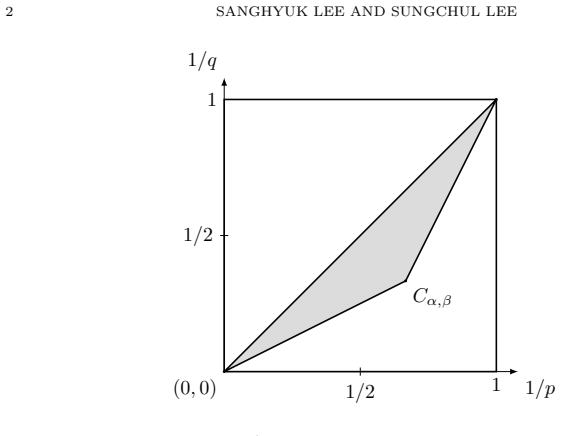
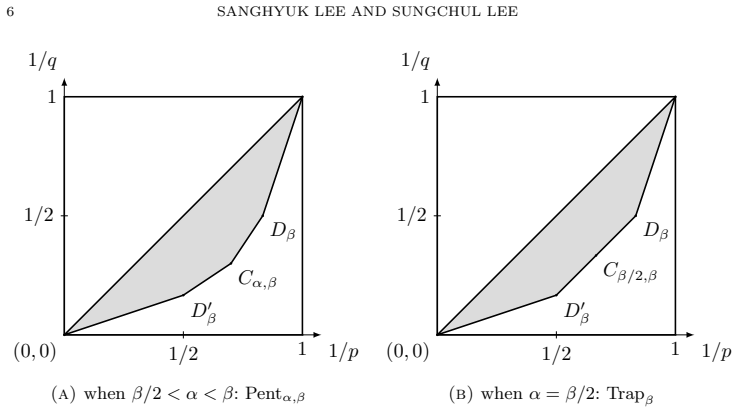
The sharp (p,q) range is determined for L^p to L^q bounds on convolution with fractal measures satisfying α-Frostman and β/2-Fourier decay conditions.
A machine-rendered reading of the paper's core claim, the machinery that carries it, and where it could break.
Core claim
We determine the sharp (p,q) range for L^p--L^q bounds of convolution operators f↦μ*f associated with fractal measures μ∈P_{α,β}(R^d), namely, compactly supported Borel probability measures satisfying the α-Frostman condition μ(B(x,ρ)) ≲ ρ^α and the β/2-Fourier decay condition |μ̂(ξ)| ≲ |ξ|^{-β/2}. Sharpness is established by constructing measures satisfying these conditions together with a suitable lower regularity condition. Modifications of the same constructions also refine previous sharpness results for the L^2 restriction estimate of Mockenhaupt--Mitsis--Bak--Seeger by producing, in every dimension and in both the geometric (α≥β) and non-geometric (β>α) regimes, a single measure in P_{
What carries the argument
The class P_{α,β}(R^d) of measures obeying the α-Frostman condition and the β/2-Fourier decay condition, with constructions that additionally satisfy a lower regularity condition to achieve sharpness.
If this is right
- The (p,q) range is sharp for all such measures in both geometric (α ≥ β) and non-geometric (β > α) cases.
- Explicit constructions provide a single measure that makes the L^2 restriction threshold sharp in every dimension.
- The same constructions work uniformly across dimensions d.
- Previous sharpness results for restriction estimates are refined by using one measure instead of possibly different ones.
Where Pith is reading between the lines
- The constructions might be adaptable to prove sharpness for related operators such as maximal averages or singular integrals.
- Similar techniques could apply to measures with different types of decay conditions beyond Fourier.
- Testing the bounds with specific self-similar measures like iterated function systems could provide numerical evidence for the thresholds.
Load-bearing premise
Sharpness holds because there exist measures in the class P_{α,β} that also obey a suitable lower regularity condition allowing the lower bounds to match the upper bounds.
What would settle it
A direct computation showing that for one of the constructed measures the convolution operator fails to be bounded at an exponent on the claimed boundary would falsify the sharpness result.
Figures

read the original abstract
In this paper, we determine the sharp \((p,q)\) range for \(L^p\)--\(L^q\) bounds of convolution operators \(f\mapsto \mu*f\) associated with fractal measures \(\mu\in \mathcal P_{\alpha,\beta}(\mathbb R^d)\), namely, compactly supported Borel probability measures satisfying the \(\alpha\)-Frostman condition \[ \mu(B(x,\rho)) \lesssim \rho^\alpha, \qquad \forall (x,\rho)\in \mathbb R^d\times (0,1), \] and the \(\beta/2\)-Fourier decay condition \[ |\widehat{\mu}(\xi)| \lesssim |\xi|^{-\beta/2}, \qquad \forall \xi\in\mathbb R^d. \] Sharpness is established by constructing measures satisfying these conditions together with a suitable lower regularity condition. Modifications of the same constructions also refine previous sharpness results for the \(L^2\) restriction estimate of Mockenhaupt--Mitsis--Bak--Seeger by producing, in every dimension and in both the geometric \((\alpha\ge\beta)\) and non-geometric \((\beta>\alpha)\) regimes, a single measure in \(\mathcal P_{\alpha,\beta}(\mathbb R^d)\) for which the corresponding threshold exponent is sharp.
Editorial analysis
A structured set of objections, weighed in public.
Referee Report
Summary. The paper determines the sharp (p,q) range for the L^p to L^q boundedness of the convolution operator f ↦ μ * f associated to measures μ in the class P_{α,β}(R^d) of compactly supported probability measures satisfying the α-Frostman condition μ(B(x,ρ)) ≲ ρ^α and the β/2-Fourier decay |μ̂(ξ)| ≲ |ξ|^{-β/2}. The positive direction follows from these two hypotheses by standard harmonic-analysis arguments; sharpness is obtained by explicit constructions of measures obeying the same upper conditions together with an additional lower-regularity condition. The constructions are given in every dimension and separately in the geometric regime α ≥ β and the non-geometric regime β > α. The same examples also sharpen the L^2 restriction theorem of Mockenhaupt–Mitsis–Bak–Seeger in both regimes.
Significance. If the constructions are correct, the work supplies a complete, parameter-sharp characterization of the convolution bounds under the stated Frostman and Fourier-decay hypotheses. The explicit, dimension-independent constructions that simultaneously achieve sharpness for both the convolution and the restriction problems constitute a concrete advance over previous partial results.
minor comments (3)
- The lower-regularity condition required for the sharpness constructions is invoked repeatedly but is never stated as a numbered definition or displayed equation; inserting a clear, self-contained statement (e.g., as Definition 2.4) would improve readability.
- In the abstract and introduction the class is denoted P_{α,β}(R^d) without an immediate reference to the precise definition; a parenthetical reminder of the two defining inequalities would help readers who consult only the abstract.
- The paper distinguishes the geometric and non-geometric regimes but does not include a short table or diagram summarizing the resulting (p,q) thresholds in each regime; such a summary would make the main theorem easier to parse.
Simulated Author's Rebuttal
We thank the referee for the positive summary, significance assessment, and recommendation of minor revision. No specific major comments appear in the report.
Circularity Check
No significant circularity; derivation self-contained via standard tools and explicit constructions
full rationale
The paper derives the positive L^p-L^q bounds from the α-Frostman and β/2-Fourier decay hypotheses using standard harmonic-analysis estimates, then establishes sharpness independently by constructing explicit measures in P_{α,β}(R^d) obeying an additional lower-regularity condition. These constructions are given separately for geometric (α ≥ β) and non-geometric (β > α) cases in every dimension and do not reduce to the upper-bound results, fitted parameters, or self-citations. The central claim therefore rests on externally verifiable constructions rather than any definitional loop or imported uniqueness theorem.
Axiom & Free-Parameter Ledger
axioms (1)
- standard math Fourier transform and convolution are well-defined and continuous for compactly supported Borel probability measures on R^d
Reference graph
Works this paper leans on
- [1]
-
[2]
Bluhm, Random recursive construction of Salem sets,Ark
C. Bluhm, Random recursive construction of Salem sets,Ark. Mat.34 (1996), no. 1, 51–63
work page 1996
-
[3]
S. Boucheron, G. Lugosi, and P. Massart,Concentration Inequalities: A Nonasymptotic The- ory of Independence, Oxford Univ. Press, Oxford, 2013
work page 2013
-
[4]
M. Carnovale, J. M. Fraser, and A. E. de Orellana, Obtaining the Fourier spectrum via Fourier coefficients,Proc. Amer. Math. Soc.(2026), Published electronically March 10, DOI: 10.1090/proc/17610
-
[5]
Chen, A Fourier restriction theorem based on convolution powers,Proc
X. Chen, A Fourier restriction theorem based on convolution powers,Proc. Amer. Math. Soc. 142 (2014), no. 11, 3897–3901
work page 2014
-
[6]
Chen, Sets of Salem type and sharpness of theL 2-Fourier restriction theorem,Trans
X. Chen, Sets of Salem type and sharpness of theL 2-Fourier restriction theorem,Trans. Amer. Math. Soc.368 (2016), no. 3, 1959–1977
work page 2016
-
[7]
X. Chen and A. Seeger, Convolution Powers of Salem Measures With Applications,Canad. J. Math.69 (2017), no. 2, 284–320
work page 2017
-
[8]
Christ, A convolution inequality concerning Cantor-Lebesgue measures,Rev
M. Christ, A convolution inequality concerning Cantor-Lebesgue measures,Rev. Mat. Iberoam.1 (1985), no. 4, 79–83
work page 1985
-
[9]
J. M. Fraser, The Fourier spectrum and sumset type problems,Math. Ann.390 (2024), no. 3, 3891–3930
work page 2024
- [10]
- [11]
-
[12]
Hambrook,Restriction theorems and Salem sets, Ph.D
K. Hambrook,Restriction theorems and Salem sets, Ph.D. thesis, University of British Columbia, 2015
work page 2015
-
[13]
K. Hambrook and I. Laba, On the Sharpness of Mockenhaupt’s Restriction Theorem,Geom. Funct. Anal.23 (2013), no. 4, 1262–1277
work page 2013
-
[14]
K. Hambrook and I. Laba, Sharpness of the Mockenhaupt–Mitsis–Bak–Seeger restriction theorem in higher dimensions,Bull. Lond. Math. Soc.48 (2016), no. 5, 757–770
work page 2016
-
[15]
He, Orthogonal projections of discretized sets,J
W. He, Orthogonal projections of discretized sets,J. Fractal Geom.7 (2020), no. 3, 271–317
work page 2020
-
[16]
B. A. Kpata, I. Fofana, and K. Koua, Necessary condition for measures which are (L q, Lp) multipliers,Ann. Math. Blaise Pascal16 (2009), no. 2, 339–353
work page 2009
-
[17]
A. K¨ aenm¨ aki and J. Lehrb¨ ack, Measures with predetermined regularity and inhomogeneous self-similar sets,Ark. Mat.55 (2017), no. 1, 165–184
work page 2017
-
[18]
A. K¨ aenm¨ aki, J. Lehrb¨ ack, and M. Vuorinen, Dimensions, Whitney covers, and tubular neigh- borhoods,Indiana Univ. Math. J.62 (2013), no. 6, 1861–1889
work page 2013
-
[19]
I. Laba and M. Pramanik, Arithmetic progressions in sets of fractional dimension,Geom. Funct. Anal.19 (2009), no. 2, 429–456
work page 2009
- [20]
-
[21]
W. Littman,L p–Lq-estimates for singular integral operators arising from hyperbolic equa- tions, inPartial differential equations, Proc. Sympos. Pure Math., Vol. XXIII, Amer. Math. Soc., Providence, RI, 1973, pp. 479–481. Proc. Sympos. Pure Math., Vol. XXIII, Univ. Cali- fornia, Berkeley, Calif., 1971
work page 1973
-
[22]
Mattila,Fourier Analysis and Hausdorff Dimension, Cambridge Stud
P. Mattila,Fourier Analysis and Hausdorff Dimension, Cambridge Stud. Adv. Math., vol. 150, Cambridge Univ. Press, Cambridge, 2015
work page 2015
-
[23]
G. Migliorati, F. Nobile, and R. Tempone, Convergence estimates in probability and in ex- pectation for discrete least squares with noisy evaluations at random points,J. Multivariate Anal.142 (2015), 167–182
work page 2015
-
[24]
Mitsis, A Stein-Tomas restriction theorem for general measures,Publ
T. Mitsis, A Stein-Tomas restriction theorem for general measures,Publ. Math. Debrecen60 (2002), no. 1–2, 89–99
work page 2002
-
[25]
Mockenhaupt, Salem sets and restriction properties of Fourier transforms,Geom
G. Mockenhaupt, Salem sets and restriction properties of Fourier transforms,Geom. Funct. Anal.10 (2000), no. 6, 1579–1587
work page 2000
-
[26]
Oberlin, A convolution property of the Cantor-Lebesgue measure,Colloq
D. Oberlin, A convolution property of the Cantor-Lebesgue measure,Colloq. Math.47 (1982), no. 1, 113–117
work page 1982
-
[27]
Oberlin, Convolution estimates for some measures on curves,Proc
D. Oberlin, Convolution estimates for some measures on curves,Proc. Amer. Math. Soc.99 (1987), no. 1, 56–60
work page 1987
-
[28]
Oberlin, Affine dimension: measuring the vestiges of curvature,Michigan Math
D. Oberlin, Affine dimension: measuring the vestiges of curvature,Michigan Math. J.51 (2003), no. 1, 13–26
work page 2003
-
[29]
A. Schrijver,A Course in Combinatorial Optimization, Lecture notes, CWI and University of Amsterdam, Amsterdam, 2017, pp. 134–144
work page 2017
-
[30]
P. Shmerkin and V. Suomala, A class of random Cantor measures, with applications, in Recent Developments in Fractals and Related Fields, Trends Math., Birkh¨ auser/Springer, Cham, 2017, pp. 233–260
work page 2017
-
[31]
P. Shmerkin and V. Suomala, Spatially independent martingales, intersections, and applica- tions,Mem. Amer. Math. Soc.251 (2018), no. 1195
work page 2018
-
[32]
Strichartz, Convolutions with kernels having singularities on a sphere,Trans
R. Strichartz, Convolutions with kernels having singularities on a sphere,Trans. Amer. Math. Soc.148 (1970), 461–471
work page 1970
-
[33]
T. H. Wolff,Lectures on Harmonic Analysis, University Lecture Series, vol. 29, American Mathematical Society, Providence, RI, 2003. (Sanghyuk Lee)Department of Mathematical Sciences and RIM, Seoul National Uni- versity, Seoul 08826, Republic of Korea Email address:shklee@snu.ac.kr (Sungchul Lee)Department of Mathematical Sciences, Seoul National Universit...
work page 2003
discussion (0)
Sign in with ORCID, Apple, or X to comment. Anyone can read and Pith papers without signing in.