Recognition: 1 theorem link
· Lean TheoremValidating Coronal Magnetic Field Models Using Gaussian Separation
Pith reviewed 2026-05-12 03:29 UTC · model grok-4.3
The pith
Gaussian separation of photospheric fields provides a check on the coronal currents in NLFFF models.
A machine-rendered reading of the paper's core claim, the machinery that carries it, and where it could break.
Core claim
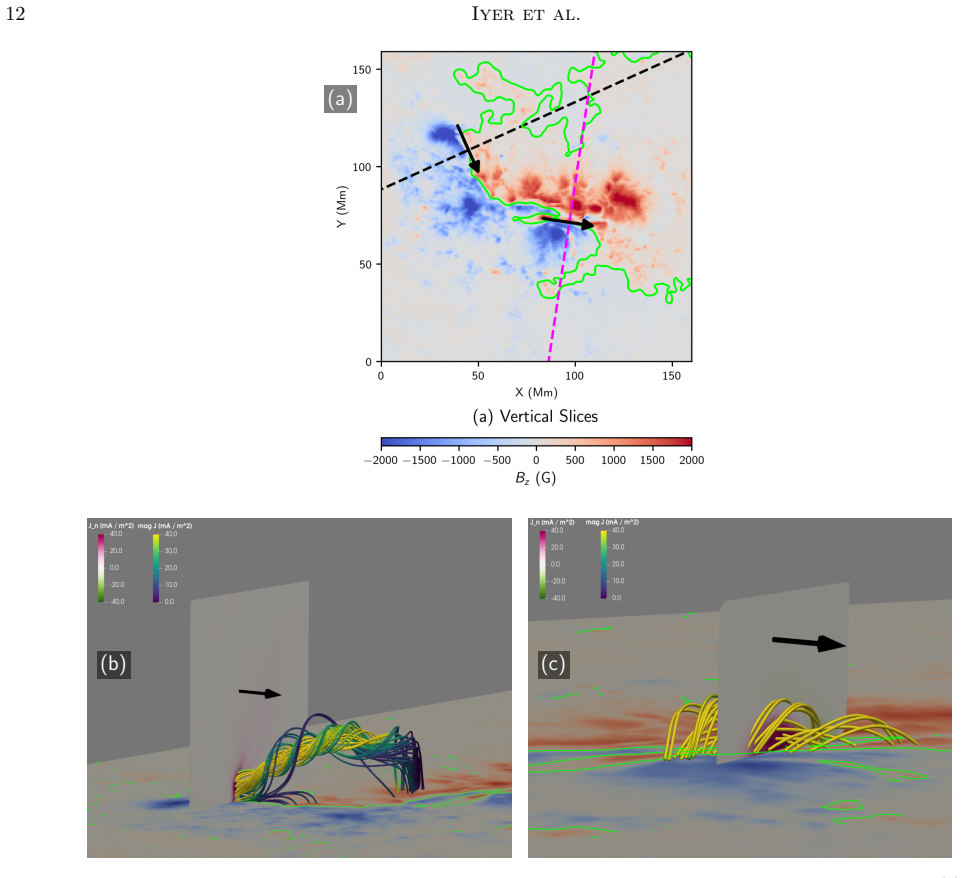
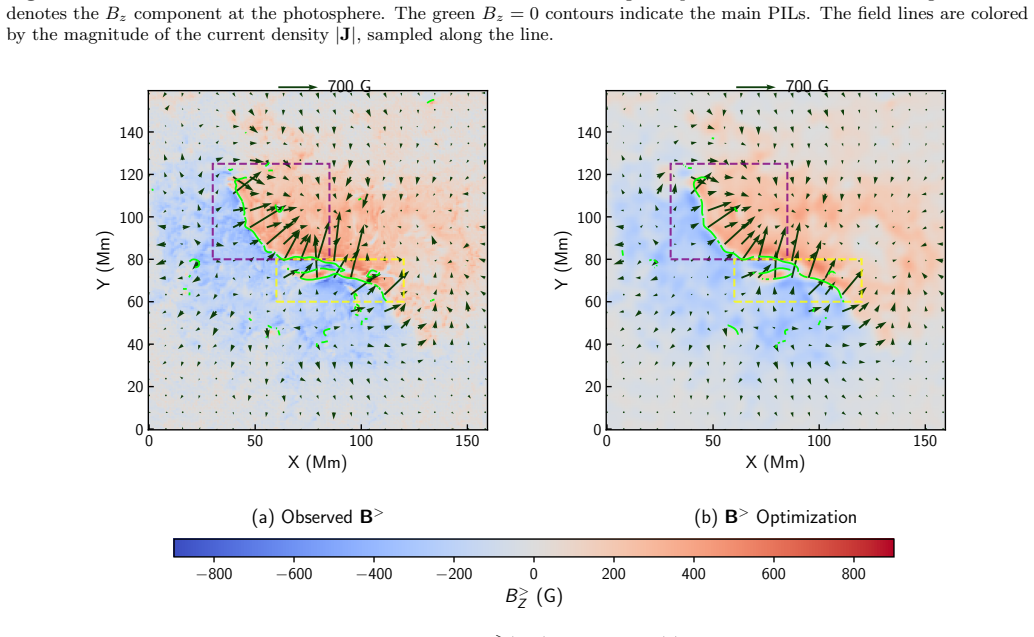
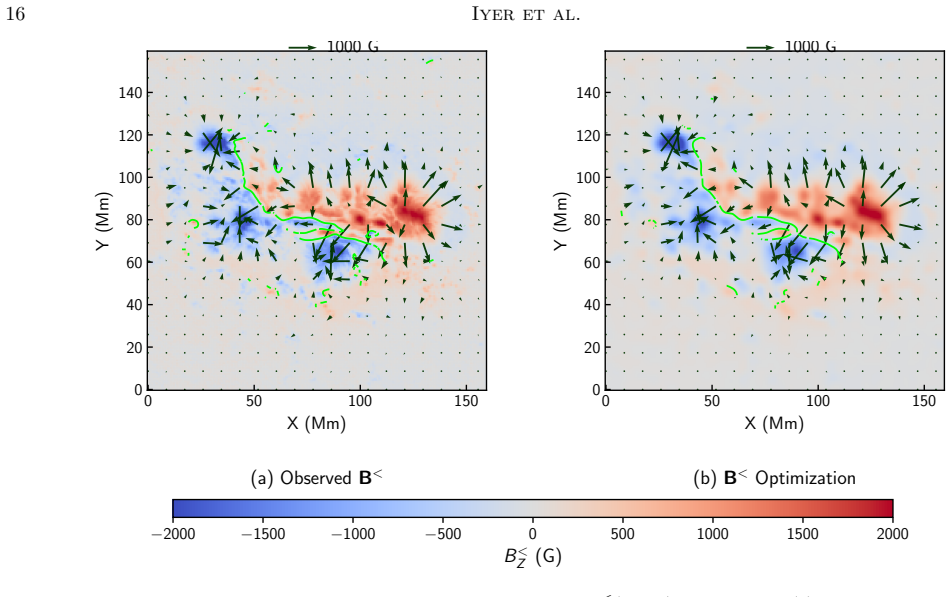
The central claim is that comparing the photospheric field components due to coronal currents, obtained via Gaussian separation, in an NLFFF model with those in the original vector magnetogram data provides a direct check on the accuracy of the model's coronal currents. Applied to active region AR 11429, both the optimization and CFIT NLFFF models reproduce the signatures of currents flowing above and parallel to the central sheared polarity inversion lines, but the CFIT model significantly alters the signature associated with a flux rope along the lower section of the main PIL.
What carries the argument
Gaussian separation, the partitioning of the photospheric vector magnetic field into three components associated with currents flowing below, above, and passing through the photosphere.
If this is right
- Both models indicate currents flowing above and parallel to central, sheared polarity inversion lines, consistent with prior studies.
- The optimization model reproduces the coronal current signatures along both sections of the main PIL more closely than the CFIT model.
- Alterations in the CFIT model arise from modifications to the vector magnetogram boundary data and from underlying model assumptions.
- Gaussian separation offers a new method to validate coronal magnetic field models beyond existing techniques.
Where Pith is reading between the lines
- The approach could be tested on forward-modeled data from MHD simulations to verify that it correctly recovers known coronal current distributions.
- Systematic application might identify which boundary-handling choices in NLFFF codes best preserve observed current patterns.
- Differences highlighted by this method may help explain discrepancies in modeled flare productivity or eruptivity for the same active region.
- Extending the comparison to time series of magnetograms could track how well models capture the evolution of coronal currents.
Load-bearing premise
Gaussian separation correctly partitions the photospheric vector magnetic field into components associated with currents flowing below, above, and passing through the photosphere, and this partitioning applies reliably to both the observed magnetogram and the NLFFF model outputs.
What would settle it
If Gaussian separation applied to a high-resolution MHD simulation of a known coronal field fails to recover the photospheric signatures of the true coronal currents when the NLFFF model is constructed from the simulation's photospheric boundary, that would falsify the validation method's reliability.
Figures







read the original abstract
Nonlinear Force-free Field (NLFFF) models are widely used to investigate coronal magnetic field structure in solar active regions, but methods to validate them remain limited. Here, we use Gaussian separation, recently applied to solar vector magnetogram data, to assess the accuracy of NLFFF models constructed with two methods: optimization and the current-field iteration (CFIT) implementation of the Grad-Rubin method. Gaussian separation partitions the photospheric vector magnetic field into three components associated with currents flowing below, above, and passing through the photosphere, respectively. Comparing the photospheric field components due to coronal currents in an NLFFF model with those in the original vector magnetogram data provides a check on the accuracy of the model's coronal currents. We consider NLFFF models constructed for the active region AR 11429. The photospheric signatures of coronal currents in both the models and the vector magnetogram data indicate currents flowing above and parallel to central, sheared polarity inversion lines (PILs), consistent with other recent studies. We find that while both models reproduce the coronal current signatures along the upper section of the main PIL, the CFIT model significantly alters the signature of a flux rope along the lower section of the PIL, including shifting its positive-polarity footpoint. These differences arise from modifications to the vector magnetogram boundary data when solving the NLFFF equations, and from the assumptions underlying the models. We propose Gaussian separation as a useful tool to validate coronal magnetic field models, in addition to existing methods.
Editorial analysis
A structured set of objections, weighed in public.
Referee Report
Summary. The paper proposes Gaussian separation as a tool to validate NLFFF coronal magnetic field models by partitioning the photospheric vector magnetic field into components associated with currents below, above, and through the photosphere. It applies the method to compare the coronal-current components extracted from an observed vector magnetogram of AR 11429 with those from two NLFFF extrapolations (optimization and CFIT/Grad-Rubin) constructed from the same boundary data. The authors report that both models reproduce the above-photosphere current signatures along the upper section of the main sheared PIL, but that the CFIT model substantially modifies the flux-rope signature along the lower PIL, including a shift in the positive-polarity footpoint; they attribute the differences to preprocessing of the boundary and to model assumptions, and recommend the technique as an additional validation method.
Significance. If Gaussian separation can be shown to isolate the photospheric imprint of coronal currents reliably, the approach would supply a direct, observationally grounded metric for assessing the fidelity of NLFFF coronal currents that is complementary to existing validation techniques such as EUV loop comparison or magnetic-helicity budgets. The work is therefore potentially useful for the solar-physics community, but its present evidential basis is limited to a single qualitative case study without quantitative metrics or synthetic validation.
major comments (2)
- [Abstract and method section] Abstract and §3 (method description): The central claim that 'comparing the photospheric field components due to coronal currents in an NLFFF model with those in the original vector magnetogram data provides a check on the accuracy of the model's coronal currents' rests on the untested assumption that Gaussian separation correctly isolates the above-photosphere current contribution in both the observed magnetogram and the (preprocessed) model boundary fields. No demonstration is given that the decomposition recovers known coronal-current signatures when applied to synthetic NLFFF solutions whose currents are prescribed.
- [Results] Results paragraph (AR 11429 case): The reported differences between the CFIT model and the observed magnetogram (alteration of the flux-rope signature and footpoint shift along the lower PIL) are described only qualitatively. No quantitative metrics, error bars, or statistical comparison of the separated B_z or transverse components are supplied, making it impossible to assess whether the observed changes exceed the uncertainties inherent in the separation procedure itself.
minor comments (2)
- [Abstract] The abstract states that the method was 'recently applied to solar vector magnetogram data' but does not cite the prior work; a reference should be added for context.
- [Method] Notation for the three Gaussian-separated components (currents below, above, and through the photosphere) should be defined explicitly with symbols when first introduced, to avoid ambiguity when the same decomposition is applied to both data and model outputs.
Simulated Author's Rebuttal
We thank the referee for their detailed and constructive report on our manuscript. The comments raise important points about the validation of our method and the presentation of results, which we address below. We believe these clarifications will improve the paper.
read point-by-point responses
-
Referee: [Abstract and method section] Abstract and §3 (method description): The central claim that 'comparing the photospheric field components due to coronal currents in an NLFFF model with those in the original vector magnetogram data provides a check on the accuracy of the model's coronal currents' rests on the untested assumption that Gaussian separation correctly isolates the above-photosphere current contribution in both the observed magnetogram and the (preprocessed) model boundary fields. No demonstration is given that the decomposition recovers known coronal-current signatures when applied to synthetic NLFFF solutions whose currents are prescribed.
Authors: We agree that demonstrating the performance of Gaussian separation on synthetic NLFFF models with known current distributions would provide additional confidence in the method. The Gaussian separation approach was introduced and tested in previous work on observed magnetograms, but we acknowledge that a direct test on synthetic data for this application is not included in the current manuscript. In the revised version, we will add a discussion in the methods section noting this limitation and outlining how such a test could be performed in future work. We maintain that the comparison between the observed and model-derived components still offers a useful consistency check, as both are treated with the same decomposition procedure. revision: partial
-
Referee: [Results] Results paragraph (AR 11429 case): The reported differences between the CFIT model and the observed magnetogram (alteration of the flux-rope signature and footpoint shift along the lower PIL) are described only qualitatively. No quantitative metrics, error bars, or statistical comparison of the separated B_z or transverse components are supplied, making it impossible to assess whether the observed changes exceed the uncertainties inherent in the separation procedure itself.
Authors: We appreciate this observation. While the differences are visually prominent in the figures, we agree that quantitative measures would enhance the rigor of the comparison. In the revised manuscript, we will include quantitative metrics such as the correlation coefficients between the separated components from the observed magnetogram and the NLFFF models, as well as the root-mean-square differences in the B_z and transverse field components associated with coronal currents. This will allow readers to better evaluate the significance of the changes, particularly for the CFIT model along the lower PIL. revision: yes
Circularity Check
Minor self-citation of Gaussian separation method; central comparison remains independent
full rationale
The paper applies an existing Gaussian separation technique (described as 'recently applied to solar vector magnetogram data') to partition photospheric vector fields into below-, above-, and through-photosphere current components, then compares the above-photosphere signatures between the original magnetogram and NLFFF model outputs for AR 11429. No equations or derivations in the provided text reduce this comparison to a fitted parameter, self-definition, or tautological renaming. The validation step is a direct difference between independent observed data and model boundary fields after separation; it does not collapse by construction. The prior application is cited for the method itself rather than serving as the sole load-bearing justification for the model accuracy claim. This is consistent with a low circularity score for a paper whose core result is an empirical comparison rather than a closed derivation.
Axiom & Free-Parameter Ledger
axioms (2)
- domain assumption The photospheric vector magnetic field can be partitioned into three components associated with currents flowing below, above, and passing through the photosphere using Gaussian separation.
- domain assumption NLFFF models constructed with optimization and CFIT methods produce boundary fields whose coronal-current signatures can be directly compared to observed magnetograms.
Reference graph
Works this paper leans on
-
[1]
Alissandrakis , C. E. 1981, title On the computation of constant alpha force-free magnetic field , , 100, 197
work page 1981
-
[2]
Aly, J. 1989, title On the reconstruction of the nonlinear force-free coronal magnetic field from boundary data, Solar Physics, 120, 19
work page 1989
-
[3]
Amari, T., Aly, J.-J., Canou, A., & Mikic, Z. 2013, title Reconstruction of the solar coronal magnetic field in spherical geometry, Astronomy & Astrophysics, 553, A43
work page 2013
-
[4]
Auer, L., House, L., & Heasley, J. 1977, title Determination of vector magnetic fields from Stokes profiles.[Lease squares techniques], Sol. Phys.;(Netherlands), 55
work page 1977
-
[5]
1986, title Poloidal and toroidal fields in geomagnetic field modeling
Backus , G. 1986, title Poloidal and toroidal fields in geomagnetic field modeling. , Reviews of Geophysics, 24, 75, 10.1029/RG024i001p00075
-
[6]
Barczynski, K., Aulanier, G., Janvier, M., Schmieder, B., & Masson, S. 2020, title Electric current evolution at the footpoints of solar eruptions, The Astrophysical Journal, 895, 18
work page 2020
-
[7]
Bobra , M. G., Sun , X., Hoeksema , J. T., et al. 2014, title The Helioseismic and Magnetic Imager (HMI) Vector Magnetic Field Pipeline: SHARPs - Space-Weather HMI Active Region Patches , , 289, 3549, 10.1007/s11207-014-0529-3
-
[8]
L., Landolfi, M., & Molodij, G
Bommier, V., Degl'Innocenti, E. L., Landolfi, M., & Molodij, G. 2007, title UNNOFIT inversion of spectro-polarimetric maps observed with THEMIS, Astronomy & Astrophysics, 464, 323
work page 2007
-
[9]
2011, title Inferring the magnetic field vector in the quiet Sun-I
Borrero, J., & Kobel, P. 2011, title Inferring the magnetic field vector in the quiet Sun-I. Photon noise and selection criteria, Astronomy & Astrophysics, 527, A29
work page 2011
-
[10]
Centeno, R. 2012, title The naked emergence of solar active regions observed with SDO/HMI, The Astrophysical Journal, 759, 72
work page 2012
-
[11]
Centeno, R., Schou, J., Hayashi, K., et al. 2014, title The Helioseismic and Magnetic Imager (HMI) vector magnetic field pipeline: optimization of the spectral line inversion code, Solar Physics, 289, 3531
work page 2014
-
[12]
Chintzoglou, G., Patsourakos, S., & Vourlidas, A. 2015, title Formation of magnetic flux ropes during confined flaring well before the onset of a pair of major coronal mass ejections, The Astrophysical Journal, 809, 34
work page 2015
-
[13]
De Rosa , M. L., Schrijver , C. J., Barnes , G., et al. 2009, title A Critical Assessment of Nonlinear Force-Free Field Modeling of the Solar Corona for Active Region 10953 , , 696, 1780, 10.1088/0004-637X/696/2/1780
-
[14]
1996, title Stokes profiles inversion techniques, Solar Physics, 164, 169
del Toro Iniesta, J., & Ruiz Cobo, B. 1996, title Stokes profiles inversion techniques, Solar Physics, 164, 169
work page 1996
-
[15]
DeRosa, M. L., Wheatland, M. S., Leka, K. D., et al. 2015, title The Influence Of Spatial Resolution On Nonlinear Force-Free Modeling, The Astrophysical Journal, 811, 107, 10.1088/0004-637X/811/2/107
-
[16]
K., Zhang, J., Vemareddy, P., & Karna, N
Dhakal, S. K., Zhang, J., Vemareddy, P., & Karna, N. 2020, title Recurring homologous solar eruptions in NOAA AR 11429, The Astrophysical Journal, 901, 40
work page 2020
-
[17]
C., Kleint, L., & Calvo-Mozo, B
Dur \'a n, J. C., Kleint, L., & Calvo-Mozo, B. 2018, title A statistical study of photospheric magnetic field changes during 75 solar flares, The Astrophysical Journal, 852, 25
work page 2018
-
[18]
Elmhamdi, A., Kordi, A., Al-Trabulsy, H., et al. 2013, title Observations and analysis of NOAA AR 11429 at KSU-Astronomical Observatory, New Astronomy, 23, 73
work page 2013
-
[19]
Erinmez, I. A., Kappenman, J. G., & Radasky, W. A. 2002, title Management of the geomagnetically induced current risks on the national grid company's electric power transmission system, Journal of Atmospheric and Solar-Terrestrial Physics, 64, 743
work page 2002
-
[20]
Forbes, T. G. 2000, title A review on the genesis of coronal mass ejections, Journal of Geophysical Research: Space Physics, 105, 23153, https://doi.org/10.1029/2000JA000005
-
[21]
Gauss, C. F. 1839, Allgemeine Theorie des Erdmagnetismus (Springer)
-
[22]
Getling, A., & Buchnev, A. 2019, title The origin and early evolution of a bipolar magnetic region in the solar photosphere, The Astrophysical Journal, 871, 224
work page 2019
-
[23]
Gilchrist, S., & Wheatland, M. 2014, title Nonlinear force-free modeling of the corona in spherical coordinates, Solar Physics, 289, 1153
work page 2014
-
[24]
Gilchrist, S. A. 2025, Python Gauss Separation Method, 1.0 Zenodo, 10.5281/zenodo.17706429
-
[25]
Gilchrist , S. A., Leka , K. D., Barnes , G., Wheatland , M. S., & DeRosa , M. L. 2020, title On Measuring Divergence for Magnetic Field Modeling , , 900, 136, 10.3847/1538-4357/aba752
-
[26]
Glassmeier, K.-H., & Tsurutani, B. T. 2014, title Carl Friedrich Gauss – General Theory of Terrestrial Magnetism – a revised translation of the German text, History of Geo- and Space Sciences, 5, 11, 10.5194/hgss-5-11-2014
-
[27]
1958, title HYDROMAGNETIC EQUILIBRIA AND FORCE-FREE FIELDS, Journal of Nuclear Energy, 7, 284
Grad, H., & Rubin, H. 1958, title HYDROMAGNETIC EQUILIBRIA AND FORCE-FREE FIELDS, Journal of Nuclear Energy, 7, 284. https://api.semanticscholar.org/CorpusID:121009637
work page 1958
-
[28]
Griffiths, D. J. 1989, Introduction to Electrodynamics, 2nd edn. (Englewood Cliffs, N.J: Prentice-Hall), 210--211
work page 1989
-
[29]
Janvier, M., Savcheva, A., Pariat, E., et al. 2016, title Evolution of flare ribbons, electric currents, and quasi-separatrix layers during an X-class flare, Astronomy & Astrophysics, 591, A141
work page 2016
-
[30]
Jarolim, R., Thalmann, J., Veronig, A., & Podladchikova, T. 2023, title Probing the solar coronal magnetic field with physics-informed neural networks, Nature Astronomy, 7, 1171
work page 2023
-
[31]
Lee, J., White, S. M., Kundu, M. R., Miki \'c , Z., & McClymont, A. 1999, title A test for coronal magnetic field extrapolations, The Astrophysical Journal, 510, 413
work page 1999
-
[32]
Liu, C., Cao, W., Chae, J., et al. 2018, title Evolution of photospheric vector magnetic field associated with moving flare ribbons as seen by GST, The Astrophysical Journal, 869, 21
work page 2018
-
[33]
Liu , Y. D., Richardson , J. D., Wang , C., & Luhmann , J. G. 2014, title Propagation of the 2012 March Coronal Mass Ejections from the Sun to Heliopause , , 788, L28, 10.1088/2041-8205/788/2/L28
-
[34]
Metcalf, T. R., Jiao, L., McClymont, A. N., Canfield, R. C., & Uitenbroek, H. 1995, title Is the solar chromospheric magnetic field force-free? Astrophysical Journal, Part 1 (ISSN 0004-637X), vol. 439, no. 1, p. 474-481, 439, 474
work page 1995
-
[35]
Metcalf , T. R., Leka , K. D., Barnes , G., et al. 2006, title An Overview of Existing Algorithms for Resolving the 180 ^ Ambiguity in Vector Magnetic Fields: Quantitative Tests with Synthetic Data , , 237, 267, 10.1007/s11207-006-0170-x
-
[36]
Metcalf , T. R., De Rosa , M. L., Schrijver , C. J., et al. 2008, title Nonlinear Force-Free Modeling of Coronal Magnetic Fields. II. Modeling a Filament Arcade and Simulated Chromospheric and Photospheric Vector Fields , , 247, 269, 10.1007/s11207-007-9110-7
-
[37]
Metcalf, T. R., DeRosa, M. L., Schrijver, C. J., et al. 2008, title Nonlinear force-free modeling of coronal magnetic fields. II. Modeling a filament arcade and simulated chromospheric and photospheric vector fields, Solar Physics, 247, 269
work page 2008
-
[38]
1974, title Equilibrium and stability of force-free magnetic field, Solar Physics, 39, 393
Molodensky, M. 1974, title Equilibrium and stability of force-free magnetic field, Solar Physics, 39, 393
work page 1974
-
[39]
Olsen , N., Glassmeier , K. H., & Jia , X. 2010, title Separation of the Magnetic Field into External and Internal Parts , , 152, 135, 10.1007/s11214-009-9563-0
-
[40]
Pesnell , W. D., Thompson , B. J., & Chamberlin , P. C. 2012, title The Solar Dynamics Observatory (SDO) , , 275, 3, 10.1007/s11207-011-9841-3
-
[41]
Petrie, G. 2012, title The abrupt changes in the photospheric magnetic and Lorentz force vectors during six major neutral-line flares, The Astrophysical Journal, 759, 50
work page 2012
-
[42]
Posner, A., Hesse, M., & St. Cyr, O. 2014, title The main pillar: Assessment of space weather observational asset performance supporting nowcasting, forecasting, and research to operations, Space Weather, 12, 257
work page 2014
-
[43]
Priest , E. R., & Forbes , T. G. 2002, title The magnetic nature of solar flares , , 10, 313, 10.1007/s001590100013
-
[44]
Regnier, S., & Amari, T. 2004, title 3D magnetic configuration of the H filament and X-ray sigmoid in NOAA AR 8151, Astronomy & Astrophysics, 425, 345
work page 2004
-
[45]
Scherrer , P. H., Schou , J., Bush , R. I., et al. 2012, title The Helioseismic and Magnetic Imager (HMI) Investigation for the Solar Dynamics Observatory (SDO) , , 275, 207, 10.1007/s11207-011-9834-2
-
[46]
Schrijver , C. J. 2009, title Driving major solar flares and eruptions: A review , Advances in Space Research, 43, 739, 10.1016/j.asr.2008.11.004
-
[47]
Schrijver , C. J., De Rosa , M. L., Metcalf , T. R., et al. 2006, title Nonlinear Force-Free Modeling of Coronal Magnetic Fields Part I: A Quantitative Comparison of Methods , , 235, 161, 10.1007/s11207-006-0068-7
-
[48]
Schrijver , C. J., DeRosa , M. L., Metcalf , T., et al. 2008, title Nonlinear Force-free Field Modeling of a Solar Active Region around the Time of a Major Flare and Coronal Mass Ejection , , 675, 1637, 10.1086/527413
-
[49]
Schuck, P. W., & Linton, M. G. 2024, title Disentangling the Entangled Linkages of Relative Magnetic Helicity, The Astrophysical Journal, 961, 156
work page 2024
-
[50]
Schuck, P. W., Linton, M. G., Knizhnik, K. J., & Leake, J. E. 2022, title On the Origin of the Photospheric Magnetic Field , The Astrophysical Journal, 936, 94, 10.3847/1538-4357/ac739a
-
[51]
1987, title Stokes profile analysis and vector magnetic fields
Skumanich, A., & Lites, B. 1987, title Stokes profile analysis and vector magnetic fields. I-Inversion of photospheric lines, Astrophysical Journal, Part 1 (ISSN 0004-637X), vol. 322, Nov. 1, 1987, p. 473-482., 322, 473
work page 1987
-
[52]
Sun, X. 2013, title On the coordinate system of Space-Weather HMI Active Region Patches (SHARPs): a technical note, arXiv preprint arXiv:1309.2392
-
[53]
T., Liu, Y., Kazachenko, M., & Chen, R
Sun, X., Hoeksema, J. T., Liu, Y., Kazachenko, M., & Chen, R. 2017, title Investigating the magnetic imprints of major solar eruptions with SDO/HMI high-cadence vector magnetograms, The Astrophysical Journal, 839, 67
work page 2017
-
[54]
Sun , X., Hoeksema , J. T., Liu , Y., et al. 2012, title Evolution of Magnetic Field and Energy in a Major Eruptive Active Region Based on SDO/HMI Observation , , 748, 77, 10.1088/0004-637X/748/2/77
-
[55]
Sun , X., Bobra , M. G., Hoeksema , J. T., et al. 2015, title Why Is the Great Solar Active Region 12192 Flare-rich but CME-poor? , , 804, L28, 10.1088/2041-8205/804/2/L28
-
[56]
Thalmann , J. K., Gupta , M., & Veronig , A. M. 2022, title The effect of spatial sampling on magnetic field modeling and helicity computation , , 662, A3, 10.1051/0004-6361/202243222
-
[57]
Thompson , W. T. 2006, title Coordinate systems for solar image data , , 449, 791, 10.1051/0004-6361:20054262
-
[58]
S., Downs, C., Török, T., et al
Titov, V. S., Downs, C., Török, T., et al. 2025, Magnetogram-matching Biot-Savart Law and Decomposition of Vector Magnetograms, 2410.02134
-
[59]
Tsurutani, B. T., Verkhoglyadova, O. P., Mannucci, A. J., Lakhina, G. S., & Huba, J. D. 2012, title Extreme changes in the dayside ionosphere during a Carrington-type magnetic storm, Journal of Space Weather and Space Climate, 2, A05
work page 2012
-
[60]
2021, title Naked emergence of an anti-Hale active region-I
Wang, J., Yan, X., Kong, D., et al. 2021, title Naked emergence of an anti-Hale active region-I. Overall evolution and magnetic properties, Astronomy & Astrophysics, 652, A55
work page 2021
-
[61]
Wang , R., Liu , Y. D., Yang , Z., & Hu , H. 2014, title Magnetic Field Restructuring Associated with Two Successive Solar Eruptions , , 791, 84, 10.1088/0004-637X/791/2/84
- [62]
-
[63]
Wheatland, M. S. 2007, title Calculating and Testing Nonlinear Force - Free Fields , Solar Physics, 245, 251, 10.1007/s11207-007-9054-y
-
[64]
Wheatland , M. S., & R \'e gnier , S. 2009, title A Self-Consistent Nonlinear Force-Free Solution for a Solar Active Region Magnetic Field , , 700, L88, 10.1088/0004-637X/700/2/L88
-
[65]
Wheatland , M. S., Sturrock , P. A., & Roumeliotis , G. 2000, title An Optimization Approach to Reconstructing Force-free Fields , , 540, 1150, 10.1086/309355
-
[66]
Wiegelmann , T. 2004, title Optimization code with weighting function for the reconstruction of coronal magnetic fields , , 219, 87, 10.1023/B:SOLA.0000021799.39465.36
-
[67]
Wiegelmann, T. 2006, title Computing nonlinear force-free fields in spherical geometry, arXiv preprint astro-ph/0612124
-
[68]
Wiegelmann , T., & Inhester , B. 2010, title How to deal with measurement errors and lacking data in nonlinear force-free coronal magnetic field modelling? , , 516, A107, 10.1051/0004-6361/201014391
-
[69]
Wiegelmann , T., Inhester , B., & Sakurai , T. 2006, title Preprocessing of Vector Magnetograph Data for a Nonlinear Force-Free Magnetic Field Reconstruction , , 233, 215, 10.1007/s11207-006-2092-z
-
[70]
2021, title Solar force-free magnetic fields, Living Reviews in Solar Physics, 18, 1
Wiegelmann, T., & Sakurai, T. 2021, title Solar force-free magnetic fields, Living Reviews in Solar Physics, 18, 1
work page 2021
-
[71]
Yadav, R., & Kazachenko, M. D. 2023, title A statistical analysis of magnetic field changes in the photosphere during solar flares using high-cadence vector magnetograms and their association with flare ribbons, The Astrophysical Journal, 944, 215
work page 2023
discussion (0)
Sign in with ORCID, Apple, or X to comment. Anyone can read and Pith papers without signing in.