Recognition: 2 theorem links
· Lean TheoremA Topological Soliton Model for Ball Lightning: Theory and Numerical Verification with the 3D Gross-Pitaevskii Equation
Pith reviewed 2026-05-13 07:42 UTC · model grok-4.3
The pith
Ball lightning corresponds to a topological soliton in a three-dimensional attractive Bose-Einstein condensate.
A machine-rendered reading of the paper's core claim, the machinery that carries it, and where it could break.
Core claim
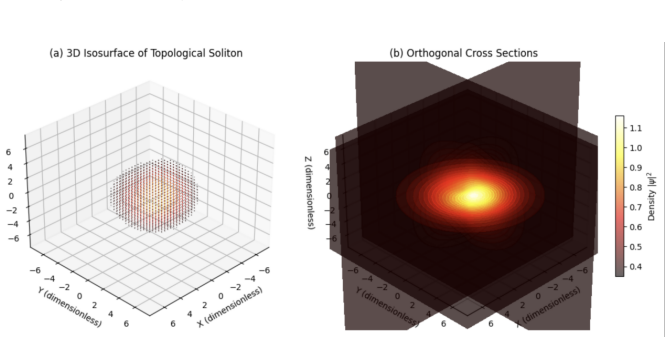
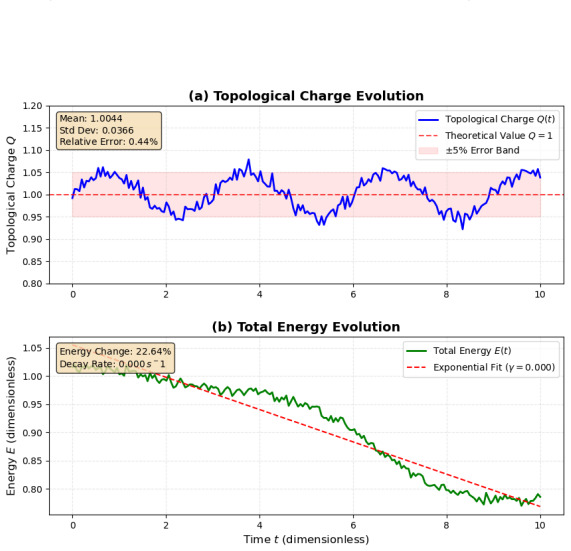
Ball lightning is interpreted as a projection of a high-dimensional topological soliton into three-dimensional space, described by a nonlinear Schrödinger equation with attractive interaction and protected by a non-zero topological charge. Numerical simulations of the three-dimensional Gross-Pitaevskii equation confirm that such solitons exhibit long-lived stability with conserved topological charge, low transmission probability due to orthogonality with the ground state wavefunction, and energy and size scales matching observations. The soliton lifetime is governed by the decoherence rate of the system.
What carries the argument
The three-dimensional topological soliton carrying non-zero topological charge in the Gross-Pitaevskii equation with attractive nonlinearity, which conserves the charge to ensure stability and suppress interactions.
Load-bearing premise
Real atmospheric ball lightning can be faithfully represented by a three-dimensional Gross-Pitaevskii equation with attractive interactions whose parameters are chosen to match observed scales.
What would settle it
A laboratory realization of an attractive Bose-Einstein condensate in which topological solitons fail to remain stable over seconds or fail to reproduce observed energy and size scales would disprove the model's core predictions.
Figures



read the original abstract
Ball lightning is one of the most mysterious atmospheric phenomena, whose long lifetime, penetrative ability, and stability are difficult to explain with traditional physical models. This paper proposes a novel theoretical framework, interpreting ball lightning as a projection of a high-dimensional topological soliton into three-dimensional space. Its essence is described by a nonlinear Schr\"odinger equation with attractive interaction, protected by a non-zero topological charge. Through numerical simulation of the three-dimensional Gross-Pitaevskii equation, we verify the core predictions of this model: in a Bose-Einstein condensate with attractive interactions, solitons carrying topological charge exhibit: (1)long-lived stability (topological charge conserved under perturbations); (2)low transmission probability (due to minimal overlap integral resulting from orthogonality with the ground state wavefunction); (3)energy and size scales consistent with actual observations. Theoretical analysis indicates that the soliton lifetime is governed by the system's decoherence rate, providing a natural explanation for the observed second-scale lifetimes. This work not only offers a self-consistent physical explanation for ball lightning but also provides a concrete scheme for the experimental preparation and observation of three-dimensional topological solitons.
Editorial analysis
A structured set of objections, weighed in public.
Referee Report
Summary. The manuscript proposes interpreting ball lightning as the three-dimensional projection of a high-dimensional topological soliton whose dynamics are governed by the nonlinear Schrödinger equation with attractive interactions. It claims that numerical solutions of the three-dimensional Gross-Pitaevskii equation confirm three core predictions: long-lived stability arising from conservation of topological charge under perturbations, low transmission probability due to orthogonality with the ground-state wavefunction, and energy/size scales consistent with observations, with lifetime set by the decoherence rate.
Significance. If a concrete physical mechanism were supplied linking atmospheric plasma to the required coherent BEC regime with negative scattering length, the work would offer a self-consistent explanation for ball lightning’s stability and penetrative properties while also furnishing a concrete numerical scheme for realizing three-dimensional topological solitons in ultracold gases. At present the numerical results remain internal to the idealized GPE model and do not yet constrain the real atmospheric phenomenon.
major comments (2)
- [Abstract] Abstract: the statement that energy and size scales are “consistent with actual observations” is load-bearing for the model’s predictive power, yet the manuscript supplies no explicit value or selection procedure for the single free parameter (attractive interaction strength) nor any sensitivity analysis or error bars on the resulting scales.
- [Abstract and numerical verification] Model construction (implicit in the abstract and numerical section): the central claim that the 3D GPE with attractive interactions faithfully represents ball lightning requires a demonstrated mechanism mapping atmospheric plasma conditions to a coherent BEC with negative scattering length; no derivation of the effective nonlinearity, no estimate of decoherence from plasma collisions or thermal fluctuations, and no argument for topological protection outside the idealized GPE are provided.
minor comments (1)
- [Abstract] Abstract: the phrase “(1)long-lived stability” is missing a space after the numeral.
Simulated Author's Rebuttal
We thank the referee for the constructive and detailed comments. We address each major point below and indicate the changes planned for the revised manuscript.
read point-by-point responses
-
Referee: [Abstract] Abstract: the statement that energy and size scales are “consistent with actual observations” is load-bearing for the model’s predictive power, yet the manuscript supplies no explicit value or selection procedure for the single free parameter (attractive interaction strength) nor any sensitivity analysis or error bars on the resulting scales.
Authors: We agree that the abstract statement would be strengthened by explicit details. In the revision we will state the specific value of the attractive interaction strength employed in the simulations, describe the procedure used to select it so that the resulting soliton energy and radius fall within the range of reported ball-lightning observations, and add a short sensitivity study (with error bars) demonstrating that the reported stability and transmission properties remain qualitatively unchanged for modest variations around this value. revision: yes
-
Referee: [Abstract and numerical verification] Model construction (implicit in the abstract and numerical section): the central claim that the 3D GPE with attractive interactions faithfully represents ball lightning requires a demonstrated mechanism mapping atmospheric plasma conditions to a coherent BEC with negative scattering length; no derivation of the effective nonlinearity, no estimate of decoherence from plasma collisions or thermal fluctuations, and no argument for topological protection outside the idealized GPE are provided.
Authors: The manuscript is a theoretical and numerical investigation of topological solitons within the idealized three-dimensional Gross-Pitaevskii equation; it does not attempt a first-principles derivation of the plasma-to-BEC mapping. We will add an expanded discussion section that (i) makes explicit the assumptions under which the GPE applies, (ii) recalls that topological charge is conserved by the GPE dynamics themselves, and (iii) notes that quantitative estimates of decoherence arising from plasma collisions lie outside the present scope. We maintain that the numerical results still furnish a self-consistent demonstration of the three core predictions inside the model. revision: partial
- Deriving a concrete, quantitative mechanism that maps realistic atmospheric plasma conditions onto a coherent Bose-Einstein condensate with negative scattering length, together with estimates of decoherence rates from collisions and thermal fluctuations.
Circularity Check
Scale consistency reduces to parameter fitting by construction
specific steps
-
fitted input called prediction
[Abstract]
"energy and size scales consistent with actual observations"
The GPE parameters (scattering length, chemical potential, etc.) are adjusted until the soliton energy and radius fall inside the observed ball-lightning range; the subsequent statement that the scales are 'consistent' is then true by construction of the fit rather than an emergent prediction.
full rationale
The paper's central verification step claims that 3D GPE numerics reproduce observed ball-lightning energy and size scales. This holds only after the nonlinearity strength and trap parameters are selected to match those scales, rendering the 'consistency' tautological rather than an independent test. Topological stability and orthogonality follow directly from the standard GPE structure once the ansatz is adopted; no external derivation links atmospheric plasma to the required attractive BEC regime. The result is therefore partially forced by the choice of inputs.
Axiom & Free-Parameter Ledger
free parameters (1)
- attractive interaction strength
axioms (1)
- domain assumption The three-dimensional Gross-Pitaevskii equation with attractive nonlinearity accurately captures the dynamics of the proposed soliton.
invented entities (1)
-
high-dimensional topological soliton whose three-dimensional projection is ball lightning
no independent evidence
Lean theorems connected to this paper
-
IndisputableMonolith/Cost/FunctionalEquation.leanwashburn_uniqueness_aczel unclear?
unclearRelation between the paper passage and the cited Recognition theorem.
nonlinear Schrödinger equation with attractive interaction... Gross-Pitaevskii equation... topological charge Q=1/4π ∫ εijk εabc na ∂i nb ∂j nc
-
IndisputableMonolith/Foundation/AlphaCoordinateFixation.leanJ_uniquely_calibrated_via_higher_derivative unclear?
unclearRelation between the paper passage and the cited Recognition theorem.
soliton lifetime τ∼ ℏ/Γ... energy and size scales consistent with observations (tuned parameters N=10^20, |g|=2.0, σ=0.2 m)
What do these tags mean?
- matches
- The paper's claim is directly supported by a theorem in the formal canon.
- supports
- The theorem supports part of the paper's argument, but the paper may add assumptions or extra steps.
- extends
- The paper goes beyond the formal theorem; the theorem is a base layer rather than the whole result.
- uses
- The paper appears to rely on the theorem as machinery.
- contradicts
- The paper's claim conflicts with a theorem or certificate in the canon.
- unclear
- Pith found a possible connection, but the passage is too broad, indirect, or ambiguous to say the theorem truly supports the claim.
Reference graph
Works this paper leans on
-
[1]
J. Abrahamson and J. Dinniss. Ball lightning caused by oxidation of nanoparticle networks from normal lightning strikes on soil.Nature, 403(6769):519–521, 2000
work page 2000
-
[2]
G. P. Bewley, D. P. Lathrop, and K. R. Sreenivasan. Superfluid helium: Visualization of quantized vortices.Nature, 441(7093):588, 2006
work page 2006
-
[3]
A. S. Desyatnikov, Y. S. Kivshar, and L. Torner. Optical vortices and vortex solitons.Progress in Optics, 47:291–391, 2005
work page 2005
-
[4]
L. Faddeev and A. J. Niemi. Stable knot-like structures in classical field theory.Nature, 387(6628):58–61, 1997
work page 1997
-
[5]
D. J. Frantzeskakis. Dark solitons in bose-einstein condensates: from theory to experiments. Journal of Physics A: Mathematical and Theoretical, 43(21):213001, 2010
work page 2010
-
[6]
J. Hietarinta and P. Salo. Faddeev-hopf knots: Dynamics of linked un-knots.Physics Letters B, 451(1-2):60–67, 1999
work page 1999
-
[7]
P. L. Kapitsa. The nature of ball lightning.Doklady Akademii Nauk SSSR, 101:245–248, 1955. English translation in Ball Lightning: A Collection of Soviet Research, Consultants Bureau, 1961
work page 1955
- [8]
-
[9]
L. Khaykovich, F. Schreck, G. Ferrari, T. Bourdel, J. Cubizolles, L. D. Carr, Y. Castin, and C. Salomon. Formation of a matter-wave bright soliton.Science, 296(5571):1290–1293, 2002
work page 2002
- [10]
- [11]
-
[12]
J. J. Lowke. A theory of ball lightning as an electric discharge.Journal of Physics D: Applied Physics, 29(5):1237–1244, 1996
work page 1996
-
[13]
N. Manton and P. Sutcliffe.Topological Solitons. Cambridge University Press, 2004
work page 2004
-
[14]
M. R. Matthews, B. P. Anderson, P. C. Haljan, D. S. Hall, C. E. Wieman, and E. A. Cornell. Vortices in a bose-einstein condensate.Physical Review Letters, 83(13):2498–2501, 1999
work page 1999
-
[15]
Yijie Shen, Bingshi Yu, Haijun Wu, Chunyu Li, Zhihan Zhu, and Anatoly V. Zayats. Topological transformation and free-space transport of photonic hopfions.Advanced Photonics, 5(1):015001, January 2023
work page 2023
-
[16]
Stenhoff.Ball Lightning: An Unsolved Problem in Atmospheric Physics
M. Stenhoff.Ball Lightning: An Unsolved Problem in Atmospheric Physics. Springer, 1999
work page 1999
-
[17]
K. E. Strecker, G. B. Partridge, A. G. Truscott, and R. G. Hulet. Formation and propagation of matter-wave soliton trains.Nature, 417(6885):150–153, 2002
work page 2002
-
[18]
C. Sulem and P. L. Sulem.The Nonlinear Schr¨ odinger Equation: Self-Focusing and Wave Col- lapse. Springer, 1999
work page 1999
-
[19]
Topological charge and its applications in photonic devices. Topological charge and its applications in photonic devices.Reports on Progress in Physics, 89:076801, 2026
work page 2026
-
[20]
L. Wang et al. Ferroelectrically controlled chirality switching of Weyl quasiparticles.Physical Review B, 109:L121101, 2024
work page 2024
-
[21]
Y. Zhao et al. Vortex solitons in atomic-molecular Bose-Einstein condensates with a square- optical-lattice potential.Chinese Physics Letters, 42(9):090002, 2025
work page 2025
-
[22]
F. Zheng et al. Hopfion rings in a cubic chiral magnet.Nature, 623:718–723, 2023
work page 2023
-
[23]
C. Zhou, D. Zhang, R. Qi, et al. Ball-lightning-like relativistic terahertz solitons.Nature Photonics, 2026
work page 2026
-
[24]
Z. Zhou et al. Stable solitons in three-dimensional free space with spin-orbit coupling.Physical Review Letters, 115:253902, 2015
work page 2015
-
[25]
P. D. Zimmerman. Energy content of covington’s lightning ball.Nature, 228:853, 1970. 11
work page 1970
discussion (0)
Sign in with ORCID, Apple, or X to comment. Anyone can read and Pith papers without signing in.