Recognition: no theorem link
Mixed-Criticality Flow Scheduling with Low Delay and Limited Bandwidth in TSN
Pith reviewed 2026-05-12 04:56 UTC · model grok-4.3
The pith
By aggregating frames with shared sources, destinations, and harmonic periods, a new TSN scheduler can accept more mixed-criticality flows while using less bandwidth.
A machine-rendered reading of the paper's core claim, the machinery that carries it, and where it could break.
Core claim
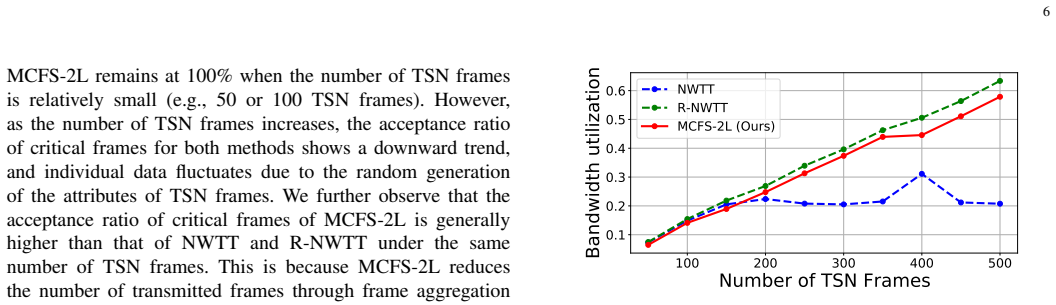
The central discovery is that aggregating critical and non-critical frames with identical source-destination pairs and harmonic periods, followed by dynamic reassembly that disaggregates only non-critical frames from unschedulable aggregates, allows the MCFS-2L scheme to increase acceptance ratios by up to 4.78 percent for critical flows and 8.58 percent for non-critical flows while cutting bandwidth utilization by up to 11.88 percent.
What carries the argument
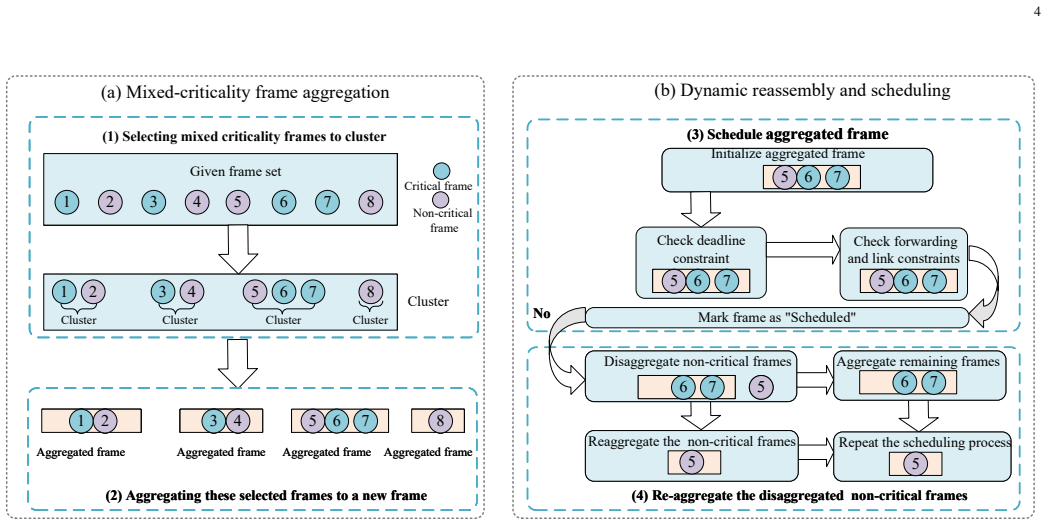
The MCFS-2L mixed-criticality flow scheduler, which aggregates frames sharing source, destination, and harmonic periods and then selectively disaggregates non-critical frames during scheduling to fit within dedicated TSN time windows.
If this is right
- More critical and non-critical flows can be accepted into the schedule without expanding the allocated bandwidth.
- Bandwidth utilization drops because fewer time windows are needed for the combined frames.
- The method preserves timing guarantees for critical flows while improving service for non-critical ones.
- Pre-allocated time windows in TSN are used more fully even when multiple flows compete for them.
Where Pith is reading between the lines
- This aggregation strategy could be tested in other deterministic Ethernet variants to see if similar gains appear.
- Hardware implementations would need to support low-overhead disaggregation to realize the full bandwidth savings in practice.
- Scaling the approach to networks with non-harmonic periods might require additional period adjustment techniques.
Load-bearing premise
Frames that share the same source, destination, and harmonic periods can be aggregated into one and later selectively disaggregated without breaking the timing rules for critical flows or creating too much extra work for the network hardware.
What would settle it
A simulation or testbed run that shows an aggregated frame, after selective disaggregation, still causes a critical flow to miss its deadline or uses more total bandwidth than the baseline methods.
Figures




read the original abstract
Time-Sensitive Networking (TSN) is a promising Ethernet protocol with time determinism, widely used in time-critical systems such as industrial automation, automotive networks, and avionics. By allocating dedicated time windows for time-sensitive flows, TSN enables deterministic transmission; however, as network traffic grows, multiple flows may contend for the same window, causing large delays. Frame aggregation can mitigate this by combining multiple small frames into a larger one, thereby reducing the number of frames and required time windows, but existing approaches typically handle only single-priority traffic and cannot fully utilize pre-allocated time windows. To address this limitation, we propose MCFS-2L, a mixed-criticality flow scheduling scheme with low delay and limited bandwidth usage. MCFS-2L first aggregates critical and non-critical frames with the same source and destination nodes and harmonic periods into a single frame, and then applies a dynamic reassembly and scheduling method that selectively disaggregates non-critical frames from unschedulable aggregated frames. Experimental results show that MCFS-2L increases the acceptance ratio of critical and non-critical flows by up to 4.78% and 8.58%, respectively, while reducing bandwidth utilization by up to 11.88%.
Editorial analysis
A structured set of objections, weighed in public.
Referee Report
Summary. The manuscript proposes MCFS-2L, a mixed-criticality scheduling scheme for TSN that first aggregates critical and non-critical frames sharing the same source/destination and harmonic periods into larger frames, then applies dynamic reassembly to selectively disaggregate only non-critical frames from any aggregated frame that cannot be scheduled. The central claims are that this yields acceptance-ratio gains of up to 4.78 % for critical flows and 8.58 % for non-critical flows while reducing bandwidth utilization by up to 11.88 %.
Significance. If the selective-disaggregation step can be shown to leave critical-flow transmission times and pre-allocated windows strictly unchanged, the technique would provide a pragmatic heuristic for improving window utilization in bandwidth-constrained TSN deployments that must accommodate both hard real-time and best-effort traffic. The reported numerical improvements, if reproducible, would be of practical interest to industrial-automation and automotive TSN designers.
major comments (2)
- [Abstract] Abstract: the quantitative claims (acceptance-ratio increases of 4.78 % / 8.58 % and bandwidth reduction of 11.88 %) are presented with no accompanying information on simulation parameters, traffic models, baseline algorithms, number of trials, or statistical tests. Without these details the central performance assertions cannot be evaluated.
- [MCFS-2L algorithm description] Description of the MCFS-2L algorithm: the selective disaggregation of non-critical frames from aggregated frames is asserted to preserve the timing guarantees and pre-allocated windows of every critical flow, yet no schedulability invariant, worst-case delay analysis, or hardware-level mechanism (e.g., on-the-fly GCL update) is supplied to establish that critical frames are never remapped or delayed. This assumption is load-bearing for both the acceptance-ratio and bandwidth-saving claims.
minor comments (1)
- [Abstract] The abstract introduces the phrase 'dynamic reassembly and scheduling method' without a concise high-level outline or pointer to the corresponding algorithm section or pseudocode.
Simulated Author's Rebuttal
We thank the referee for the constructive feedback on our manuscript. We address each major comment point-by-point below and indicate the revisions planned for the next version.
read point-by-point responses
-
Referee: [Abstract] Abstract: the quantitative claims (acceptance-ratio increases of 4.78 % / 8.58 % and bandwidth reduction of 11.88 %) are presented with no accompanying information on simulation parameters, traffic models, baseline algorithms, number of trials, or statistical tests. Without these details the central performance assertions cannot be evaluated.
Authors: We agree that the abstract would benefit from additional context. Due to typical length constraints, we summarize results concisely there while providing full details in the body. In the revision we will add one sentence to the abstract noting the use of harmonic-period traffic models, comparison to standard TSN scheduling without aggregation, and that results are averaged over 1000 random scenarios. Complete parameters, traffic generation, number of trials, and any statistical reporting already appear in Section 5. revision: yes
-
Referee: [MCFS-2L algorithm description] Description of the MCFS-2L algorithm: the selective disaggregation of non-critical frames from aggregated frames is asserted to preserve the timing guarantees and pre-allocated windows of every critical flow, yet no schedulability invariant, worst-case delay analysis, or hardware-level mechanism (e.g., on-the-fly GCL update) is supplied to establish that critical frames are never remapped or delayed. This assumption is load-bearing for both the acceptance-ratio and bandwidth-saving claims.
Authors: We acknowledge the need for an explicit argument. MCFS-2L aggregates only frames with identical source/destination and harmonic periods; selective disaggregation then removes solely non-critical frames from any unschedulable aggregate, leaving each critical frame's size, period, and pre-allocated window unchanged. Because critical frames are never split or remapped, their timing guarantees hold by construction. In the revised manuscript we will add a short schedulability invariant and worst-case argument in Section 4 establishing that critical-flow windows remain fixed. No runtime GCL update is required, as all critical scheduling decisions are made offline. revision: yes
Circularity Check
No circularity: procedural algorithm with independent experimental validation
full rationale
The paper describes MCFS-2L as a scheduling algorithm that aggregates frames sharing src/dst and harmonic periods then selectively disaggregates non-critical portions from unschedulable aggregates. No equations, derivations, or fitted parameters appear in the provided text that would reduce the reported acceptance-ratio gains (4.78%/8.58%) or bandwidth reduction (11.88%) to self-referential definitions, self-citations, or inputs-by-construction. Performance numbers are presented solely as outcomes of simulation experiments, not as premises that justify the algorithm itself. The central claims therefore remain independent of the patterns that trigger circularity scores above 0.
Axiom & Free-Parameter Ledger
axioms (2)
- domain assumption Frames sharing source, destination, and harmonic periods can be aggregated into a single frame without violating individual timing constraints.
- domain assumption Dynamic reassembly can selectively remove non-critical frames from an unschedulable aggregate while preserving schedulability of the remaining critical frames.
Reference graph
Works this paper leans on
-
[1]
refinedTS: Refined time synchronization for cross-domain CAN-TSN communication,
D. Wei, B. Fu, Z. Wang, X. Yu, Y . Lei, H. Zheng, X. Liu, and G. Xie, “refinedTS: Refined time synchronization for cross-domain CAN-TSN communication,”IEEE Transactions on Networking, vol. 34, no. 1, pp. 2998–4157, 2025
work page 2025
-
[2]
802.1Qbv-Enhancements for Scheduled Traffic,
IEEE 802.1Qbv-2015, “802.1Qbv-Enhancements for Scheduled Traffic,” https://www.ieee802.org/1/pages/802.1bu.html, 2016. 7
work page 2015
-
[3]
A survey and experimental study of real-time scheduling methods for 802.1 Qbv TSN networks,
C. Xue, T. Zhang, Y . Zhou, M. Nixon, A. Loveless, and S. Han, “A survey and experimental study of real-time scheduling methods for 802.1 Qbv TSN networks,”ACM Computing Surveys, vol. 58, no. 2, pp. 1–37, 2025
work page 2025
-
[4]
Fastscheduler: Polynomial-time scheduling for time-triggered flows in TSN,
C. Long, H. Zhang, Z. Wang, Y . Zheng, and Z. Li, “Fastscheduler: Polynomial-time scheduling for time-triggered flows in TSN,”IEEE Transactions on Network and Service Management, vol. 22, no. 6, pp. 5675 – 5689, 2025
work page 2025
-
[5]
Making the case for centralized automotive E/E architectures,
V . Bandur, G. Selim, V . Pantelic, and M. Lawford, “Making the case for centralized automotive E/E architectures,”IEEE Transactions on V ehicular Technology, vol. 70, no. 2, pp. 1230–1245, 2021
work page 2021
-
[6]
Pfv2: Packet fragmentation with variable size and vigorous mapping in time-sensitive networking,
W. Yan, B. Fu, D. Wei, R. Li, Y . Lei, Y . Jia, and G. Xie, “Pfv2: Packet fragmentation with variable size and vigorous mapping in time-sensitive networking,”Journal of Systems Architecture, vol. 166, p. 103457, 2025
work page 2025
-
[7]
Recent advances and trends in on-board embedded and networked automotive systems,
L. L. Bello, R. Mariani, S. Mubeen, and S. Saponara, “Recent advances and trends in on-board embedded and networked automotive systems,” IEEE Transactions on Industrial Informatics, vol. 15, no. 2, pp. 1038– 1051, 2018
work page 2018
-
[8]
A high-flexibility CAN- TSN gateway with a low-congestion TSN-to-CAN scheduler,
G. Xie, Y . Zhang, N. Chen, and W. Chang, “A high-flexibility CAN- TSN gateway with a low-congestion TSN-to-CAN scheduler,”IEEE Transactions on Computer-Aided Design of Integrated Circuits and Systems, vol. 42, no. 12, pp. 5072–5083, 2023
work page 2023
-
[9]
Real-time analysis and message priority assignment for TSN-CAN gateway,
W. Wu, H. Huang, W. Li, R. Liu, Y . Xie, and S. Long, “Real-time analysis and message priority assignment for TSN-CAN gateway,”IEEE Transactions on Intelligent Transportation Systems, 2024
work page 2024
-
[10]
A conflict-free can- to-tsn scheduler for can-tsn gateway,
W. Yan, B. Fu, J. Huang, R. Lu, R. Li, and G. Xie, “A conflict-free can- to-tsn scheduler for can-tsn gateway,”Journal of Systems Architecture, p. 103188, 2024
work page 2024
-
[11]
IEEE 802.1Qbu-2016, “802.1Qbu-Frame Preemption,” https://www.ieee 802.org/1/pages/802.1bu.html, 2016
work page 2016
-
[12]
Reliability-aware scheduling and routing for messages in time-sensitive networking,
Y . Zhou, S. Samii, P. Eles, and Z. Peng, “Reliability-aware scheduling and routing for messages in time-sensitive networking,”ACM Transac- tions on Embedded Computing Systems, vol. 20, no. 5, pp. 1–24, 2021
work page 2021
-
[13]
No-wait packet scheduling for IEEE time- sensitive networks (TSN),
F. D ¨urr and N. G. Nayak, “No-wait packet scheduling for IEEE time- sensitive networks (TSN),” inProceedings of the 24th International Conference on Real-Time Networks and Systems, 2016, pp. 203–212
work page 2016
-
[14]
Rethinking the use of network cycle in time- sensitive networking (TSN) flow scheduling,
J. Lin, W. Li, X. Feng, S. Zhan, J. Feng, J. Cheng, T. Wang, Q. Li, Y . Wang, F. Liet al., “Rethinking the use of network cycle in time- sensitive networking (TSN) flow scheduling,” in2022 IEEE/ACM 30th International Symposium on Quality of Service (IWQoS). IEEE, 2022, pp. 1–11
work page 2022
-
[15]
User- centric immersive communications in 6G: A data-oriented framework via digital twin,
C. Zhou, S. Hu, J. Gao, X. Huang, W. Zhuang, and X. Shen, “User- centric immersive communications in 6G: A data-oriented framework via digital twin,”IEEE Wireless Communications, vol. 32, no. 3, pp. 122–129, 2025
work page 2025
discussion (0)
Sign in with ORCID, Apple, or X to comment. Anyone can read and Pith papers without signing in.