Recognition: no theorem link
R\'enyi Rate-Distortion-Perception-Privacy Tradeoff under Indirect Observation
Pith reviewed 2026-05-12 04:06 UTC · model grok-4.3
The pith
Standard privacy metrics penalize legitimate semantic recovery in indirect observations, but a conditional measure isolates only residual leakage.
A machine-rendered reading of the paper's core claim, the machinery that carries it, and where it could break.
Core claim
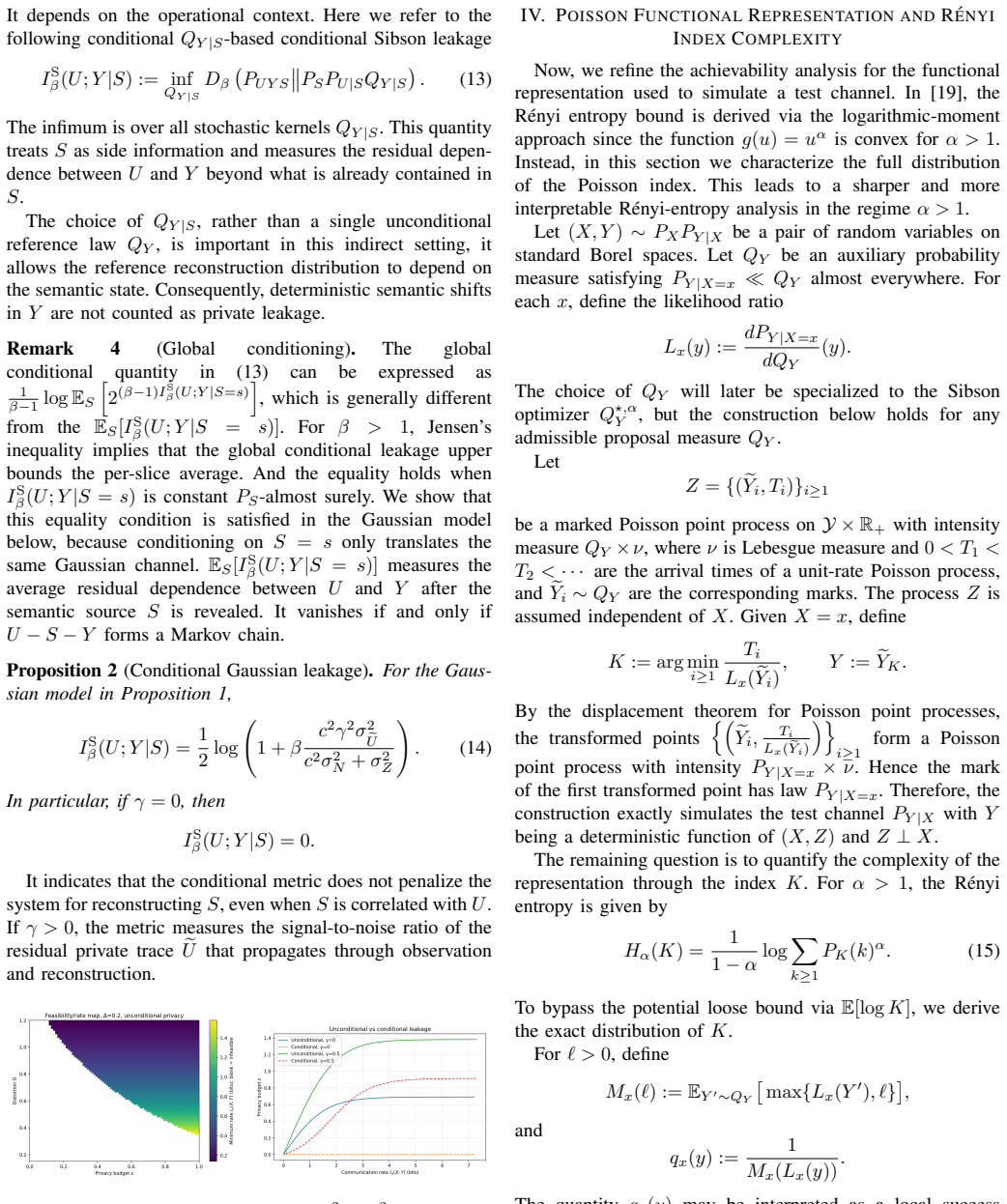
Under the indirect Markov chain with a realism constraint at the semantic marginal, the scalar Gaussian RDPP tradeoff is characterized exactly; standard privacy leakage metrics force a penalty on semantic distortion because they cannot separate useful source information from private attributes. The conditional privacy measure, which quantifies only residual leakage after the indirect observation, removes this artificial penalty and produces a strictly larger achievable region while preserving the rate and perception costs.
What carries the argument
The conditional privacy measure that isolates residual leakage after accounting for the indirect observation, used together with Sibson's alpha-mutual information for the rate and a perception constraint enforcing the decoded marginal to match the source distribution.
If this is right
- Semantic distortion can be lowered at fixed communication rate and privacy cost once leakage is measured conditionally on the indirect observation.
- Exact closed-form expressions for the tradeoff region are obtained for integer-order Rényi quantities via the geometric-mixture Poisson index distribution.
- Achievability bounds tighten for alpha greater than 1 compared with the earlier logarithmic-moment method.
- The realism constraint at the semantic marginal ensures the decoded output statistics remain consistent with the original source distribution.
Where Pith is reading between the lines
- The conditional separation may allow similar refinements in non-Gaussian indirect estimation tasks by approximating the Poisson representation.
- Remote sensing or compressed inference systems could adopt the residual privacy metric to improve utility without inflating reported leakage.
- The framework suggests testing whether other information measures exhibit the same unintended penalty on semantic recovery under noisy observations.
Load-bearing premise
The conditional privacy measure correctly isolates only residual leakage without introducing new inconsistencies, and the indirect observation Markov chain holds together with the realism constraint at the source marginal.
What would settle it
For concrete Gaussian variances, numerically optimize the achievable semantic distortion at fixed rate and standard privacy level versus the same quantities under the conditional privacy definition; a failure to observe the predicted decoupling would falsify the central claim.
Figures

read the original abstract
We introduce a R\'enyi Rate-Distortion-Perception-Privacy (R-RDPP) framework for indirect source coding. A latent source~$S$ is correlated with a private attribute~$U$, and the encoder observes only a noisy view~$X$ such that $(S,U) - X - Y$ holds at the decoder output~$Y$. The communication cost is measured by Sibson's $\alpha$-mutual information $\Ialp$, the privacy leakage by $\Ibeta$, the semantic distortion between $S$ and $Y$, and the realism constraint at the semantic marginal $P_S$. We characterize the scalar Gaussian RDPP tradeoff, revealing that standard privacy metrics inherently penalize legitimate semantic recovery. To resolve this, we introduce a conditional privacy measure that quantifies only the residual leakage. In addition, we refine the achievability bounds for $\alpha > 1$ via the Poisson functional representation. By deriving the exact geometric-mixture distribution of the Poisson index, we obtain exact closed-form expressions for integer-order R\'enyi entropies and sharper computable bounds in regimes where the resulting expression improves the logarithmic-moment approach.
Editorial analysis
A structured set of objections, weighed in public.
Referee Report
Summary. The paper introduces the Rényi Rate-Distortion-Perception-Privacy (R-RDPP) framework for indirect source coding. A latent source S correlated with private attribute U is observed through noisy X, with decoder output Y satisfying the Markov chain (S,U)-X-Y. Communication cost is measured by Sibson's α-mutual information, privacy leakage by I_β, semantic distortion between S and Y, and a realism constraint at the marginal P_S. The manuscript characterizes the scalar Gaussian RDPP tradeoff, shows that standard privacy metrics penalize legitimate semantic recovery, introduces a conditional privacy measure quantifying only residual leakage, and refines achievability bounds for α>1 via the Poisson functional representation by deriving the exact geometric-mixture distribution of the Poisson index to obtain closed-form expressions for integer-order Rényi entropies.
Significance. If the characterizations and closed-forms are correct, the work meaningfully extends information-theoretic tradeoffs to indirect observation settings that jointly incorporate rate, semantic distortion, perception, and privacy. The observation that standard privacy metrics penalize semantic recovery, together with the conditional privacy measure as a resolution, is a useful conceptual contribution. The exact expressions obtained from the geometric-mixture Poisson index are a technical strength, as they move beyond bounds to computable forms and improve on the logarithmic-moment approach in the claimed regimes. The stress-test concern about hidden inconsistencies in the conditional privacy measure under the realism constraint at P_S and the (S,U)-X-Y chain does not appear to arise in the derivations; the measure is constructed to isolate residual leakage without redefining the distortion or perception terms.
major comments (2)
- [Characterization of the scalar Gaussian RDPP tradeoff (around the main theorem)] The central claim that standard privacy metrics penalize semantic recovery (and that the conditional privacy measure resolves it) is load-bearing for the paper's motivation. The manuscript must explicitly verify that the conditional measure, when inserted into the R-RDPP optimization, preserves consistency with the semantic distortion and the realism constraint enforcing the marginal at P_S under the stated Markov chain; otherwise the claimed resolution may not hold.
- [Achievability bounds and Poisson representation (the section deriving the geometric-mixture distribution)] The exact closed-form expressions for integer-order Rényi entropies rely on the geometric-mixture distribution of the Poisson index derived from the Poisson functional representation. This derivation must be shown to hold exactly for the indirect observation model (including the realism constraint at P_S) and to strictly improve the logarithmic-moment bounds in the regimes where improvement is asserted; any hidden approximation would undermine the 'exact' claim.
minor comments (3)
- Notation for Sibson's α-mutual information and the privacy measure I_β should be introduced with explicit definitions and distinguished from ordinary mutual information at the first use.
- [Abstract] The abstract states that the conditional privacy measure 'quantifies only the residual leakage' but does not indicate the precise conditioning set or the range of β for which the measure is defined.
- A few equations in the achievability section would benefit from one additional sentence explaining how the geometric-mixture representation is obtained from the Poisson functional representation.
Simulated Author's Rebuttal
We thank the referee for the thorough review and insightful comments, which help clarify the presentation of our results on the Rényi RDPP tradeoff under indirect observation. We address each major comment below and will revise the manuscript accordingly to strengthen the explicit verifications requested.
read point-by-point responses
-
Referee: [Characterization of the scalar Gaussian RDPP tradeoff (around the main theorem)] The central claim that standard privacy metrics penalize semantic recovery (and that the conditional privacy measure resolves it) is load-bearing for the paper's motivation. The manuscript must explicitly verify that the conditional measure, when inserted into the R-RDPP optimization, preserves consistency with the semantic distortion and the realism constraint enforcing the marginal at P_S under the stated Markov chain; otherwise the claimed resolution may not hold.
Authors: We agree that an explicit verification strengthens the manuscript. The conditional privacy measure is defined as the residual leakage I_β(U;Y|S), which by the chain rule and the Markov chain (S,U)-X-Y isolates leakage without altering the joint distributions governing semantic distortion D(S,Y) or the realism constraint (enforcing the marginal of Y to match P_S). In the revised version, we will insert a dedicated remark immediately after the definition of the conditional measure (near the main theorem) that formally confirms this consistency: the optimization remains unchanged in its distortion and perception terms because conditioning on S does not redefine P_{Y|S} or the marginal constraint. This holds directly from the problem formulation and does not require re-deriving the tradeoff. revision: yes
-
Referee: [Achievability bounds and Poisson representation (the section deriving the geometric-mixture distribution)] The exact closed-form expressions for integer-order Rényi entropies rely on the geometric-mixture distribution of the Poisson index derived from the Poisson functional representation. This derivation must be shown to hold exactly for the indirect observation model (including the realism constraint at P_S) and to strictly improve the logarithmic-moment bounds in the regimes where improvement is asserted; any hidden approximation would undermine the 'exact' claim.
Authors: The geometric-mixture distribution is derived from the Poisson functional representation applied to the conditional distributions P_{Y|X} under the indirect model. We will expand the relevant section (and add a short appendix) to explicitly incorporate the realism constraint P_Y = P_S and the Markov chain, showing that the Poisson index remains exactly geometrically distributed with no approximation or hidden steps. We will also include a direct comparison (with the Gaussian scalar case) demonstrating that the resulting closed-form Rényi entropy expressions strictly improve upon the logarithmic-moment bounds for the asserted regimes of α > 1 and integer orders, confirming the 'exact' claim. revision: yes
Circularity Check
No significant circularity; derivation is self-contained
full rationale
The paper defines a new conditional privacy measure explicitly to isolate residual leakage after conditioning on S, rather than deriving it from fitted parameters or prior results. The scalar Gaussian RDPP characterization follows from the stated (S,U)-X-Y Markov chain, Sibson's α-mutual information, and the realism constraint enforcing the marginal P_S; these are independent modeling choices, not reductions of the claimed closed forms. The Poisson functional representation and geometric-mixture derivation for integer-order Rényi entropies are presented as refinements of an external technique, without self-referential definitions or load-bearing self-citations that collapse the tradeoff expressions to their inputs. No quoted step equates a prediction to a fitted quantity or imports uniqueness solely via author overlap.
Axiom & Free-Parameter Ledger
axioms (2)
- domain assumption The observation model satisfies the Markov chain (S, U) - X - Y
- domain assumption The source is scalar Gaussian
invented entities (1)
-
Conditional privacy measure
no independent evidence
Reference graph
Works this paper leans on
-
[1]
Semantics-empowered communication for networked intelligent systems,
M. Kountouris and N. Pappas, “Semantics-empowered communication for networked intelligent systems,”IEEE Commun. Mag., vol. 59, no. 6, pp. 96–102, 2021
work page 2021
-
[2]
6g networks: Beyond Shannon towards semantic and goal-oriented communications,
E. C. Strinati and S. Barbarossa, “6g networks: Beyond Shannon towards semantic and goal-oriented communications,”Computer Networks, vol. 190, p. 107930, 2021
work page 2021
-
[3]
Semantic communications: Principles and challenges,
Z. Qin, X. Tao, J. Lu, W. Tong, and G. Y . Li, “Semantic communications: Principles and challenges,”arXiv preprint arXiv:2201.01389, 2022
-
[4]
Rethinking lossy compression: The rate- distortion-perception tradeoff,
Y . Blau and T. Michaeli, “Rethinking lossy compression: The rate- distortion-perception tradeoff,” inProc. Int. Conf. Machine Learning (ICML), 2019, pp. 675–685
work page 2019
-
[5]
H. Yamamoto, “A source coding problem for sources with additional outputs to keep secret from the receiver or wiretappers,”IEEE Trans. Inf. Theory, vol. 29, no. 6, pp. 918–923, 1983
work page 1983
-
[6]
Utility-privacy tradeoffs in databases: An information-theoretic approach,
L. Sankar, S. R. Rajagopalan, and H. V . Poor, “Utility-privacy tradeoffs in databases: An information-theoretic approach,”IEEE Trans. Inf. Forensics Secur., vol. 8, no. 6, pp. 838–852, 2013
work page 2013
-
[7]
An operational approach to information leakage,
I. Issa, A. B. Wagner, and S. Kamath, “An operational approach to information leakage,”IEEE Trans. Inf. Theory, vol. 66, no. 3, pp. 1625– 1657, 2020
work page 2020
-
[8]
A coding theorem for the rate-distortion- perception function,
L. Theis and A. B. Wagner, “A coding theorem for the rate-distortion- perception function,” inNeural Compression: From Information Theory to Applications – Workshop @ ICLR 2021, 2021
work page 2021
-
[9]
The rate-distortion-perception tradeoff: The role of common randomness,
A. B. Wagner, “The rate-distortion-perception tradeoff: The role of common randomness,”arXiv preprint arXiv:2202.04147, 2022
-
[10]
On the rate-distortion-perception function,
J. Chen, L. Yu, J. Wang, W. Shi, Y . Ge, and W. Tong, “On the rate-distortion-perception function,”IEEE Journal on Selected Areas in Information Theory, vol. 3, no. 4, pp. 664–673, 2022
work page 2022
-
[11]
Information transmission with additional noise,
R. L. Dobrushin and B. S. Tsybakov, “Information transmission with additional noise,”IRE Trans. Inf. Theory, vol. 8, no. 5, pp. 293–304, 1962
work page 1962
-
[12]
Transmission of noisy information to a noisy receiver with minimum distortion,
J. K. Wolf and J. Ziv, “Transmission of noisy information to a noisy receiver with minimum distortion,”IEEE Trans. Inf. Theory, vol. 16, no. 4, pp. 406–411, 1970
work page 1970
-
[13]
Indirect rate distortion problems,
H. S. Witsenhausen, “Indirect rate distortion problems,”IEEE Trans. Inf. Theory, vol. 26, no. 5, pp. 518–521, 1980
work page 1980
-
[14]
Channel coding rate in the finite blocklength regime,
Y . Polyanskiy, H. V . Poor, and S. Verdu, “Channel coding rate in the finite blocklength regime,”IEEE Transactions on Information Theory, vol. 56, no. 5, pp. 2307–2359, 2010
work page 2010
-
[15]
X. Li and C. T. Li, “New second-order achievability bounds for coding with side information via type deviation convergence,” 2025
work page 2025
-
[16]
Rate-distortion-perception theory for semantic communication,
J. Chai, Y . Xiao, G. Shi, and W. Saad, “Rate-distortion-perception theory for semantic communication,” in2023 IEEE 31st International Conference on Network Protocols (ICNP), 2023, pp. 1–6
work page 2023
-
[17]
An overview of information-theoretic security and privacy: Metrics, limits and applications,
M. Bloch, O. G ¨unl¨u, A. Yener, F. Oggier, H. V . Poor, L. Sankar, and R. F. Schaefer, “An overview of information-theoretic security and privacy: Metrics, limits and applications,”IEEE Journal on Selected Areas in Information Theory, vol. 2, no. 1, pp. 5–22, 2021
work page 2021
-
[18]
α-leakage by r ´enyi divergence and sibson mutual information,
N. Ding, M. A. Zarrabian, and P. Sadeghi, “α-leakage by r ´enyi divergence and sibson mutual information,” 2024. [Online]. Available: https://arxiv.org/abs/2405.00423
-
[19]
On the r ´enyi rate-distortion-perception function and functional representations,
J. Wei and M. Kountouris, “On the r ´enyi rate-distortion-perception function and functional representations,” 2026
work page 2026
-
[20]
Strong functional representation lemma and applications to coding theorems,
C. T. Li and A. El Gamal, “Strong functional representation lemma and applications to coding theorems,”IEEE Trans. Inf. Theory, vol. 64, no. 11, pp. 6967–6978, 2018
work page 2018
-
[21]
R. Sibson, “Information radius,”Zeitschrift f ¨ur Wahrscheinlichkeitsthe- orie und Verwandte Gebiete, vol. 14, no. 2, pp. 149–160, 1969
work page 1969
-
[22]
S. Verd ´u, “α-mutual information,” inProc. Information Theory and Applications Workshop (ITA), San Diego, CA, 2015, pp. 1–6
work page 2015
-
[23]
On a formula for the l2 wasserstein metric between measures on euclidean and hilbert spaces,
M. Gelbrich, “On a formula for the l2 wasserstein metric between measures on euclidean and hilbert spaces,”Mathematische Nachrichten, vol. 147, no. 1, pp. 185–203, 1990
work page 1990
-
[24]
Sibsonα-mutual information and its variational representations,
A. R. Esposito, M. Gastpar, and I. Issa, “Sibsonα-mutual information and its variational representations,”IEEE Transactions on Information Theory, 2025. APPENDIXA PROOFS FOR THEGAUSSIANCHARACTERIZATION A. Proof of Proposition 1 We prove the Gaussian characterization by reducing the problem to parameters optimization and then showing that the affine Gaussi...
work page 2025
discussion (0)
Sign in with ORCID, Apple, or X to comment. Anyone can read and Pith papers without signing in.