Recognition: 2 theorem links
· Lean TheoremFair Allocation under Conflict Constraints
Pith reviewed 2026-05-12 04:17 UTC · model grok-4.3
The pith
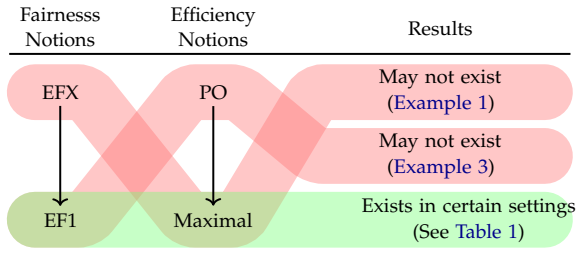
For any conflict graph, two agents with monotone valuations always admit a maximal EF1 allocation.
A machine-rendered reading of the paper's core claim, the machinery that carries it, and where it could break.
Core claim
For two agents with monotone valuations, a maximal EF1 allocation always exists on any graph. The existence proof relies on a color-switching technique, which locally modifies a maximal allocation while preserving feasibility and restoring EF1. Such allocations can be computed in pseudopolynomial time in general, and in polynomial time for additive valuations on arbitrary graphs as well as monotone valuations on interval and bipartite graphs. For three or more agents, an EF1 and maximal allocation fails to exist even under identical monotone valuations, and deciding existence is NP-hard. Under identical non-monotone additive valuations on a path graph, an EF[1,1] and maximal allocation is gu
What carries the argument
color-switching technique that locally modifies a maximal allocation to restore EF1 while preserving feasibility
If this is right
- For two agents with monotone valuations a maximal EF1 allocation can always be produced no matter what the underlying conflict graph is.
- Such allocations are computable in polynomial time when valuations are additive or the graph is an interval graph or bipartite graph.
- For three agents with identical monotone valuations no EF1 maximal allocation is guaranteed to exist.
- Deciding whether an EF1 and maximal allocation exists is NP-hard in general.
- On path graphs with identical non-monotone additive valuations an EF[1,1] and maximal allocation is always guaranteed.
Where Pith is reading between the lines
- The color-switching repair might be adaptable to other fairness criteria such as proportionality or to graphs with additional structure.
- Real-world scheduling problems with resource conflicts could directly use the two-agent existence result as a starting point for algorithmic implementations.
- The hardness results for three or more agents indicate that practical systems may need to relax maximality or fairness when the number of participants grows.
- The application of the cycle-plus-triangles theorem on paths suggests similar graph-theoretic tools could resolve existence questions on other restricted graph families.
Load-bearing premise
Valuations are monotone so that adding an item never decreases an agent's value.
What would settle it
A concrete graph together with two agents having monotone valuations where every maximal allocation leaves at least one agent envious even after removing one item.
Figures



read the original abstract
We study the fair allocation of indivisible items subject to conflict constraints. In this framework, the items are represented as the vertices of a graph, with edges corresponding to conflicts between pairs of items. Each agent is assigned an independent set of items from the graph. Our goal is to achieve a fair and efficient allocation of these items. Fairness pertains to satisfying envy-freeness up to one item (EF1), while efficiency is defined by maximality, meaning that no unallocated item can be feasibly assigned to any agent. First, we explore the case of two agents. For monotone valuations, we show that a maximal EF1 allocation always exists on any graph. Our existence proof relies on a color-switching technique, which locally modifies a maximal allocation while preserving feasibility and restoring EF1. We further show that such allocations can be computed in pseudopolynomial time in general, and in polynomial time for additive valuations on arbitrary graphs, as well as for monotone valuations on interval and bipartite graphs. By contrast, once monotonicity is dropped, maximal EF1 allocations need not exist even for identical additive valuations, and deciding existence becomes NP-hard. Next, we consider the case with a general number of agents. Again, we arrive at a negative result: An EF1 and maximal allocation fails to exist even for three agents under identical monotone valuations, and determining the existence of such an allocation is NP-hard. On the positive side, we show that under identical non-monotone additive valuations on a path graph, an EF[1,1] and maximal allocation always exists. This result involves a novel application of the "cycle plus triangles" theorem.
Editorial analysis
A structured set of objections, weighed in public.
Referee Report
Summary. The paper studies fair allocation of indivisible items under conflict constraints, modeled as a graph where each agent receives an independent set. For two agents with monotone valuations, it proves existence of a maximal EF1 allocation on arbitrary graphs via a color-switching technique that locally modifies allocations while preserving feasibility and EF1. It gives pseudopolynomial-time algorithms in general and polynomial-time algorithms for additive valuations on arbitrary graphs and monotone valuations on interval and bipartite graphs. Without monotonicity, maximal EF1 allocations need not exist (even for identical additive valuations) and existence is NP-hard. For multiple agents, EF1 + maximal allocations fail to exist even for three agents with identical monotone valuations, and existence is NP-hard; however, EF[1,1] + maximal allocations exist for identical non-monotone additive valuations on path graphs, via a novel application of the cycle-triangle theorem.
Significance. If the proofs hold, the work meaningfully extends fair division to graph-constrained settings by characterizing when maximality and (approximate) envy-freeness can coexist. The color-switching argument, the explicit non-existence constructions, the complexity results, and the application of the cycle-triangle theorem are all strengths that could influence follow-up work on constrained fair allocation. The computational results for restricted graph classes are practically relevant.
major comments (2)
- [§3] §3 (two-agent monotone case): the color-switching procedure is claimed to terminate by strictly decreasing total envy while preserving maximality and independent-set feasibility; the case analysis on the envy graph must explicitly verify that monotonicity prevents new envy violations or maximality breaches in every configuration, including when the switch affects multiple agents' bundles.
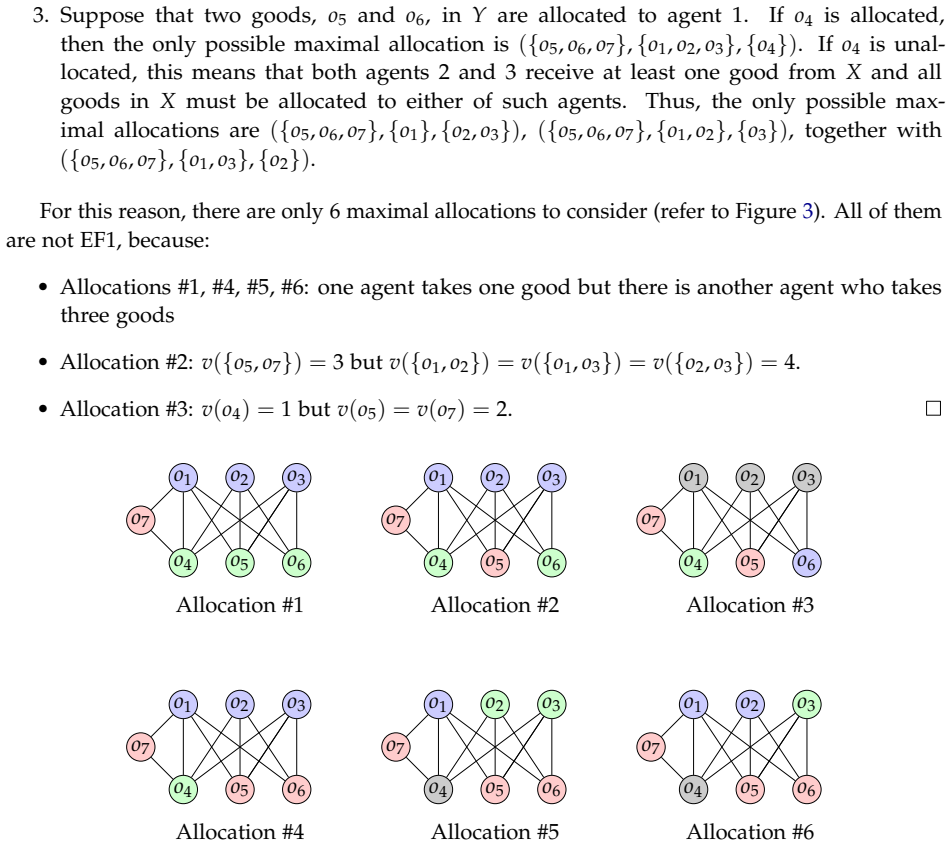
- [§5] §5 (multi-agent negative result): the non-existence claim for three agents with identical monotone valuations is witnessed by an explicit construction; the construction must be checked to ensure the conflict graph forces the independent-set constraint to interact with the valuation in a way that blocks all maximal EF1 allocations.
minor comments (2)
- The precise definition of EF[1,1] (as opposed to EF1) should be stated formally in the introduction or preliminaries, with a brief comparison to standard EF1.
- The pseudopolynomial-time algorithm for general monotone valuations (mentioned in the abstract) would benefit from a high-level pseudocode or complexity breakdown in the main text rather than only in the appendix.
Simulated Author's Rebuttal
We thank the referee for their positive evaluation and insightful comments, which help clarify the presentation of our results. We address each major comment below and will incorporate the suggested clarifications in the revised manuscript.
read point-by-point responses
-
Referee: [§3] §3 (two-agent monotone case): the color-switching procedure is claimed to terminate by strictly decreasing total envy while preserving maximality and independent-set feasibility; the case analysis on the envy graph must explicitly verify that monotonicity prevents new envy violations or maximality breaches in every configuration, including when the switch affects multiple agents' bundles.
Authors: We agree that the termination argument benefits from a more exhaustive case analysis. In the revision, we will expand the proof of the color-switching procedure in §3 to enumerate all relevant envy-graph configurations for two agents. For each configuration, we will explicitly show that monotonicity ensures the switch strictly decreases total envy, preserves EF1 (no new violations are introduced), and maintains both maximality and independent-set feasibility. This includes the cases where the switch modifies bundles of both agents simultaneously, with direct verification that no new conflicts arise under the graph constraints. revision: yes
-
Referee: [§5] §5 (multi-agent negative result): the non-existence claim for three agents with identical monotone valuations is witnessed by an explicit construction; the construction must be checked to ensure the conflict graph forces the independent-set constraint to interact with the valuation in a way that blocks all maximal EF1 allocations.
Authors: The explicit construction in §5 is designed precisely so that the conflict graph restricts feasible independent sets in a way that interacts with the identical monotone valuations to eliminate all maximal EF1 allocations. In the revised manuscript, we will add a detailed walkthrough of the construction, enumerating the possible maximal allocations and showing in each case how the graph-induced constraints force an EF1 violation. This makes the interaction between the graph and valuations fully explicit. revision: yes
Circularity Check
No significant circularity; proofs rely on independent graph-theoretic arguments
full rationale
The paper's core results are existence proofs for maximal EF1 allocations (via color-switching on the conflict graph and a decreasing potential function on total envy) and NP-hardness/non-existence via explicit counterexamples and reductions. These steps are self-contained algorithmic constructions and standard complexity arguments that do not reduce to fitted parameters, self-definitional equivalences, or load-bearing self-citations. Monotonicity is an explicit assumption used in case analysis, not smuggled in; the cycle-plus-triangles theorem is an external graph-theoretic fact. The derivation chain stands independently of its inputs.
Axiom & Free-Parameter Ledger
axioms (2)
- domain assumption Valuations are monotone for the two-agent existence theorem
- standard math Cycle-plus-triangles theorem holds for the path-graph positive result
Lean theorems connected to this paper
-
IndisputableMonolith/Foundation/AlexanderDuality.leanalexander_duality_circle_linking unclearOur existence proof relies on a color-switching technique, which locally modifies a maximal allocation while preserving feasibility and restoring EF1.
-
IndisputableMonolith/Cost/FunctionalEquation.leanwashburn_uniqueness_aczel unclearthe valuations are monotone (adding an item never decreases value)
Reference graph
Works this paper leans on
-
[1]
Richard M. Karp , editor =. Proceedings of a Symposium on the Complexity of Computer Computations , series =
-
[2]
Li, Bo and Li, Minming and Zhang, Ruilong , journal=
-
[3]
ACM Transactions on Economics and Computation , volume=
Caragiannis, Ioannis and Kurokawa, David and Moulin, Herv. ACM Transactions on Economics and Computation , volume=
-
[4]
Varian, Hal R , journal=
-
[5]
Budish, Eric , journal=
-
[6]
Brams, Steven J and Taylor, Alan D , year=
- [7]
-
[8]
Barman, Siddharth and Krishnamurthy, Sanath Kumar and Vaish, Rohit , booktitle=
-
[9]
Lipton, Richard J and Markakis, Evangelos and Mossel, Elchanan and Saberi, Amin , booktitle=
- [10]
- [11]
-
[12]
Aziz, Haris and Caragiannis, Ioannis and Igarashi, Ayumi and Walsh, Toby , booktitle=
-
[13]
Traxler, Martino , journal=
-
[14]
Theoretical Computer Science , volume=
Bil. Theoretical Computer Science , volume=. 2016 , pages=
work page 2016
-
[15]
Gardner, Martin , publisher=
-
[16]
Freeman, Rupert and Sikdar, Sujoy and Vaish, Rohit and Xia, Lirong , booktitle=
-
[17]
Freeman, Rupert and Shah, Nisarg and Vaish, Rohit , booktitle=
-
[18]
Budish, Eric and Cachon, G. Operations Research , volume=. 2017 , publisher=
work page 2017
-
[19]
Bhaskar, Umang and Sricharan, AR and Vaish, Rohit , booktitle=
-
[20]
Gamow, George and Stern, Marvin , journal=
- [21]
-
[22]
Steinhaus, Hugo , journal=
-
[23]
Conitzer, Vincent and Freeman, Rupert and Shah, Nisarg , booktitle=
-
[24]
Annual Review of Economics , volume=
Moulin, Herv. Annual Review of Economics , volume=. 2019 , publisher=
work page 2019
-
[25]
Dubins, Lester E and Spanier, Edwin H , journal=
-
[26]
Proceedings of the 21st European Conference on Artificial Intelligence , pages=
Gourv. Proceedings of the 21st European Conference on Artificial Intelligence , pages=
-
[27]
Garg, Jugal and Murhekar, Aniket and Qin, John , booktitle=
-
[28]
arXiv preprint arXiv:2003.11313 , year=
Chiarelli, Nina and Krnc, Matja. arXiv preprint arXiv:2003.11313 , year=
-
[29]
Hummel, Halvard and Hetland, Magnus Lie , journal=
-
[30]
Sprumont, Yves , journal =. The Division Problem with Single-Peaked Preferences: A Characterization of the Uniform Allocation Rule , year =
-
[31]
Swaprava Nath , title =
-
[32]
Morimoto, Shuhei and Serizawa, Shigehiro and Ching, Stephen , journal =. 2013 , number =
work page 2013
-
[33]
Ebadian, Soroush and Peters, Dominik and Shah, Nisarg , booktitle=
-
[34]
Hosseini, Hadi and Igarashi, Ayumi and Searns, Andrew , booktitle=
-
[35]
Hsiao, Ju Yuan and Tang, Chuan Yi and Chang, Ruay Shiung , journal=. 1992 , publisher=
work page 1992
-
[36]
Zhou, Shengwei and Wu, Xiaowei , booktitle=
-
[37]
Li, Bo and Li, Yingkai and Wu, Xiaowei , journal=
-
[38]
Chen, Xingyu and Liu, Zijie , journal=
-
[39]
Sun, Ankang and Chen, Bo and Doan, Xuan Vinh , journal=
-
[40]
de Keijzer, Bart and Bouveret, Sylvain and Klos, Tomas and Zhang, Yingqian , booktitle=
-
[41]
Kierstead, Hal A and Kostochka, Alexandr V , journal=. 2008 , publisher=
work page 2008
-
[42]
Biswas, Arpita and Ke, Yiduo and Khuller, Samir and Liu, Quanquan C , booktitle=
-
[43]
Artificial Intelligence , pages=
Amanatidis, Georgios and Aziz, Haris and Birmpas, Georgios and Filos-Ratsikas, Aris and Li, Bo and Moulin, Herv. Artificial Intelligence , pages=. 2023 , publisher=
work page 2023
-
[44]
Chaudhury, Bhaskar Ray and Garg, Jugal and Mehlhorn, Kurt , booktitle=
- [45]
-
[46]
Chiarelli, Nina and Krnc, Matja. Algorithmica , volume=. 2023 , publisher=
work page 2023
-
[47]
Proceedings of the 26th International Joint Conference on Artificial Intelligence , pages=
Bouveret, Sylvain and Cechl. Proceedings of the 26th International Joint Conference on Artificial Intelligence , pages=
-
[48]
Games and Economic Behavior , volume=
Bil. Games and Economic Behavior , volume=. 2022 , publisher=
work page 2022
-
[49]
Autonomous Agents and Multi-Agent Systems , volume=
Beynier, Aur. Autonomous Agents and Multi-Agent Systems , volume=. 2019 , publisher=
work page 2019
-
[50]
Bredereck, Robert and Kaczmarczyk, Andrzej and Niedermeier, Rolf , journal=. 2022 , publisher=
work page 2022
-
[51]
Hosseini, Hadi and Payan, Justin and Sengupta, Rik and Vaish, Rohit and Viswanathan, Vignesh , booktitle=
-
[52]
Abebe, Rediet and Kleinberg, Jon and Parkes, David C , booktitle=
-
[53]
Autonomous Agents and Multi-Agent Systems , volume=
Bouveret, Sylvain and Cechl. Autonomous Agents and Multi-Agent Systems , volume=. 2019 , publisher=
work page 2019
-
[54]
Hajnal, A. and Szemer\'. Combinatorial Theory and Its Applications,. 1970 , MRCLASS =
work page 1970
- [55]
-
[56]
Ajtai, Miklos and Aspnes, James and Naor, Moni and Rabani, Yuval and Schulman, Leonard J and Waarts, Orli , journal=. 1998 , publisher=
work page 1998
- [57]
-
[58]
Leung, Joseph YT , year=
-
[59]
Igarashi, Ayumi and Yokoyama, Tomohiko , booktitle=
- [60]
-
[61]
Benabbou, Nawal and Chakraborty, Mithun and Ho, Xuan-Vinh and Sliwinski, Jakub and Zick, Yair , journal=
-
[62]
Goldman, Jonathan and Procaccia, Ariel D , journal=. 2015 , publisher=
work page 2015
-
[63]
Brandt, Felix and Conitzer, Vincent and Endriss, Ulle and Lang, J. 2016 , publisher=
work page 2016
-
[64]
Biswas, Arpita and Barman, Siddharth , booktitle=
-
[65]
Dror, Amitay and Feldman, Michal and Segal-Halevi, Erel , journal=
-
[66]
Hila Shoshan and Noam Hazon and Erel Segal-Halevi , title =. Proceedings of the 22nd International Conference on Autonomous Agents and Multiagent Systems (AAMAS) , pages =
-
[67]
Fleischner, Herbert and Stiebitz, Michael , journal=. 1997 , publisher=
work page 1997
- [68]
-
[69]
Fleischner, Herbert and Stiebitz, Michael , journal=. 1992 , publisher=
work page 1992
- [70]
-
[71]
Alon, Noga , journal=
- [72]
- [73]
- [74]
- [75]
- [76]
-
[77]
Aharoni, Ron and Alon, Noga and Berger, Eli and Chudnovsky, Maria and Kotlar, Dani and Loebl, Martin and Ziv, Ran , booktitle=. 2017 , publisher=
work page 2017
-
[78]
Igarashi, Ayumi and Manurangsi, Pasin and Yoneda, Hirotaka , booktitle=
-
[79]
Jana, Satyabrata and Maheshwari, Anil and Mehrabi, Saeed and Roy, Sasanka , journal=. 2023 , publisher=
work page 2023
-
[80]
Kleinberg, Jon and Tardos, Eva , year=
discussion (0)
Sign in with ORCID, Apple, or X to comment. Anyone can read and Pith papers without signing in.