Recognition: 1 theorem link
· Lean TheoremPhysical design of cold neutron direct geometry inelastic spectrometer at China Spallation Neutron Source
Pith reviewed 2026-05-12 04:03 UTC · model grok-4.3
The pith
CNIS at CSNS reaches ~1% energy resolution in high-resolution mode via optimized flight paths and choppers.
A machine-rendered reading of the paper's core claim, the machinery that carries it, and where it could break.
Core claim
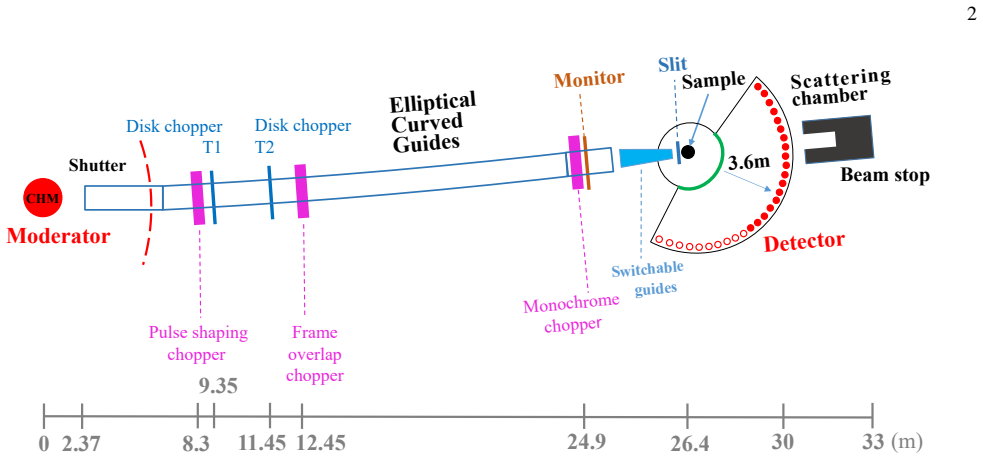
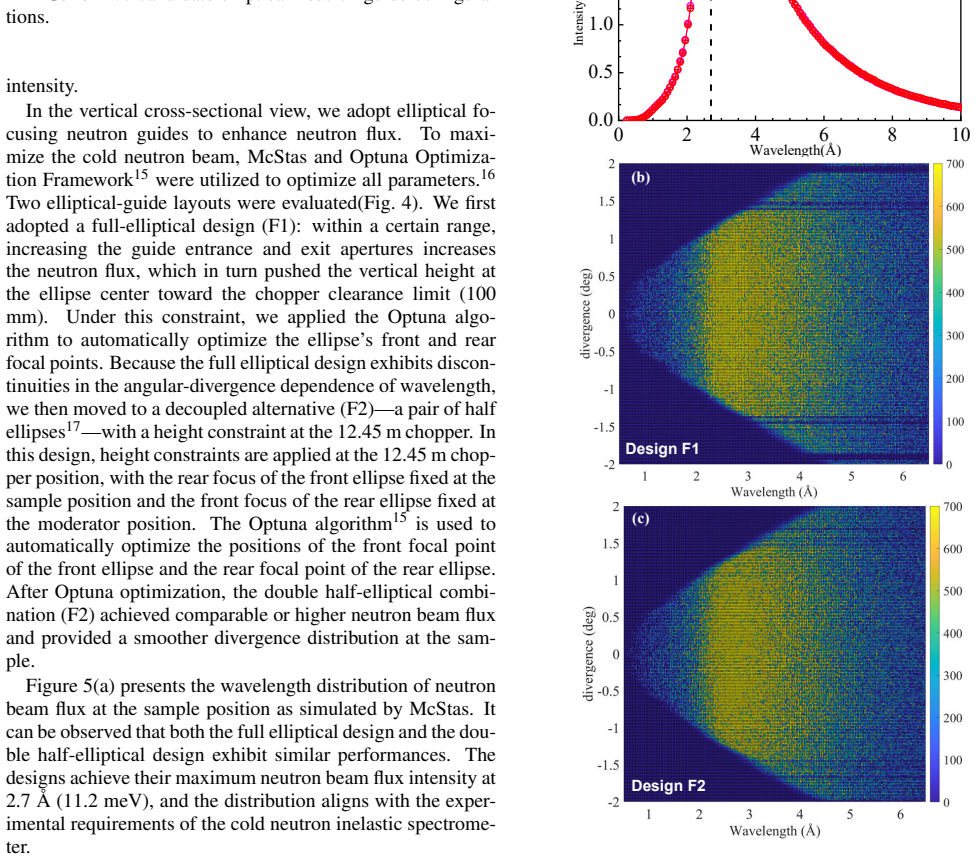
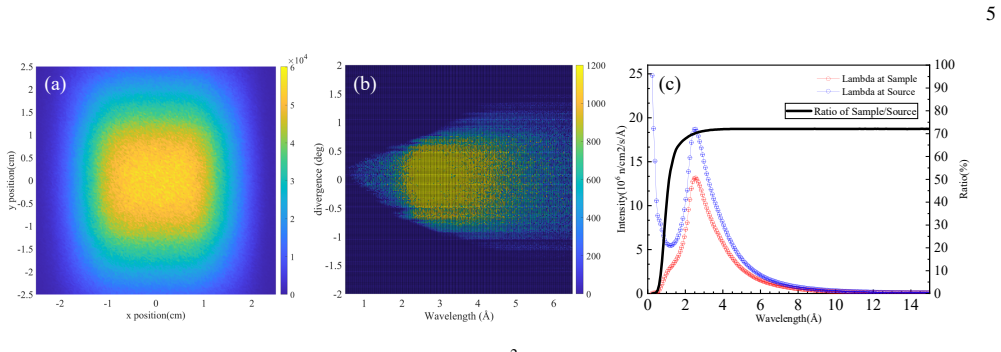
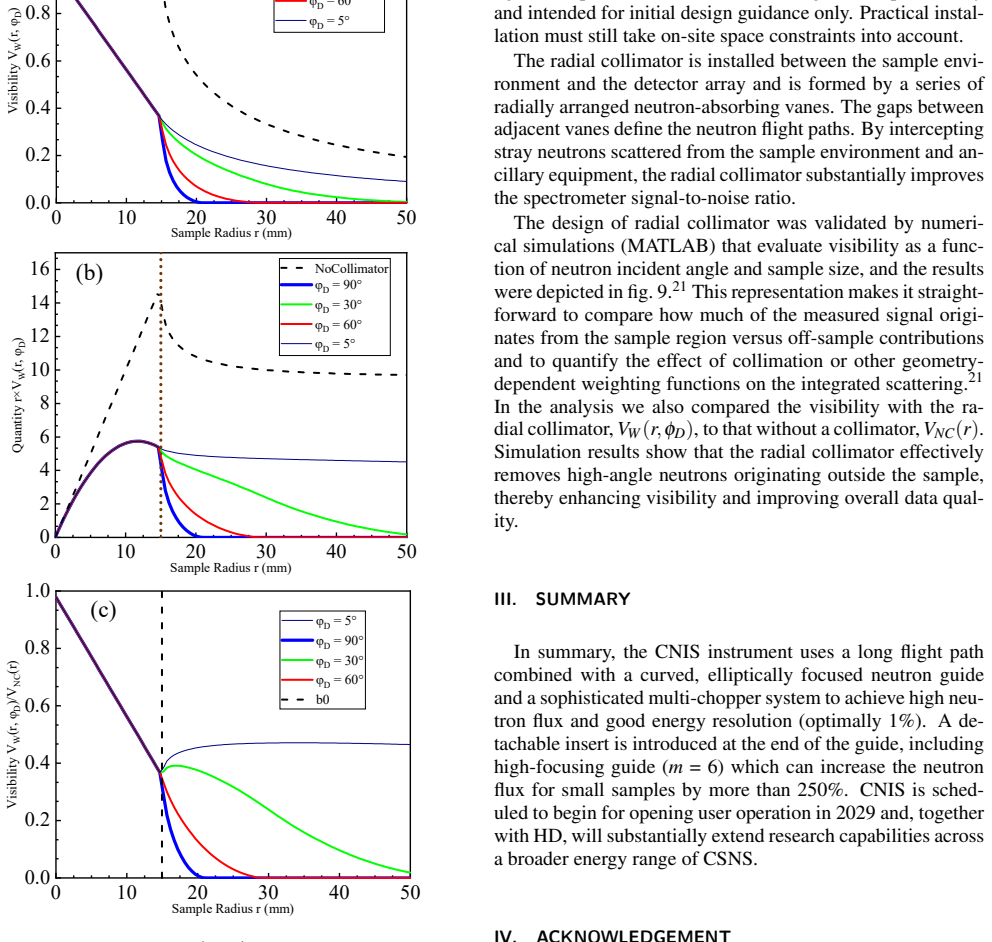
Through combined flight-path and chopper optimization, CNIS achieves excellent routine-mode energy resolution and can reach approximately ~1% in a dedicated high-resolution configuration. The instrument is built around bent supermirror guides, elliptical-focusing geometry, and a flexible chopper system that together suppress background and deliver cold neutrons efficiently to the sample for studies of low-energy lattice and magnetic excitations.
What carries the argument
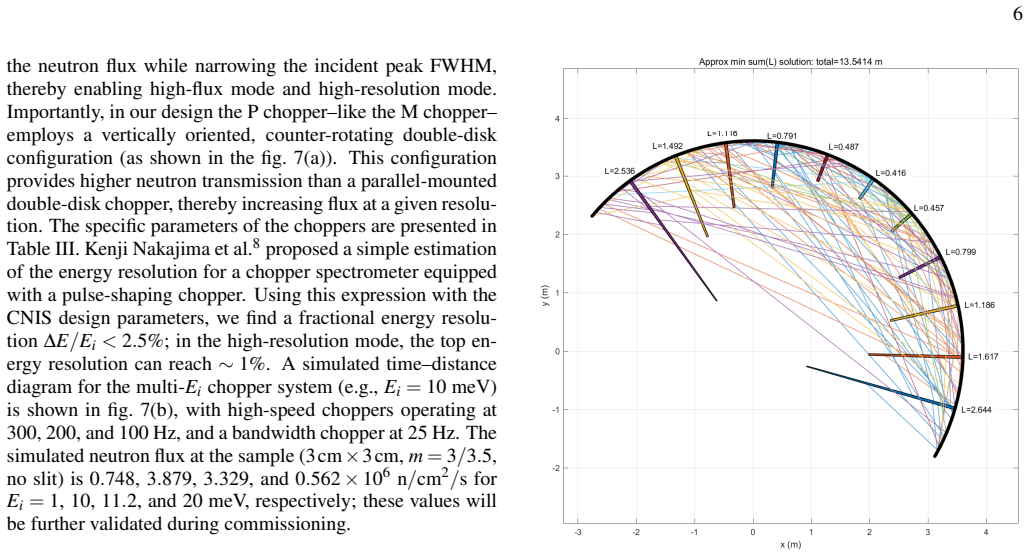
The bent supermirror guides combined with elliptical-focusing geometry and a multi-disk chopper suite for pulse shaping, band selection, and monochromatization.
If this is right
- Routine operation will support detailed mapping of low-energy excitations in lattice and magnetic systems.
- Multi-Ei capability will let users collect data at several incident energies in a single run without changing hardware.
- The radial collimator and vacuum airbox will reduce background and simplify integration with sample environments.
- Interchangeable high-focusing guide inserts will allow switching between standard and high-resolution modes.
- User operation is scheduled to begin in 2029.
Where Pith is reading between the lines
- Similar guide-plus-chopper optimization could be applied to upgrade resolution on existing cold-neutron spectrometers at other spallation sources.
- If background remains as low as modeled, the design may open new parameter space for studying weak magnetic signals in quantum materials.
- The modular airbox approach might reduce setup time for temperature or field experiments across multiple instruments.
- High-resolution mode could be tested first with a standard vanadium sample to confirm the 1% target before full user program starts.
Load-bearing premise
The quoted resolution targets will hold in practice only if neutron transport simulations of the guides, focusing geometry, and chopper timing match real performance after construction.
What would settle it
After the instrument is built, measure the actual energy resolution on a known standard sample in the dedicated high-resolution configuration and compare the result directly to the simulated ~1% value.
Figures





read the original abstract
The Cold-Neutron Inelastic Spectrometer (CNIS) is a direct-geometry, time-of-flight instrument designed for China Spallation Neutron Source (CSNS) and optimized to probe low-energy lattice and magnetic excitations. The instrument integrates a long flight path with bent supermirror guides and an elliptical-focusing geometry to suppress high-energy background while improving cold-neutron delivery to the sample. A flexible multi-disk chopper suite provides pulse shaping, band selection and monochromatization, enabling multi-$E_\textrm{i}$ operation. Modular features, including an interchangeable high-focusing guide insert, radial collimation and a vacuum ``airbox'' for simplified sample-environment integration, enhance signal-to-noise and operational versatility. Through combined flight-path and chopper optimization, CNIS achieves excellent routine-mode energy resolution and can reach approximately $\sim 1\%$ in a dedicated high-resolution configuration. CNIS is planned to commence user operation in 2029, offering a highly flexible platform for cold-neutron inelastic scattering studies.
Editorial analysis
A structured set of objections, weighed in public.
Referee Report
Summary. The manuscript presents the physical design of the Cold-Neutron Inelastic Spectrometer (CNIS), a direct-geometry time-of-flight instrument planned for the China Spallation Neutron Source (CSNS). It describes a long flight path with bent supermirror guides and elliptical focusing to improve cold-neutron delivery and suppress background, a multi-disk chopper suite for pulse shaping, band selection, and multi-Ei operation, plus modular elements such as an interchangeable high-focusing guide insert, radial collimation, and a vacuum airbox. Through flight-path and chopper optimization the design targets excellent routine-mode energy resolution together with approximately 1% resolution in a dedicated high-resolution configuration, with user operations scheduled to begin in 2029.
Significance. If the neutron-transport simulations and optimization results hold after construction, CNIS would provide a flexible, high-performance platform for cold-neutron inelastic scattering at CSNS, enabling studies of low-energy lattice and magnetic excitations with competitive resolution and background control. The proposal applies established neutron-optics principles to the specific characteristics of the CSNS source and incorporates practical modular features that enhance operational versatility.
major comments (2)
- [Abstract and performance-optimization section] The central performance claims (routine-mode resolution and ~1% high-resolution mode) are stated in the abstract and the optimization discussion but rest on unshown neutron-transport simulations; no quantitative results, parameter tables, error budgets, or direct comparisons to existing instruments are supplied to substantiate the targets. This is load-bearing for the paper's primary assertions about instrument capability.
- [§3 (Instrument layout and guide design)] The description of the bent supermirror guides and elliptical-focusing geometry (likely §3) is qualitative; without explicit simulation outputs for neutron flux, divergence, or background suppression factors, the claimed improvements in signal-to-noise cannot be independently evaluated.
minor comments (3)
- [Abstract] The abstract refers to 'excellent routine-mode energy resolution' without quoting a numerical range or FWHM value, which would clarify the performance baseline for readers.
- [Figures] Figure captions for the instrument layout and chopper suite would benefit from additional detail identifying labeled components and their functions.
- [Design-parameters section] A short table summarizing key design parameters (flight-path length, chopper frequencies, guide m-values, etc.) would improve readability and allow direct comparison with other spectrometers.
Simulated Author's Rebuttal
We thank the referee for their thorough review and constructive feedback on the CNIS design manuscript. The comments correctly identify areas where additional quantitative detail from our simulations would strengthen the paper. We address each major comment below and will revise the manuscript to incorporate the requested information.
read point-by-point responses
-
Referee: [Abstract and performance-optimization section] The central performance claims (routine-mode resolution and ~1% high-resolution mode) are stated in the abstract and the optimization discussion but rest on unshown neutron-transport simulations; no quantitative results, parameter tables, error budgets, or direct comparisons to existing instruments are supplied to substantiate the targets. This is load-bearing for the paper's primary assertions about instrument capability.
Authors: We agree that the performance claims require more explicit supporting data. In the revised manuscript we will expand the performance-optimization section (and add a dedicated subsection if needed) with key quantitative outputs from our McStas neutron-transport simulations. This will include tabulated neutron flux values at the sample for routine and high-resolution configurations, energy-resolution figures with associated uncertainties, a concise error budget for the resolution calculations, and direct comparisons to the performance of established instruments such as LET (ISIS) and CNCS (SNS). These additions will substantiate the stated targets without altering the original design conclusions. revision: yes
-
Referee: [§3 (Instrument layout and guide design)] The description of the bent supermirror guides and elliptical-focusing geometry (likely §3) is qualitative; without explicit simulation outputs for neutron flux, divergence, or background suppression factors, the claimed improvements in signal-to-noise cannot be independently evaluated.
Authors: We acknowledge that the current §3 description is primarily qualitative. We will revise this section to include explicit simulation results, specifically: (i) neutron flux and divergence profiles at the sample position with and without the elliptical focusing insert, (ii) quantitative background-suppression factors arising from the bent supermirror guide (e.g., reduction in high-energy neutron transmission), and (iii) corresponding signal-to-noise estimates. These data will be drawn from the same ray-tracing runs already performed for the design and presented as tables or figures to permit independent evaluation. revision: yes
Circularity Check
No significant circularity detected
full rationale
The manuscript is a pre-construction instrument design proposal. All headline performance figures (routine-mode resolution and ~1% high-resolution mode) are obtained from neutron-transport simulations of the proposed guide geometry, focusing optics, and chopper timing parameters. These are presented as design targets computed from the chosen layout rather than as quantities that are algebraically or definitionally identical to the inputs. No equations, self-citations, or uniqueness theorems are invoked that would reduce the claimed resolutions to the design parameters by construction; the argument therefore remains self-contained and non-circular.
Axiom & Free-Parameter Ledger
free parameters (3)
- flight path length
- supermirror guide curvature and focusing parameters
- multi-disk chopper frequencies and phases
axioms (2)
- domain assumption Neutron reflection from supermirror coatings follows standard geometric optics with high efficiency
- standard math Time-of-flight energy resolution is determined by flight path length and neutron pulse width
Lean theorems connected to this paper
-
IndisputableMonolith/Foundation/RealityFromDistinction.leanreality_from_one_distinction unclearThrough combined flight-path and chopper optimization, CNIS achieves excellent routine-mode energy resolution and can reach approximately ∼1% in a dedicated high-resolution configuration.
Reference graph
Works this paper leans on
-
[1]
China Spallation Neutron Source: Design, R
Jie Wei and Hesheng Chen and Yanwei Chen and Yuanbo Chen and Yunlong Chi and Changdong Deng and Haiyi Dong and Lan Dong and Shouxian Fang and Ji Feng and Shinian Fu and Lunhua He and Wei He and Yuekun Heng and Kaixi Huang and Xuejun Jia and Wen Kang and Xiangcheng Kong and Jian Li and Tianjiao Liang and Guoping Lin and Zhenan Liu and Huafu Ouyang and Qing...
work page 2009
-
[2]
China's first pulsed neutron source , author=. Nature materials , volume=. 2016 , publisher=
work page 2016
-
[3]
The design of high energy direct geometry chopper spectrometer at CSNS , journal =
Wei Luo and Yu Feng and XinZhi Liu and Meng Wang and DongHui Zhu and Wei Gao and YanSheng Geng and QingYong Ren and JunYing Shen and Yuan Sun and XiaoYue Zhang and YuanGuang Xia and TaiSen Zuo and Yue Zheng and Xin Tong , keywords =. The design of high energy direct geometry chopper spectrometer at CSNS , journal =. 2023 , issn =
work page 2023
-
[4]
Ehlers, G. and Podlesnyak, A. A. and Kolesnikov, A. I. , title =. Review of Scientific Instruments , volume =. 2016 , month =
work page 2016
-
[5]
and Nakajima ,Taro and Harriger ,Leland and Zaliznyak ,Igor and Masuda ,Takatsugu , title =
Kikuchi ,Hodaka and Asai ,Shinichiro and Sato ,Taku J. and Nakajima ,Taro and Harriger ,Leland and Zaliznyak ,Igor and Masuda ,Takatsugu , title =. Journal of the Physical Society of Japan , volume =
-
[6]
Sala, G. and Mourigal, M. and Boone, C. and Butch, N. P. and Christianson, A. D. and Delaire, O. and DeSantis, A. J. and Hart, C. L. and Hermann, R. P. and Huegle, T. and Kent, D. N. and Lin, J. Y. Y. and Lumsden, M. D. and Manley, M. E. and Quirinale, D. G. and Stone, M. B. and Z, Y. , title =. Review of Scientific Instruments , volume =. 2022 , month =
work page 2022
-
[7]
Sala, Gabriele and Lin, Jiao Y. Y. and Graves, Van B. and Ehlers, Georg. Conceptual design of CHESS, a new direct-geometry inelastic neutron spectrometer dedicated to studying small samples. Journal of Applied Crystallography. 2018
work page 2018
-
[8]
Acta Physica Sinica , volume =
Non-elastic Neutron Scattering Spectrometer and Its Applications , author =. Acta Physica Sinica , volume =. 2025 , issn =
work page 2025
-
[9]
The high-resolution time-of-flight spectrometer TOFTOF , journal =
Tobias Unruh and Jürgen Neuhaus and Winfried Petry , keywords =. The high-resolution time-of-flight spectrometer TOFTOF , journal =. 2007 , issn =
work page 2007
-
[10]
Nuclear Instruments and Methods , volume=
Neutron time-of-flight spectrometers , author=. Nuclear Instruments and Methods , volume=. 1979 , publisher=
work page 1979
-
[11]
Design and construction of the China Spallation Neutron Source , journal =. 2025 , issn =
work page 2025
-
[12]
Journal of research of the National Institute of Standards and Technology , volume=
Neutron time-of-flight spectroscopy , author=. Journal of research of the National Institute of Standards and Technology , volume=
-
[13]
Physica B: Condensed Matter , volume=
McStas 1.7-a new version of the flexible Monte Carlo neutron scattering package , author=. Physica B: Condensed Matter , volume=. 2004 , publisher=
work page 2004
-
[14]
document of CSNS , author=
-
[15]
Journal of the Physical Society of Japan , volume=
AMATERAS: a cold-neutron disk chopper spectrometer , author=. Journal of the Physical Society of Japan , volume=. 2011 , publisher=
work page 2011
-
[16]
Review of Scientific Instruments , volume=
CHESS: The future direct geometry spectrometer at the second target station , author=. Review of Scientific Instruments , volume=. 2022 , publisher=
work page 2022
-
[17]
Applied Crystallography , volume=
Optimization of moderators and beam extraction at the ESS , author=. Applied Crystallography , volume=. 2018 , publisher=
work page 2018
-
[18]
Journal of the Physical Society of Japan , volume=
Recent Improvement of the Signal-to-Noise Ratio on the Fermi Chopper Spectrometer 4SEASONS , author=. Journal of the Physical Society of Japan , volume=. 2013 , publisher=
work page 2013
-
[19]
EPJ Web of Conferences , volume=
Panther—the new thermal neutron time-of-flight spectrometer at the ILL , author=. EPJ Web of Conferences , volume=. 2022 , organization=
work page 2022
-
[20]
Deen, P. P. and Longeville, S. and Lohstroh, W. and Moreira, F. and Fabrèges, G. and Loaiza, L. and Noferini, D. , title =. Review of Scientific Instruments , volume =. 2021 , month =
work page 2021
-
[21]
LET, a cold neutron multi-disk chopper spectrometer at ISIS , author=. Nuclear Instruments and Methods in Physics Research Section A: Accelerators, Spectrometers, Detectors and Associated Equipment , volume=. 2011 , publisher=
work page 2011
-
[22]
Journal of the Physical Society of Japan , volume=
IN5 cold neutron time-of-flight spectrometer, prepared to tackle single crystal spectroscopy , author=. Journal of the Physical Society of Japan , volume=. 2011 , publisher=
work page 2011
-
[23]
The high-resolution time-of-flight spectrometer TOFTOF , author=. Nuclear Instruments and Methods in Physics Research Section A: Accelerators, Spectrometers, Detectors and Associated Equipment , volume=. 2007 , publisher=
work page 2007
-
[24]
Physica B: Condensed Matter , volume=
MERLIN, a new high count rate spectrometer at ISIS , author=. Physica B: Condensed Matter , volume=. 2006 , publisher=
work page 2006
-
[25]
An analysis of the effectiveness of oscillating radial collimators in neutron scattering applications , author=. Nuclear Instruments and Methods in Physics Research Section A: Accelerators, Spectrometers, Detectors and Associated Equipment , volume=. 1994 , publisher=
work page 1994
-
[26]
Optuna: A next-generation hyperparameter optimization framework , author=. Proceedings of the 25th ACM SIGKDD international conference on knowledge discovery & data mining , pages=
-
[27]
Bayesian optimization of combined ballistic neutron guides for the Elastic Diffuse Scattering spectrometer at CSNS , author=. Nuclear Instruments and Methods in Physics Research Section A: Accelerators, Spectrometers, Detectors and Associated Equipment , pages=. 2025 , publisher=
work page 2025
- [28]
-
[29]
H. Kikuchi, S. Asai, T. J. Sato, T. Nakajima, L. Harriger, I. Zaliznyak, T. Masuda, A new inelastic neutron spectrometer hodaca, Journal of the Physical Society of Japan 93 (9) (2024) 091004
work page 2024
-
[30]
G. Sala, M. Mourigal, C. Boone, N. P. Butch, A. D. Christianson, O. Delaire, A. J. DeSantis, C. L. Hart, R. P. Hermann, T. Huegle, D. N. Kent, J. Y. Y. Lin, M. D. Lumsden, M. E. Manley, D. G. Quirinale, M. B. Stone, Y. Z, Chess: The future direct geometry spectrometer at the second target station, Review of Scientific Instruments 93 (6) (2022) 065109
work page 2022
-
[31]
G. Sala, J. Y. Y. Lin, V. B. Graves, G. Ehlers, Conceptual design of CHESS, a new direct-geometry inelastic neutron spectrometer dedicated to studying small samples , Journal of Applied Crystallography 51 (2) (2018) 282--293
work page 2018
-
[32]
Z. Hu, Y. Yuan, L. Li, Q. Ren, Y. Feng, J. Shen, W. Luo, X. Tong, Non-elastic neutron scattering spectrometer and its applications, Acta Physica Sinica 74 (1-20241412) (2025) 012501--1
work page 2025
- [33]
- [34]
-
[35]
K. Nakajima, S. Ohira-Kawamura, T. Kikuchi, M. Nakamura, R. Kajimoto, Y. Inamura, N. Takahashi, K. Aizawa, K. Suzuya, K. Shibata, et al., Amateras: a cold-neutron disk chopper spectrometer, Journal of the Physical Society of Japan 80 (Suppl. B) (2011) SB028
work page 2011
-
[36]
J. Ollivier, H. Mutka, In5 cold neutron time-of-flight spectrometer, prepared to tackle single crystal spectroscopy, Journal of the Physical Society of Japan 80 (Suppl. B) (2011) SB003
work page 2011
-
[37]
P. P. Deen, S. Longeville, W. Lohstroh, F. Moreira, G. Fabrèges, L. Loaiza, D. Noferini, Cspec: The cold chopper spectrometer of the ess, a detailed overview prior to commissioning, Review of Scientific Instruments 92 (10) (2021) 105104
work page 2021
-
[38]
H. Chen, X.-L. Wang, China's first pulsed neutron source, Nature materials 15 (7) (2016) 689--691
work page 2016
-
[39]
J. Wei, H. Chen, Y. Chen, Y. Chen, Y. Chi, C. Deng, H. Dong, L. Dong, S. Fang, J. Feng, S. Fu, L. He, W. He, Y. Heng, K. Huang, X. Jia, W. Kang, X. Kong, J. Li, T. Liang, G. Lin, Z. Liu, H. Ouyang, Q. Qin, H. Qu, C. Shi, H. Sun, J. Tang, J. Tao, C. Wang, F. Wang, D. Wang, Q. Wang, S. Wang, T. Wei, J. Xi, T. Xu, Z. Xu, W. Yin, X. Yin, J. Zhang, Z. Zhang, Z...
work page 2009
-
[40]
W. Luo, Y. Feng, X. Liu, M. Wang, D. Zhu, W. Gao, Y. Geng, Q. Ren, J. Shen, Y. Sun, X. Zhang, Y. Xia, T. Zuo, Y. Zheng, X. Tong, The design of high energy direct geometry chopper spectrometer at csns, Nuclear Instruments and Methods in Physics Research Section A: Accelerators, Spectrometers, Detectors and Associated Equipment 1046 (2023) 167676
work page 2023
-
[41]
H. Chen, Y. Chen, S. Fu, L. Ma, S. Wang, F. Chen, Y. Chen, H. Dong, L. Dong, G. Feng, J. Gu, L. He, K. He, W. He, C. Hu, J. Huang, Q. Ji, X. Jia, D. Jin, L. Kang, W. Kang, T. Liang, G. Lin, H. Liu, J. Li, H. Ouyang, F. Qi, X. Qi, H. Qu, H. Sun, Z. Sun, L. Shen, J. Tang, J. Tao, F. Wang, L. Wang, P. Wang, Q. Wang, Y. Wu, J. Xi, T. Xu, W. Yin, B. Zhang, J. ...
work page 2025
- [42]
-
[43]
P. Zhou, Z. Zeng, Z. He, X. Wang, L. Lin, M. Tang, A. Goukassov, F. Wang, T. Liang, E. Feng, Bayesian optimization of combined ballistic neutron guides for the elastic diffuse scattering spectrometer at csns, Nuclear Instruments and Methods in Physics Research Section A: Accelerators, Spectrometers, Detectors and Associated Equipment (2025) 171264
work page 2025
-
[44]
G. Sala, M. Mourigal, C. Boone, N. Butch, A. Christianson, O. Delaire, A. DeSantis, C. Hart, R. Hermann, T. Huegle, et al., Chess: The future direct geometry spectrometer at the second target station, Review of Scientific Instruments 93 (6) (2022)
work page 2022
-
[45]
R. Kajimoto, M. Nakamura, Y. Inamura, K. Ikeuchi, S. Ji, K. Nakajima, S. Ohira-Kawamura, W. Kambara, M. Sawabe, A. Kamiya, et al., Recent improvement of the signal-to-noise ratio on the fermi chopper spectrometer 4seasons, Journal of the Physical Society of Japan 82 (Suppl. A) (2013) SA032
work page 2013
-
[46]
B. F k, S. Rols, G. Manzin, O. Meulien, Panther—the new thermal neutron time-of-flight spectrometer at the ill, in: EPJ Web of Conferences, Vol. 272, EDP Sciences, 2022, p. 02001
work page 2022
- [47]
- [48]
discussion (0)
Sign in with ORCID, Apple, or X to comment. Anyone can read and Pith papers without signing in.