Recognition: no theorem link
Frequency Matching in Spiking Neural Networks for mmWave Sensing
Pith reviewed 2026-05-12 03:58 UTC · model grok-4.3
The pith
Spiking neural networks outperform standard networks on mmWave sensing by setting LIF decay to match the data's useful frequency band.
A machine-rendered reading of the paper's core claim, the machinery that carries it, and where it could break.
Core claim
When the discriminative content of mmWave measurements lies in low-to-mid frequencies, the low-pass behavior of leaky integrate-and-fire neurons can be tuned by matching their effective bandwidth to that content; the resulting membrane decay factor lets SNNs suppress noise without extra preprocessing or deeper layers, delivering 6.22 percent higher test accuracy and 3.64 times lower theoretical energy on four standard datasets compared with ANN baselines.
What carries the argument
The frequency-matching criterion for the LIF membrane decay factor, which aligns the neuron's low-pass cutoff with the low-to-mid frequency band that carries the signal's discriminative information.
If this is right
- SNNs can be deployed on resource-limited edge devices for always-on mmWave perception without heavy preprocessing pipelines.
- Hyperparameter selection for SNNs becomes data-driven rather than purely empirical when spectral content is analyzed first.
- Energy consumption drops by a factor of roughly 3.6 while accuracy rises, making continuous sensing more practical on battery hardware.
- The same LIF bandwidth alignment explains performance differences between SNNs and ANNs on other temporal sensing tasks.
- A unified evaluation protocol across four datasets confirms the gains hold under consistent training and testing conditions.
Where Pith is reading between the lines
- The same bandwidth-matching principle could be tested on other radar or time-of-flight modalities that share similar spectral structure.
- Frequency analysis of the input could become a lightweight preprocessing step that decides whether to use an SNN or an ANN layer.
- Hardware designers might expose tunable decay parameters so that the matching can be performed at runtime based on observed signal statistics.
- Synthetic signals with controlled frequency content would provide a clean testbed to isolate the contribution of the LIF filter alone.
Load-bearing premise
Discriminative information in mmWave signals resides primarily in low-to-mid frequencies so the built-in filtering of LIF neurons aligns with it without extra steps.
What would settle it
Construct or select an mmWave dataset in which the key discriminative features sit only in high frequencies, apply the proposed decay-factor rule, and observe no accuracy gain or an accuracy loss relative to an ANN baseline under the same protocol.
Figures



read the original abstract
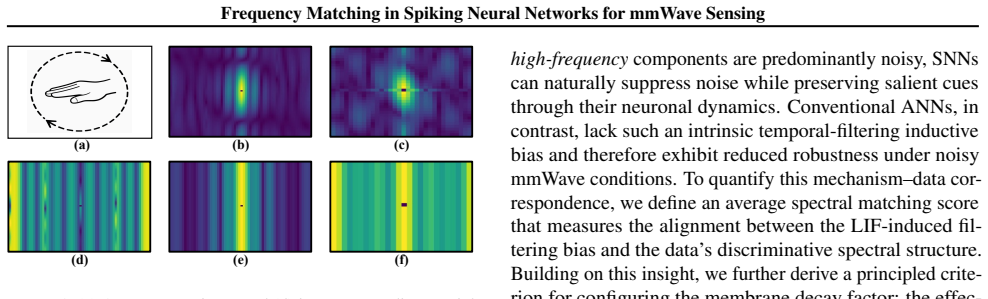
Millimeter-wave (mmWave) sensing enables privacy-preserving, always-on edge perception, but its measurements are often sparse, temporally irregular, and corrupted by high-frequency noise. Existing mmWave pipelines predominantly rely on artificial neural networks (ANNs), which achieve robustness through extensive preprocessing or deep architectures, thereby limiting their efficiency on edge devices. In this work, we study spiking neural networks (SNNs) for mmWave sensing from a mechanism-data alignment perspective. By leveraging the low-pass filtering behavior of leaky integrate-and-fire (LIF) dynamics, we analyze how their implicit temporal filtering interacts with the frequency structure of mmWave signals. Our analysis shows that when discriminative information resides in low-to-mid frequencies, LIF dynamics can inherently suppress high-frequency noise, clarifying when and why SNNs outperform ANNs. Based on this insight, we derive a principled criterion for configuring the membrane decay factor by matching the effective bandwidth of LIF dynamics to the data's discriminative spectral content. Experimental results across four widely used mmWave datasets validate the proposed frequency-matching hypothesis, yielding an average test-accuracy improvement of 6.22% and a 3.64$\times$ reduction in theoretical energy consumption relative to ANN baselines, under a unified evaluation protocol.
Editorial analysis
A structured set of objections, weighed in public.
Referee Report
Summary. The paper proposes using spiking neural networks (SNNs) based on leaky integrate-and-fire (LIF) neurons for mmWave sensing by deriving a frequency-matching criterion for the membrane decay factor. This criterion aligns the effective low-pass bandwidth of LIF dynamics (via the transfer function) with the low-to-mid frequency content assumed to carry discriminative information in mmWave signals, enabling inherent high-frequency noise suppression. Experiments across four datasets under a unified protocol report an average 6.22% test accuracy improvement and 3.64× theoretical energy reduction relative to ANN baselines.
Significance. If the frequency-alignment mechanism is confirmed, the work offers a principled, parameter-free way to configure SNNs for edge sensing applications where signals exhibit concentrated low-to-mid frequency discriminative content, explaining specific conditions under which SNNs can outperform ANNs due to intrinsic filtering rather than sparsity alone. The emphasis on mechanism-data alignment and reproducible energy metrics are positive features.
major comments (2)
- [Experimental results and hypothesis validation] The load-bearing assumption that discriminative information in the four mmWave datasets resides primarily in low-to-mid frequencies (allowing LIF bandwidth matching to explain the gains) lacks direct support. No class-conditional power spectra, per-frequency mutual information, or explicit comparison between chosen decay factors and data spectral content is provided to validate the alignment; without this, gains could arise from other SNN properties.
- [Abstract and experimental evaluation] The reported 6.22% average accuracy gain and 3.64× energy reduction are presented under a unified protocol, but the manuscript does not detail statistical significance testing, run-to-run variance, or controls confirming that ANN baselines received equivalent hyperparameter optimization and preprocessing.
minor comments (2)
- [Method] The derivation of the bandwidth-matching criterion from the LIF transfer function H(f) ≈ 1 / (1 + j 2π f τ) should include an explicit equation or step-by-step calculation showing how the decay factor is set from data spectrum.
- [Energy analysis] Clarify whether the energy reduction is purely theoretical (based on spike sparsity) or includes measured hardware costs, and ensure all dataset preprocessing steps are identical for SNN and ANN baselines.
Simulated Author's Rebuttal
We thank the referee for their constructive and detailed comments, which have helped us identify areas to strengthen the validation of our core hypothesis and improve the rigor of our experimental reporting. We address each major comment point by point below.
read point-by-point responses
-
Referee: [Experimental results and hypothesis validation] The load-bearing assumption that discriminative information in the four mmWave datasets resides primarily in low-to-mid frequencies (allowing LIF bandwidth matching to explain the gains) lacks direct support. No class-conditional power spectra, per-frequency mutual information, or explicit comparison between chosen decay factors and data spectral content is provided to validate the alignment; without this, gains could arise from other SNN properties.
Authors: We agree that direct spectral validation would provide stronger, more explicit support for the frequency-matching hypothesis and help isolate the contribution of LIF filtering from other SNN characteristics. In the revised manuscript we have added class-conditional power spectral density plots for all four datasets, which confirm that discriminative information is concentrated in the low-to-mid frequency range. We also include a direct comparison of the effective bandwidths implied by the matched decay factors against the observed spectral content of each dataset. To further address alternative explanations, we report additional ablation results using deliberately mismatched decay factors; these yield consistently lower accuracy, supporting that the reported gains arise from the alignment mechanism rather than generic SNN properties such as sparsity. revision: yes
-
Referee: [Abstract and experimental evaluation] The reported 6.22% average accuracy gain and 3.64× energy reduction are presented under a unified protocol, but the manuscript does not detail statistical significance testing, run-to-run variance, or controls confirming that ANN baselines received equivalent hyperparameter optimization and preprocessing.
Authors: We concur that explicit reporting of variance, statistical tests, and baseline controls is essential for reproducibility and fair comparison. In the revised version we now present accuracy results as means and standard deviations over five independent runs with distinct random seeds. We have added paired t-test results demonstrating that the accuracy improvements are statistically significant (p < 0.05). We have also expanded the experimental protocol section to confirm that ANN baselines were subjected to an identical hyperparameter search budget, grid ranges, and preprocessing pipeline as the SNN models; these controls are now documented in both the main text and supplementary material. revision: yes
Circularity Check
No significant circularity; derivation is mechanistic and externally grounded
full rationale
The paper's core step analyzes the standard LIF transfer function H(f) ≈ 1/(1 + j2πfτ) to identify its low-pass behavior, then proposes a bandwidth-matching rule for the decay factor τ based on the (independently measurable) spectral content of mmWave signals. This rule is applied to configure the model and is subsequently validated by accuracy and energy metrics on four external datasets. No equation reduces to a fitted parameter renamed as a prediction, no self-citation supplies the uniqueness or ansatz, and the frequency-alignment hypothesis is stated as an assumption whose empirical consequences are tested rather than presupposed. The derivation therefore remains self-contained against the LIF dynamics and the observable data spectrum.
Axiom & Free-Parameter Ledger
axioms (1)
- domain assumption Leaky integrate-and-fire neurons exhibit low-pass filtering behavior whose effective bandwidth is controlled by the membrane decay factor
Reference graph
Works this paper leans on
-
[1]
Lv, C., Han, D., Wang, Y ., Zheng, X., Huang, X., and Li, D
IEEE, 2025. Lv, C., Han, D., Wang, Y ., Zheng, X., Huang, X., and Li, D. Advancing spiking neural networks for sequential mod- eling with central pattern generators.Advances in Neu- ral Information Processing Systems, 37:26915–26940, 2024a. Lv, C., Wang, Y ., Han, D., Zheng, X., Huang, X., and Li, D. Efficient and effective time-series forecasting with sp...
work page 2025
-
[2]
Safa, A., Corradi, F., Keuninckx, L., Ocket, I., Bourdoux, A., Catthoor, F., and Gielen, G
IEEE, 2020. Safa, A., Corradi, F., Keuninckx, L., Ocket, I., Bourdoux, A., Catthoor, F., and Gielen, G. G. Improving the accuracy of spiking neural networks for radar gesture recognition through preprocessing.IEEE Transactions on Neural Networks and Learning Systems, 34(6):2869–2881, 2021. Satopaa, V ., Albrecht, J., Irwin, D., and Raghavan, B. Find- ing ...
work page 2020
-
[3]
forβ∈[0,1)and define ˜H(ω;β)≜ |H(ω;β)| 2 |H(0;β)| 2 . Then forω∈[0, π], ˜H(ω;β) = (1−β) 2 1 +β 2 −2βcosω .(80) Proof.Using|z −1|2 = 1/|z|2 and |1−βe −jω |2 = (1−βe −jω)(1−βe jω) = 1 +β 2 −2βcosω, we obtain |H(ω;β)| 2 = 1 1 +β 2 −2βcosω .(81) At DC (ω= 0),cos 0 = 1, hence |H(0;β)| 2 = 1 (1−β) 2 .(82) Substituting Eq. (81)–Eq. (82) into the definition of ˜H...
-
[4]
˜H(·;β)is continuous on[0, π]and strictly decreasing on(0, π)
-
[5]
˜H(0;β) = 1and ˜H(π;β) = 1−β 1+β 2
-
[6]
A unique half-power cutoff ωc ∈(0, π] satisfying ˜H(ω c;β) = 1 2 existsiff β≥3−2 √
-
[7]
If β <3−2 √ 2, then ˜H(ω;β)> 1 2 for all ω∈[0, π] , hence no half-power cutoff occurs within the one-sided band. In this regime, we set the one-sided effective bandwidth to its maximal value, i.e., it saturates at the Nyquist limitπ. 24 Frequency Matching in Spiking Neural Networks for mmWave Sensing Proof. (1) Continuity follows from Eq. (80) since the d...
-
[8]
Using ˜H(π;β) = 1−β 1+β 2 , the condition ˜H(π;β)≤ 1 2 is equivalent to 1−β 1+β ≤ 1√ 2, i.e., β≥3−2 √
-
[9]
Ifβ <3−2 √ 2, then ˜H(π;β)> 1 2 and by monotonicity ˜H(ω;β)> 1 2 for allω∈[0, π]. Closed-form cutoff and induced effective bandwidth.When the cutoff exists, we can solve ˜H(ω c;β) = 1 2 explicitly to obtain a computable effective bandwidthB eff(β). Proposition C.4(Closed-form cutoff and effective bandwidth for LIF).Assume β∈[3−2 √ 2,1) so that the unique ...
-
[10]
Then the discrete in-band index set {ωk ∈Ω L :ω k ≤ω c(β)} is apiecewise-constantfunction ofβ, changing only whenω c(β)crosses a grid pointω k. Proof. Because ˜H(ω;β) is low-pass in ω for fixed β and varies continuously with β for each fixed ωk, the half-power solution ωc(β) moves continuously as β varies. However, the membership condition ωk ≤ω c(β) can ...
-
[11]
Then the induced one-sided effective bandwidth Beff(β)≜ω c(β) is strictly decreasing inβ, i.e., d dβ Beff(β)<0.(88) Proof.From Eq. (84), the cutoff admits the closed form ωc(β) = arccos x(β) , x(β)≜ 4β−1−β 2 2β .(89) For β∈[3−2 √ 2,1) , we have x(β)∈[−1,1] , so ωc(β) is well-defined. Moreover, for any β∈(0,1) we can rewrite x(β) as x(β) = 2− 1 +β 2 2β = 2...
work page 2023
-
[12]
incur substantially higher #OPs and energy; moreover, for a fixed ANN architecture, the reported values are nearly invariant across datasets, as the forward graph and tensor shapes are fixed once the input specification is set. Second, SNN+LIF models deliver pronounced efficiency gains relative to comparable architectural families: for instance, Spik- ing...
work page 1913
discussion (0)
Sign in with ORCID, Apple, or X to comment. Anyone can read and Pith papers without signing in.