Recognition: no theorem link
A Resource Allocation Game and its Equilibrium Strategies
Pith reviewed 2026-05-12 03:43 UTC · model grok-4.3
The pith
In a resource allocation game with smallest-first all-or-nothing grants, Nash equilibria for two players are specific pairs of identity or alternating identity-flat functions, and a finite algorithm constructs them for large numbers of玩家.
A machine-rendered reading of the paper's core claim, the machinery that carries it, and where it could break.
Core claim
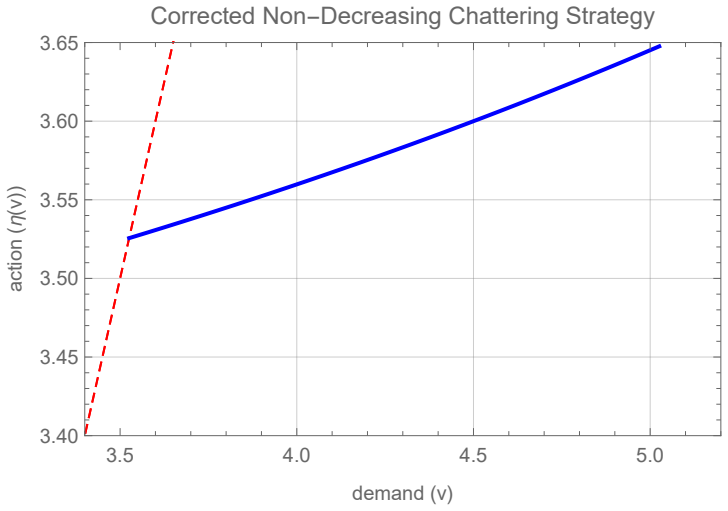
For the two-player game the Nash equilibrium profiles inside the AIF family are either two identity functions, two AIF functions sharing one switch point, or a pair consisting of a one-switch AIF and a three-switch AIF. For large n the first-order mean-field limit produces a single-switch AIF equilibrium; the Gaussian approximation yields a construction algorithm that searches the AIF family and, when a gradient conflict appears, enters a chattering regime in which players effectively alternate between slope-one and flat segments at infinite speed. The algorithm is proved always to terminate after finitely many steps at a Nash equilibrium.
What carries the argument
Alternating identity-and-flat (AIF) functions, which are piecewise strategies that alternate between segments of slope one (identity) and flat (constant) segments, used both to enumerate two-player equilibria and as the starting family for the large-n construction algorithm.
If this is right
- Two-player games admit only three equilibrium types inside the AIF family.
- The mean-field limit supplies an explicit one-switch AIF equilibrium for large player counts.
- The construction algorithm reaches a Nash equilibrium in finite steps even after entering the chattering regime.
- Numerical examples confirm that the Gaussian approximation matches simulated equilibria for moderate n.
Where Pith is reading between the lines
- The chattering regime offers a deterministic way to realize what would otherwise require mixed strategies in a continuous-action game.
- Explicit switch-point formulas could be derived for particular demand distributions such as exponential or uniform, enabling closed-form predictions.
- The model suggests that mechanism designers could enforce the smallest-first rule to make equilibrium strategies more predictable than in proportional allocation.
Load-bearing premise
Equilibrium strategies can be found or approximated inside the restricted family of alternating identity-and-flat functions without missing other equilibria or requiring different functional forms.
What would settle it
A counter-example in which a continuous strictly increasing non-AIF strategy yields strictly higher expected payoff against every AIF equilibrium strategy for some two-player demand distribution, or a large-n instance in which the construction algorithm cycles indefinitely or stabilizes at a non-equilibrium point.
Figures


read the original abstract
In this paper we propose a Bayesian game to allocate resources. In this game, there are $c$ units of resources to be allocated to $n$ players. Agent $i$ has a demand of $V_i$ units of resources and takes action $X_i$ according to a strategy function $s_i$, \ie $X_i=s_i(V_i)$. Payoffs are setup such that player $i$ is contented with no more than $V_i$ units of resources. We assume that resources are granted to the players on a smallest-request-first and all-or-nothing basis. For this game with two players, we analyze the equilibrium strategy functions mathematically within the family of alternating identity-and-flat (AIF) functions. We show that Nash equilibrium profiles consist of two identity functions, two AIF functions with a common switch point, or two AIF functions with one and three switch points, respectively. For an $n$-player game with a large $n$ and a large $c_n$ of order $O(n)$, we present a mean-field first order approximation and a second-order Gaussian approximation for its equilibrium strategy function. The first-order analysis obtains an equilibrium AIF function with one switch point. In Gaussian analysis of large games, we propose a construction algorithm. This construction algorithm begins in searching within the family of AIF functions. If a gradient conflict condition occurs, the game enters a chattering regime, in which players play a continuous, strictly increasing strategy function that is not an identity nor a flat function. Conceptually one can view the chattering regime as if players alternate between a slope-one strategy and a flat strategy infinitely fast in order to sustain a high payoff. We prove that the construction algorithm always obtains a Nash equilibrium and terminates in a finite number of steps. We present several numerical examples for the two player game as well as the Gaussian model.
Editorial analysis
A structured set of objections, weighed in public.
Referee Report
Summary. The paper proposes a Bayesian resource allocation game in which n players with private demands V_i select actions X_i = s_i(V_i) and resources are allocated on a smallest-request-first, all-or-nothing basis. For the two-player case the authors characterize Nash equilibrium profiles within the family of alternating identity-and-flat (AIF) strategy functions, showing that they consist of two identity functions, two AIF functions sharing a common switch point, or AIF functions with one and three switch points. For large n with c_n of order O(n) they derive a mean-field first-order AIF equilibrium with one switch point and then a second-order Gaussian construction algorithm that searches within AIF functions; when a gradient conflict arises the algorithm enters a chattering regime whose strategy is described as the infinite-speed alternation of slope-1 and flat segments, yielding a continuous strictly increasing function. The paper asserts that this algorithm always produces a Nash equilibrium and terminates after finitely many steps, and supplies numerical illustrations for both the two-player and Gaussian cases.
Significance. If the chattering regime can be placed on a rigorous footing, the work would supply a concrete algorithmic method for approximating equilibria in large Bayesian resource-allocation games that combines mean-field and Gaussian corrections with a finite-termination guarantee. The explicit two-player characterization inside the AIF family is a clear technical contribution, and the finite-step claim for the construction procedure would be attractive for computational applications in mechanism design or distributed resource systems.
major comments (1)
- [Gaussian analysis and construction algorithm] In the Gaussian-analysis and construction-algorithm section the chattering regime is introduced only conceptually (infinite alternation of slope-1 and flat segments) without a formal definition as a measurable strategy, a limit construction, or a verification that the resulting function remains a best response in the Gaussian-approximated payoff. Consequently the claim that the algorithm 'always obtains a Nash equilibrium' once this regime is entered, together with the finite-termination argument, rests on an incomplete foundation and constitutes the principal load-bearing gap for the large-n result.
minor comments (2)
- [Abstract and two-player analysis] The abstract and early sections would benefit from an explicit statement that the two-player analysis is exhaustive only inside the AIF family rather than claiming all possible equilibria.
- [Notation and definitions] Notation for the AIF switch points and the precise definition of the gradient-conflict condition should be introduced with displayed equations before the algorithm is described.
Simulated Author's Rebuttal
We thank the referee for the thorough reading and for highlighting the need for a more rigorous treatment of the chattering regime. We agree that the current manuscript presents this regime primarily at a conceptual level and will revise the Gaussian-analysis section to supply the missing formal foundations.
read point-by-point responses
-
Referee: In the Gaussian-analysis and construction-algorithm section the chattering regime is introduced only conceptually (infinite alternation of slope-1 and flat segments) without a formal definition as a measurable strategy, a limit construction, or a verification that the resulting function remains a best response in the Gaussian-approximated payoff. Consequently the claim that the algorithm 'always obtains a Nash equilibrium' once this regime is entered, together with the finite-termination argument, rests on an incomplete foundation and constitutes the principal load-bearing gap for the large-n result.
Authors: We acknowledge that the chattering regime is described conceptually in the present version. In the revision we will define the chattering strategy formally as the pointwise limit of a sequence of AIF functions whose number of switches tends to infinity while the switch points become dense in an interval; this limit is a continuous, strictly increasing, measurable function. We will then verify that the limiting payoff under the Gaussian approximation is continuous in the strategy and that the chattering function satisfies the first-order optimality condition (no profitable deviation) within the approximated game. With these additions the existing finite-termination argument for the construction algorithm carries through, because each step before chattering remains within the AIF family and the chattering regime, once entered, is shown to be an equilibrium. We believe this closes the identified gap while preserving the algorithmic character of the large-n result. revision: yes
Circularity Check
No significant circularity; derivations start from game definition and proceed via explicit best-response analysis
full rationale
The paper begins with an explicit definition of the Bayesian resource allocation game, payoffs, and strategy functions s_i(V_i) on measurable functions with all-or-nothing allocation. Two-player equilibria are derived mathematically by restricting to the AIF family and solving the resulting best-response conditions, yielding the stated profiles of identity functions or AIF functions with one or three switch points. For large n the mean-field first-order AIF equilibrium is obtained directly from the limiting payoff, after which the second-order Gaussian construction algorithm is defined to search within AIF functions and switch to a chattering regime only upon gradient conflict; the termination and Nash property are proved from the algorithm's finite-step rules and the approximation structure. No parameters are fitted to target equilibria and then relabeled as predictions, no load-bearing self-citations appear, and no ansatz is imported via prior work. The chattering regime is introduced conceptually within the construction rather than presupposed, so the central claims do not reduce to their inputs by definition or construction.
Axiom & Free-Parameter Ledger
axioms (2)
- domain assumption Players have private demands V_i drawn from a known distribution and choose actions X_i = s_i(V_i) to maximize expected payoff under the smallest-request-first all-or-nothing rule.
- ad hoc to paper Equilibrium analysis is confined to the family of alternating identity-and-flat functions.
invented entities (2)
-
Alternating identity-and-flat (AIF) strategy functions
no independent evidence
-
Chattering regime
no independent evidence
Reference graph
Works this paper leans on
-
[1]
Challenges and issues of resource allocation techniques in cloud computing,
A. Abid, M. F. Manzoor, M. S. Farooq, U. Farooq, and M. Hussain, “Challenges and issues of resource allocation techniques in cloud computing,”KSII Transactions on Internet & Information Systems, vol. 14, no. 7, 2020
work page 2020
-
[2]
A review of internet of things — resource allocation,
X. Li and L. D. Xu, “A review of internet of things — resource allocation,”IEEE Internet of Things Journal, vol. 8, no. 11, pp. 8657–8666, 2021
work page 2021
-
[3]
Y. Xu, G. Gui, H. Gacanin, and F. Adachi, “A survey on resource allocation for 5G heterogeneous networks: Current research, future trends, and challenges,”IEEE Communications Surveys & Tutorials, vol. 23, no. 2, pp. 668–695, 2021
work page 2021
-
[4]
Fair resource allocation in systems with complete information sharing,
F. Fossati, S. Hoteit, S. Moretti, and S. Secci, “Fair resource allocation in systems with complete information sharing,” IEEE/ACM Transactions on Networking, vol. 26, no. 6, pp. 2801–2814, 2018
work page 2018
-
[5]
Rate control for communication networks: Shadow prices, proportional fairness and stability,
F. P . Kelly, A. K. Maulloo, and D. K. H. Tan, “Rate control for communication networks: Shadow prices, proportional fairness and stability,”J. Oper. Res. Soc., vol. 49, no. 3, p. 237–252, March 1998
work page 1998
-
[6]
Fair optimization and networks: A survey,
W. Ogryczak, H. Luss, M. Pi ´oro, D. Nace, and A. Tomaszewski, “Fair optimization and networks: A survey,”Journal of Applied Mathematics, vol. 2014, no. 612018, pp. 1–25, 2014
work page 2014
-
[7]
Fair end-to-end window-based congestion control,
J. Mo and J. Walrand, “Fair end-to-end window-based congestion control,”IEEE/ACM Trans. on Networking, vol. 8, no. 5, p. 556–567, October 2000. 23
work page 2000
-
[8]
R. Jain, D. M. Chiu, , and W. R. Hawe, “A quantitative measure of fairness and discrimination for resource allocation in shared computer system,” Hudson, MA, USA, Eastern Research Laboratory, Digital Equipment Corporation, 1984
work page 1984
-
[9]
Resource allocation for URLLC and eMBB traffic in uplink wireless networks,
D.-S. Lee, C.-S. Chang, R. Zhang, and M.-P . Lee, “Resource allocation for URLLC and eMBB traffic in uplink wireless networks,”Performance Evaluation, vol. 161, September 2023
work page 2023
-
[10]
Distributed algorithm design for resource allocation problems of high-order multiagent systems,
Z. Deng, “Distributed algorithm design for resource allocation problems of high-order multiagent systems,”IEEE Transactions on Control of Network Systems, vol. 8, no. 1, pp. 177–186, 2021
work page 2021
-
[11]
Distributed resource allocation algorithm for general linear multiagent systems,
B. Shao, M. Li, and X. Shi, “Distributed resource allocation algorithm for general linear multiagent systems,”IEEE Access, vol. 10, pp. 74 691–74 701, 2022
work page 2022
-
[12]
Distributed resource allocation algorithms,
J. Bar-Ilan and D. Peleg, “Distributed resource allocation algorithms,” inInternational Workshop on Distributed Algorithms. Springer, 1992, pp. 277–291
work page 1992
-
[13]
Game-theoretic resource allocation for fog-based industrial internet of things environment,
Y. Jie, C. Guo, K.-K. R. Choo, C. Z. Liu, and M. Li, “Game-theoretic resource allocation for fog-based industrial internet of things environment,”IEEE Internet of Things Journal, vol. 7, no. 4, pp. 3041–3052, 2020
work page 2020
-
[14]
I. Curiel, M. Maschler, and S. Tijs, “Bankruptcy games,”Zeitschrift f ¨ur Operations Research, vol. 31, p. A143–A159, 1987
work page 1987
-
[15]
Game theoretic resource allocation for multicell D2D communications with incomplete information,
J. Huang, Y. Yin, Y. Sun, Y. Zhao, C.-c. Xing, and Q. Duan, “Game theoretic resource allocation for multicell D2D communications with incomplete information,” in2015 IEEE International Conference on Communications (ICC). IEEE, 2015, pp. 3039–3044
work page 2015
-
[16]
A new game theoretical resource allocation algorithm for cloud computing,
F. Teng and F. Magoul `es, “A new game theoretical resource allocation algorithm for cloud computing,” inAdvances in Grid and Pervasive Computing: 5th International Conference, GPC 2010, Hualien, Taiwan, May 10-13, 2010. Proceedings 5. Springer, 2010, pp. 321–330
work page 2010
-
[17]
A. S. Tanenbaum,Modern Operating Systems, 3rd ed. Pearson Education, Inc., 2008
work page 2008
-
[18]
Stationary analysis of the shortest queue first service policy,
F. Guillemin and A. Simonian, “Stationary analysis of the shortest queue first service policy,”Queueing System, vol. 77, p. 393–426, 2014
work page 2014
-
[19]
The queue M/G/1 with the shortest remaining processing time discipline,
L. E. Schrage and L. W. Miller, “The queue M/G/1 with the shortest remaining processing time discipline,”Operations Research, vol. 14, no. 4, pp. 670 – 684, 1966
work page 1966
-
[20]
Performance of the smallest-variance-first rule in appointment sequencing,
M. A. de Kemp, M. Mandjes, and N. Olver, “Performance of the smallest-variance-first rule in appointment sequencing,” Operations Research, vol. 69, no. 6, pp. 1909 – 1935, November-December 2021
work page 1909
-
[21]
Winning the battle but losing the war: The psychology of debt management,
M. Amar, D. Ariely, S. Ayal, C. E. Cryder, and S. I. Rick, “Winning the battle but losing the war: The psychology of debt management,”Journal of Marketing Research, vol. XLVIII (Special Issue 2011), p. S38 – S50, 2011
work page 2011
-
[22]
M. J. Osborne,An introduction to game theory. New York: Oxford University Press, 2004
work page 2004
-
[23]
M. Huang, R. P . Malham ´e, and P . E. Caines, “Large population stochastic dynamic games: closed-loop McKean-Vlasov systems and the Nash certainty equivalence principle,”Communications in Information & Systems, vol. 6, no. 3, pp. 221– 252, 2006
work page 2006
-
[24]
J.-M. Lasry and P .-L. Lions, “Mean field games,”Japanese Journal of Mathematics, vol. 2, no. 1, pp. 229–260, 2007
work page 2007
-
[25]
B. Jovanovic and R. W. Rosenthal, “Anonymous sequential games,”Journal of Mathematical Economics, vol. 17, no. 1, pp. 77–87, 1988
work page 1988
-
[26]
From the master equation to mean field game limit theory: a central limit theorem,
F. Delarue, D. Lacker, and K. Ramanan, “From the master equation to mean field game limit theory: a central limit theorem,” Electronic Journal of Probability, vol. 24, pp. 1–54, 2019
work page 2019
-
[27]
P . Cardaliaguet, F. Delarue, J.-M. Lasry, and P .-L. Lions,The master equation and the convergence problem in mean field games, ser. Annals of Mathematics Studies. Princeton University Press, 2019, vol. 201
work page 2019
-
[28]
The Fokker-Planck equation of N-particles systems and its mean field limit,
C. Bertucci, J.-M. Lasry, and P .-L. Lions, “The Fokker-Planck equation of N-particles systems and its mean field limit,” Communications in Mathematical Physics, vol. 370, no. 3, pp. 991–1025, 2019
work page 2019
-
[29]
W. Whitt,Stochastic-Process Limits: An Introduction to Stochastic-Process Limits and Their Application to Queues, ser. Springer Series in Operations Research and Financial Engineering. New York: Springer, 2002
work page 2002
-
[30]
Y. S. Chow and H. Teicher,Probability Theory: Independence, Interchangeability, Martingales, 2nd ed., ser. Springer Texts in Statistics. Springer-Verlag, 1988
work page 1988
-
[31]
M. I. Zelikin and V. Borisov,Theory of Chattering Control with Applications to Astronautics, Robotics, Economics, and Engineering. Boston, MA: Birkh ¨auser, 1994
work page 1994
-
[32]
Rudin,Principles of Mathematical Analysis, 3rd ed
W. Rudin,Principles of Mathematical Analysis, 3rd ed. New York: McGraw-Hill, 1976
work page 1976
-
[33]
U. M. Ascher and L. R. Petzold,Computer Methods for Ordinary Differential Equations and Differential-Algebraic Equations. Philadelphia, PA: Society for Industrial and Applied Mathematics (SIAM), 1998. 24
work page 1998
discussion (0)
Sign in with ORCID, Apple, or X to comment. Anyone can read and Pith papers without signing in.