Recognition: no theorem link
Search for invisible decays of light mesons via J/psi to VP (V=ω/φ,P=η/η') decays at STCF
Pith reviewed 2026-05-12 03:07 UTC · model grok-4.3
The pith
Projected STCF data can set upper limits on invisible decays of ω, φ, η and η' mesons at a few times 10^{-7}.
A machine-rendered reading of the paper's core claim, the machinery that carries it, and where it could break.
Core claim
By scaling an inclusive Monte Carlo sample of 1.3 × 10^9 J/ψ events to the expected STCF statistics, the analysis sets 90% CL upper limits of B(ω → invisible) < 3.7 × 10^{-7}, B(φ → invisible) < 8.9 × 10^{-7}, B(η → invisible) < 1.8 × 10^{-7} and B(η' → invisible) < 4.1 × 10^{-7}.
What carries the argument
The J/ψ → V P decay chain (V = ω/φ, P = η/η') used to tag events and infer invisible decays of the partner meson from missing energy and momentum after reconstructing the visible products.
If this is right
- The projected limits would tighten constraints on models of light dark matter that couple to these mesons.
- The results show that high-statistics J/ψ samples at STCF enable rare invisible-decay searches that were previously inaccessible.
- Deep learning techniques are identified as a route to further improve the limits toward theoretical predictions for light dark matter.
- The tagging method via J/ψ → V P provides a clean experimental handle for missing-energy searches in light-meson systems.
Where Pith is reading between the lines
- The same scaling approach could be applied to other proposed high-luminosity tau-charm or beauty factories to compare projected sensitivities across facilities.
- Confirmation of these limits would motivate dedicated theoretical calculations of expected invisible rates from specific dark-sector models.
- Combining the projected limits with existing bounds from other experiments would further restrict the parameter space for light invisible particles.
- Real detector data may require adjustments to the background modeling used in the toy projections, altering the final reach.
Load-bearing premise
The inclusive Monte Carlo sample and its scaling to full STCF luminosity accurately represent future detector performance, background composition, and reconstruction efficiencies.
What would settle it
Real STCF data showing an excess of events with missing mass or energy consistent with invisible decays at a rate above the projected upper limits would indicate that the sensitivity estimates are too optimistic.
Figures




read the original abstract
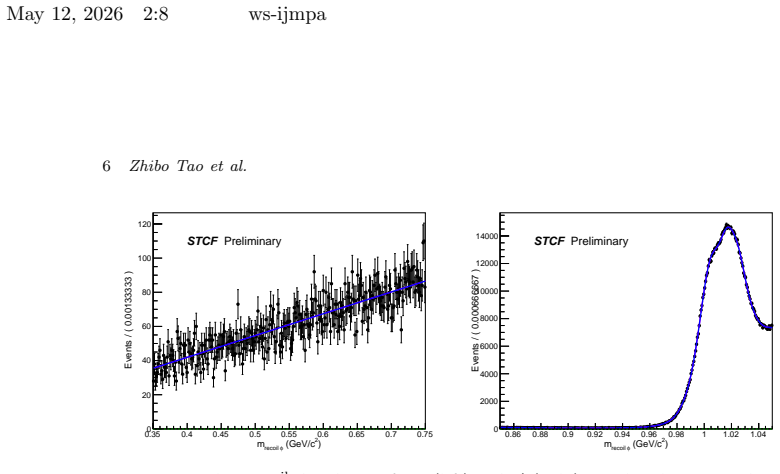
We present a preliminary feasibility study of searches for invisible decays of light mesons via $J/\psi \to VP$ $(V=\omega/\phi,P=\eta/\eta')$ using a traditional analytical method at the proposed Super $\tau$-Charm facility (STCF) which is expected to accumulate $3.4\times10^{12}$ $J/\psi$ events per year, based on an inclusive Monte Carlo sample of $1.3 \times 10^{9}$ $J/\psi$ events. The upper limits on the invisible decay branching fractions at the 90\% confidence level are set as $\mathcal{B}(\omega \to invisible) < 3.7 \times 10^{-7}$, $\mathcal{B}(\phi \to invisible) < 8.9 \times 10^{-7}$, $\mathcal{B}(\eta \to invisible) < 1.8 \times 10^{-7}$ and $\mathcal{B}(\eta' \to invisible) < 4.1 \times 10^{-7}$, respectively, using a projected toy data corresponding to the expected STCF statistics. By using the machine learning technique such as Deep Learning, the upper limit may be further improved to approach theoretical predictions for light dark matter.
Editorial analysis
A structured set of objections, weighed in public.
Referee Report
Summary. The manuscript presents a preliminary feasibility study for searches of invisible decays of the light mesons ω, φ, η, and η' produced in J/ψ → V P decays at the proposed Super τ-Charm Facility (STCF). Based on an inclusive Monte Carlo sample of 1.3 × 10^9 J/ψ events, the authors scale to the expected annual luminosity of 3.4 × 10^12 J/ψ events and use toy data to set projected 90% confidence level upper limits on the invisible branching fractions: B(ω → invisible) < 3.7 × 10^{-7}, B(φ → invisible) < 8.9 × 10^{-7}, B(η → invisible) < 1.8 × 10^{-7}, and B(η' → invisible) < 4.1 × 10^{-7}. The study employs a traditional analytical method with missing momentum reconstruction and notes that deep learning could further improve the sensitivity.
Significance. If the Monte Carlo scaling assumptions hold, these projected limits would represent a significant improvement over current constraints and could probe regions of parameter space for light dark matter models. The work highlights the physics potential of the STCF for rare decay searches using the J/ψ → VP tag. Strengths include the use of both conventional and suggested advanced analysis techniques. However, the projected nature means the actual impact depends on the realization of the detector performance as assumed.
major comments (1)
- [§4] The upper limits quoted in the abstract and §4 are obtained by scaling the inclusive MC sample of 1.3×10^9 events to 3.4×10^12 events via toy data. This scaling assumes that background rates, efficiencies, and missing momentum resolution scale linearly without additional contributions from pile-up, machine backgrounds, or changes in detector response at the higher luminosity; no quantitative study of these effects is provided, which is load-bearing for the validity of the quoted limits such as B(η → invisible) < 1.8 × 10^{-7}.
minor comments (2)
- [Abstract] The abstract mentions 'a traditional analytical method' but does not specify the details of the selection criteria or fitting procedure used in the projection.
- Consider adding a table summarizing the expected signal and background yields in the toy data for each channel to improve clarity.
Simulated Author's Rebuttal
We thank the referee for the detailed review and constructive feedback on our preliminary feasibility study. We address the major comment below and agree that additional clarification on the scaling assumptions is needed to strengthen the manuscript. The revisions will be incorporated in the next version.
read point-by-point responses
-
Referee: [§4] The upper limits quoted in the abstract and §4 are obtained by scaling the inclusive MC sample of 1.3×10^9 events to 3.4×10^12 events via toy data. This scaling assumes that background rates, efficiencies, and missing momentum resolution scale linearly without additional contributions from pile-up, machine backgrounds, or changes in detector response at the higher luminosity; no quantitative study of these effects is provided, which is load-bearing for the validity of the quoted limits such as B(η → invisible) < 1.8 × 10^{-7}.
Authors: We appreciate the referee pointing out this key assumption in our projection. As stated in the manuscript, this is a preliminary feasibility study based on an inclusive Monte Carlo sample of 1.3×10^9 J/ψ events, scaled to the expected 3.4×10^12 events per year at STCF using toy data. The linear scaling of backgrounds, efficiencies, and missing-momentum resolution is a standard approach for such early projections when full high-luminosity detector simulations (including pile-up and machine backgrounds) are not yet available. We acknowledge that non-linear effects from pile-up, machine backgrounds, or changes in detector response could modify the sensitivity. In the revised manuscript, we will add a new paragraph in Section 4 explicitly discussing these assumptions, stating that the quoted limits represent optimistic projections under ideal conditions, and noting that a more detailed simulation study will be required once the STCF detector design and luminosity-dependent backgrounds are better defined. This will not change the numerical results but will better contextualize their scope. revision: partial
Circularity Check
Projected upper limits from scaled MC simulation exhibit no circularity
full rationale
The paper conducts a feasibility study by taking a fixed inclusive MC sample of 1.3e9 J/ψ events to model efficiencies, backgrounds, and missing-momentum reconstruction, then scaling the statistics linearly to generate toy data at the projected STCF luminosity of 3.4e12 events. Upper limits are computed from this toy data via standard statistical procedures. No equation or step defines the reported branching-fraction limits in terms of themselves, renames a fitted parameter as a prediction, or relies on a self-citation chain for the central result. The MC scaling assumptions are external inputs and do not reduce the derivation to its own outputs.
Axiom & Free-Parameter Ledger
Reference graph
Works this paper leans on
-
[1]
L. N. Chang, O. Lebedev and J. N. Ng,Phys. Lett. B441, 419 (1998)
work page 1998
-
[2]
C. Bœhm, X. Chu, J.-L. Kuo and J. Pradler,Phys. Rev. D103, 075005 (2021)
work page 2021
- [3]
-
[4]
E. Bertuzzo, C. J. Caniu Barros and G. Grilli di Cortona,JHEP2017, 116 (2017)
work page 2017
- [5]
- [6]
-
[7]
J. F. Beacom, N. F. Bell and G. Bertone,Phys. Rev. Lett.94, 171301 (2005)
work page 2005
- [8]
- [9]
-
[10]
N. Arkani-Hamed, D. P. Finkbeiner, T. R. Slatyer and N. Weiner,Phys. Rev. D79, 015014 (2009)
work page 2009
-
[11]
McElrath,arXiv:0712.0016 [hep-ph]
B. McElrath,arXiv:0712.0016 [hep-ph]. May 12, 2026 2:8 ws-ijmpa Invisible decays of light mesons11
-
[12]
BESIII Collaboration (M. Ablikimet al.),Phys. Rev. D98, 032001 (2018)
work page 2018
-
[13]
BESIII Collaboration (M. Ablikimet al.),Phys. Rev. D87, 012009 (2013)
work page 2013
- [14]
-
[15]
GEANT4 Collaboration (S. Agostinelliet al.),Nucl. Instrum. Meth. A506, 250 (2003)
work page 2003
-
[16]
Particle Data Group Collaboration (S. Navaset al.),Phys. Rev. D110, 030001 (2024)
work page 2024
-
[17]
J. C. Chen, G. S. Huang, X. R. Qi, D. H. Zhang and Y. S. Zhu,Phys. Rev. D62, 034003 (2000)
work page 2000
-
[18]
ARGUS Collaboration (H. Albrechtet al.),Phys. Lett. B241, 278 (1990)
work page 1990
-
[19]
A. Vaswaniet al.,arXiv:1706.03762 [cs.CL]
work page internal anchor Pith review Pith/arXiv arXiv
- [20]
discussion (0)
Sign in with ORCID, Apple, or X to comment. Anyone can read and Pith papers without signing in.