Recognition: no theorem link
Orbital and Spin Nernst Effects in Monolayers of Transition Metal Dichalcogenides
Pith reviewed 2026-05-12 02:23 UTC · model grok-4.3
The pith
Monolayers of transition metal dichalcogenides generate transverse orbital currents from temperature gradients without spin-orbit coupling.
A machine-rendered reading of the paper's core claim, the machinery that carries it, and where it could break.
Core claim
The central discovery is that the orbital Nernst effect in TMD monolayers arises from orbital Berry curvature and does not require spin-orbit coupling, while the spin Nernst effect does require it and scales with its magnitude; both can be calculated analytically in the valley approximation and numerically in the full Brillouin zone, with doping controlling the response in semiconducting cases.
What carries the argument
Orbital Berry curvature within the low-energy valley model and tight-binding band structure, which generates the Nernst conductivity for orbital angular momentum transport.
If this is right
- The orbital Nernst conductivity is finite in doped MoS2 and intrinsic in NbS2.
- The spin Nernst effect scales with spin-orbit coupling strength and vanishes without it.
- Doping provides a route to tune both orbital and spin Nernst responses.
- These effects can be detected in a setup with temperature gradient and transverse current measurement.
Where Pith is reading between the lines
- If the orbital Nernst effect is confirmed, similar thermal orbital responses may exist in other valleytronic 2D systems.
- Thermal generation of orbital currents could offer an energy-efficient alternative to electrical driving in orbitronic devices.
- The separation of orbital and spin contributions allows independent study of each in materials with tunable SOC.
Load-bearing premise
The low-energy valley model and tight-binding calculations accurately represent the Berry curvatures responsible for the Nernst effects without major interference from disorder, scattering, or distant bands.
What would settle it
An experiment observing no transverse orbital current in a doped MoS2 monolayer under a temperature gradient, or a current that does not vanish when spin-orbit coupling is effectively absent, would contradict the claim.
Figures




read the original abstract
In recent years, orbitronic effects have attracted growing attention as complementary counterparts to the well-established spintronic phenomena. In this work, we demonstrate that monolayers of transition metal dichalcogenides provide an excellent platform for the observation of the orbital Nernst effect, a relatively less explored phenomenon describing the generation of a transverse orbital current in response to an applied temperature gradient. We show that, similar to its electrical counterpart, viz., the orbital Hall effect, the orbital Nernst effect does not require the presence of spin-orbit coupling. Analytical results based on a low-energy valley model offer key insights into the underlying mechanisms, highlighting in particular the crucial role of electronic states at the Fermi energy for the emergence of this effect. The inclusion of spin-orbit coupling further gives rise to a spin Nernst effect, which scales with the strength of spin-orbit coupling and vanishes in its absence. We substantiate our analytical findings with full Brillouin-zone tight-binding results for two representative systems, monolayer 2H MoS$_2$ and 2H NbS$_2$. Our results show that while both orbital and spin Nernst conductivities in MoS$_2$ require electron or hole doping, both effects are intrinsically present in metallic NbS$_2$. Our work reveals the central role of orbital and spin Berry curvatures, identifies doping as an effective route for tuning orbital and spin Nernst responses, and proposes a possible experimental setup for detecting these effects in monolayer transition metal dichalcogenides.
Editorial analysis
A structured set of objections, weighed in public.
Referee Report
Summary. The paper claims that monolayers of transition metal dichalcogenides (TMDs) such as MoS₂ and NbS₂ provide an excellent platform for the orbital Nernst effect, in which a temperature gradient generates a transverse orbital current. Analytical results from a low-energy valley model show that this effect arises from orbital Berry curvature at the Fermi energy and does not require spin-orbit coupling (SOC); inclusion of SOC additionally produces a spin Nernst effect that scales with SOC strength and vanishes without it. These analytic findings are substantiated by full Brillouin-zone tight-binding calculations, which indicate that both effects require doping in semiconducting MoS₂ but are intrinsic in metallic NbS₂. Doping is identified as a tuning parameter, and an experimental detection scheme is proposed.
Significance. If the central claims hold, the work establishes TMD monolayers as a tunable platform for orbitronic transport phenomena complementary to spintronics. The demonstration that the orbital Nernst effect is intrinsic (SOC-independent) and the explicit separation of orbital versus spin contributions via Berry curvature provide mechanistic clarity that could guide experiments. The contrast between doped MoS₂ and intrinsic NbS₂, together with the proposed measurement geometry, offers concrete predictions for thermoelectric and orbital-current devices.
major comments (2)
- [low-energy valley model] The low-energy valley model (analytical section) assumes constant orbital moment and parabolic dispersion near K/K' valleys. At the doping levels where sizable Nernst signals appear (chemical potentials ~0.1–0.2 eV), trigonal warping and remote-band mixing become relevant; the manuscript provides no explicit range-of-validity estimate or error bound for the analytic orbital-Nernst formula once these terms are restored.
- [tight-binding results for MoS₂ and NbS₂] Tight-binding results section: although full-BZ numerics are shown for MoS₂ and NbS₂, there is no direct quantitative comparison (e.g., overlay plot or table) of the valley-model orbital-Nernst conductivity versus the TB value evaluated at identical Fermi energies. Without this cross-check, the assertion that the low-energy model captures the essential physics—and therefore that the orbital Nernst effect is “intrinsically present” in NbS₂—remains unverified.
minor comments (2)
- [abstract and results] The abstract states that both effects “require electron or hole doping” in MoS₂; the main text should explicitly quote the doping window (in eV or carrier density) over which the TB conductivities are appreciable.
- [methods] Notation for the Nernst conductivity tensor (orbital versus spin components) could be introduced once in the methods and used consistently in all figures and equations.
Simulated Author's Rebuttal
We thank the referee for the positive assessment and constructive feedback on our manuscript. We agree that clarifying the validity range of the low-energy model and providing a direct quantitative comparison with the tight-binding results will strengthen the presentation. Below we address each major comment and commit to revisions that incorporate these points.
read point-by-point responses
-
Referee: [low-energy valley model] The low-energy valley model (analytical section) assumes constant orbital moment and parabolic dispersion near K/K' valleys. At the doping levels where sizable Nernst signals appear (chemical potentials ~0.1–0.2 eV), trigonal warping and remote-band mixing become relevant; the manuscript provides no explicit range-of-validity estimate or error bound for the analytic orbital-Nernst formula once these terms are restored.
Authors: We acknowledge that the low-energy valley model is an effective approximation whose accuracy decreases at higher doping where trigonal warping and remote-band effects become non-negligible. Our full Brillouin-zone tight-binding calculations already incorporate these higher-order terms and show that the orbital Nernst conductivity remains sizable and qualitatively consistent with the analytic prediction even at chemical potentials of 0.1–0.2 eV. To make this explicit, we will add a dedicated paragraph in the revised manuscript that estimates the doping range of validity by comparing the analytic formula against the tight-binding results and notes the doping level at which deviations exceed 20%. revision: yes
-
Referee: [tight-binding results for MoS₂ and NbS₂] Tight-binding results section: although full-BZ numerics are shown for MoS₂ and NbS₂, there is no direct quantitative comparison (e.g., overlay plot or table) of the valley-model orbital-Nernst conductivity versus the TB value evaluated at identical Fermi energies. Without this cross-check, the assertion that the low-energy model captures the essential physics—and therefore that the orbital Nernst effect is “intrinsically present” in NbS₂—remains unverified.
Authors: We agree that an explicit side-by-side comparison is needed to quantify how well the valley model reproduces the full-band results. In the revised manuscript we will add a new figure (or panel) that overlays the orbital Nernst conductivity obtained from the analytic valley model against the tight-binding value evaluated at the same Fermi energies for both MoS₂ (doped) and NbS₂ (intrinsic). A supplementary table will also list the relative deviation at representative doping levels. This cross-check will directly support our claim that the low-energy model captures the essential physics and that the orbital Nernst effect is intrinsic in metallic NbS₂. revision: yes
Circularity Check
No circularity: derivations use independent standard models
full rationale
The paper computes orbital and spin Nernst conductivities from Berry curvatures obtained via a standard low-energy valley model (parabolic/linear dispersion near K/K' points) and full Brillouin-zone tight-binding Hamiltonians for MoS2 and NbS2. These band structures and the Nernst formulas are not defined in terms of each other; the models pre-exist the target observables and are not fitted to Nernst data. No self-citations, uniqueness theorems, or ansatzes from the authors' prior work are invoked as load-bearing steps. The chain is therefore self-contained and externally verifiable against known TMD band structures.
Axiom & Free-Parameter Ledger
axioms (2)
- domain assumption Low-energy valley model approximates the band structure near K and K' points sufficiently for Nernst conductivity calculations
- domain assumption Tight-binding model for 2H-MoS2 and 2H-NbS2 captures the essential orbital and spin Berry curvatures across the full Brillouin zone
Reference graph
Works this paper leans on
-
[1]
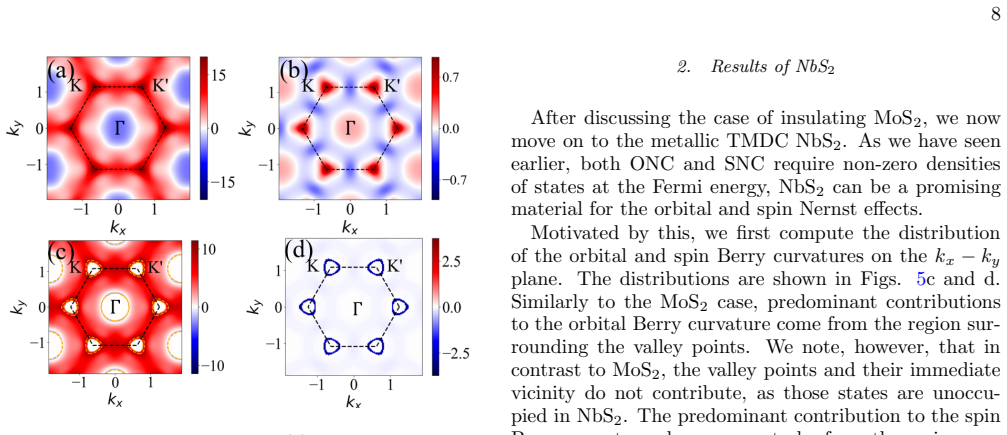
Results of MoS 2 As discussed in section III, the key quantities in de- termining the OHC, ONC, and their spin counterparts, viz., SHC and SNC are respectively the orbital and spin Berry curvatures. We, therefore, compute the distribu- tion of these quantities on thek x −k y plane of the BZ of MoS 2, using Eqs. (11) and (12), respectively, within the tigh...
-
[2]
Results of NbS 2 After discussing the case of insulating MoS 2, we now move on to the metallic TMDC NbS 2. As we have seen earlier, both ONC and SNC require non-zero densities of states at the Fermi energy, NbS 2 can be a promising material for the orbital and spin Nernst effects. Motivated by this, we first compute the distribution of the orbital and spi...
work page 2024
-
[3]
S. Pancharatnam, Generalized theory of interference, and its applications, Proceedings of the Indian Academy of Sciences, Section A44(1956)
work page 1956
-
[4]
C. A. Mead, The geometric phase in molecular systems, Rev. Mod. Phys.64, 51 (1992)
work page 1992
-
[5]
D. Xiao, M.-C. Chang, and Q. Niu, Berry phase effects on electronic properties, Rev. Mod. Phys.82, 1959 (2010)
work page 1959
-
[6]
D. J. Thouless, Localisation and the two-dimensional hall effect, J. Phys. C: Solid State Phys.14(1981)
work page 1981
-
[7]
T. Jungwirth, Q. Niu, and A. H. MacDonald, Anomalous hall effect in ferromagnetic semiconductors, Phys. Rev. Lett.88, 207208 (2002)
work page 2002
-
[8]
T. Thonhauser, D. Ceresoli, D. Vanderbilt, and R. Resta, Orbital magnetization in periodic insulators, Phys. Rev. Lett.95, 137205 (2005)
work page 2005
-
[9]
K. Y. Bliokh, A. Niv, V. Kleiner, and E. Hasman, Ge- ometrodynamics of spinning light, Nature Photonics2 (2008)
work page 2008
- [10]
-
[12]
V. o. T. Phong, Z. Addison, S. Ahn, H. Min, R. Agar- wal, and E. J. Mele, Optically controlled orbitronics on a triangular lattice, Phys. Rev. Lett.123, 236403 (2019)
work page 2019
-
[13]
E. Hall, Xxxviii. on the new action of mag- netism on a permanent electric current, The Lon- don, Edinburgh, and Dublin Philosophical Mag- azine and Journal of Science10, 301 (1880), https://doi.org/10.1080/14786448008626936
-
[14]
E. Hall, Xviii. on the “rotational coefficient” in nickel and cobalt, The London, Edinburgh, and Dublin Philo- sophical Magazine and Journal of Science12, 157 (1881), https://doi.org/10.1080/14786448108627086
-
[15]
K. von Klitzing, T. Chakraborty, P. Kim,et al., 40 years of the quantum hall effect, Nature Reviews Physics2, 397 (2020)
work page 2020
-
[16]
A. v. Ettingshausen and W. Nernst, Ueber das auftreten electromotorischer kr¨ afte in metallplatten, welche von einem w¨ armestrome durchflossen werden und sich im magnetischen felde befinden, Annalen der Physik265, 343 (1886)
-
[17]
Shitade, Spin accumulation in the spin nernst effect, Phys
A. Shitade, Spin accumulation in the spin nernst effect, Phys. Rev. B106, 045203 (2022)
work page 2022
-
[18]
I. ˇZuti´ c, J. Fabian, and S. Das Sarma, Spintronics: Fun- damentals and applications, Rev. Mod. Phys.76, 323 (2004)
work page 2004
-
[19]
Fert, Nobel lecture: Origin, development, and future of spintronics, Rev
A. Fert, Nobel lecture: Origin, development, and future of spintronics, Rev. Mod. Phys.80, 1517 (2008)
work page 2008
- [20]
-
[21]
M. Meyer, J. Baumbach, S. Krishtopenko, A. Wolf, M. Emmerling, S. Schmid, M. Kamp, B. Jouault, J.-B. Rodriguez, E. Tournie, T. M¨ uller, R. Thomale, G. Bas- tard, F. Teppe, F. Hartmann, and S. H¨ ofling, Quantum 12 spin hall effect in iii-v semiconductors at elevated temper- atures: Advancing topological electronics, Science Ad- vances11, eadz2408 (2025)
work page 2025
-
[22]
L. M. Canonico, T. P. Cysne, T. G. Rappoport, and R. B. Muniz, Two-dimensional orbital hall insulators, Phys. Rev. B101, 075429 (2020)
work page 2020
-
[23]
A. Manchon, J. ˇZelezn´ y, I. M. Miron, T. Jungwirth, J. Sinova, A. Thiaville, K. Garello, and P. Gambardella, Current-induced spin-orbit torques in ferromagnetic and antiferromagnetic systems, Rev. Mod. Phys.91, 035004 (2019)
work page 2019
-
[24]
S. Fukami, K.-J. Lee, and M. Kl¨ aui, Challenges and opportunities in orbitronics, Nature Physics 10.1038/s41567-025-03143-w (2025)
-
[25]
J. Shi, G. Vignale, D. Xiao, and Q. Niu, Quantum theory of orbital magnetization and its generalization to inter- acting systems, Phys. Rev. Lett.99, 197202 (2007)
work page 2007
-
[26]
D. Tian, Y. Li, D. Qu, S. Y. Huang, X. Jin, and C. L. Chien, Manipulation of pure spin current in ferromag- netic metals independent of magnetization, Phys. Rev. B 94, 020403(R) (2016)
work page 2016
-
[27]
G.-Y. Guo, Anisotropic spin hall and spin nernst effects in bismuth semimetal, Journal of Magnetism and Mag- netic Materials563, 169949 (2022)
work page 2022
-
[28]
Y. K. Kato, R. C. Myers, A. C. Gossard, and D. D. Awschalom, Observation of the spin hall effect in semi- conductors, Science306, 1910 (2004)
work page 1910
- [29]
-
[30]
E. Derunova, Y. Sun, C. Felser, S. S. P. Parkin, and B. Yan, Giant intrinsic spin hall effect in w 3ta and other a15 superconductors, Science Advances5, eaav8575 (2019)
work page 2019
-
[31]
Y. Sun, Y. Zhang, C. Felser, and B. Yan, Strong intrinsic spin hall effect in the taas family of weyl semimetals, Phys. Rev. Lett.117, 146403 (2016)
work page 2016
- [32]
- [33]
-
[34]
D. Go, D. Jo, C. Kim, and H.-W. Lee, Intrinsic spin and orbital hall effects from orbital texture, Phys. Rev. Lett. 121, 086602 (2018)
work page 2018
-
[35]
L. M. Canonico, T. P. Cysne, A. Molina-Sanchez, R. B. Muniz, and T. G. Rappoport, Orbital hall insulating phase in transition metal dichalcogenide monolayers, Phys. Rev. B101, 161409(R) (2020)
work page 2020
-
[36]
B. A. Bernevig, T. L. Hughes, and S.-C. Zhang, Orbi- tronics: The intrinsic orbital current inp-doped silicon, Phys. Rev. Lett.95, 066601 (2005)
work page 2005
-
[37]
J. L. Costa, E. Santos, J. B. S. Mendes, and A. Azevedo, Dominance of the orbital hall effect over spin in transition metal heterostructures, Phys. Rev. B112, 054443 (2025)
work page 2025
-
[38]
T. P. Cysne, F. S. M. Guimar˜ aes, L. M. Canonico, T. G. Rappoport, and R. B. Muniz, Orbital magnetoelectric ef- fect in zigzag nanoribbons ofp-band systems, Phys. Rev. B104, 165403 (2021)
work page 2021
-
[39]
S. Bhowal and S. Satpathy, Intrinsic orbital moment and prediction of a large orbital hall effect in two- dimensional transition metal dichalcogenides, Phys. Rev. B101, 121112(R) (2020)
work page 2020
-
[40]
S. Bhowal and G. Vignale, Orbital hall effect as an al- ternative to valley hall effect in gapped graphene, Phys. Rev. B103, 195309 (2021)
work page 2021
-
[41]
F. Xue, V. Amin, and P. M. Haney, Imaging the valley and orbital hall effect in monolayer mos 2, Phys. Rev. B 102, 161103 (2020)
work page 2020
-
[42]
G. Sala, H. Wang, W. Legrand, and P. Gambardella, Or- bital hanle magnetoresistance in a 3dtransition metal, Phys. Rev. Lett.131, 156703 (2023)
work page 2023
- [43]
- [44]
-
[45]
S. Bhowal and S. Satpathy, Orbital gyrotropic magne- toelectric effect and its strain engineering in monolayer NbX2, Phys. Rev. B102, 201403(R) (2020)
work page 2020
-
[46]
Interplay of Valley, Orbital, Spin, and Layer Degrees of Freedom in Ta$_2$CS$_2$ MXene
K. Dutta, A. Mondal, S. Bhowal, S. Ghosh, and I. Das- gupta, Interplay of valley, orbital, spin, and layer degrees of freedom in ta 2cs2 mxene (2026), arXiv:2605.01271 [cond-mat.str-el]
work page internal anchor Pith review Pith/arXiv arXiv 2026
-
[47]
C. Kittel, Surface and interface physics, inIntroduction to Solid State Physics(Wiley, New York, 2004) Chap. 17, pp. 487–514
work page 2004
-
[48]
T. P. Cysne, L. M. Canonico, M. Costa, R. B. Muniz, and T. G. Rappoport, Orbitronics in two-dimensional mate- rials, npj Spintronics3, 39 (2025)
work page 2025
-
[49]
T. P. Cysne, M. Costa, L. M. Canonico, M. B. Nardelli, R. B. Muniz, and T. G. Rappoport, Disentangling or- bital and valley hall effects in bilayers of transition metal dichalcogenides, Phys. Rev. Lett.126, 056601 (2021)
work page 2021
-
[50]
T. P. Cysne, S. Bhowal, G. Vignale, and T. G. Rap- poport, Orbital hall effect in bilayer transition metal dichalcogenides: From the intra-atomic approximation to the bloch states orbital magnetic moment approach, Phys. Rev. B105, 195421 (2022)
work page 2022
-
[51]
P. Sahu, S. Bhowal, and S. Satpathy, Effect of the in- version symmetry breaking on the orbital hall effect: A model study, Physical Review B103, 085113 (2021)
work page 2021
-
[52]
D. Jo, D. Go, and H.-W. Lee, Gigantic intrinsic orbital hall effects in weakly spin-orbit coupled metals, Phys. Rev. B98, 214405 (2018)
work page 2018
-
[53]
S. Bhowal and S. Satpathy, Intrinsic orbital and spin hall effects in monolayer transition metal dichalcogenides, Phys. Rev. B102, 035409 (2020)
work page 2020
-
[54]
P. Sahu, J. K. Bidika, B. Biswal, S. Satpathy, and B. R. K. Nanda, Emergence of giant orbital hall and tun- able spin hall effects in centrosymmetric transition metal dichalcogenides, Phys. Rev. B110, 054403 (2024)
work page 2024
-
[55]
G. Sala and P. Gambardella, Giant orbital hall effect and orbital-to-spin conversion in 3d, 5d, and 4fmetallic het- erostructures, Phys. Rev. Res.4, 033037 (2022)
work page 2022
-
[56]
A. Pezo, D. Garc´ ıa Ovalle, and A. Manchon, Orbital hall physics in two-dimensional dirac materials, Phys. Rev. B 108, 075427 (2023)
work page 2023
-
[57]
H. Hayashi, D. Jo, D. Go, T. Gao, S. Haku, Y. Mokrousov, H.-W. Lee, and K. Ando, Observation of long-range orbital transport and giant orbital torque, (2023)
work page 2023
-
[58]
Q. Yang, J. Xiao, I. Robredo, M. G. Vergniory, B. Yan, and C. Felser, Monopole-like orbital-momentum locking 13 and the induced orbital transport in topological chiral semimetals, Proceedings of the National Academy of Sci- ences of the United States of America120, e2305541120 (2023)
work page 2023
- [59]
-
[60]
I. Baek and H.-W. Lee, Negative intrinsic orbital hall effect in group xiv materials, Phys. Rev. B104, 245204 (2021)
work page 2021
-
[61]
L. Salemi and P. M. Oppeneer, First-principles theory of intrinsic spin and orbital hall and nernst effects in metallic monoatomic crystals, Phys. Rev. Materials6, 095001 (2022)
work page 2022
- [62]
-
[63]
A. Rani, A. Verma, and B. C. Yadav, Advancements in transition metal dichalcogenides (tmdcs) for self-powered photodetectors: challenges, properties, and functional- ization strategies, Materials Advances6(2024)
work page 2024
-
[64]
M. Cutler and N. F. Mott, Observation of anderson local- ization in an electron gas, Phys. Rev.181, 1336 (1969)
work page 1969
-
[65]
O. K. Andersen and T. Saha-Dasgupta, Muffin-tin or- bitals of arbitrary order, Physical Review B62, R16219 (2000)
work page 2000
- [66]
-
[67]
D. J. Kim, C. Y. Jeon, J. G. Choi, J. W. Lee, S. Surabhi, J. R. Jeong, K. J. Lee, and B. G. Park, Observation of transverse spin nernst magnetoresistance induced by thermal spin current in ferromagnet/non- magnet bilayers, Nature Communications8, 1400 (2017), erratum in: Nature Communications (2018), 9(1):138, doi:10.1038/s41467-017-02303-8
-
[68]
A. Bose, R. Jain, J. J. Bauer, R. A. Buhrman, C. A. Ross, and D. C. Ralph, Origin of transverse voltages generated by thermal gradients and electric fields in ferrimagnetic-insulator/heavy-metal bilayers, Phys. Rev. B105, L100408 (2022)
work page 2022
-
[69]
R. Jain, M. Stanley, A. Bose, A. R. Richardella, X. S. Zhang, T. Pillsbury, D. A. Muller, N. Samarth, and D. C. Ralph, Thermally generated spin current in the topologi- cal insulator bi2se3, Science Advances9, eadi4540 (2023), epub 2023 Dec 13
work page 2023
-
[70]
Y. K. Kato, R. C. Myers, A. C. Gossard, and D. D. Awschalom, Observation of the spin hall effect in semi- conductors, Science306, 1910 (2004), epub 2004 Nov 11
work page 1910
-
[71]
Y. G. Choi, D. Jo, K. H. Ko, D. Go, K. H. Kim, H. G. Park, C. Kim, B. C. Min, G. M. Choi, and H. W. Lee, Observation of the orbital hall effect in a light metal ti, Nature619, 52 (2023), epub 2023 Jul 5
work page 2023
-
[72]
A. Bose, S. Bhuktare, H. Singh, S. Dutta, V. G. Achanta, and A. Tulapurkar, Direct detection of spin nernst effect in platinum, Applied Physics Letters112, 162401 (2018)
work page 2018
-
[73]
A. Bose, A. S. Shukla, S. Dutta, S. Bhuktare, H. Singh, and A. A. Tulapurkar, Control of magnetization dy- namics by spin-nernst torque, Phys. Rev. B98, 184412 (2018)
work page 2018
-
[74]
J. M. Kim, D. J. Kim, C. Y. Cheon, K. W. Moon, C. Kim, P. Cao Van, J. R. Jeong, C. Hwang, K. J. Lee, and B. G. Park, Observation of thermal spin-orbit torque in w/cofeb/mgo structures, Nano Letters20, 7803 (2020), epub 2020 Oct 15
work page 2020
-
[75]
D. Lee, D. Go, H.-J. Park, W. Jeong, H.-W. Ko, D. Yun, D. Jo, S. Lee, G. Go, J. H. Oh, K.-J. Kim, B.-G. Park, B.-C. Min, H. C. Koo, H.-W. Lee, O. Lee, and K.-J. Lee, Orbital torque in magnetic bilayers, Nature Communica- tions12, 6710 (2021)
work page 2021
-
[76]
A. Bose, F. Kammerbauer, R. Gupta, D. Go, Y. Mokrousov, G. Jakob, and M. Kl¨ aui, Detection of long-range orbital-hall torques, Phys. Rev. B107, 134423 (2023)
work page 2023
discussion (0)
Sign in with ORCID, Apple, or X to comment. Anyone can read and Pith papers without signing in.