Recognition: unknown
Interplay of Valley, Orbital, Spin, and Layer Degrees of Freedom in Ta₂CS₂ MXene
Pith reviewed 2026-05-09 18:20 UTC · model grok-4.3
The pith
Ta_{2}CS_{2} MXene hosts coupled valley, orbital, spin and layer degrees of freedom that enable tunable spin splittings and Hall effects.
A machine-rendered reading of the paper's core claim, the machinery that carries it, and where it could break.
Core claim
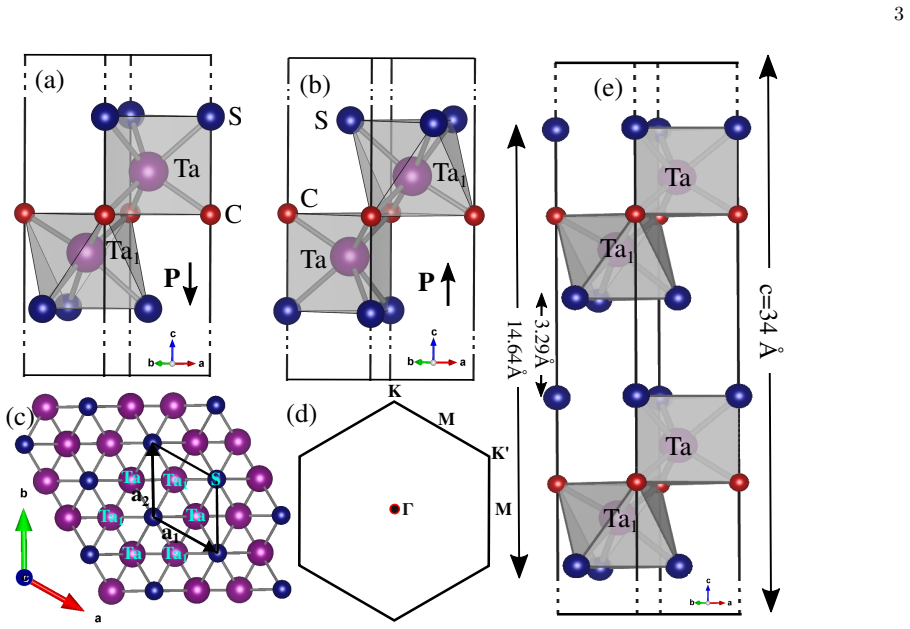
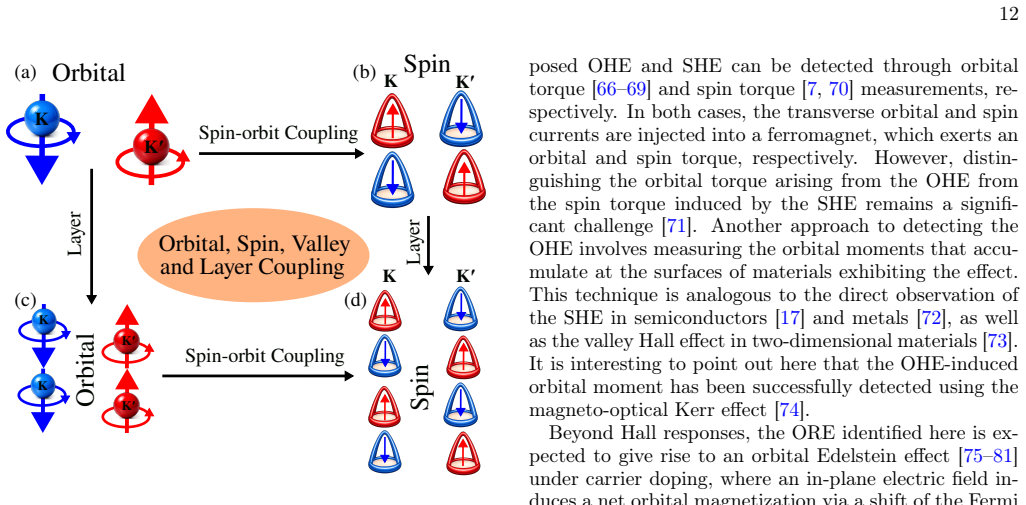
Ta_{2}CS_{2} MXene provides an excellent platform for hosting multiple coupled degrees of freedom, viz., valley, spin, orbital, and layer. The interplay among these degrees of freedom gives rise to a range of intriguing properties in reciprocal space, including valley-orbital and orbital-layer coupling. In the presence of spin-orbit interaction, these couplings lead to valley-dependent and layer-dependent spin splitting of the electronic bands. The intrinsic electric polarization in Ta_{2}CS_{2} introduces an additional tuning parameter, enabling control over these coupled degrees of freedom and resulting in switchable valley-dependent orbital moments and Zeeman-like spin splitting. These 0n
What carries the argument
The valley-orbital and orbital-layer couplings in the band structure of Ta_{2}CS_{2} modulated by spin-orbit interaction and intrinsic electric polarization.
If this is right
- The electronic bands exhibit valley-dependent and layer-dependent spin splitting.
- Intrinsic electric polarization enables switching of valley-dependent orbital moments and Zeeman-like spin splitting.
- The orbital and spin textures manifest as orbital and spin Hall effects.
- Noncentrosymmetric MXenes are established as a promising platform for multiple degree of freedom interplay and spin-orbit transport.
Where Pith is reading between the lines
- Analogous couplings may be found in other noncentrosymmetric MXenes.
- These effects could be used to design devices that control both valley and spin information simultaneously.
- Transport experiments measuring the Hall conductivities could test the predicted textures.
Load-bearing premise
First-principles calculations accurately capture the couplings without significant errors from the exchange-correlation approximations or structural model.
What would settle it
Experimental observation of no valley-dependent spin splitting or no switchable orbital moments in Ta_{2}CS_{2} samples would falsify the claims.
Figures


read the original abstract
We show that the MXene Ta$_2$CS$_2$ provides an excellent platform for hosting multiple coupled degrees of freedom, viz., valley, spin, orbital, and layer. The interplay among these degrees of freedom gives rise to a range of intriguing properties in reciprocal space, including valley-orbital and orbital-layer coupling. In the presence of spin-orbit interaction, these couplings lead to valley-dependent and layer-dependent spin splitting of the electronic bands. We further show that the intrinsic electric polarization in Ta$_2$CS$_2$ introduces an additional tuning parameter, enabling control over these coupled degrees of freedom and resulting in switchable valley-dependent orbital moments and Zeeman-like spin splitting. We demonstrate that these nontrivial orbital and spin textures manifest in the orbital and spin Hall effects, respectively. Our results establish noncentrosymmetric MXenes as a promising platform for exploring the interplay among multiple degrees of freedom, their tunability, and the resulting orbital and spin transport phenomena in these two-dimensional materials, thereby paving the way for next-generation spin-orbitronic devices.
Editorial analysis
A structured set of objections, weighed in public.
Referee Report
Summary. The manuscript uses first-principles calculations to show that the noncentrosymmetric MXene Ta₂CS₂ hosts coupled valley, orbital, spin, and layer degrees of freedom. Valley-orbital and orbital-layer couplings are reported; inclusion of spin-orbit coupling produces valley-dependent and layer-dependent spin splittings. The material's intrinsic electric polarization is shown to act as a tuning knob that switches the sign of valley-dependent orbital moments and produces a Zeeman-like spin splitting. These orbital and spin textures are demonstrated to generate orbital and spin Hall effects, positioning noncentrosymmetric MXenes as platforms for spin-orbitronic phenomena.
Significance. If the reported couplings and transport responses are robust, the work identifies a concrete 2D material in which four degrees of freedom can be simultaneously addressed and electrically switched, extending the known phenomenology of MXenes and offering a potential route to electrically tunable orbital and spin currents.
major comments (2)
- [Computational Methods] The central claims rest on DFT+SOC calculations of band splittings, orbital moments, and Berry-phase-derived Hall conductivities, yet no benchmarks against GW, hybrid functionals, or Hubbard-corrected calculations are provided for the Ta 5d states. This is load-bearing because the valley-orbital coupling, layer-dependent spin splitting, and switchable orbital moments are all sensitive to the precise positioning of the d bands and the strength of SOC.
- [Results and Discussion] The demonstration of polarization-reversible orbital moments and Zeeman-like spin splitting lacks quantitative error bars or convergence tests with respect to k-mesh density and smearing; these quantities enter the orbital and spin Hall conductivities directly, so uncontrolled numerical uncertainty directly affects the claimed transport signatures.
minor comments (2)
- [Introduction] The abstract and introduction use the phrase 'excellent platform' without a quantitative comparison to other known valleytronic or spin-orbitronic 2D materials; a brief table of relevant energy scales would strengthen the claim.
- [Electronic Structure] Notation for the layer degree of freedom (e.g., how layer polarization is defined and computed) is introduced without an explicit equation or figure reference in the early sections.
Simulated Author's Rebuttal
We thank the referee for the constructive and positive review. The comments correctly identify areas where additional validation would strengthen the presentation of our DFT+SOC results. We address each major comment below and have incorporated revisions to improve the manuscript.
read point-by-point responses
-
Referee: [Computational Methods] The central claims rest on DFT+SOC calculations of band splittings, orbital moments, and Berry-phase-derived Hall conductivities, yet no benchmarks against GW, hybrid functionals, or Hubbard-corrected calculations are provided for the Ta 5d states. This is load-bearing because the valley-orbital coupling, layer-dependent spin splitting, and switchable orbital moments are all sensitive to the precise positioning of the d bands and the strength of SOC.
Authors: We agree that benchmarks would enhance confidence in the quantitative details. Full GW calculations remain computationally prohibitive for the polarized Ta₂CS₂ structure with the required dense k-sampling. However, we have added new calculations using the HSE06 hybrid functional for the key electronic bands and orbital moments near the Fermi level. These confirm that the valley-orbital coupling, the sign of the polarization-reversible orbital moments, and the layer-dependent spin splittings are qualitatively robust, with only small shifts (<0.2 eV) in band positions compared to PBE+SOC. We have inserted a dedicated paragraph in the Methods section and a short discussion in the Results, together with a supplementary figure comparing PBE+SOC and HSE06 results. We also reference prior MXene literature where PBE+SOC has been shown to capture the essential SOC-driven splittings. revision: yes
-
Referee: [Results and Discussion] The demonstration of polarization-reversible orbital moments and Zeeman-like spin splitting lacks quantitative error bars or convergence tests with respect to k-mesh density and smearing; these quantities enter the orbital and spin Hall conductivities directly, so uncontrolled numerical uncertainty directly affects the claimed transport signatures.
Authors: We appreciate this point. In the revised manuscript we have performed and documented explicit convergence tests. The orbital moments and both orbital and spin Hall conductivities were recomputed on k-meshes ranging from 6×6×1 to 24×24×1 and with Gaussian smearing from 0.005 eV to 0.02 eV. The reported values stabilize to within 4 % beyond a 12×12×1 mesh and 0.01 eV smearing. We have added these convergence plots to the Supplementary Information and included numerical error bars (derived from the residual variation) on the polarization-dependent orbital-moment and Hall-conductivity curves in the main-text figures. These additions directly address the concern about uncontrolled numerical uncertainty in the transport signatures. revision: yes
Circularity Check
No circularity: results are direct DFT outputs on material structure
full rationale
The paper computes electronic band structures, valley-orbital and orbital-layer couplings, SOC-induced spin splittings, polarization-tunable orbital moments, and orbital/spin Hall effects via standard first-principles methods applied to the Ta2CS2 lattice. No derivation step reduces by the paper's own equations to a fitted parameter renamed as prediction, nor does any central claim rest on a self-citation chain that itself lacks independent verification. The workflow is self-contained against external benchmarks such as known DFT implementations for 2D materials with SOC and Berry-phase quantities.
Axiom & Free-Parameter Ledger
axioms (1)
- domain assumption Density functional theory with spin-orbit coupling is sufficient to describe the valley, orbital, spin, and layer couplings in Ta₂CS₂
Forward citations
Cited by 1 Pith paper
-
Orbital and Spin Nernst Effects in Monolayers of Transition Metal Dichalcogenides
TMD monolayers exhibit an orbital Nernst effect independent of spin-orbit coupling and a spin Nernst effect that scales with it, both tunable by doping and arising from Berry curvatures.
Reference graph
Works this paper leans on
-
[1]
The transport of orbital angular momentum, manifested through phenomenon such as the OHE, forms the cen- tral theme of orbitronics
Atom Center Approximation (ACA) Since nontrivial orbital textures can give rise to the OHE [17], we now focus on investigating OHE in Ta2CS2. The transport of orbital angular momentum, manifested through phenomenon such as the OHE, forms the cen- tral theme of orbitronics. The orbital degree of freedom plays a role analogous to spin in conventional spintr...
-
[2]
Therefore, we further evaluate the OHE by incorporating both local and nonlocal contributions to the orbital angular mo- mentum (OAM) [10, 56]
Modern theory Within the ACA, only the local contribution of the orbital magnetic moment is retained, while the itiner- ant (nonlocal) contribution is neglected. Therefore, we further evaluate the OHE by incorporating both local and nonlocal contributions to the orbital angular mo- mentum (OAM) [10, 56]. The symmetrized form of the local OAM operator is g...
-
[3]
From the energy eigenvalues and eigenfunctions calcu- lated from the TB model in the presence of SOC, we com- pute the spin Berry curvature
and further indicates that both crystallographic en- vironment and the breaking of inversion-symmetry play crucial roles in shaping the spin-orbit driven band struc- ture in this system. From the energy eigenvalues and eigenfunctions calcu- lated from the TB model in the presence of SOC, we com- pute the spin Berry curvature. The spin Berry curvature is a...
2020
-
[4]
Sinova, S
J. Sinova, S. O. Valenzuela, J. Wunderlich, C. H. Back, and T. Jungwirth, Spin hall effects, Rev. Mod. Phys.87, 1213 (2015)
2015
-
[5]
von Klitzing, T
K. von Klitzing, T. Chakraborty, P. Kim, V. Madhavan, X. Dai, J. McIver, Y. Tokura, L. Savary, D. Smirnova, A. M. Rey, C. Felser, J. Gooth, and X. Qi, 40 years of the quantum hall effect, Nature Reviews Physics2, 397 (2020)
2020
-
[6]
B. A. Bernevig, T. L. Hughes, and S.-C. Zhang, Orbitron- ics: The intrinsic orbital current inp-doped silicon, Phys. Rev. Lett.95, 066601 (2005)
2005
-
[7]
V. o. T. Phong, Z. Addison, S. Ahn, H. Min, R. Agar- wal, and E. J. Mele, Optically controlled orbitronics on a triangular lattice, Phys. Rev. Lett.123, 236403 (2019). 13
2019
-
[8]
Žutić, J
I. Žutić, J. Fabian, and S. Das Sarma, Spintronics: Funda- mentals and applications, Rev. Mod. Phys.76, 323 (2004)
2004
-
[9]
Fert, Nobel lecture: Origin, development, and future of spintronics, Rev
A. Fert, Nobel lecture: Origin, development, and future of spintronics, Rev. Mod. Phys.80, 1517 (2008)
2008
-
[10]
Manchon, J
A. Manchon, J. Železný, I. M. Miron, T. Jungwirth, J. Sinova, A. Thiaville, K. Garello, and P. Gambardella, Current-induced spin-orbit torques in ferromagnetic and antiferromagnetic systems, Rev. Mod. Phys.91, 035004 (2019)
2019
-
[11]
T. P. Cysne, L. M. Canonico, M. Costa, R. B. Muniz, and T. G. Rappoport, Orbitronics in two-dimensional materi- als, npj Spintronics3, 39 (2025)
2025
-
[12]
S. Fukami, K.-J. Lee, and M. Kläui, Challenges and op- portunities in orbitronics, Nature Physics 10.1038/s41567- 025-03143-w (2025)
-
[13]
J. Shi, G. Vignale, D. Xiao, and Q. Niu, Quantum theory of orbital magnetization and its generalization to interact- ing systems, Phys. Rev. Lett.99, 197202 (2007)
2007
-
[14]
D. Tian, Y. Li, D. Qu, S. Y. Huang, X. Jin, and C. L. Chien, Manipulation of pure spin current in ferromagnetic metals independent of magnetization, Phys. Rev. B94, 020403 (2016)
2016
-
[15]
B. F. Miao, S. Y. Huang, D. Qu, and C. L. Chien, Inverse spin hall effect in a ferromagnetic metal, Phys. Rev. Lett. 111, 066602 (2013)
2013
-
[16]
J. L. Costa, E. Santos, J. B. S. Mendes, and A. Azevedo, Dominance of the orbital hall effect over spin in transition metal heterostructures, Phys. Rev. B112, 054443 (2025)
2025
-
[17]
Sinova, D
J. Sinova, D. Culcer, Q. Niu, N. A. Sinitsyn, T. Jung- wirth, and A. H. MacDonald, Universal intrinsic spin hall effect, Phys. Rev. Lett.92, 126603 (2004)
2004
-
[18]
M. U. Farooq, L. Xian, and L. Huang, Spin hall effect in two-dimensional inse: Interplay between rashba and dres- selhaus spin-orbit couplings, Phys. Rev. B105, 245405 (2022)
2022
-
[20]
D. Go, D. Jo, C. Kim, and H.-W. Lee, Intrinsic spin and orbital hall effects from orbital texture, Phys. Rev. Lett. 121, 086602 (2018)
2018
-
[21]
L. M. Canonico, T. P. Cysne, T. G. Rappoport, and R. B. Muniz,Two-dimensionalorbitalhallinsulators,Phys.Rev. B101, 075429 (2020)
2020
-
[22]
L. M. Canonico, T. P. Cysne, A. Molina-Sanchez, R. B. Muniz,andT.G.Rappoport,Orbitalhallinsulatingphase in transition metal dichalcogenide monolayers, Phys. Rev. B101, 161409 (2020)
2020
-
[23]
Q. Yang, J. Xiao, I. Robredo, M. G. Vergniory, B. Yan, and C. Felser, Monopole-like orbital-momentum locking and the induced orbital transport in topological chiral semimetals, Proceedings of the National Academy of Sci- ences120, e2305541120 (2023)
2023
-
[24]
Bhowal and S
S. Bhowal and S. Satpathy, Intrinsic orbital moment and prediction of a large orbital hall effect in two- dimensional transition metal dichalcogenides, Phys. Rev. B101, 121112 (2020)
2020
-
[25]
Bhowal and S
S. Bhowal and S. Satpathy, Intrinsic orbital and spin hall effects in monolayer transition metal dichalcogenides, Phys. Rev. B102, 035409 (2020)
2020
-
[26]
Bhowal and G
S. Bhowal and G. Vignale, Orbital hall effect as an alter- native to valley hall effect in gapped graphene, Phys. Rev. B103, 195309 (2021)
2021
-
[27]
P. Sahu, J. K. Bidika, B. Biswal, S. Satpathy, and B. R. K. Nanda, Emergence of giant orbital hall and tun- able spin hall effects in centrosymmetric transition metal dichalcogenides, Phys. Rev. B110, 054403 (2024)
2024
-
[28]
Baek and H.-W
I. Baek and H.-W. Lee, Negative intrinsic orbital hall effect in group xiv materials, Phys. Rev. B104, 245204 (2021)
2021
-
[29]
T. P. Cysne, M. Costa, L. M. Canonico, M. B. Nardelli, R. B. Muniz, and T. G. Rappoport, Disentangling or- bital and valley hall effects in bilayers of transition metal dichalcogenides, Phys. Rev. Lett.126, 056601 (2021)
2021
-
[30]
Mu and J
X. Mu and J. Zhou, Valley- dphysrevb.111.165102,ependent giant orbital moments and transport features in rhombohedral graphene multilayers, Phys. Rev. B111, 165102 (2025)
2025
-
[31]
T. P. Cysne, S. Bhowal, G. Vignale, and T. G. Rap- poport, Orbital hall effect in bilayer transition metal dichalcogenides: From the intra-atomic approximation to the bloch states orbital magnetic moment approach, Phys. Rev. B105, 195421 (2022)
2022
-
[32]
Sun and G
H. Sun and G. Vignale, Orbital magnetic moment dy- namics and hanle magnetoresistance in multilayered two- dimensional materials, Phys. Rev. B111, L180408 (2025)
2025
-
[33]
Derunova, Y
E. Derunova, Y. Sun, C. Felser, S. S. P. Parkin, B. Yan, and M. N. Ali, Giant intrinsic spin hall effect in w<sub>3</sub>ta and other a15 superconductors, Sci- ence Advances5, eaav8575 (2019)
2019
-
[34]
Y. Sun, Y. Zhang, C. Felser, and B. Yan, Strong intrinsic spin hall effect in the taas family of weyl semimetals, Phys. Rev. Lett.117, 146403 (2016)
2016
-
[35]
A. M. Jones, H. Yu, J. S. Ross, P. Klement, N. J. Ghimire, J. Yan, D. G. Mandrus, W. Yao, and X. Xu, Spin–layer locking effects in optical orientation of exciton spin in bilayer wse2, Nature Physics10, 130 (2014)
2014
-
[36]
X. Li, Z. Huang, C. E. Shuck, G. Liang, Y. Gogotsi, and C. Zhi, Mxene chemistry, electrochemistry and en- ergy storage applications, Nature Reviews Chemistry6, 389 (2022)
2022
-
[37]
Zhang, C
L. Zhang, C. Tang, C. Zhang, and A. Du, First-principles screening of novel ferroelectric mxene phases with a large piezoelectric response and unusual auxeticity, Nanoscale 12, 21291 (2020)
2020
-
[38]
J. L. Hart, K. Hantanasirisakul, A. C. Lang, B. Anasori, D.Pinto, Y.Pivak, J.T.vanOmme, S.J.May, Y.Gogotsi, and M. L. Taheri, Control of mxenes’ electronic properties through termination and intercalation, Nature Communi- cations10, 522 (2019)
2019
-
[39]
Walter, W
J. Walter, W. Boonchuduang, and S. Hara, Xps study on pristine and intercalated tantalum carbosulfide, Journal of Alloys and Compounds305, 259 (2000)
2000
-
[40]
Sakamaki, H
K. Sakamaki, H. Wada, H. Nozaki, Y. ¯Onuki, and M. Kawai, Topochemical formation of van der waals type niobium carbosulfide 1t-nb2s2c, Journal of Alloys and Compounds339, 283 (2002)
2002
-
[41]
Beckmann, H
O. Beckmann, H. Boller, and H. Nowotny, Die kristall- strukturen von ta2s2c und ti4s5 (ti0,81s), Monatshefte für Chemie / Chemical Monthly101, 945 (1970)
1970
-
[42]
14 References [86-89] correspond to the references cited in the Supplemental Material
Interplay of valley, orbital, spin, and layer degrees of freedom in ta 2cs2 mxene, , the Supplemental Material covers bilayer Ta2CS2 phonon calculations, LMTO and NMTO band structure comparison, and hopping param- eters for the Ta2CS2 monolayer with both polarisations. 14 References [86-89] correspond to the references cited in the Supplemental Material
-
[43]
Kohn and L
W. Kohn and L. J. Sham, Self-consistent equations in- cluding exchange and correlation effects, Phys. Rev.140, A1133 (1965)
1965
-
[44]
Giannozzi, S
P. Giannozzi, S. Baroni, N. Bonini, M. Calandra, R. Car, C. Cavazzoni, D. Ceresoli, G. L. Chiarotti, M. Cococ- cioni, I. Dabo, A. Dal Corso, S. de Gironcoli, S. Fab- ris, G. Fratesi, R. Gebauer, U. Gerstmann, C. Gougous- sis, A. Kokalj, M. Lazzeri, L. Martin-Samos, N. Marzari, F. Mauri, R. Mazzarello, S. Paolini, A. Pasquarello, L. Paulatto, C. Sbraccia, ...
2009
-
[45]
Kresse and J
G. Kresse and J. Furthmüller, Efficient iterative schemes for ab initio total-energy calculations using a plane-wave basis set, Phys. Rev. B54, 11169 (1996)
1996
-
[46]
O. K. Andersen and T. Saha-Dasgupta, Muffin-tin or- bitals of arbitrary order, Phys. Rev. B62, R16219 (2000)
2000
-
[47]
M. G. Lopez, D. Vanderbilt, T. Thonhauser, and I. Souza, Wannier-based calculation of the orbital mag- netization in crystals, Phys. Rev. B85, 014435 (2012)
2012
-
[48]
A. A. Mostofi, J. R. Yates, G. Pizzi, Y.-S. Lee, I. Souza, D.Vanderbilt,andN.Marzari,Anupdatedversionofwan- nier90: A tool for obtaining maximally-localised wannier functions, Computer Physics Communications185, 2309 (2014)
2014
-
[49]
D. R. Hamann, Optimized norm-conserving vanderbilt pseudopotentials, Phys. Rev. B88, 085117 (2013)
2013
-
[50]
J. P. Perdew, K. Burke, and M. Ernzerhof, Generalized gradient approximation made simple, Phys. Rev. Lett.77, 3865 (1996)
1996
-
[51]
Marzari and D
N. Marzari and D. Vanderbilt, Maximally localized gen- eralized wannier functions for composite energy bands, Phys. Rev. B56, 12847 (1997)
1997
-
[52]
Kresse and D
G. Kresse and D. Joubert, From ultrasoft pseudopoten- tials to the projector augmented-wave method, Phys. Rev. B59, 1758 (1999)
1999
-
[53]
Y. Li, J. Jiang, X. Li, M. Li, Y. Zheng, and K. Sun, Mxenes with functional n terminal group offer a covalent bond storage mechanism for anions, Phys. Rev. B110, 155401 (2024)
2024
-
[54]
H. S. Sarmah, K. Dutta, S. Ghosh, and I. Dasgupta, Rashba and zeeman splitting in non-magnetic and non- centrosymmetric mxeneta 2cs2, Phys. Rev. Mater.9, 074004 (2025)
2025
-
[55]
S. A. Nikolaev, M. Chshiev, F. Ibrahim, S. Krishnia, N. Sebe, J.-M. George, V. Cros, H. Jaffrès, and A. Fert, Large chiral orbital texture and orbital edelstein effect in co/al heterostructure, Nano Letters24, 13465 (2024)
2024
-
[56]
D. Xiao, J. Shi, and Q. Niu, Berry phase correction to electron density of states in solids, Phys. Rev. Lett.95, 137204 (2005)
2005
-
[57]
Ceresoli, T
D. Ceresoli, T. Thonhauser, D. Vanderbilt, and R. Resta, Orbital magnetization in crystalline solids: Multi-band in- sulators, chern insulators, and metals, Phys. Rev. B74, 024408 (2006)
2006
-
[58]
The orbital magnetic momentM orb(k)is calculated inQuantum ESPRESSOusing the expressionM orb(k) =P n e 2ℏ fnk Im⟨∇ kunk|×(H k +ε nk −2ε F )|∇kunk⟩,where fnk is the Fermi–Dirac distribution function,εnk is the band energy,H k is thek-dependent Hamiltonian, andε F denotes the Fermi energy
-
[59]
Thonhauser, D
T. Thonhauser, D. Ceresoli, D. Vanderbilt, and R. Resta, Orbital magnetization in periodic insulators, Phys. Rev. Lett.95, 137205 (2005)
2005
-
[60]
THONHAUSER, Theory of orbital magnetization in solids,InternationalJournalofModernPhysicsB25,1429 (2011)
T. THONHAUSER, Theory of orbital magnetization in solids,InternationalJournalofModernPhysicsB25,1429 (2011)
2011
-
[61]
A. Pezo, D. García Ovalle, and A. Manchon, Orbital hall effect in crystals: Interatomic versus intra-atomic contri- butions, Phys. Rev. B106, 104414 (2022)
2022
-
[62]
A. H. MacDonald, Transition-metal g factor trends, Jour- nal of Physics F: Metal Physics12, 2579 (1982)
1982
-
[63]
J. Qiao, J. Zhou, Z. Yuan, and W. Zhao, Calculation of intrinsic spin hall conductivity by wannier interpolation, Phys. Rev. B98, 214402 (2018)
2018
-
[64]
G. Y. Guo, S. Murakami, T.-W. Chen, and N. Nagaosa, Intrinsic spin hall effect in platinum: First-principles cal- culations, Phys. Rev. Lett.100, 096401 (2008)
2008
-
[65]
Jafari, E
H. Jafari, E. Barts, P. Przybysz, K. Tenzin, P. J. Kowal- czyk, P. Dabrowski, and J. Sławińska, Robust zeeman- type band splitting in sliding ferroelectrics, Phys. Rev. Mater.8, 024005 (2024)
2024
-
[66]
S. S. Brinkman, X. L. Tan, B. Brekke, A. C. Mathisen, O. Finnseth, R. J. Schenk, K. Hagiwara, M.-J. Huang, J. Buck, M. Kalläne, M. Hoesch, K. Rossnagel, K.-H. Ou Yang, M.-T. Lin, G.-J. Shu, Y.-J. Chen, C. Tusche, and H. Bentmann, Chirality-driven orbital angular mo- mentum and circular dichroism in cosi, Phys. Rev. Lett. 132, 196402 (2024)
2024
-
[67]
Beaulieu, J
S. Beaulieu, J. Schusser, S. Dong, M. Schüler, T. Pincelli, M. Dendzik, J. Maklar, A. Neef, H. Ebert, K. Hricovini, M. Wolf, J. Braun, L. Rettig, J. Minár, and R. Ernstorfer, Revealing hidden orbital pseudospin texture with time- reversal dichroism in photoelectron angular distributions, Phys. Rev. Lett.125, 216404 (2020)
2020
-
[68]
Hsieh, Y
D. Hsieh, Y. Xia, L. Wray, D. Qian, A. Pal, J. H. Dil, J. Osterwalder, F. Meier, G. Bihlmayer, C. L. Kane, Y. S. Hor, R. J. Cava, and M. Z. Hasan, Observation of uncon- ventional quantum spin textures in topological insulators, Science323, 919 (2009)
2009
-
[69]
Go and H.-W
D. Go and H.-W. Lee, Orbital torque: Torque generation by orbital current injection, Phys. Rev. Res.2, 013177 (2020)
2020
-
[70]
Lee, M.-G
S. Lee, M.-G. Kang, D. Go, D. Kim, J.-H. Kang, T. Lee, G.-H. Lee, J. Kang, N. J. Lee, Y. Mokrousov, S. Kim, K.- J. Kim, K.-J. Lee, and B.-G. Park, Efficient conversion of orbital hall current to spin current for spin-orbit torque switching, Communications Physics4, 234 (2021)
2021
-
[71]
Hayashi, D
H. Hayashi, D. Jo, D. Go, T. Gao, S. Haku, Y. Mokrousov, H.-W. Lee, and K. Ando, Observation of long-range orbital transport and giant orbital torque, Communications Physics6, 32 (2023)
2023
-
[72]
Sala and P
G. Sala and P. Gambardella, Giant orbital hall effect and orbital-to-spin conversion in3d,5d, and4fmetallic het- erostructures, Phys. Rev. Res.4, 033037 (2022)
2022
-
[73]
I. M. Miron, K. Garello, G. Gaudin, P.-J. Zermatten, M. V. Costache, S. Auffret, S. Bandiera, B. Rodmacq, A. Schuhl, and P. Gambardella, Perpendicular switching of a single ferromagnetic layer induced by in-plane current injection, Nature476, 189 (2011)
2011
-
[74]
D. Go, F. Freimuth, J.-P. Hanke, F. Xue, O. Gomonay, K.-J. Lee, S. Blügel, P. M. Haney, H.-W. Lee, and Y. Mokrousov, Theory of current-induced angular mo- mentum transfer dynamics in spin-orbit coupled systems, 15 Phys. Rev. Res.2, 033401 (2020)
2020
-
[75]
Stamm, C
C. Stamm, C. Murer, M. Berritta, J. Feng, M. Gabureac, P. M. Oppeneer, and P. Gambardella, Magneto-optical de- tection of the spin hall effect in pt and w thin films, Phys. Rev. Lett.119, 087203 (2017)
2017
-
[76]
K. F. Mak, D. Xiao, and J. Shan, Light–valley inter- actions in 2d semiconductors, Nature Photonics12, 451 (2018)
2018
-
[77]
Y.-G. Choi, D. Jo, K.-H. Ko, D. Go, K.-H. Kim, H. G. Park, C. Kim, B.-C. Min, G.-M. Choi, and H.-W. Lee, Observation of the orbital hall effect in a light metal ti, Nature619, 52 (2023)
2023
-
[78]
L. S. Levitov, Y. V. Nazarov, and G. M. Eliashberg, Magnetoelectric effects in conductors with mirror isomer symmetry, Soviet Journal of Experimental and Theoreti- cal Physics61, 133 (1985)
1985
-
[79]
Johansson, B
A. Johansson, B. Göbel, J. Henk, M. Bibes, and I. Mer- tig, Spin and orbital edelstein effects in a two-dimensional electron gas: Theory and application tosrtio3 interfaces, Phys. Rev. Res.3, 013275 (2021)
2021
-
[80]
Salemi, M
L. Salemi, M. Berritta, A. K. Nandy, and P. M. Oppe- neer, Orbitally dominated rashba-edelstein effect in non- centrosymmetric antiferromagnets, Nature Communica- tions10, 5381 (2019)
2019
-
[81]
Leiva-Montecinos, J
S. Leiva-Montecinos, J. Henk, I. Mertig, and A. Johans- son, Spin and orbital edelstein effect in a bilayer system with rashba interaction, Phys. Rev. Res.5, 043294 (2023)
2023
discussion (0)
Sign in with ORCID, Apple, or X to comment. Anyone can read and Pith papers without signing in.