Recognition: 2 theorem links
· Lean TheoremPolarization-Aware Ray-Tracing Enhanced Back-Projection Algorithm for Microwave Imaging in Complex Multipath Environments
Pith reviewed 2026-05-12 03:37 UTC · model grok-4.3
The pith
Ray-tracing enhanced back-projection algorithm enables microwave imaging of hidden targets and higher resolution from reflections.
A machine-rendered reading of the paper's core claim, the machinery that carries it, and where it could break.
Core claim
By tightly incorporating ray-tracing into a generalized back-projection algorithm and applying polarization-dependent phase compensation, the method images hidden targets via reflected paths and achieves improved resolution equivalent to a virtually larger aperture, all without new measurements.
What carries the argument
The ray-tracing enhanced back-projection algorithm (RT-BPA) with polarization-aware compensation, which generalizes traditional BPA by including contributions from traced reflected ray paths.
Load-bearing premise
The assumption that reflected ray paths can be accurately traced and polarization-dependent phase compensation correctly applied using the shooting-and-bouncing-rays framework without detailed prior knowledge of the environment geometry and materials.
What would settle it
Perform microwave measurements in a controlled room with a metallic reflector and a target behind an obstruction, then compare the image from standard back-projection (no target visible) to the ray-tracing version (target appears) and verify resolution gain matches the virtual aperture size.
Figures


read the original abstract
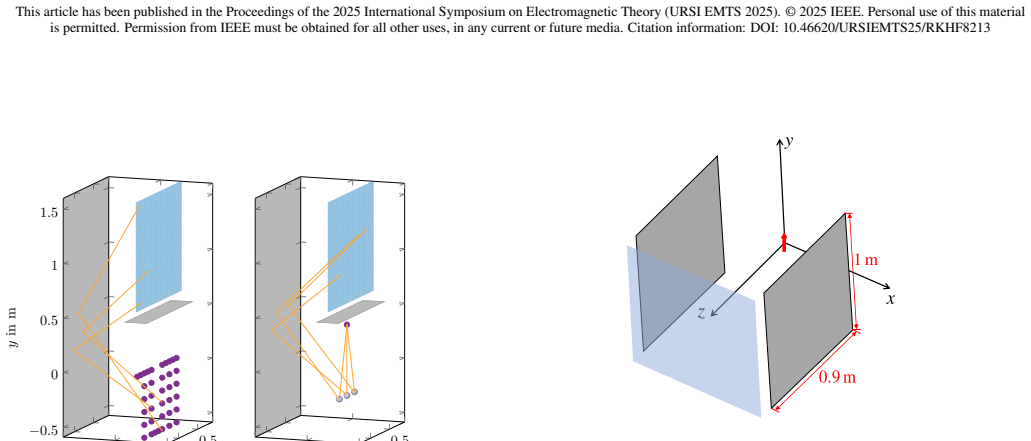
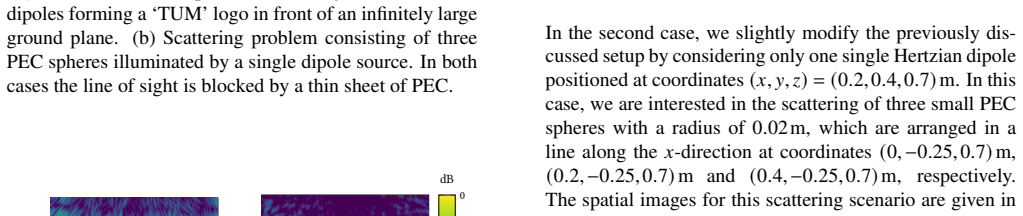
A ray-tracing (RT) enhanced back-projection algorithm (RT-BPA) for microwave imaging in multipath environments is presented. By tightly incorporating the concept of ray-tracing into a generalized version of traditional BPA, this method ensures improved image quality by addressing two important issues. First, when the line-of-sight (LOS) path is obstructed, reflected paths, if available, enable imaging of hidden targets, which extends the applicability of the standard BPA beyond its normal use case. Second, the consideration of reflected ray-paths is equivalent to virtually increasing the aperture size, thus, improving image resolution without requiring new measurements. A key factor in achieving these advancements is the consideration of the vector nature of electromagnetic waves with polarization-dependent phase compensation, which is often ignored when employing a scalar-wave based formulation of the electromagnetic vector field. In addition, the presented method employs a shooting and bouncing rays (SBR) framework, offering better flexibility compared to manual path evaluation in existing RT-BPAs.
Editorial analysis
A structured set of objections, weighed in public.
Referee Report
Summary. The manuscript presents a polarization-aware ray-tracing enhanced back-projection algorithm (RT-BPA) for microwave imaging in complex multipath environments. It integrates a shooting-and-bouncing-rays (SBR) framework into a generalized BPA formulation, using reflected paths to image targets when line-of-sight is obstructed and to virtually enlarge the effective aperture for improved resolution, while applying polarization-dependent phase compensation that is often omitted in scalar-wave approximations.
Significance. If the performance claims hold under realistic conditions, the work would meaningfully extend the applicability of BPA-based microwave imaging to occluded and multipath scenarios without requiring additional hardware or measurements. The emphasis on vector EM effects and SBR flexibility over manual path specification is a constructive direction, though its practical impact hinges on validation that is currently absent.
major comments (2)
- [Abstract] Abstract: the claims that reflected paths enable hidden-target imaging and that they are 'equivalent to virtually increasing the aperture size' are presented without any supporting numerical results, error metrics (e.g., PSNR, resolution measures), simulation data, or experimental comparisons against standard BPA or other RT-BPA variants.
- [Method description] Method (SBR integration): the polarization-dependent phase compensation and path tracing presuppose an accurate, a-priori 3D model of scene geometry and material properties (permittivities, conductivities) to compute Fresnel coefficients and path lengths; no procedure is given for acquiring, refining, or operating without this model in unknown multipath scenes, which directly risks defocusing or ghosting that would undermine both claimed benefits.
minor comments (1)
- [Abstract] Abstract: the frequency range, antenna configuration, or imaging geometry are not specified, making it difficult to assess the practical scope of the multipath improvements.
Simulated Author's Rebuttal
We thank the referee for the constructive feedback on our manuscript. We address each major comment point by point below, indicating the revisions made where appropriate.
read point-by-point responses
-
Referee: [Abstract] Abstract: the claims that reflected paths enable hidden-target imaging and that they are 'equivalent to virtually increasing the aperture size' are presented without any supporting numerical results, error metrics (e.g., PSNR, resolution measures), simulation data, or experimental comparisons against standard BPA or other RT-BPA variants.
Authors: The abstract is intended as a concise summary of the method and its intended benefits. The full manuscript contains simulation results in Sections IV and V, including visual comparisons of images formed with and without reflected paths, as well as against standard BPA, that illustrate the hidden-target imaging capability and resolution improvement. To directly address the concern and strengthen the abstract, we have revised it to include brief quantitative indicators drawn from those simulations (e.g., resolution enhancement factors and successful reconstruction of occluded targets). revision: yes
-
Referee: [Method description] Method (SBR integration): the polarization-dependent phase compensation and path tracing presuppose an accurate, a-priori 3D model of scene geometry and material properties (permittivities, conductivities) to compute Fresnel coefficients and path lengths; no procedure is given for acquiring, refining, or operating without this model in unknown multipath scenes, which directly risks defocusing or ghosting that would undermine both claimed benefits.
Authors: We agree that accurate scene geometry and material properties are required for reliable SBR-based path tracing and polarization compensation. The manuscript targets applications in which a 3D model is available a priori (e.g., indoor or industrial settings with CAD data). In the revised manuscript we have added a dedicated paragraph in Section III discussing practical model acquisition approaches, such as integration with existing building information models or laser-based mapping, and we explicitly note the risk of artifacts when the model is inaccurate or unavailable as a limitation of the current formulation. revision: yes
Circularity Check
No circularity: algorithmic extension of BPA via RT and polarization remains independent of its inputs
full rationale
The paper describes a generalized back-projection algorithm that incorporates ray-tracing (SBR) and polarization-dependent phase compensation to handle multipath. No equations, derivations, or steps in the abstract or described method reduce the claimed image-quality gains (hidden-target imaging or virtual aperture enlargement) to fitted parameters, self-definitions, or self-citation chains. The central claims rest on standard EM propagation physics and existing BPA/RT concepts rather than tautological re-labeling of inputs. Self-citations, if present, are not load-bearing for the core derivation.
Axiom & Free-Parameter Ledger
axioms (1)
- domain assumption Electromagnetic wave propagation in the target environment can be adequately approximated by geometric ray-tracing with polarization tracking.
Lean theorems connected to this paper
-
IndisputableMonolith/Foundation/RealityFromDistinction.leanreality_from_one_distinction unclearBy tightly incorporating the concept of ray-tracing into a generalized version of traditional BPA... polarization-dependent phase compensation... shooting and bouncing rays (SBR) framework
-
IndisputableMonolith/Cost/FunctionalEquation.leanwashburn_uniqueness_aczel unclearthe term δ(w) is either 1 for parallel polarization or 0 for vertical polarization... extra π-phase shift
Reference graph
Works this paper leans on
-
[1]
Multipath exploitation in through-the-wall radar imaging using sparse reconstruction,
M. Leigsnering, F. Ahmad, M. Amin, and A. Zoubir, “Multipath exploitation in through-the-wall radar imaging using sparse reconstruction,”IEEE Trans. Aerosp. Electron. Syst., vol. 50, no. 2, pp. 920–939, 2014
work page 2014
-
[2]
Multipath exploitation in non-LOS urban synthetic aperture radar,
P. Setlur, T. Negishi, N. Devroye, and D. Erricolo, “Multipath exploitation in non-LOS urban synthetic aperture radar,”IEEE J. Sel. Top. Signal Process., vol. 8, no. 1, pp. 137–152, Feb. 2014
work page 2014
-
[3]
Virtual multi- views method for through-wall radar imaging based on green function,
H. Zhou, Y . He, Y . Wang, and R. Duan, “Virtual multi- views method for through-wall radar imaging based on green function,” inIET Int. Radar Conf., Oct. 2015, pp. 1–5
work page 2015
-
[4]
W. Zhang, Y . Ji, S. Wu, Y . Yuan, C. Li, and G. Fang, “A ray-tracing-based synthetic imaging technique for nonfocal region of real-aperture imaging systems,” IEEE Trans. Antennas Propagat., vol. 71, no. 9, pp. 7566–7578, 2023
work page 2023
-
[5]
Improving the backprojection algorithm with ray tracing,
D. Rhiem, A. Froehly, and P. Wallrath, “Improving the backprojection algorithm with ray tracing,” in21st Eur . Radar Conf. (EuRAD), Sep. 2024, pp. 244–247
work page 2024
-
[6]
M. M. Saurer, B. Hofmann, and T. F. Eibert, “A fully polarimetric multilevel fast spectral domain algorithm for 3-D imaging with irregular sample locations,” IEEE Trans. Microwave Theory Techn., vol. 70, no. 9, pp. 4231–4242, 2022
work page 2022
-
[7]
Q. Wang, M. M. Saurer, and T. F. Eibert, “3-D near- field passive radar imaging utilizing phase-corrected frequency domain inverse source reconstructions,” IEEE Trans. Antennas Propag., vol. 73, no. 1, pp. 504–516, 2025
work page 2025
-
[8]
Optix: a gen- eral purpose ray tracing engine,
S. G. Parker, J. Bigler, A. Dietrich, H. Friedrich, J. Hoberock, D. Luebke, D. McAllister, M. McGuire, K. Morley, A. Robison, and M. Stich, “Optix: a gen- eral purpose ray tracing engine,”ACM Trans. Graph., vol. 29, no. 4, Jul. 2010
work page 2010
-
[9]
M. M. Saurer, H. Na, M. Brinkmann, and T. F. Eib- ert, “On the solution of linearized inverse scattering problems in near-field microwave imaging by opera- tor inversion and matched filtering,”IEEE Trans. Mi- crowave Theory Techn., pp. 1–14, Jan. 2025
work page 2025
-
[10]
Short-range imaging system with a nonuniform SFCW approach,
F. Gumbmann and A. Schiessl, “Short-range imaging system with a nonuniform SFCW approach,”IEEE Trans. Microwave Theory Techn., vol. 65, no. 4, pp. 1345–1354, 2017
work page 2017
-
[11]
M. Born, E. Wolf, A. B. Bhatia, P. C. Clemmow, D. Gabor, A. R. Stokes, A. M. Taylor, P. A. Way- man, and W. L. Wilcock,Principles of Optics: Elec- tromagnetic Theory of Propagation, Interference and Diffraction of Light, 7th ed. Cambridge University Press, 1999
work page 1999
-
[12]
A multiple Huygens surface-based ray tracing framework with GPU acceleration,
H. Na, M. M. Taygur, and T. F. Eibert, “A multiple Huygens surface-based ray tracing framework with GPU acceleration,”IEEE Trans. Antennas Propag., vol. 72, no. 1, pp. 183–196, Jan. 2024
work page 2024
-
[13]
Altair. (2025) FEKO. [Online]. Available: https://altairhyperworks.com/product/FEKO
work page 2025
discussion (0)
Sign in with ORCID, Apple, or X to comment. Anyone can read and Pith papers without signing in.