Recognition: 2 theorem links
· Lean TheoremA cell-decomposition based path planner for 3D navigation in constrained workspaces
Pith reviewed 2026-05-12 03:43 UTC · model grok-4.3
The pith
A cell decomposition for 3D grids ensures visibility between neighbors to simplify path feasibility checks in optimization.
A machine-rendered reading of the paper's core claim, the machinery that carries it, and where it could break.
Core claim
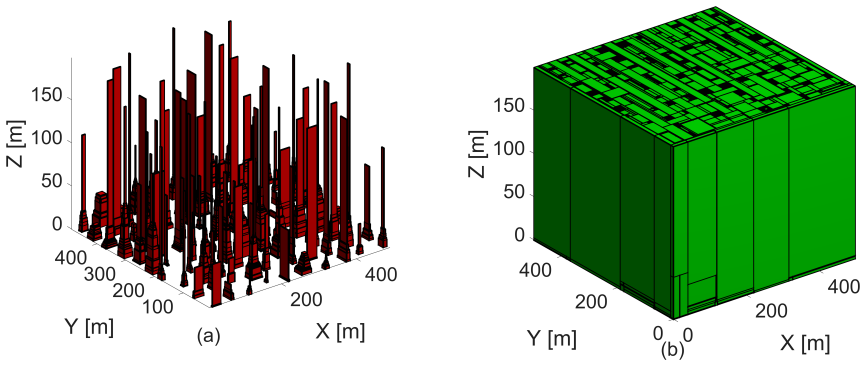
The core discovery is a cell decomposition algorithm for binary occupancy grids that ensures mutual complete visibility from each cell to at least one adjacent cell. This decomposition establishes a simplified framework for verifying path feasibility that can be easily embedded in optimization problems. The paper demonstrates this by formulating SOCP and MISOCP problems and proposing the KSP-SOCP method, which combines Yen's k-shortest path algorithm with SOCP to achieve better solutions than standard SOCP without the full cost of MISOCP. Evaluations in nine city-like workspaces confirm efficient partitioning and feasible path computation.
What carries the argument
The cell decomposition algorithm ensuring mutual complete visibility from each cell to at least one adjacent cell.
If this is right
- The feasibility of paths in 3D constrained workspaces can be verified within standard optimization solvers such as SOCP.
- Combining k-shortest paths with SOCP yields improved feasible paths compared to plain SOCP while using less memory than MISOCP.
- The decomposition works efficiently on city-like 3D maps, supporting both optimization methods in finding valid routes.
- It is particularly suitable for large-scale 3D navigation problems due to its time and memory efficiency.
Where Pith is reading between the lines
- The visibility property could support incremental updates when the occupancy grid changes slightly.
- Similar decompositions might help in other domains requiring 3D visibility queries, such as lighting design or sensor placement.
Load-bearing premise
Workspaces can be accurately modeled as binary occupancy grids for which the cell decomposition always ensures mutual complete visibility from each cell to at least one adjacent cell.
What would settle it
If a decomposition of some binary occupancy grid fails to provide complete visibility from every cell to at least one adjacent cell, or if paths found by the embedded optimization actually collide with obstacles, the central claim would be falsified.
Figures

read the original abstract
This paper proposes a cell decomposition algorithm for binary occupancy grids that ensures mutual complete visibility from each cell to at least one adjacent cell. This decomposition establishes a simplified framework for verifying path feasibility that can be easily embedded in optimization problems. To illustrate its utility, we formulate both second-order cone programs (SOCP) and their mixed-integer variant (MISOCP) within the proposed framework. Furthermore, we propose the KSP-SOCP method, which combines Yen's k-shortest path algorithm with the SOCP, achieving improved solutions compared to a standard SOCP approach while avoiding the computational burden of MISOCP. The cell decomposition algorithm, KSP-SOCP, and MISOCP approaches were evaluated in 9 city-like workspaces. The decomposition efficiently partitioned each map, enabling both optimization methods to compute feasible paths. The proposed KSP-SOCP achieved time performance comparable to the MISOCP while requiring less memory, making it highly suitable for large-scale problems.
Editorial analysis
A structured set of objections, weighed in public.
Referee Report
Summary. The paper proposes a cell-decomposition algorithm for 3D binary occupancy grids that guarantees mutual complete visibility from each cell to at least one adjacent cell. This property is leveraged to embed path feasibility verification into SOCP and MISOCP formulations; a hybrid KSP-SOCP method (Yen's k-shortest paths plus SOCP) is introduced to improve solution quality without the full cost of MISOCP. The methods are demonstrated on nine city-like workspaces, where the decomposition enables feasible path computation and KSP-SOCP shows competitive runtime with lower memory use.
Significance. If the visibility guarantee can be established rigorously, the decomposition would provide a useful abstraction for embedding collision-free path constraints directly into convex and mixed-integer optimization problems, potentially simplifying large-scale 3D navigation in constrained environments.
major comments (3)
- [cell decomposition algorithm description] The manuscript asserts that the cell decomposition algorithm ensures mutual complete visibility from each cell to at least one adjacent cell, yet supplies no formal proof, inductive argument, termination condition, or edge-case analysis for this property. This guarantee is load-bearing for the central claim that path feasibility can thereafter be verified without explicit collision checking inside the SOCP/MISOCP.
- [evaluation on 9 workspaces] The evaluation section reports that the decomposition 'efficiently partitioned each map' and enabled feasible paths in nine workspaces, but provides no quantitative metrics (runtime, memory, path length, success rate), feasibility verification procedure, or error analysis, preventing assessment of the performance claims.
- [experimental validation] All reported test cases are city-like regular environments; the paper does not examine narrow passages, thin obstacles, or non-convex 3D cavities where the visibility property after decomposition may fail to hold.
minor comments (1)
- [SOCP formulation] Notation for the cell adjacency graph and the precise embedding of visibility constraints into the SOCP objective and constraints could be clarified with an explicit example.
Simulated Author's Rebuttal
We thank the referee for their constructive comments on our manuscript. We address each major comment in detail below, indicating the revisions we intend to make.
read point-by-point responses
-
Referee: The manuscript asserts that the cell decomposition algorithm ensures mutual complete visibility from each cell to at least one adjacent cell, yet supplies no formal proof, inductive argument, termination condition, or edge-case analysis for this property. This guarantee is load-bearing for the central claim that path feasibility can thereafter be verified without explicit collision checking inside the SOCP/MISOCP.
Authors: We acknowledge this point. The decomposition algorithm is intended to ensure the visibility property by construction through recursive subdivision of the binary grid cells until each cell is mutually visible to its adjacent cells. To strengthen the manuscript, we will add a formal proof using induction on the number of decomposition steps, specify the termination condition (when further subdivision would exceed the grid resolution or no visibility violation exists), and include edge-case analysis for scenarios such as completely free space or fully obstructed regions. revision: yes
-
Referee: The evaluation section reports that the decomposition 'efficiently partitioned each map' and enabled feasible paths in nine workspaces, but provides no quantitative metrics (runtime, memory, path length, success rate), feasibility verification procedure, or error analysis, preventing assessment of the performance claims.
Authors: We agree that the evaluation lacks sufficient quantitative detail. In the revised manuscript, we will expand this section to include specific metrics: decomposition runtimes and memory consumption for each of the nine workspaces, computation times and memory usage for the SOCP, MISOCP, and KSP-SOCP methods, average path lengths, success rates, a clear description of how feasibility is verified using the visibility property without additional collision checks, and any error bounds or analysis conducted during the experiments. revision: yes
-
Referee: All reported test cases are city-like regular environments; the paper does not examine narrow passages, thin obstacles, or non-convex 3D cavities where the visibility property after decomposition may fail to hold.
Authors: The experiments were conducted on city-like workspaces to demonstrate applicability in structured, constrained 3D environments typical of urban navigation. We recognize that the visibility property's robustness in irregular settings such as narrow passages or non-convex cavities requires further investigation. We will add a new subsection on limitations and future work, discussing potential failure modes and how the framework could be extended, but we are unable to perform additional experiments on these cases within the scope of this revision due to the significant effort required to generate representative 3D grids and run the optimizations. revision: partial
- Validation of the method in non-city-like environments including narrow passages, thin obstacles, and non-convex 3D cavities.
Circularity Check
No circularity detected in derivation chain
full rationale
The paper proposes a constructive cell-decomposition algorithm for binary occupancy grids that is asserted to produce the mutual visibility property, then embeds SOCP/MISOCP formulations and a KSP-SOCP heuristic within the resulting partition, and evaluates performance on nine simulated city-like maps. No equation or step reduces by construction to its own inputs, no fitted parameter is relabeled as a prediction, and no load-bearing claim rests on a self-citation chain or imported uniqueness theorem. The visibility guarantee is presented as an output of the algorithm rather than an input assumption, and the subsequent optimization steps operate on the produced cells without circular reference back to the original grid data. The derivation is therefore self-contained as an algorithmic construction plus empirical verification.
Axiom & Free-Parameter Ledger
axioms (1)
- domain assumption Binary occupancy grids admit a cell decomposition ensuring mutual complete visibility from each cell to at least one adjacent cell.
Lean theorems connected to this paper
-
IndisputableMonolith/Foundation/AlexanderDuality.leanalexander_duality_circle_linking unclear?
unclearRelation between the paper passage and the cited Recognition theorem.
This paper proposes a cell decomposition algorithm for binary occupancy grids that ensures mutual complete visibility from each cell to at least one adjacent cell.
-
IndisputableMonolith/Foundation/RealityFromDistinction.leanreality_from_one_distinction unclear?
unclearRelation between the paper passage and the cited Recognition theorem.
P3) Mutual complete visibility : All cells must have mutual complete visibility with at least one adjacent cell of the same type
What do these tags mean?
- matches
- The paper's claim is directly supported by a theorem in the formal canon.
- supports
- The theorem supports part of the paper's argument, but the paper may add assumptions or extra steps.
- extends
- The paper goes beyond the formal theorem; the theorem is a base layer rather than the whole result.
- uses
- The paper appears to rely on the theorem as machinery.
- contradicts
- The paper's claim conflicts with a theorem or certificate in the canon.
- unclear
- Pith found a possible connection, but the passage is too broad, indirect, or ambiguous to say the theorem truly supports the claim.
Reference graph
Works this paper leans on
-
[1]
Ahuja, R.K., Magnanti, T.L., and Orlin, J.B. (1993). Network flows: theory, algorithms, and applications
work page 1993
-
[2]
Burgard, W. (2005). Principles of Robot Motion: The- ory, Algorithms, and Implementations . MIT Press
work page 2005
-
[3]
Daniel, K., Nash, A., Koenig, S., and Felner, A. (2010). Theta*: any-angle path planning on grids. J. Artif. Int. Res., 39(1), 533–579
work page 2010
-
[4]
Deits, R. and Tedrake, R. (2015b). Efficient mixed-integer planning for uavs in cluttered environments. In 2015 IEEE ICRA , 42–49. Du Toit, N.E. and Burdick, J.W. (2012). Robot motion planning in dynamic, uncertain environments. IEEE Trans. Robot., 28(1), 101–115
work page 2015
-
[5]
Hart, P.E., Nilsson, N.J., and Raphael, B. (1968). A formal basis for the heuristic determination of minimum cost paths. IEEE Trans. Syst. Sci. Cybern. , 4(2), 100–107
work page 1968
-
[6]
Teller, S. (2011). Anytime motion planning using the rrt*. In 2011 IEEE ICRA , 1478–1483
work page 2011
-
[7]
Katrakazas, C., Quddus, M., Chen, W.H., and Deka, L. (2015). Real-time motion planning methods for autonomous on-road driving: State-of-the-art and future research directions. Transp. Res. C: Emerg. Technol. , 60, 416–442
work page 2015
-
[8]
Liberti, L. (2019). Undecidability and hardness in mixed- integer nonlinear programming. RAIRO-Oper. Res. , 53(1), 81–109. doi:10.1051/ro/2018036
-
[9]
Lupascu, M., Hustiu, S., Burlacu, A., and Kloetzer, M. (2019). Path planning for autonomous drones using 3d rectangular cuboid decomposition. In 2019 23rd ICSTCC, 119–124
work page 2019
-
[10]
Marcucci, T., Petersen, M., von Wrangel, D., and Tedrake, R. (2023). Motion planning around obstacles with convex optimization. Science Robotics, 8(84), eadf7843
work page 2023
-
[11]
Mellinger, D., Kushleyev, A., and Kumar, V. (2012). Mixed-integer quadratic program trajectory generation for heterogeneous quadrotor teams. In 2012 IEEE International Conference on Robotics and Automation , 477–483. doi:10.1109/ICRA.2012.6225009
-
[12]
Morais, J.P.L., Pimenta, L.C.A., Alves, M.A., and Raffo, G.V. (2025). A multi-layer mpc scheme for autonomous uav navigation in constrained environments. In 2025 IF AC ACA
work page 2025
-
[13]
Nielsen, L.D., Sung, I., and Nielsen, P. (2019). Convex decomposition for a coverage path planning for au- tonomous vehicles: Interior extension of edges. Sensors, 19(19)
work page 2019
-
[14]
Schouwenaars, T., De Moor, B., Feron, E., and How, J. (2001). Mixed integer programming for multi-vehicle path planning. In 2001 ECC , 2603–2608
work page 2001
-
[15]
Toumieh, C. and Lambert, A. (2022). Voxel-grid based convex decomposition of 3d space for safe corridor generation. J. Intell. & Robot. Syst. , 105(4)
work page 2022
-
[16]
Yen, J.Y. (1971). Finding the k shortest loopless paths in a network. Management Science , 17(11), 712–716. Appendix A. ALGORITHMS OF CHECKP1-P4 PROCEDURES Algorithm 2 CheckP1 Input: C ∈ N6 >0, B ∈ NNx×Ny ×Nz >0 Output: p ∈ {0, 1} 1: i ← C1:3, p ← 1 2: while i3 ≤ C6 do 3: if Bi1,i2,i3 ̸= 0 then p ← 0 4: break 5: end if 6: i1 ← i1 + 1 7: for j = 1 to 2 do ...
work page 1971
discussion (0)
Sign in with ORCID, Apple, or X to comment. Anyone can read and Pith papers without signing in.