Recognition: no theorem link
Tracing the kinematic perturbations of the Milky Way spiral arms with APOGEE DR17 and Gaia DR3
Pith reviewed 2026-05-12 02:50 UTC · model grok-4.3
The pith
A revised model including both sine and cosine radial-velocity terms reproduces Milky Way stellar streaming motions to within 2 percent, constraining spiral pitch angle to about 10 degrees.
A machine-rendered reading of the paper's core claim, the machinery that carries it, and where it could break.
Core claim
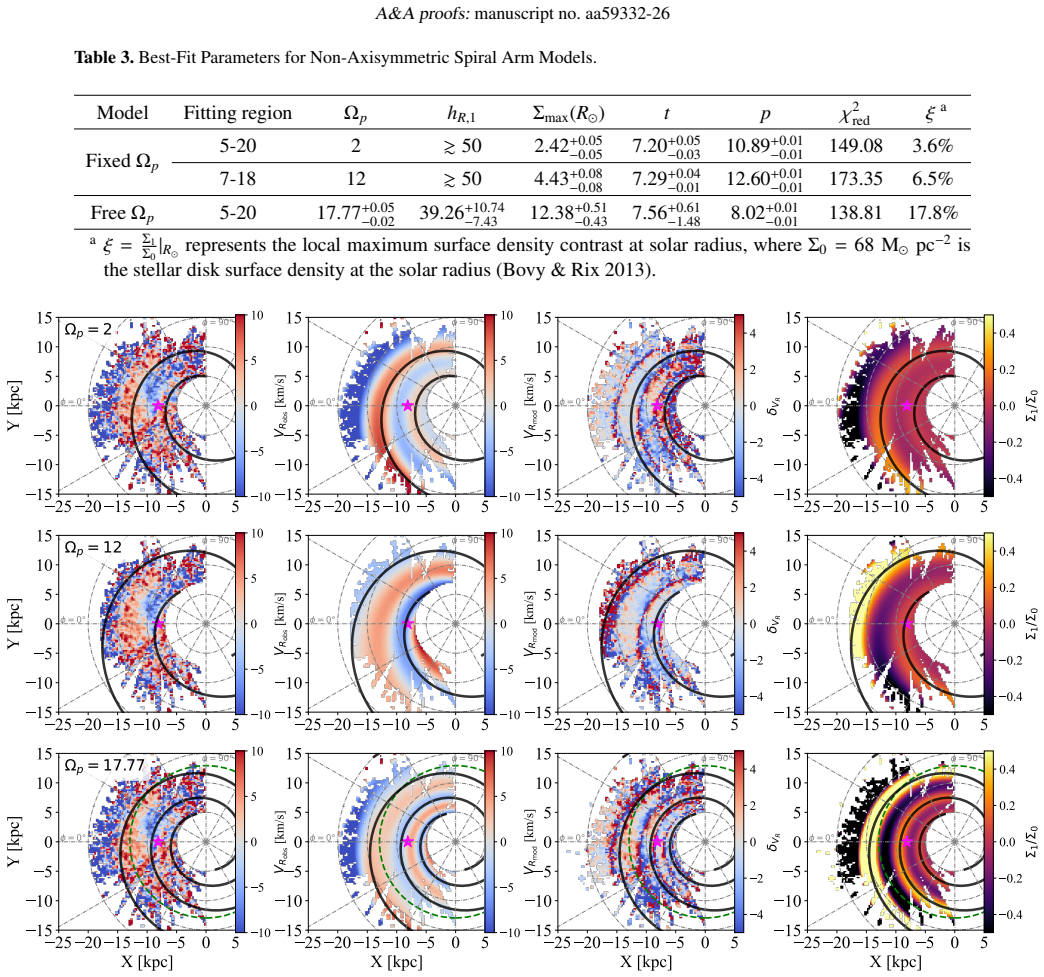
By constructing a revised steady-state radial-velocity response model that includes both the VR,sin and the dynamically important VR,cos components for a two-armed logarithmic spiral potential, and by validating the model through orbit integrations and Bayesian recovery before applying it to the observed two-dimensional radial-velocity field while accounting for Lindblad and corotation resonances, the authors reproduce the phase and amplitude of mock velocity fields to the ~2% level. When fitted to APOGEE DR17 and Gaia DR3 data on RGB stars, the model yields a robust pitch angle of p ≃ 10° and a local surface density contrast of ξ ≃ 5--18% at the solar radius, with the spiral pattern speed Ω
What carries the argument
The revised steady-state radial-velocity response model incorporating both VR,sin and VR,cos components for a two-armed logarithmic spiral potential, validated with orbit integrations and applied while accounting for Lindblad and corotation resonances.
If this is right
- The model reproduces the phase and amplitude of the mock radial-velocity field to the ~2% level, substantially improving on earlier VR,sin-only formulations.
- Resonance effects strongly shape the velocity field, producing extremely large radial velocities near the Lindblad resonances and vanishing velocities near corotation.
- Applied to the data, the model supplies a robust pitch angle of p ≃ 10° and a local surface density contrast of ξ ≃ 5--18% at the solar radius.
- The radial scale length remains less well-constrained (hR,1 ≃ 40--50 kpc) owing to intrinsic parameter covariance.
- The observed kinematics constrain the spiral pattern speed to Ωp ≈ 10--20 km s^{-1} kpc^{-1}.
Where Pith is reading between the lines
- The same modeling approach could be tested on kinematic maps of external galaxies to check whether two-armed responses remain dominant.
- Future high-resolution surveys focused on resonance zones might reveal whether additional perturbations are needed to explain residuals.
- The derived pattern-speed range offers a concrete benchmark for N-body simulations that evolve spiral structure self-consistently.
Load-bearing premise
The observed stellar velocity field is dominated by the steady-state response to a two-armed logarithmic spiral potential, with resonances properly accounted for and no major contributions from other non-axisymmetric or time-dependent perturbations.
What would settle it
Independent measurements of radial velocities near the expected Lindblad resonances that fail to show the large amplitudes predicted by the model, or pattern-speed estimates from other techniques lying outside the 10--20 km s^{-1} kpc^{-1} range.
Figures




read the original abstract
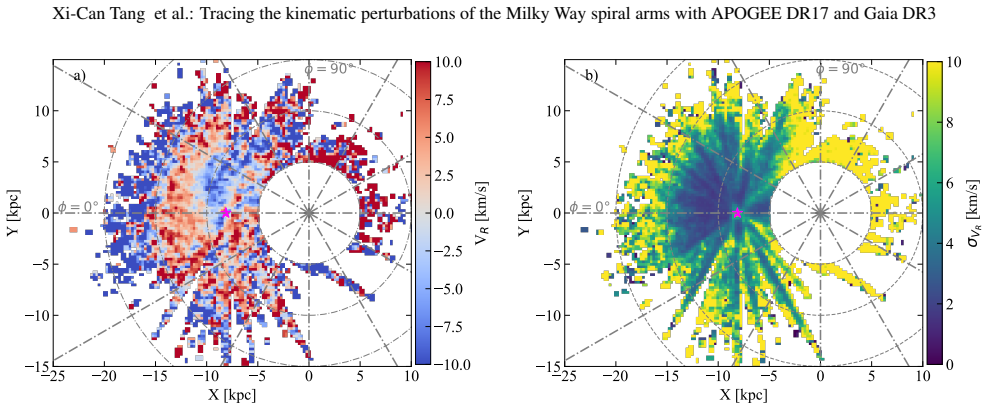
Aims. We constrain the dynamical perturbations of the spiral arms in the Milky Way disk, based on the non-axisymmetric streaming motions of RGB stars revealed by APOGEE and \textit{Gaia}. Methods. We develop a revised steady-state radial-velocity response model that incorporates both the \(V_{R,\sin}\) and the dynamically important \(V_{R,\cos}\) components for a two-armed logarithmic spiral potential. The model is validated using orbit integrations with \texttt{AGAMA} and Bayesian parameter recovery with \texttt{dynesty}, and is applied to the smoothed two-dimensional radial-velocity field of RGB stars while accounting for Lindblad and corotation resonances. Results. The revised model reproduces the phase and amplitude of the mock radial-velocity field to the \(\sim2\%\) level, substantially improving upon earlier \(V_{R,\sin}\)-only formulations. Applied to the observational data, it yields a robust pitch angle of \(p \simeq 10^\circ\) and a local surface density contrast of \(\xi \simeq 5\)--\(18\%\) at the solar radius. The radial scale length is less well-constrained (\(h_{R,1} \simeq 40\)--\(50\,\mathrm{kpc}\)) due to intrinsic parameter covariance. Resonance effects strongly shape the velocity field, thus affecting the fitting: the radial velocity becomes extremely large near the Lindblad resonances, whereas it vanishes close to the corotation resonance. Conclusions. Our results demonstrate that including both the \(V_{R,\sin}\) and \(V_{R,\cos}\) terms is essential for a physically consistent interpretation of stellar streaming motions induced by a spiral potential. The observed kinematics constrain the spiral pattern speed to \(\Omega_{p} \approx 10\)--\(20\,\mathrm{km\,s}^{-1}\mathrm{kpc}^{-1}\).
Editorial analysis
A structured set of objections, weighed in public.
Referee Report
Summary. The paper presents a revised steady-state radial-velocity response model for a two-armed logarithmic spiral potential, incorporating both the V_{R,sin} and dynamically important V_{R,cos} components. The model is validated on mock data generated via AGAMA orbit integrations and recovered with dynesty Bayesian fitting, achieving ~2% reproduction of the phase and amplitude. It is then applied to the smoothed 2D radial-velocity field of RGB stars from APOGEE DR17 and Gaia DR3, accounting for Lindblad and corotation resonances, to derive a pitch angle p ≃ 10°, local surface density contrast ξ ≃ 5–18%, radial scale length h_{R,1} ≃ 40–50 kpc (with noted covariance), and pattern speed Ω_p ≈ 10–20 km s^{-1} kpc^{-1}.
Significance. If the central assumptions hold, this provides useful constraints on Milky Way spiral structure from kinematic data, with the inclusion of the cos term and explicit resonance treatment representing a methodological improvement over prior V_{R,sin}-only approaches. The mock validation using orbit integrations and Bayesian recovery is a positive feature that supports the fitting procedure. The results could inform dynamical models of the disk, though their robustness hinges on the dominance of the assumed perturbation.
major comments (2)
- [Abstract and Results] Abstract and Results: The central claim that the observed kinematics constrain the spiral parameters relies on the assumption that the velocity field is dominated by the steady-state response to a fixed two-armed logarithmic spiral. However, no residual map after model subtraction, fraction of explained variance, or direct comparison to a joint bar+spiral potential is provided, leaving open the risk that unmodeled contributions from the bar, multi-arm structure, or time-dependent effects bias the recovered p, ξ, and Ω_p (particularly given the already noted covariance in h_{R,1}).
- [Methods] Methods (model validation): The ~2% recovery is demonstrated only for mocks generated from the identical two-armed steady-state model; while this confirms the fitting machinery, it does not test the model's applicability when the real data contain additional non-axisymmetric perturbations, which is load-bearing for the observational conclusions.
minor comments (2)
- [Results] Results: The parameter covariance affecting h_{R,1} is acknowledged; including the full posterior corner plots or correlation coefficients would help readers assess the robustness of the other parameters.
- [Abstract] Abstract: The description of the data smoothing procedure and its effect on the fitted velocity field could be expanded for clarity, as it directly impacts the input to the resonance-aware model.
Simulated Author's Rebuttal
We thank the referee for the detailed and constructive report. We have revised the manuscript to address the concerns raised, particularly by adding residual analysis and expanding the discussion of model limitations. Our point-by-point responses follow.
read point-by-point responses
-
Referee: [Abstract and Results] The central claim that the observed kinematics constrain the spiral parameters relies on the assumption that the velocity field is dominated by the steady-state response to a fixed two-armed logarithmic spiral. However, no residual map after model subtraction, fraction of explained variance, or direct comparison to a joint bar+spiral potential is provided, leaving open the risk that unmodeled contributions from the bar, multi-arm structure, or time-dependent effects bias the recovered p, ξ, and Ω_p (particularly given the already noted covariance in h_{R,1}).
Authors: We agree that including a residual map and a measure of explained variance would better support the central claim. In the revised manuscript, we have added a new figure displaying the residual radial-velocity field (observed minus model) and quantified the fraction of variance explained by the model. This indicates that while the model captures the dominant features, some variance remains, consistent with additional perturbations. We have also expanded the discussion to address potential biases from the bar and multi-arm structures, noting that our focus on the outer disk and RGB stars helps mitigate bar effects. A full joint bar+spiral comparison is not included as it lies outside the scope of this study, but we have added caveats regarding this assumption. revision: partial
-
Referee: [Methods] The ~2% recovery is demonstrated only for mocks generated from the identical two-armed steady-state model; while this confirms the fitting machinery, it does not test the model's applicability when the real data contain additional non-axisymmetric perturbations, which is load-bearing for the observational conclusions.
Authors: The mock tests were designed to validate the Bayesian fitting procedure and confirm that the model parameters can be accurately recovered when the underlying assumptions hold. We acknowledge that this does not directly test robustness against additional perturbations present in the real Milky Way. To mitigate this, we have included in the revised text a more thorough discussion of how deviations from the steady-state two-armed model (e.g., due to the bar or transient arms) could affect the results, and we emphasize that the recovered parameters are consistent with independent estimates from other methods. Full end-to-end testing with more complex mocks would be a valuable extension but is beyond the current scope. revision: partial
Circularity Check
No significant circularity: independent validation precedes data inference
full rationale
The derivation chain consists of (1) constructing a revised analytic response model for a two-armed logarithmic spiral that includes both V_R,sin and V_R,cos terms, (2) validating that model on independent mock data generated by AGAMA orbit integrations, and (3) performing Bayesian parameter recovery on the observed APOGEE+Gaia radial-velocity field. None of these steps reduces the final parameters (p, ξ, Ω_p) to the inputs by construction; the AGAMA validation is external and the subsequent fit is a standard inference under stated assumptions. No self-citations, fitted inputs renamed as predictions, or ansatz smuggling appear in the provided derivation. The result is therefore self-contained against external benchmarks.
Axiom & Free-Parameter Ledger
free parameters (4)
- pitch angle p =
~10 degrees
- surface density contrast xi =
5-18%
- radial scale length h_R,1 =
40-50 kpc
- pattern speed Omega_p =
10-20 km/s/kpc
axioms (2)
- domain assumption Steady-state radial velocity response to a two-armed logarithmic spiral potential
- domain assumption Lindblad and corotation resonances must be explicitly accounted for in the velocity field
Reference graph
Works this paper leans on
-
[1]
ALMA Resolves the Spiraling Accretion Flow in the Luminous OB Cluster-forming Region G33.92+0.11. , keywords =. doi:10.1088/0004-637X/804/1/37 , archivePrefix =. 1505.04255 , primaryClass =
-
[2]
Updated Gaia-2MASS 3D maps of Galactic interstellar dust. , keywords =. doi:10.1051/0004-6361/202142846 , archivePrefix =. 2203.01627 , primaryClass =
-
[3]
Protostars and Planets VII , year = 2023, editor =
The Solar Neighborhood in the Age of Gaia. Protostars and Planets VII , year = 2023, editor =. doi:10.48550/arXiv.2212.00067 , archivePrefix =. 2212.00067 , primaryClass =
-
[4]
A Deep, High-angular-resolution 3D Dust Map of the Southern Galactic Plane. , keywords =. doi:10.3847/1538-4357/adfbe6 , archivePrefix =. 2503.02657 , primaryClass =
-
[5]
A parsec-scale Galactic 3D dust map out to 1.25 kpc from the Sun. , keywords =. doi:10.1051/0004-6361/202347628 , archivePrefix =. 2308.01295 , primaryClass =
-
[6]
3D extinction maps of the Milky Way disc from Gaia GSP-Spec parameters. arXiv e-prints , keywords =. doi:10.48550/arXiv.2511.12156 , archivePrefix =. 2511.12156 , primaryClass =
-
[7]
, year = 2019, month = dec, volume =
A 3D Dust Map Based on Gaia, Pan-STARRS 1, and 2MASS. , keywords =. doi:10.3847/1538-4357/ab5362 , archivePrefix =. 1905.02734 , primaryClass =
-
[8]
2025, MNRAS, 542, L94, doi: 10.1093/mnrasl/slaf075
Metal-rich stellar counterpart of the Radcliffe Wave and the 3D chemical footprints of the Milky Way spiral arms. , keywords =. doi:10.1093/mnrasl/slaf075 , archivePrefix =. 2504.03843 , primaryClass =
-
[9]
A Galactic-scale gas wave in the solar neighbourhood. , keywords =. doi:10.1038/s41586-019-1874-z , archivePrefix =. 2001.08748 , primaryClass =
-
[10]
The Radcliffe Wave is oscillating. , keywords =. doi:10.1038/s41586-024-07127-3 , archivePrefix =. 2402.12596 , primaryClass =
-
[11]
, year = 1969, month = oct, volume =
Large-Scale Shock Formation in Spiral Galaxies and its Implications on Star Formation. , year = 1969, month = oct, volume =. doi:10.1086/150177 , adsurl =
-
[12]
Dawes Review 4: Spiral Structures in Disc Galaxies. , keywords =. doi:10.1017/pasa.2014.31 , archivePrefix =. 1407.5062 , primaryClass =
-
[13]
Spirals in Galaxies. , keywords =. doi:10.1146/annurev-astro-052920-104505 , archivePrefix =. 2110.05615 , primaryClass =
-
[14]
Transient spiral structure and the disc velocity substructure in Gaia DR2. , keywords =. doi:10.1093/mnras/sty2532 , archivePrefix =. 1806.02832 , primaryClass =
-
[15]
Footprints of the Sagittarius dwarf galaxy in the Gaia data set. , keywords =. doi:10.1093/mnras/stz583 , archivePrefix =. 1808.00451 , primaryClass =
-
[16]
Tidally induced spiral arm wraps encoded in phase space. , keywords =. doi:10.1051/0004-6361/202244064 , archivePrefix =. 2206.03495 , primaryClass =
-
[17]
Milky Way dynamics in light of Gaia. , keywords =. doi:10.1016/j.newar.2024.101721 , archivePrefix =. 2501.04075 , primaryClass =
-
[18]
Astronomy Letters , keywords =
Galactic kinematics from a sample of young massive stars. Astronomy Letters , keywords =. doi:10.1134/S106377371308001X , archivePrefix =. 1307.1677 , primaryClass =
-
[19]
Resonant excitation of motion perpendicular to galactic planes. , keywords =. doi:10.1093/mnras/196.3.455 , adsurl =
-
[20]
Simple galaxy models with massive haloes. , keywords =. doi:10.1093/mnras/260.1.191 , adsurl =
-
[21]
, archivePrefix = "arXiv", eprint =
Structure in phase space associated with spiral and bar density waves in an N-body hybrid galactic disc. , keywords =. doi:10.1111/j.1365-2966.2011.19349.x , archivePrefix =. 1010.5745 , primaryClass =
-
[22]
Strong Evidence for the Density-wave Theory of Spiral Structure in Disk Galaxies. , keywords =. doi:10.3847/2041-8205/827/1/L2 , archivePrefix =. 1608.00969 , primaryClass =
-
[23]
The Great Wave: Evidence of a large-scale vertical corrugation propagating outwards in the Galactic disc. arXiv e-prints , keywords =. doi:10.48550/arXiv.2407.18659 , archivePrefix =. 2407.18659 , primaryClass =
-
[24]
The bar and spiral arms in the Milky Way: structure and kinematics. Research in Astronomy and Astrophysics , keywords =. doi:10.1088/1674-4527/20/10/159 , archivePrefix =. 2012.10130 , primaryClass =
-
[25]
2019a, MNRAS, 482, 1525, doi: 10.1093/mnras/sty2672
AGAMA: action-based galaxy modelling architecture. , keywords =. doi:10.1093/mnras/sty2672 , archivePrefix =. 1802.08239 , primaryClass =
-
[26]
2013, ApJ, 779, 115, doi: 10.1088/0004-637X/779/2/115 Chanam´ e, J., Kleyna, J., & van der Marel, R
A Direct Dynamical Measurement of the Milky Way's Disk Surface Density Profile, Disk Scale Length, and Dark Matter Profile at 4 kpc < -0.5ex R < -0.5ex 9 kpc. , keywords =. doi:10.1088/0004-637X/779/2/115 , archivePrefix =. 1309.0809 , primaryClass =
-
[27]
, year = 2016, month = sep, volume =
Six Decades of Spiral Density Wave Theory. , year = 2016, month = sep, volume =. doi:10.1146/annurev-astro-081915-023426 , adsurl =
-
[28]
What Does the Milky Way Look Like?. , keywords =. doi:10.3847/1538-4357/acc45c , archivePrefix =. 2304.10690 , primaryClass =
-
[29]
Tracing the Milky Way warp and spiral arms with classical Cepheids. , keywords =. doi:10.1051/0004-6361/202243273 , archivePrefix =. 2209.02731 , primaryClass =
-
[30]
A non-axisymmetric potential for the Milky Way disk. , keywords =. doi:10.1051/0004-6361/202453077 , archivePrefix =. 2411.12800 , primaryClass =
-
[31]
Dynamics of stars around spiral arms in an N-body/SPH simulated barred spiral galaxy. , keywords =. doi:10.1111/j.1365-2966.2012.21733.x , archivePrefix =. 1202.6387 , primaryClass =
-
[32]
Gas Dynamics in the Milky Way: A Low Pattern Speed Model. , keywords =. doi:10.3847/0004-637X/824/1/13 , archivePrefix =. 1603.09650 , primaryClass =
-
[33]
Gas Dynamics in the Galaxy: Total Mass Distribution and the Bar Pattern Speed. , keywords =. doi:10.3847/1538-4357/ac3823 , archivePrefix =. 2103.10342 , primaryClass =
-
[34]
, year = 2009, month = mar, volume =
The Spitzer/GLIMPSE Surveys: A New View of the Milky Way. , year = 2009, month = mar, volume =. doi:10.1086/597811 , adsurl =
-
[35]
Detection of the Milky Way spiral arms in dust from 3D mapping. , keywords =. doi:10.1051/0004-6361/201833284 , archivePrefix =. 1808.00015 , primaryClass =
-
[36]
A cross-match with Gaia DR2 and an updated map of the solar neighbourhood
The Alma catalogue of OB stars - II. A cross-match with Gaia DR2 and an updated map of the solar neighbourhood. , keywords =. doi:10.1093/mnras/stab688 , archivePrefix =. 2103.02748 , primaryClass =
-
[37]
Measuring non-axisymmetry in spiral galaxies. , keywords =. doi:10.1093/mnras/292.2.349 , archivePrefix =. astro-ph/9707332 , primaryClass =
-
[38]
The properties of the local spiral arms from RAVE data: two-dimensional density wave approach. , keywords =. doi:10.1111/j.1365-2966.2012.21638.x , archivePrefix =. 1207.0363 , primaryClass =
-
[39]
, archivePrefix = "arXiv", eprint =
Detection of the gravitational redshift in the orbit of the star S2 near the Galactic centre massive black hole. , keywords =. doi:10.1051/0004-6361/201833718 , archivePrefix =. 1807.09409 , primaryClass =
-
[40]
The Astrophysical Journal , author =
On the Spiral Structure of Disk Galaxies. , year = 1964, month = aug, volume =. doi:10.1086/147955 , adsurl =
-
[41]
2021, A&A, 651, A104, doi: 10.1051/0004-6361/202140687
Galactic spiral structure revealed by Gaia EDR3. , keywords =. doi:10.1051/0004-6361/202140687 , archivePrefix =. 2103.01970 , primaryClass =
- [42]
-
[43]
From the bulge to the outer disc: StarHorse stellar parameters, distances, and extinctions for stars in APOGEE DR16 and other spectroscopic surveys. , keywords =. doi:10.1051/0004-6361/201937364 , archivePrefix =. 1912.09778 , primaryClass =
-
[44]
, archivePrefix = "arXiv", eprint =
Understanding the spiral structure of the Milky Way using the local kinematic groups. , keywords =. doi:10.1111/j.1365-2966.2011.19190.x , archivePrefix =. 1106.1170 , primaryClass =
-
[45]
The rotation speed of the spiral pattern in the Milky Way galaxy. arXiv e-prints , keywords =. doi:10.48550/arXiv.2510.26450 , archivePrefix =. 2510.26450 , primaryClass =
-
[46]
A New View of the Spiral Structure of the Northern Outer Milky Way in Carbon Monoxide. , keywords =. doi:10.3847/2041-8213/ad9605 , archivePrefix =. 2411.11220 , primaryClass =
-
[47]
The spiral pattern rotation speed of the Galaxy and the corotation radius with Gaia DR2. , keywords =. doi:10.1093/mnras/stz1196 , archivePrefix =. 1905.08133 , primaryClass =
-
[48]
Astronomy Letters , keywords =
Determination of the Spiral Pattern Speed in the Galaxy from Three Samples of Stars. Astronomy Letters , keywords =. doi:10.1134/S1063773723030027 , archivePrefix =. 2306.08443 , primaryClass =
-
[49]
Milky Way spiral arms from open clusters in Gaia EDR3. , keywords =. doi:10.1051/0004-6361/202039751 , archivePrefix =. 2105.04590 , primaryClass =
-
[50]
The Proper Motion of Sagittarius A*. II. The Mass of Sagittarius A*. , keywords =. doi:10.1086/424960 , archivePrefix =. astro-ph/0408107 , primaryClass =
-
[51]
The Milky Way Tomography with SDSS. I. Stellar Number Density Distribution. , keywords =. doi:10.1086/523619 , archivePrefix =. astro-ph/0510520 , primaryClass =
-
[52]
Mapping the asymmetric disc of the Milky Way
Gaia Data Release 3. Mapping the asymmetric disc of the Milky Way. , keywords =. doi:10.1051/0004-6361/202243797 , archivePrefix =. 2206.06207 , primaryClass =
-
[53]
The Milky Way as seen by classical Cepheids: II. Spiral structure. , keywords =. doi:10.1051/0004-6361/202451100 , archivePrefix =. 2406.09127 , primaryClass =
-
[54]
A low density wave's spiral pattern speed, from the tracer separations (age gradient) across a spiral arm in the Milky Way. , keywords =. doi:10.1093/mnras/stab1679 , archivePrefix =. 2106.15761 , primaryClass =
-
[55]
A high pitch angle structure in the Sagittarius Arm. , keywords =. doi:10.1051/0004-6361/202141198 , archivePrefix =. 2107.05643 , primaryClass =
-
[56]
Discovery of a coherent, wave-like velocity pattern for the Radcliffe wave. , keywords =. doi:10.1093/mnrasl/slac050 , archivePrefix =. 2205.03218 , primaryClass =
-
[57]
Constraining the pitch angle of the galactic spiral arms in the Milky Way. , keywords =. doi:10.1016/j.newar.2017.09.001 , archivePrefix =. 1709.05303 , primaryClass =
-
[58]
The Milky Way spiral structure parameters from data on masers and selected open clusters. , keywords =. doi:10.1093/mnras/stt1987 , archivePrefix =. 1310.3974 , primaryClass =
-
[59]
Research in Astronomy and Astrophysics , keywords =
The spiral structure of the Milky Way. Research in Astronomy and Astrophysics , keywords =. doi:10.1088/1674-4527/18/12/146 , archivePrefix =. 1810.08819 , primaryClass =
-
[60]
The local spiral structure of the Milky Way. Science Advances , keywords =. doi:10.1126/sciadv.1600878 , archivePrefix =. 1610.00242 , primaryClass =
-
[61]
The spiral structure of our Galaxy determined from H II regions. , keywords =
-
[62]
Trigonometric Parallaxes of High-mass Star-forming Regions: Our View of the Milky Way. , keywords =. doi:10.3847/1538-4357/ab4a11 , archivePrefix =. 1910.03357 , primaryClass =
-
[63]
The observed spiral structure of the Milky Way. , keywords =. doi:10.1051/0004-6361/201424039 , archivePrefix =. 1407.7331 , primaryClass =
-
[64]
The Strength of the Dynamical Spiral Perturbation in the Galactic Disk. , keywords =. doi:10.3847/1538-4357/abac0b , archivePrefix =. 2003.01132 , primaryClass =
-
[65]
StarHorse results for spectroscopic surveys and Gaia DR3: Chrono-chemical populations in the solar vicinity, the genuine thick disk, and young alpha-rich stars. , keywords =. doi:10.1051/0004-6361/202245399 , archivePrefix =. 2303.09926 , primaryClass =
-
[66]
Global survey of star clusters in the Milky Way. III. 139 new open clusters at high Galactic latitudes. , keywords =. doi:10.1051/0004-6361/201322720 , archivePrefix =. 1406.6267 , primaryClass =
-
[67]
Estimating Distances from Parallaxes. V. Geometric and Photogeometric Distances to 1.47 Billion Stars in Gaia Early Data Release 3. , keywords =. doi:10.3847/1538-3881/abd806 , archivePrefix =. 2012.05220 , primaryClass =
work page internal anchor Pith review doi:10.3847/1538-3881/abd806 2012
-
[68]
and Lang, Dustin and Goodman, Jonathan , title =
emcee: The MCMC Hammer. , keywords =. doi:10.1086/670067 , archivePrefix =. 1202.3665 , primaryClass =
-
[69]
Spiral structure in galaxies a density wave theory
-
[70]
Galactic Dynamics: Second Edition
-
[71]
Weinberg, Martin D. , year=. Kinematic signature of a rotating bar near a resonance , volume=. doi:10.1086/173589 , journal=
-
[72]
Statistics and Computing , keywords =
Dynamic nested sampling: an improved algorithm for parameter estimation and evidence calculation. Statistics and Computing , keywords =. doi:10.1007/s11222-018-9844-0 , archivePrefix =. 1704.03459 , primaryClass =
-
[73]
The Milky Way's Rowdy Neighbors: The Effects of the Large Magellanic Cloud and Sagittarius Dwarf on the Milky Way Disk. , keywords =. doi:10.3847/1538-4357/ad901b , archivePrefix =. 2407.12095 , primaryClass =
-
[74]
Testing kinematic distances under a realistic Galactic potential: Investigating systematic errors in the kinematic distance method arising from a non-axisymmetric potential. , keywords =. doi:10.1051/0004-6361/202450000 , archivePrefix =. 2403.18000 , primaryClass =
-
[75]
Dynamics of tidal spiral arms: Machine learning-assisted identification of equations and application to the Milky Way. , keywords =. doi:10.1051/0004-6361/202556039 , archivePrefix =. 2506.17383 , primaryClass =
-
[76]
Gaia DR1 Evidence of Disrupting the Perseus Arm. , keywords =. doi:10.3847/2041-8213/aaa839 , archivePrefix =. 1712.04714 , primaryClass =
-
[77]
Clues to growth and disruption of two neighbouring spiral arms of the Milky Way. , keywords =. doi:10.1093/mnras/stae2041 , archivePrefix =. 2401.13037 , primaryClass =
discussion (0)
Sign in with ORCID, Apple, or X to comment. Anyone can read and Pith papers without signing in.