Recognition: 2 theorem links
· Lean TheoremRFAmpDesigner: A Self-Evolving Multi-Agent LLM Framework for Automated Radio Frequency Amplifier Design
Pith reviewed 2026-05-12 03:01 UTC · model grok-4.3
The pith
A multi-agent LLM framework automates RF amplifier sizing by converting high-dimensional tuning into low-dimensional resource allocation and reusing prior designs through RAG.
A machine-rendered reading of the paper's core claim, the machinery that carries it, and where it could break.
Core claim
By introducing a resource-allocation middleware that recasts high-dimensional parameter tuning as lower-dimensional resource distribution, combined with RAG-driven reuse of past design knowledge in a multi-agent setup, general-purpose LLMs can autonomously produce RF amplifier designs for fractional bandwidths of 10% to 80% and center frequencies of 10 GHz to 50 GHz, providing the first LLM-driven method that operates on design concepts rather than raw netlist text.
What carries the argument
resource-allocation middleware that reframes high-dimensional parameter tuning as a low-dimensional resource distribution problem, enabling LLMs to inject sizing knowledge and distinguish high-cost from low-cost actions while searching in parallel
If this is right
- The framework generates amplifier designs meeting bandwidths from 10% to 80% and center frequencies from 10 GHz to 50 GHz.
- It reduces dependence on large curated datasets by reusing knowledge stored in a memory base.
- Agents can explore design options in parallel while prioritizing lower-cost actions.
- The method treats circuit sizing through conceptual design steps rather than direct netlist manipulation.
Where Pith is reading between the lines
- The same middleware and memory structure might extend to sizing other analog blocks such as mixers or filters.
- Integration with real-time simulation tools could close the loop and improve yield without changing the core LLM agents.
- Non-specialists could use the system to prototype RF circuits more quickly once the designs are verified.
Load-bearing premise
That the resource-allocation middleware and RAG-based self-evolution allow general-purpose LLMs to produce functionally correct and competitive RF amplifier designs without extensive domain-specific fine-tuning or direct simulation feedback loops.
What would settle it
Running circuit simulations or measurements on the generated amplifier netlists to check whether they actually achieve the claimed fractional bandwidths and center frequencies across the 10-50 GHz range.
Figures




read the original abstract
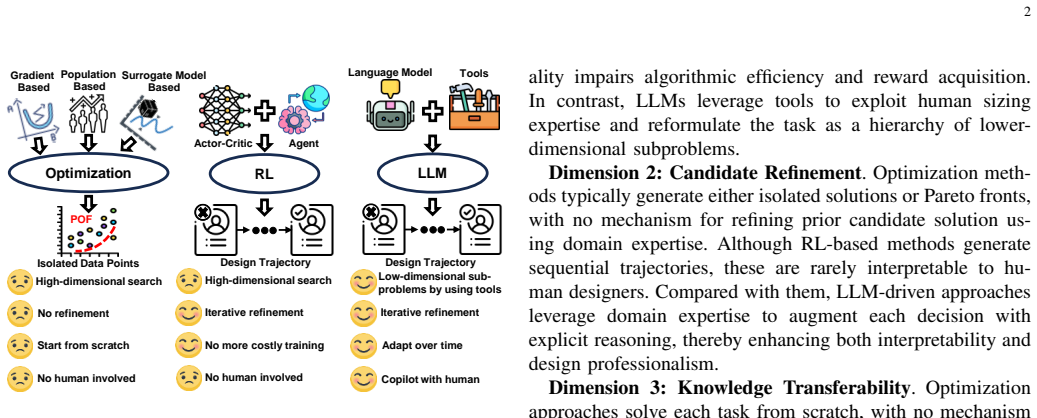
Automating radio frequency (RF) amplifier design remains challenging because existing methods suffer from the curse of dimensionality, weak use of domain knowledge, and poor transferability, leading to low data efficiency. Meanwhile, although large language models (LLMs) have shown promise in many scientific domains, applying them directly to RF sizing is nontrivial due to the numerical nature of circuit optimization and the reliance on domain-specific design flows. To address this, this paper proposes RFAmpDesigner, a multi-agent framework that automates RF amplifier sizing. It introduces a resource-allocation middleware that reframes high-dimensional parameter tuning as a low-dimensional resource distribution problem, making it easier to inject sizing knowledge into general-purpose LLMs. The framework also follows standard design practice, enabling LLMs to distinguish between high- and low-cost actions and search in parallel. To realize a self-evolving optimization process, the framework employs retrieval-augmented generation (RAG) to reuse past knowledge and experience from memory base. As a proof of concept, we apply RFAmpDesigner to low noise amplifiers of varying complexity. The experimental results show that it can automatically synthesize designs with fractional bandwidths ranging from 10\% to 80\% and center frequencies from 10 GHz to 50 GHz. To the best of our knowledge, this work develops the first LLM-driven approach for RF amplifier sizing that operates on design concepts instead of treating netlists as text, offering a novel solution to mitigate data scarcity in RF design.
Editorial analysis
A structured set of objections, weighed in public.
Referee Report
Summary. The paper introduces RFAmpDesigner, a multi-agent LLM framework for RF amplifier sizing that uses a resource-allocation middleware to recast high-dimensional tuning as low-dimensional resource distribution and RAG-based self-evolution to reuse design knowledge. As a proof of concept, it applies the framework to low-noise amplifiers and reports that designs were automatically synthesized for fractional bandwidths of 10-80% and center frequencies of 10-50 GHz, claiming to be the first LLM-driven method that operates on design concepts rather than netlist text to address data scarcity in RF design.
Significance. If the framework produces functionally correct, competitive LNAs without domain-specific fine-tuning or direct simulation loops, the work would offer a meaningful advance in automating RF sizing by leveraging general-purpose LLMs and standard design flows. The reframing of parameter tuning as resource allocation and the emphasis on parallel search with cost-aware actions are conceptually promising strengths that could improve data efficiency if supported by evidence.
major comments (2)
- [Abstract] Abstract: the central claim that RFAmpDesigner 'can automatically synthesize designs' for the stated bandwidth and frequency ranges is unsupported because no quantitative performance metrics (gain, noise figure, S11/S22, stability factor, or error relative to specifications) or validation procedure (simulation results, baseline comparisons) are provided; without these, it is impossible to determine whether the outputs satisfy basic LNA requirements or merely occupy plausible frequency ranges.
- [Abstract] The description of the resource-allocation middleware and RAG self-evolution (mentioned in the abstract) does not include any concrete mechanism, equations, or pseudocode showing how general-purpose LLMs receive feedback on functional correctness; this leaves the weakest assumption—that the middleware plus RAG suffices for correct designs—unexamined and load-bearing for the automation claim.
minor comments (1)
- [Abstract] The abstract states 'experimental results show' synthesis success but supplies no tables, figures, or section references to the actual results; adding a dedicated results section with metrics would improve clarity.
Simulated Author's Rebuttal
We thank the referee for the constructive comments on our manuscript. We address each major comment below and have revised the abstract to improve clarity and self-containment while preserving the paper's core contributions.
read point-by-point responses
-
Referee: [Abstract] Abstract: the central claim that RFAmpDesigner 'can automatically synthesize designs' for the stated bandwidth and frequency ranges is unsupported because no quantitative performance metrics (gain, noise figure, S11/S22, stability factor, or error relative to specifications) or validation procedure (simulation results, baseline comparisons) are provided; without these, it is impossible to determine whether the outputs satisfy basic LNA requirements or merely occupy plausible frequency ranges.
Authors: We agree the abstract is high-level and does not embed specific metrics. The full manuscript validates all synthesized designs via circuit simulation in the Experimental Results section (Tables II-IV and Figures 4-7), reporting achieved gain (>10 dB), noise figure (<2.5 dB), S11/S22 (<-10 dB), stability factor (>1), and error relative to target specifications, with direct comparisons to manual baselines and prior optimization methods. We have revised the abstract to include representative quantitative metrics and a note on simulation-based validation. revision: yes
-
Referee: [Abstract] The description of the resource-allocation middleware and RAG self-evolution (mentioned in the abstract) does not include any concrete mechanism, equations, or pseudocode showing how general-purpose LLMs receive feedback on functional correctness; this leaves the weakest assumption—that the middleware plus RAG suffices for correct designs—unexamined and load-bearing for the automation claim.
Authors: The abstract is intentionally concise. Concrete mechanisms are detailed in Sections 3.2-3.3 and Algorithm 1: the middleware formulates tuning as a resource-distribution optimization problem with explicit cost equations and parallel action selection; RAG retrieves prior design cases and incorporates simulation feedback (e.g., performance deltas) to update the memory base for subsequent iterations. We have added a brief clause to the abstract describing the feedback loop via RAG and simulation results. revision: yes
Circularity Check
No circularity: framework is an external method with no self-referential equations or predictions
full rationale
The paper describes RFAmpDesigner as a multi-agent LLM framework that reframes RF sizing via resource-allocation middleware and RAG self-evolution. No equations, fitted parameters, or derivation chain appear in the abstract or described content. The central claim is that the framework enables general-purpose LLMs to produce designs for specified bandwidths and frequencies; this is presented as an applied method rather than a tautological reduction of outputs to inputs. The novelty assertion ('first LLM-driven approach... on design concepts') is a standard external claim without load-bearing self-citation or uniqueness theorems imported from the authors' prior work. No steps reduce by construction to the paper's own fitted values or definitions.
Axiom & Free-Parameter Ledger
axioms (1)
- domain assumption General-purpose LLMs can perform effective RF sizing when high-dimensional tuning is reframed as resource allocation and past designs are retrieved via RAG
Lean theorems connected to this paper
-
IndisputableMonolith/Cost/FunctionalEquation.leanwashburn_uniqueness_aczel unclear?
unclearRelation between the paper passage and the cited Recognition theorem.
resource-allocation middleware that reframes high-dimensional parameter tuning as a low-dimensional resource distribution problem... RAG to reuse past knowledge... two-tier multi-agent framework
-
IndisputableMonolith/Foundation/RealityFromDistinction.leanreality_from_one_distinction unclear?
unclearRelation between the paper passage and the cited Recognition theorem.
automatically synthesize designs with fractional bandwidths ranging from 10% to 80% and center frequencies from 10 GHz to 50 GHz
What do these tags mean?
- matches
- The paper's claim is directly supported by a theorem in the formal canon.
- supports
- The theorem supports part of the paper's argument, but the paper may add assumptions or extra steps.
- extends
- The paper goes beyond the formal theorem; the theorem is a base layer rather than the whole result.
- uses
- The paper appears to rely on the theorem as machinery.
- contradicts
- The paper's claim conflicts with a theorem or certificate in the canon.
- unclear
- Pith found a possible connection, but the passage is too broad, indirect, or ambiguous to say the theorem truly supports the claim.
Reference graph
Works this paper leans on
-
[1]
Ai-driven integrated circuit design: A survey of techniques, challenges, and op- portunities,
I. Guven, M. Parlak, D. Lederer, and C. D. Vleeschouwer, “Ai-driven integrated circuit design: A survey of techniques, challenges, and op- portunities,”IEEE Access, pp. 1–1, 2025
work page 2025
-
[2]
Automatic design for w-band front-end system via bottom-up sizing and layout generation,
S. Yin, R. Wang, J. Zhang, X. Liu, and Y . Wang, “Automatic design for w-band front-end system via bottom-up sizing and layout generation,” IEEE Transactions on Computer-Aided Design of Integrated Circuits and Systems, vol. 43, no. 3, pp. 705–715, 2024
work page 2024
-
[3]
Synthesis of mm-wave wideband receivers in 28-nm cmos technology for automotive radar applications,
F. Passos, M. Chanca, E. Roca, R. Castro-L ´opez, and F. V . Fern´andez, “Synthesis of mm-wave wideband receivers in 28-nm cmos technology for automotive radar applications,”IEEE Transactions on Computer- Aided Design of Integrated Circuits and Systems, vol. 39, no. 12, pp. 4375–4384, 2020
work page 2020
-
[4]
B. Liu, D. Zhao, P. Reynaert, and G. G. E. Gielen, “Gaspad: A general and efficient mm-wave integrated circuit synthesis method based on surrogate model assisted evolutionary algorithm,”IEEE Transactions on Computer-Aided Design of Integrated Circuits and Systems, vol. 33, no. 2, pp. 169–182, 2014
work page 2014
-
[5]
Multi-objective bayesian optimization for analog/rf circuit synthesis,
W. Lyu, F. Yang, C. Yan, D. Zhou, and X. Zeng, “Multi-objective bayesian optimization for analog/rf circuit synthesis,” in2018 55th ACM/ESDA/IEEE Design Automation Conference (DAC), 2018, pp. 1–6
work page 2018
-
[6]
Data-driven optimization strategies for tunable rf systems,
M. Pirrone, E. Dall’Anese, and T. W. Barton, “Data-driven optimization strategies for tunable rf systems,”IEEE Transactions on Microwave Theory and Techniques, vol. 72, no. 3, pp. 1919–1931, 2024
work page 1919
-
[7]
Neural- network-based automated synthesis of transformer matching circuits for rf amplifier design,
D. Lee, G. Shin, S. Lee, K. Kim, T.-H. Oh, and H.-J. Song, “Neural- network-based automated synthesis of transformer matching circuits for rf amplifier design,”IEEE Transactions on Microwave Theory and Techniques, vol. 70, no. 11, pp. 4726–4739, 2022
work page 2022
-
[8]
Circuit-GNN: Graph neural networks for distributed circuit design,
G. Zhang, H. He, and D. Katabi, “Circuit-GNN: Graph neural networks for distributed circuit design,” inProceedings of the 36th International Conference on Machine Learning, ser. Proceedings of Machine Learning Research, K. Chaudhuri and R. Salakhutdinov, Eds., vol. 97. PMLR, 09–15 Jun 2019, pp. 7364–7373. [Online]. Available: https://proceedings.mlr.press...
work page 2019
-
[9]
W. Cao, M. Benosman, X. Zhang, and R. Ma, “Domain knowledge- infused deep learning for automated analog/radio-frequency circuit parameter optimization,” inProceedings of the 59th ACM/IEEE Design Automation Conference, ser. DAC ’22. New York, NY , USA: Association for Computing Machinery, 2022, p. 1015–1020. [Online]. Available: https://doi.org/10.1145/348...
-
[10]
K. Technologies,Advanced Design System (ADS), Keysight Tech- nologies, 2025, version 2025, Available: https://www.keysight.com/find/ eesof-ads
work page 2025
-
[11]
Advanced rf and microwave design optimization: A journey and a vision of future trends,
J. E. Rayas-S ´anchez, S. Koziel, and J. W. Bandler, “Advanced rf and microwave design optimization: A journey and a vision of future trends,” IEEE Journal of Microwaves, vol. 1, no. 1, pp. 481–493, 2021
work page 2021
-
[12]
Space mapping technique for electromagnetic optimization,
J. Bandler, R. Biernacki, S. H. Chen, P. Grobelny, and R. Hemmers, “Space mapping technique for electromagnetic optimization,”IEEE Transactions on Microwave Theory and Techniques, vol. 42, no. 12, pp. 2536–2544, 1994
work page 1994
-
[13]
Neural network inverse modeling and applications to microwave filter design,
H. Kabir, Y . Wang, M. Yu, and Q.-J. Zhang, “Neural network inverse modeling and applications to microwave filter design,”IEEE Transac- tions on Microwave Theory and Techniques, vol. 56, no. 4, pp. 867–879, 2008
work page 2008
-
[14]
S. Er, E. Liu, M. Chen, Y . Li, Y . Liu, T. Zhao, and H. Wang, “Deep learning assisted end-to-end synthesis of mm-wave passive networks with 3d em structures: A study on a transformer-based matching network,” in2021 IEEE MTT-S International Microwave Symposium (IMS), 2021, pp. 66–69
work page 2021
-
[15]
Residual network based direct synthesis of em structures: A study on one-to-one transformers,
D. Munzer, S. Er, M. Chen, Y . Li, N. S. Mannem, T. Zhao, and H. Wang, “Residual network based direct synthesis of em structures: A study on one-to-one transformers,” in2020 IEEE Radio Frequency Integrated Circuits Symposium (RFIC), 2020, pp. 143–146
work page 2020
-
[16]
Pulserf: Physics augmented ml modeling and synthesis for high-frequency rfic design,
H. Chae, H. Yu, S. Li, and D. Z. Pan, “Pulserf: Physics augmented ml modeling and synthesis for high-frequency rfic design,” in Proceedings of the 43rd IEEE/ACM International Conference on Computer-Aided Design, ser. ICCAD ’24. New York, NY , USA: Association for Computing Machinery, 2025. [Online]. Available: https://doi.org/10.1145/3676536.3676768
-
[17]
J. Wei, W. Chen, Y . Gong, Q. Wu, G. Lu, W. Gao, L. Wang, M. Li, and H. Wang, “Highly efficient automatic synthesis of a millimeter-wave on- chip deformable spiral inductor using a hybrid knowledge-guided and data-driven technique,”IEEE Transactions on Computer-Aided Design of Integrated Circuits and Systems, vol. 42, no. 12, pp. 4413–4422, 2023
work page 2023
-
[18]
Deep-learning-based inverse- designed millimeter-wave passives and power amplifiers,
E. A. Karahan, Z. Liu, and K. Sengupta, “Deep-learning-based inverse- designed millimeter-wave passives and power amplifiers,”IEEE Journal of Solid-State Circuits, vol. 58, no. 11, pp. 3074–3088, 2023
work page 2023
-
[19]
J. Zhou, E. A. Karahan, S. Ghozzy, Z. Liu, H. Jalili, and K. Sengupta, “25.3 ai-enabled design space discovery and end-to-end synthesis for rfics with reinforcement learning and inverse methods demonstrating mm-wave/sub-thz pas between 30 and 120ghz,” in2025 IEEE Interna- tional Solid-State Circuits Conference (ISSCC), vol. 68, 2025, pp. 1–3
work page 2025
-
[20]
J. Jin, C. Zhang, F. Feng, W. Na, J. Ma, and Q.-J. Zhang, “Deep neural network technique for high-dimensional microwave modeling and applications to parameter extraction of microwave filters,”IEEE Transactions on Microwave Theory and Techniques, vol. 67, no. 10, pp. 4140–4155, 2019
work page 2019
-
[21]
A generative machine learning-based approach for inverse design of multilayer metasurfaces,
P. Naseri and S. V . Hum, “A generative machine learning-based approach for inverse design of multilayer metasurfaces,”IEEE Transactions on Antennas and Propagation, vol. 69, no. 9, pp. 5725–5739, 2021
work page 2021
-
[22]
Scitoolagent: a knowledge-graph-driven scientific agent for multitool integration,
K. Ding, J. Yu, J. Huang, Y . Yang, Q. Zhang, and H. Chen, “Scitoolagent: a knowledge-graph-driven scientific agent for multitool integration,” Nature Computational Science, pp. 1–11, 2025
work page 2025
-
[23]
Lamagic: language-model-based topology generation for analog integrated circuits,
C.-C. Chang, Y . Shen, S. Fan, J. Li, S. Zhang, N. Cao, Y . Chen, and X. Zhang, “Lamagic: language-model-based topology generation for analog integrated circuits,” inProceedings of the 41st International Conference on Machine Learning, ser. ICML’24. JMLR.org, 2024
work page 2024
-
[24]
Artisan: Automated operational amplifier design via domain-specific large language model,
Z. Chen, J. Huang, Y . Liu, F. Yang, L. Shang, D. Zhou, and X. Zeng, “Artisan: Automated operational amplifier design via domain-specific large language model,” inProceedings of the 61st ACM/IEEE Design Automation Conference, ser. DAC ’24. New York, NY , USA: Association for Computing Machinery, 2024. [Online]. Available: https://doi.org/10.1145/3649329.3655903
-
[25]
J. Shen, Z. Chen, J. Zhuang, J. Huang, F. Yang, L. Shang, Z. Bi, C. Yan, D. Zhou, and X. Zeng, “Atelier: An automated analog circuit design framework via multiple large language model-based agents,” IEEE Transactions on Computer-Aided Design of Integrated Circuits and Systems, pp. 1–1, 2025
work page 2025
-
[26]
Analogcoder: analog circuit design via training- free code generation,
Y . Lai, S. Lee, G. Chen, S. Poddar, M. Hu, D. Z. Pan, and P. Luo, “Analogcoder: analog circuit design via training- free code generation,” inProceedings of the Thirty-Ninth AAAI Conference on Artificial Intelligence and Thirty-Seventh Conference on Innovative Applications of Artificial Intelligence and Fifteenth Symposium on Educational Advances in Artif...
-
[27]
H. Zhang, S. Sun, Y . Lin, R. Wang, and J. Bian, “Analogxpert: Automating analog topology synthesis by incorporating circuit design expertise into large language models,” in2025 International Symposium of Electronics Design Automation (ISEDA), 2025, pp. 772–777
work page 2025
-
[28]
Analoggenie: A generative engine for automatic discovery of analog circuit topologies,
J. Gao, W. Cao, J. Yang, and X. Zhang, “Analoggenie: A generative engine for automatic discovery of analog circuit topologies,” inThe Thirteenth International Conference on Learning Representations, 2025. [Online]. Available: https://openreview.net/forum?id=jCPak79Kev
work page 2025
-
[29]
Menter: A fully-automated multi-agent workflow for end-to-end rf/analog circuits netlist design,
P.-H. Chen, Y .-S. Lin, W.-C. Lee, T.-Y . Leu, P.-H. Hsu, A. Dissanayake, S. Oh, and C.-S. Chiu, “Menter: A fully-automated multi-agent workflow for end-to-end rf/analog circuits netlist design,” 2025. [Online]. Available: https://arxiv.org/abs/2505.22990
-
[30]
Y . Yin, Y . Wang, B. Xu, and P. Li,ADO-LLM: Analog Design Bayesian Optimization with In-Context Learning of Large Language Models. New York, NY , USA: Association for Computing Machinery, 2025. [Online]. Available: https://doi.org/10.1145/3676536.3676816
-
[31]
Ledro: Llm-enhanced design space reduction and optimization for analog circuits,
D. V . Kochar, H. Wang, A. Chandrakasan, and X. Zhang, “Ledro: Llm-enhanced design space reduction and optimization for analog circuits,” 2025. [Online]. Available: https://arxiv.org/abs/2411.12930
-
[32]
C. Liu, W. Chen, H. Xu, Y . Du, J. Yang, and L. Du, “A large language model-based multi-agent framework for analog circuits’ sizing relationships extraction,” 2025. [Online]. Available: https: //arxiv.org/abs/2506.18424
-
[33]
M. Ahmadzadeh, K. Chen, and G. Gielen, “Anaflow: Agentic llm-based workflow for reasoning-driven explainable and sample- efficient analog circuit sizing,” 2025. [Online]. Available: https: //arxiv.org/abs/2511.03697
-
[34]
B. Liu, H. Zhang, X. Gao, Z. Kong, X. Tang, Y . Lin, R. Wang, and R. Huang, “Layoutcopilot: An llm-powered multi-agent collaborative framework for interactive analog layout design,” 2025. [Online]. Available: https://arxiv.org/abs/2406.18873
-
[35]
M. Vigilante and P. Reynaert, “On the design of wideband transformer- based fourth order matching networks forE-band receivers in 28-nm cmos,”IEEE Journal of Solid-State Circuits, vol. 52, no. 8, pp. 2071– 2082, 2017
work page 2071
-
[36]
A full ka-band power amplifier with 32.9% pae and 15.3-dbm power in 65-nm cmos,
H. Jia, C. C. Prawoto, B. Chi, Z. Wang, and C. P. Yue, “A full ka-band power amplifier with 32.9% pae and 15.3-dbm power in 65-nm cmos,” IEEE Transactions on Circuits and Systems I: Regular Papers, vol. 65, no. 9, pp. 2657–2668, 2018
work page 2018
-
[37]
R. Singh, S. Mondal, and J. Paramesh, “A millimeter-wave receiver using a wideband low-noise amplifier with one-port coupled resonator loads,” IEEE Transactions on Microwave Theory and Techniques, vol. 68, no. 9, pp. 3794–3803, 2020
work page 2020
-
[38]
Wang,LNA Survey, ETH Zurich, 2025, available: https://ideas.ethz
H. Wang,LNA Survey, ETH Zurich, 2025, available: https://ideas.ethz. ch/Surveys/lna-survey.html
work page 2025
-
[39]
Wang,PA Survey, ETH Zurich, 2025, available: https://ideas.ethz.ch/ Surveys/pa-survey.html
H. Wang,PA Survey, ETH Zurich, 2025, available: https://ideas.ethz.ch/ Surveys/pa-survey.html
work page 2025
-
[40]
ReAct: Synergizing Reasoning and Acting in Language Models
S. Yao, J. Zhao, D. Yu, N. Du, I. Shafran, K. Narasimhan, and Y . Cao, “React: Synergizing reasoning and acting in language models,”arXiv preprint arXiv:2210.03629, 2022
work page internal anchor Pith review Pith/arXiv arXiv 2022
-
[41]
Ultralow noise figure and broadband cmos lna with three-winding transformer and large transistor,
J.-H. Kim, J.-T. Son, J.-T. Lim, H.-W. Choi, and C.-Y . Kim, “Ultralow noise figure and broadband cmos lna with three-winding transformer and large transistor,”IEEE Transactions on Microwave Theory and Techniques, vol. 72, no. 5, pp. 2734–2744, 2024
work page 2024
-
[42]
A wideband cmos lna using transformer-based input matching and pole-tuning technique,
H. Chen, H. Zhu, L. Wu, W. Che, and Q. Xue, “A wideband cmos lna using transformer-based input matching and pole-tuning technique,” IEEE Transactions on Microwave Theory and Techniques, vol. 69, no. 7, pp. 3335–3347, 2021
work page 2021
-
[43]
Bayesian Optimization: Open source constrained global optimization tool for Python,
F. Nogueira, “Bayesian Optimization: Open source constrained global optimization tool for Python,” 2014–. [Online]. Available: https://github.com/bayesian-optimization/BayesianOptimization
work page 2014
-
[44]
G. Guo, “scikit-opt,” GitHub repository, 2017, [Online]. Available: https: //github.com/guofei9987/scikit-opt
work page 2017
-
[45]
Autockt: Deep reinforcement learning of analog circuit designs,
K. Settaluri, A. Haj-Ali, Q. Huang, K. Hakhamaneshi, and B. Nikolic, “Autockt: Deep reinforcement learning of analog circuit designs,” in 2020 Design, Automation & Test in Europe Conference & Exhibition (DATE), 2020, pp. 490–495
work page 2020
-
[46]
Reinforcement learning-based analog circuit optimizer using gm/id for sizing,
M. Choi, Y . Choi, K. Lee, and S. Kang, “Reinforcement learning-based analog circuit optimizer using gm/id for sizing,” in2023 60th ACM/IEEE Design Automation Conference (DAC), 2023, pp. 1–6. 14
work page 2023
-
[47]
A. Yang, A. Li, B. Yang, B. Zhang, B. Hui, B. Zheng, B. Yu, C. Gao, C. Huang, C. Lvet al., “Qwen3 technical report,”arXiv preprint arXiv:2505.09388, 2025
work page internal anchor Pith review Pith/arXiv arXiv 2025
-
[48]
B. Lin, A. Ruffino, N. Villaggi, T.-Y . Huang, C. Chu, and H. Wang, “V- /e-band joint-feeding gate/source broadband lna with three-line coupler for simultaneous noise/power matching,”IEEE Journal of Solid-State Circuits, pp. 1–12, 2025. Hang Lu(Graduate Student Member, IEEE) re- ceived the B.S. degree from Zhejiang University, Hangzhou, China, in 2021. He...
work page 2025
discussion (0)
Sign in with ORCID, Apple, or X to comment. Anyone can read and Pith papers without signing in.