Recognition: 2 theorem links
· Lean TheoremThe Nitsche--Hopf conjecture for minimal graphs
Pith reviewed 2026-05-13 07:37 UTC · model grok-4.3
The pith
Minimal graphs over disks satisfy W(ξ)² |K(ξ)| < π²/(2R²) at the point above the center, with sharp constant.
A machine-rendered reading of the paper's core claim, the machinery that carries it, and where it could break.
Core claim
If S is a minimal graph over a disk of radius R, and if ξ is the point above the center, then W(ξ)² |K(ξ)| < π²/(2R²). The constant is sharp, as shown by the horizontal tangent-plane extremal sequence of Finn and Osserman. The bicentric-quadrilateral comparison theorem controls |K| but not the normalized product W²|K|; the missing information is recovered from the zero equation for the horizontal harmonic projection at the distinguished point z_o in fixed-arc normalization of the Scherk-type family. This reduces the sharp Hopf estimate to a scalar derivative inequality at the admissible zero of the monotone function G_{A,B}, which is proved on the full parameter domain by a barrier argument,
What carries the argument
The Scherk-type comparison family in fixed-arc normalization, where the zero of the horizontal harmonic projection at the distinguished point z_o reduces the normalized Hopf estimate to a scalar derivative inequality for the monotone function G_{A,B}.
If this is right
- Combined with the bicentric-quadrilateral comparison theorem, the estimate controls the normalized curvature for all minimal graphs over disks.
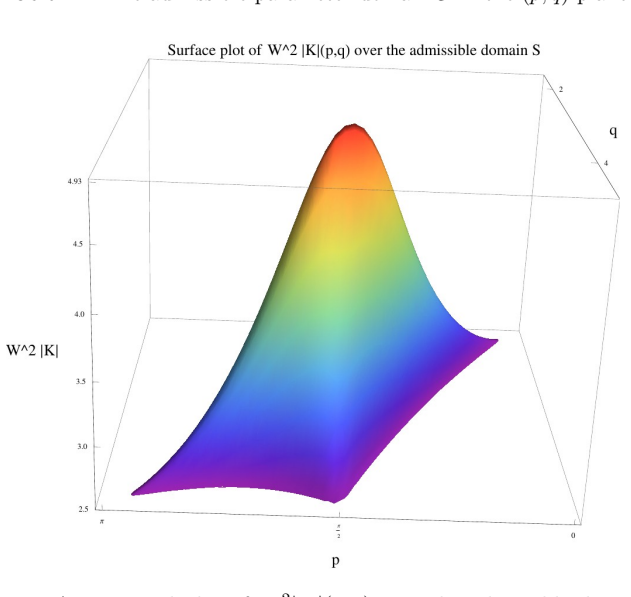
- Throughout the normalized Scherk-type family, W²|K| satisfies π²/4 ≤ W²|K| ≤ π²/2 at the distinguished point.
- The horizontal tangent-plane sequence of Finn and Osserman achieves equality in the limit.
- The method supplies sharp a priori control on the product of slope and curvature for solutions of the minimal surface equation over disks.
Where Pith is reading between the lines
- If analogous zeros of harmonic projections can be located in comparison families for other base domains, the reduction technique may extend the bound beyond disks.
- The explicit Bernstein-polynomial certificates suggest that similar positivity arguments could be automated for related curvature estimates in geometric PDE.
- The two-sided bounds in the Scherk family provide a concrete test case for numerical solvers of the minimal surface equation.
Load-bearing premise
The zero of the horizontal harmonic projection at the distinguished point z_o in the fixed-arc normalization of the Scherk-type family reduces the normalized Hopf estimate to a scalar derivative inequality for the monotone function G_{A,B} that holds on the full admissible parameter domain.
What would settle it
A minimal graph over a disk of radius R where W(ξ)² |K(ξ)| is at least π²/(2R²) at the point above the center, or an admissible parameter pair A,B for which the derivative inequality on G_{A,B} fails to hold.
Figures

read the original abstract
We prove the Nitsche--Hopf conjecture for non-parametric minimal graphs over disks. If \(S\) is a minimal graph over a disk of radius \(R\), and if \(\xi\) is the point above the center, then \[ W(\xi)^2 |K(\xi)|<\frac{\pi^2}{2R^2}. \] Here \(K\) is the Gaussian curvature and \[ W=\sqrt{1+|\nabla u|^2}=\frac1{n_3} \] is the reciprocal of the vertical component of the upward unit normal. The constant is sharp, as shown by the horizontal tangent-plane extremal sequence of Finn and Osserman. The main difficulty is that the bicentric-quadrilateral comparison theorem for Gaussian curvature controls \(|K|\), but it does not by itself control the normalized quantity \(W^2|K|\): the slope factor \(W\) can be arbitrarily large. We show that the missing information is recovered inside the Scherk-type comparison family from the zero equation for the horizontal harmonic projection. More precisely, in the fixed-arc normalization the point corresponding to the center of the physical disk is a distinguished zero \(z_\circ\) of the harmonic projection. The equation \(f(z_\circ)=0\), written in harmonic-measure coordinates, reduces the sharp Hopf estimate to a scalar derivative inequality at the admissible zero of a monotone function \(G_{A,B}\). We prove this scalar inequality on the full admissible parameter domain by a barrier argument and two explicit Bernstein-polynomial positivity certificates. Combined with the bicentric-quadrilateral comparison theorem of the first author and Melentijevi\'c, the Scherk-family estimate gives the sharp normalized Hopf estimate for arbitrary minimal graphs over disks. As a byproduct, we obtain the two-sided bound \[ \frac{\pi^2}{4}\leq W^2|K|\leq \frac{\pi^2}{2} \] throughout the normalized Scherk-type comparison family, evaluated at the distinguished point corresponding to the center.
Editorial analysis
A structured set of objections, weighed in public.
Referee Report
Summary. The manuscript proves the Nitsche-Hopf conjecture for non-parametric minimal graphs over disks: if S is a minimal graph over a disk of radius R and ξ is the point above the center, then W(ξ)² |K(ξ)| < π²/(2R²), where W = 1/n₃ is the reciprocal of the vertical normal component and K is Gaussian curvature. The constant is sharp by the Finn-Osserman sequence. The argument combines the bicentric-quadrilateral comparison theorem with a reduction inside the Scherk-type family: the distinguished zero zₒ of the horizontal harmonic projection (in fixed-arc normalization and harmonic-measure coordinates) collapses the normalized Hopf estimate to a scalar derivative inequality for the monotone function G_{A,B}, which is then established on the full admissible parameter domain by an explicit barrier argument together with two Bernstein-polynomial positivity certificates. A byproduct is the two-sided bound π²/4 ≤ W²|K| ≤ π²/2 on the normalized Scherk family at the corresponding point.
Significance. If the central claim holds, the result resolves a classical conjecture in minimal-surface theory by supplying a sharp normalized curvature bound that controls the product W²|K| rather than |K| alone. The explicit algebraic positivity certificates and the reduction via an independently defined harmonic-projection zero constitute a verifiable, essentially parameter-free derivation once the certificates are confirmed; this adds a concrete computational strength to the proof. The two-sided bound on the comparison family is a useful byproduct for future work on Scherk-type surfaces.
major comments (2)
- [Reduction via harmonic projection zero] The reduction from the zero equation f(zₒ)=0 to the scalar derivative inequality for G_{A,B} (in harmonic-measure coordinates) is load-bearing for the normalized estimate. A fully expanded derivation of this step, including the explicit differentiation under the fixed-arc normalization, would eliminate any residual ambiguity about whether the inequality is strictly monotone on the entire admissible domain.
- [Positivity certificates for G_{A,B}] The two Bernstein-polynomial positivity certificates are asserted to hold throughout the compact admissible parameter domain, including at the distinguished zero zₒ and the boundary arcs. Because these certificates are algebraic and the domain is compact, an explicit statement of the degree of the polynomials together with a reference to the (machine-checkable) verification at the boundary parameters would make the verification fully transparent and remove the only remaining point of possible incompleteness.
minor comments (2)
- [Introduction] The notation distinguishing the physical disk radius R from the normalized Scherk parameters A,B should be introduced once in the introduction and used consistently thereafter.
- [Figures] Figure captions for the Scherk-type comparison surfaces would benefit from an explicit label indicating the location of the distinguished point zₒ.
Simulated Author's Rebuttal
We thank the referee for the positive assessment and the detailed suggestions for improving the clarity of the proof. We address each major comment below and will revise the manuscript accordingly to incorporate the requested expansions.
read point-by-point responses
-
Referee: [Reduction via harmonic projection zero] The reduction from the zero equation f(zₒ)=0 to the scalar derivative inequality for G_{A,B} (in harmonic-measure coordinates) is load-bearing for the normalized estimate. A fully expanded derivation of this step, including the explicit differentiation under the fixed-arc normalization, would eliminate any residual ambiguity about whether the inequality is strictly monotone on the entire admissible domain.
Authors: We agree that expanding this reduction step will enhance transparency. In the revised manuscript, we will include a fully expanded derivation of the reduction from the zero equation f(zₒ)=0 to the scalar derivative inequality for G_{A,B} in harmonic-measure coordinates. This will explicitly detail the differentiation under the fixed-arc normalization and confirm the strict monotonicity on the admissible domain. revision: yes
-
Referee: [Positivity certificates for G_{A,B}] The two Bernstein-polynomial positivity certificates are asserted to hold throughout the compact admissible parameter domain, including at the distinguished zero zₒ and the boundary arcs. Because these certificates are algebraic and the domain is compact, an explicit statement of the degree of the polynomials together with a reference to the (machine-checkable) verification at the boundary parameters would make the verification fully transparent and remove the only remaining point of possible incompleteness.
Authors: We will add an explicit statement of the degrees of the Bernstein polynomials used in the positivity certificates. Additionally, we will include a reference to the machine-checkable verification at the boundary parameters to ensure full transparency. This addresses the concern about completeness of the verification. revision: yes
Circularity Check
Minor self-citation to prior theorem; central derivation independent
full rationale
The paper invokes the bicentric-quadrilateral comparison theorem of the first author and Melentijević solely as an external input that is then combined with a new Scherk-type family estimate. The new estimate is obtained by reducing the normalized Hopf quantity, via the independently defined zero z_o of the horizontal harmonic projection in fixed-arc normalization, to a scalar derivative inequality for the monotone function G_{A,B}. This inequality is established on the full admissible domain by an explicit barrier argument plus two algebraic Bernstein-polynomial positivity certificates. The certificates are parameter-free and machine-checkable; the domain is compact. Sharpness is supported by the external Finn-Osserman sequence. No step reduces by definition or by fitted input to the target bound, and the single self-citation is not load-bearing for the central claim. The logical chain is therefore self-contained.
Axiom & Free-Parameter Ledger
axioms (2)
- domain assumption Bicentric-quadrilateral comparison theorem for Gaussian curvature of minimal graphs
- domain assumption Existence and basic properties of the Scherk-type comparison family in harmonic-measure coordinates
Lean theorems connected to this paper
-
IndisputableMonolith/Cost/FunctionalEquation.leanwashburn_uniqueness_aczel unclearThe equation f(z◦)=0, written in harmonic-measure coordinates, reduces the sharp Hopf estimate to a scalar derivative inequality at the admissible zero of a monotone function G_{A,B}. We prove this scalar inequality on the full admissible parameter domain by a barrier argument and two explicit Bernstein-polynomial positivity certificates.
-
IndisputableMonolith/Foundation/AlexanderDuality.leanalexander_duality_circle_linking unclearCombined with the bicentric-quadrilateral comparison theorem of the first author and Melentijević, the Scherk-family estimate gives the sharp normalized Hopf estimate for arbitrary minimal graphs over disks.
Reference graph
Works this paper leans on
-
[1]
A. Alarcón, F. Forstnerič, and F. J. López,Minimal surfaces from a complex analytic viewpoint, Springer Monographs in Mathematics, Springer, Cham, 2021
work page 2021
-
[2]
Duren,Harmonic mappings in the plane, Cambridge Tracts in Mathematics, vol
P. Duren,Harmonic mappings in the plane, Cambridge Tracts in Mathematics, vol. 156, Cambridge University Press, Cambridge, 2004
work page 2004
-
[3]
R. Finn and R. Osserman, On the Gauss curvature of non-parametric minimal surfaces,J. Analyse Math. 12(1964), 351–364
work page 1964
-
[4]
R. R. Hall, On an inequality of E. Heinz,J. Analyse Math.42(1982/83), 185–198
work page 1982
-
[5]
R. R. Hall, The Gaussian curvature of minimal surfaces and Heinz’ constant,J. Reine Angew. Math.502 (1998), 19–28
work page 1998
-
[6]
Heinz, Über die Lösungen der Minimalflächengleichung,Nachr
E. Heinz, Über die Lösungen der Minimalflächengleichung,Nachr. Akad. Wiss. Göttingen Math.-Phys. Kl. IIa(1952), no. 8, 51–56
work page 1952
-
[7]
Hopf, On an inequality for minimal surfacesz=z(x,y),J
E. Hopf, On an inequality for minimal surfacesz=z(x,y),J. Rational Mech. Anal.2(1953), 519–522
work page 1953
-
[8]
D. Kalaj and P. Melentijević, Gaussian curvature conjecture for minimal graphs,Duke Math. J.175(2026), no. 3, 361–396
work page 2026
-
[9]
J. C. C. Nitsche, On the inequality of E. Heinz and E. Hopf,Applicable Analysis3(1973), no. 1, 47–56
work page 1973
-
[10]
J. C. C. Nitsche,Vorlesungen über Minimalflächen, Grundlehren der mathematischen Wissenschaften, vol. 199, Springer-Verlag, Berlin–New York, 1975. F aculty of Natural Sciences and Mathematics, University of Montenegro, Podgorica, Mon- tenegro Email address:davidk@ucg.ac.me Department of Mathematics, Shantou University, Shantou, Guangdong 515063, P. R. Chi...
work page 1975
discussion (0)
Sign in with ORCID, Apple, or X to comment. Anyone can read and Pith papers without signing in.